
 Worksheets
Physics Midterm
Total questions: 100
Worksheet time: 5hrs 0mins
What is physics?
Study of animals
Study of rocks and how they form
Study of matter and energy
Study of chemicals

The variable that is being measured or observed is called the _______________. Hint: this is the variable that is the result or effect
independent variable
dependent variable
control variable
The _________________________ answers the problem you are trying to solve in an experiment and explains the results to others.
procedure
hypothesis
conclusion
data
The experimental group in an experiment will
not receive the independent variable.
will receive the independent variable.
will not have a dependent variable.
will not have any controlled variables.
Which of the following makes an experiment a controlled experiment?
It only tests one variable.
It tests multiple variables.
It allows for the collection of data.
It can answer a question about an observation.
Which of the following is found in both the experimental and control groups of an experiment?
controlled variables
independent variables
The group which does not get the independent variable; "normal" conditions
Control Group
Dependent Variable
Experimental Group
Constant
Exactly how old do astronomers think the universe is?
13.8 billion years
4.5 billion years
9.8 billion years
20 billion years
Which theory suggests that the universe has been expanding since its inception?
Steady State Theory
Big Bang Theory
Plasma Cosmology
Quantum Fluctuation Model
The ________ shift gives astronomers evidence that the galaxies are moving away from us.
blue
orange
red
galaxy
The current belief is that the universe is _______________.
4.6 billion years old
very young
expanding
static
The farther away something in the universe is, the ____________ it is moving away from us.
slower
faster
less
shorter
How did we get all of the elements on the periodic table?
Protons, neutrons, and electrons fused together after the Big Bang to form elements.
All elements were formed in the exact moment the Big Bang happened.

How do scientists believe the universe was created?
The "Big Bang" theory.
The "Theory of Evolution."
The sun exploding.
None of these.

A universe is made up of many galaxies.
True
False
Scientists theorize that the portion of the universe visible today expanded explosively from a hot, dense mass about 14 billion years ago. What is evidence for this “big bang”?
tides on Earth caused by the big bang’s gravitational forces
volcanoes on Venus, which erupt because of the force of the “big bang”
cosmic background radiation, which is energy left over from the big bang
the formation of black holes caused by the collapse of very hot dense massive stars
What is the Doppler effect?
The observed change in frequency of sound or light because of the relative motion of a wave source and the observer.
The observed change in amplitude of sound or light because of the relative motion of a wave source and the observer.
The observed change in wave speed of sound or light because of the relative motion of a wave source and the observer.
The observed change in equilibrium position of sound or light because of the relative motion of a wave source and the observer.
What happens to the wavelength and frequency of a wave as an object moves TOWARDS us?
Wavelength = decreases
Frequency = increases
Wavelength = increases
Frequency = increases
Wavelength = increases
Frequency = decreases
Wavelength = decreases
Frequency = decreases
What happens to the wavelength and frequency of a wave as an object moves AWAY from us?
Wavelength = decreases
Frequency = increases
Wavelength = increases
Frequency = increases
Wavelength = increases
Frequency = decreases
Wavelength = decreases
Frequency = decreases

If you are standing in front of this car, the wavelengths nearest you would have a _______ frequency
quieter
louder
higher
lower

What is the atomic emission spectrum?
The pattern formed when light emitted by an element is separated into the different wavelengths it contains.
The specific frequencies of light emitted by an element.
The tool that uses a prism to separate light into its individual colors.
The fixed energies an electron can have in an atom.
Why is the atomic emission spectrum considered like a fingerprint for each element?
Because it can be used to identify unknown samples.
Because it contains specific wavelengths of light.
Because it is unique to each element.
Because it is the same for atoms anywhere in the universe.
What is at the center of our solar system?
The Moon, a gravity rounded body of planetary mass that orbit Earth
The asteroid belt, rocks and stones that did not form planets
The sun, a star or hot ball of glowing gas
The Kuiper belt, a circumstellar disc extending from Neptune
Jovian planets have thick atmospheres composed of hydrogen, helium, methane, and ammonia and are low density.
True
False

What type of material is normally found in the core of a terrestrial planet?
coal
frozen water
light silicates
dense iron & nickel
Most of these are located between the orbits of Mars and Jupiter.
Comet
Meteor
Asteroid


What are the differences in composition between Kuiper Belt objects and the inner solar system objects?
Kuiper Belt objects are made entirely of gas
Compositions differ in terms of ices and rock/metal
Inner solar system objects are made entirely of ice
Compositions are the same in both regions
What does Kepler's 1st Law state?
all planets move in elliptical shaped orbits around the sun
all ellipses have one foci
the area that a planet revolves around the sun is equal
the speed that a planet revolves around the sun changes

Which planet in this image will have the largest orbital radius?
Mercury
Venus
Earth
Mars

Based on the table, which planet in our solar system will have the fastest orbital speed?
Venus
Earth
Saturn
Mercury


You discover a new planet in our solar system. You measure it's orbital period to be 246 years.
Where is this planet likely to be located based on this information?
Closer to the Sun than Mercury.
Located between Earth and Jupiter.
Located between Uranus and Neptune.
Located beyond Neptune.

The graph shows Keplers 3rd Law. A new planet is discovered at a distance of 35 AU. What is the orbital period?
250 years
200 years
175 years
16 years
What two things determine the amount of energy an object has?
mass and speed
speed and position
mass and position
mass and weight
What two things determine the amount of energy an object has?
mass and speed
speed and position
mass and position
mass and weight
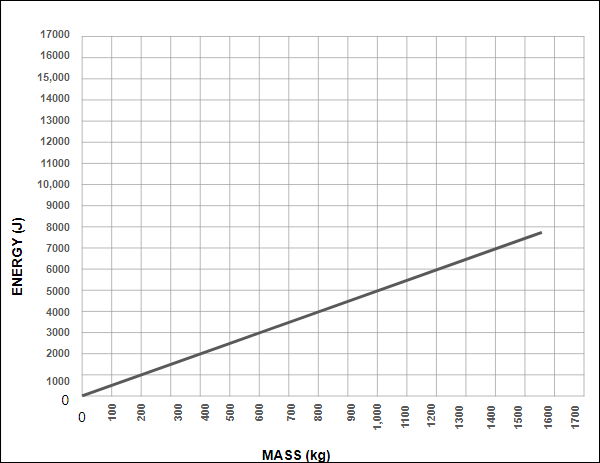
Based on the graph, when the mass doubles from 500 kg to 1000 kg, what happens to kinetic energy?
Kinetic energy remains the same
Kinetic energy doubles
Kinetic energy quadruples
There is too little information to know


How does this archer demonstrate potential energy?
By pulling back the bowstring
By releasing the arrow
By standing still
By aiming at the target
What happens to the energy when the archer releases the arrow?
It is converted into kinetic energy
It disappears
It remains the same
It is converted into thermal energy

Which has higher potential energy?
Bowling ball scenario
Hanging bucket

Which has higher kinetic energy?
Bowling ball scenario
Hanging bucket
Define mass.
A measure of the amount of matter in an object
The force exerted by gravity on an object
A unit of measure for weight
The volume of an object
Define energy.
The capacity to do work
A unit of power
A type of molecule
A measurement of heat
Define Work.
Force applied over a distance
A measure of the energy produced by a system
The rate of doing work
A unit of power
The SI unit of work and all other forms of energy
calorie
energy
joule
power
watt
The process of changing energy from one form to another.
transmission
transportation
transformation
Energy of moving parts
electrical
chemical
mechanical
Vibrations produce _______ energy.
chemical
sound
electrical
light
How could you increase the potential energy of an object without changing its mass and gravity?
Make the object larger
Lower the object towards the ground
Raise the object farther off the ground
Allow the object to roll on the ground
Total Energy =
kinetic + potential
kinetic - potential
potential - kinetic
The acceleration due to gravity on Earth is .....
g = 1.6 m/s2
g = 3.8 m/s2
g = 9.8 m/s2
g = 24.6 m/s2
Abigail, Benjamin, and Henry are playing on a hill. Abigail rolls a 5 kg ball from the top of the hill. The potential energy of the ball at the top of the hill is 250 J. If all of the potential energy of the ball is transformed into kinetic energy, what is the velocity of the ball at the point of maximum kinetic energy? KE= 2 1mv2
5 m/s
10 m/s
100 m/s
1250 m/s

Ethan is at an amusement park and decides to ride a roller coaster. The roller coaster car he is in has a mass of 250 Kg. The car is sitting on top of a 25 m hill. The gravitational potential energy (PE=mgh) of the car at the highest point of the track is 61,250 J. Ethan is curious to know the PE, KE, and mechanical energy (ME) at exactly the middle point between the top of the hill and the very bottom. Can you help Ethan figure this out?
PE= 250
KE= 25
ME 61260
PE= 25
KE=250
ME= 61250
PE=0
KE=61250
ME=100
PE= 30625
KE=30625
ME= 61250

A mother is on the train. To the boy, she looks like she is moving. To the mother, she isn’t. Why are the perspectives different?
Distance
Frame of reference
Reference point
Speed
What is speed?
A measure of how fast an object is moving
A measure of both the speed and direction of an object's motion
A rate of change of an object's velocity
A measure of how quickly an object's velocity is changing
What is velocity?
A measure of how fast an object is moving
A measure of both the speed and direction of an object's motion
A rate of change of an object's velocity
A measure of how quickly an object's velocity is changing
What is acceleration?
A measure of how fast an object is moving
A measure of both the speed and direction of an object's motion
A rate of change of an object's velocity
A measure of how quickly an object's velocity is changing
Which of the following is a vector quantity? (magnitude and direction)
Speed
Velocity
Acceleration
Distance
How is acceleration measured?
Meters per second
Meters per second squared
Miles per hour
Kilometers per hour
Can an object have a constant speed but changing velocity?
Yes
No

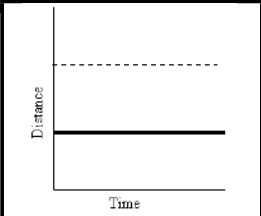

What is this graph showing?
Constant Speed
Acceleration (speeding up)
Negative Acceleration (slowing down)
No motion

A roller coasters accelerates from an initial speed of 6.0 m/s to a final speed of 70 m/s over 4 seconds. What's the acceleration?
24 m/s2
18 m/s2
16 m/s2
16 m/s

Two toy race cars are going to be raced down the same ramp. Which information is most helpful in predicting which car will win the race?
length of the ramp
volume of the cars
slope of the ramp
mass of the cars
John stands at the top of a steep hill and pushes a ball over the edge with his foot. Which force causes the ball to continue rolling down the hill?
mass
gravity
friction
air resistance

? = mass x acceleration
or
? = m x a
is used to find
1st
Law of Motion
2nd
Law of Motion
3rd
Law of Motion
1st
Law of Motion
2nd
Law of Motion
3rd
Law of Motion


