Wayground logo

Free Printable Worksheets

Font size

S
M
L
XL
Worksheets

Punnett Sq and Pedigree Practice

Total questions: 68

Worksheet time: 4hrs 20mins

Name
Class
Date
1.

How many alleles (letters) does a child get from each parent?

a)

1

b)

2

c)

3

d)

4

2.

How many alleles (letters) does a child get from each parent?

a)

1

b)

2

c)

3

d)

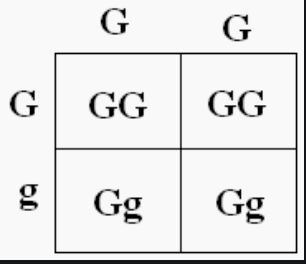
4

3.
Aa, DD, bB, yy are all examples of
a)
genotypes
b)
phenotypes
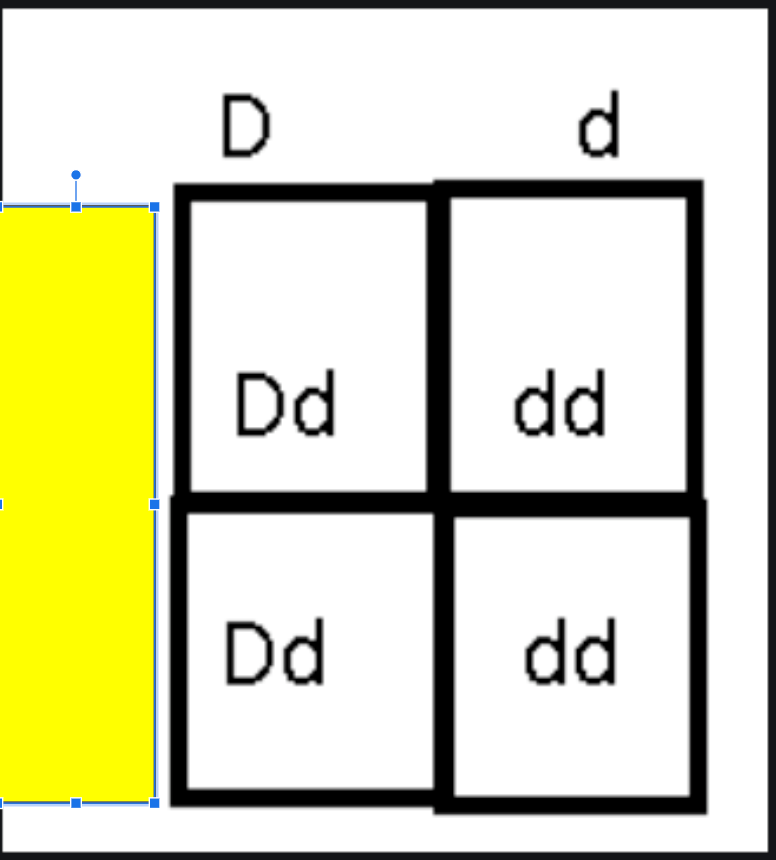
4.
What you see, or the physical appearance.
a)
Genotype
b)
Phenotype
c)
Homozygous
d)
Heterozygous
5.
AA and Aa always show up as
a)
dominant
b)
recessive
6.
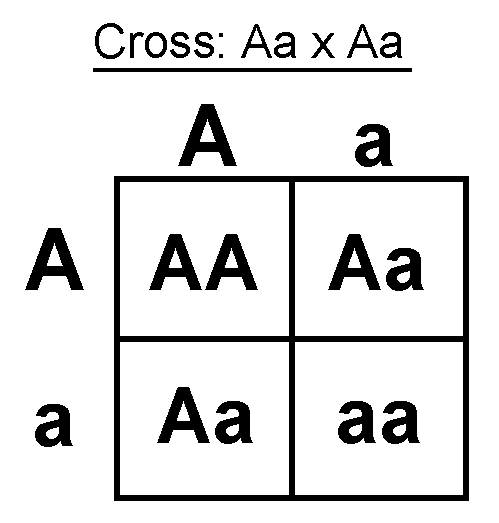
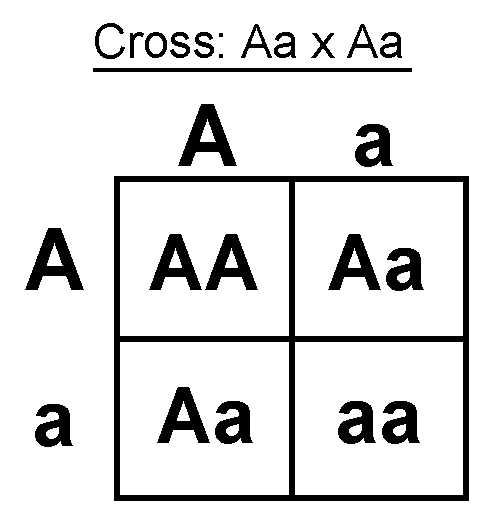
aa always shows up as
a)
dominant
b)
recessive
7.
If B = brown hair and b = blonde hair, what is the probability of brown hair?
a)
25%
b)
50%
c)
0%
d)
75%
8.
In certain species of plants, purple flowers (P) are dominant to white flowers (p). If two heterozygous plants are crossed, what will be the phenotype of the offspring?
a)
100% purple flowers
b)
100% white flowers
c)
75% white flowers, 25% purple flowers
d)
25% white flowers, 75% purple flowers
9.
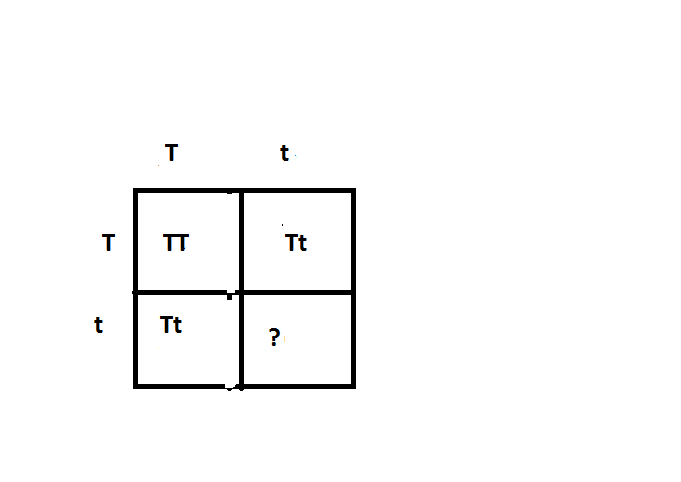
T - tall and t = short
In the punnett square below, what belongs in the missing square
a)
tt
b)
Tt
c)
Bb
d)
TT
10.
What do we use pedigrees for?
a)
To look at families
b)
To make determinations about the offspring
c)
To track traits in families
d)
Nothing
11.
In a pedigree, what shape represents a male?
a)
circle
b)
square
c)
triangle
d)
diamond
12.
What does an open circle represent?
a)
Not Affected Male
b)
Not Affected Female
c)
Affected Male
d)
Affected Female
13.
What does a filled in square represent?
a)
Not affected Female
b)
Not affected Male
c)
Affected Male
d)
Affected Female
14.
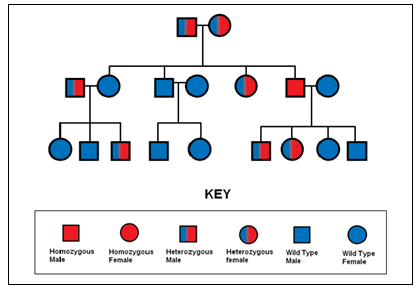
What do half colored symbols represent?
a)
The individual is a carrier (heterozygous).
b)
The individual expresses the trait.
c)
The individual has both recessive alleles.
d)
The individual has both dominant alleles.
15.
How many individuals are there in the 3rd generation?
a)
2
b)
3
c)
4
d)
6
16.
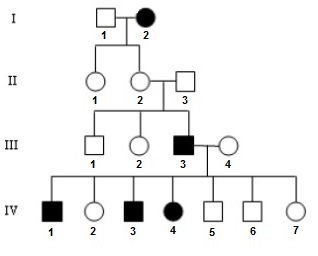
Give the genotype for person III-3
a)
GG
b)
Gg
c)
gg
17.
Give the genotype for person II-1
a)
GG
b)
Gg
c)
gg
18.
How are individuals III-2 and II-4 related?
a)
Cousins
b)
Dad and Daughter
c)
Uncle and Niece
d)
Grandpa and Granddaughter
19.
How many kids did the mother and father from the first generation have?
a)
2
b)
4
c)
5
d)
6
20.
This pedigree represents the inheritance of hemophilia in this family. How many of the females have the hemophilia trait?
a)
8
b)
5
c)
2
d)
3
21.

If this pedigree shows a recessive disorder, what MUST the genotype of individual 4 be?

a)

HH

b)

Hh

c)

hh

22.

If black fur is dominant and white fur is recessive, what genotype would an organism with white fur have?

a)

FF

b)

Ff

c)

ff

23.

In mice, black fur (B) is dominant to white fur (b). According to the Punnett square shown, the offspring in box 4 would:

a)

be white.

b)

be heterozygous.

c)

be gray.

d)

be homozygous.

24.
How many boys did the mother and father from the first generation have?
a)
2
b)
4
c)
5
d)
6
25.
What do half colored symbols represent?
a)

The individual is a carrier.

b)

The individual expresses the trait.

c)

The individual has both recessive alleles.

d)

The individual has both dominant alleles.

26.
T - tall and t = short
In the punnett square below, what belongs in the missing square
a)
tt
b)
Tt
c)
Bb
d)
TT
27.
Which of the following is a phenotype?
a)
Aa
b)
red hair
c)
heterozygous
d)
DNA
28.
Dominant alleles are represented by a:
a)
Male gene
b)
lowercase letter
c)
recessive trait
d)
capital letter
29.
Give the genotype for person II-1
a)
GG
b)
Gg
c)
gg
30.
Give the genotype for person III-3
a)
GG
b)
Gg
c)
gg
31.
This pedigree represents the inheritance of hemophilia in this family. How many of the females have the hemophilia trait?
a)
8
b)
5
c)
2
d)
3
32.
Is this trait (the shaded individuals) dominant or recessive?
a)
dominant
b)
recessive
33.

Which of the following correctly states the genotype probabilities for the offspring of the parents shown in this punnett square?

a)

50% heterozygous 50% homozygous dominant

b)

50% heterozygous 50% homozygous recessive

c)

50% heterozygous 25% homozygous recessive 25% homozygous dominant

d)

100% heterozygous

34.

Which of the following correctly states the genotype probabilities for the offspring of the parents shown in this punnett square?

a)

50% heterozygous 50% homozygous dominant

b)

50% heterozygous 50% homozygous recessive

c)

50% heterozygous 25% homozygous recessive 25% homozygous dominant

d)

100% heterozygous

35.
Homozygous is when...
a)
the alleles are the same
b)
the alleles are different
c)
the alleles are absent
d)
the alleles are present
36.
Heterozygous is when...
a)
the alleles are the same
b)
the alleles are different
c)
the alleles are absent
d)
the alleles are present
37.

In a Punnett Square, 1 box is equal to 25%. How much are 3 boxes equal to?

a)

25%

b)

50%

c)

75%

d)

100%

38.

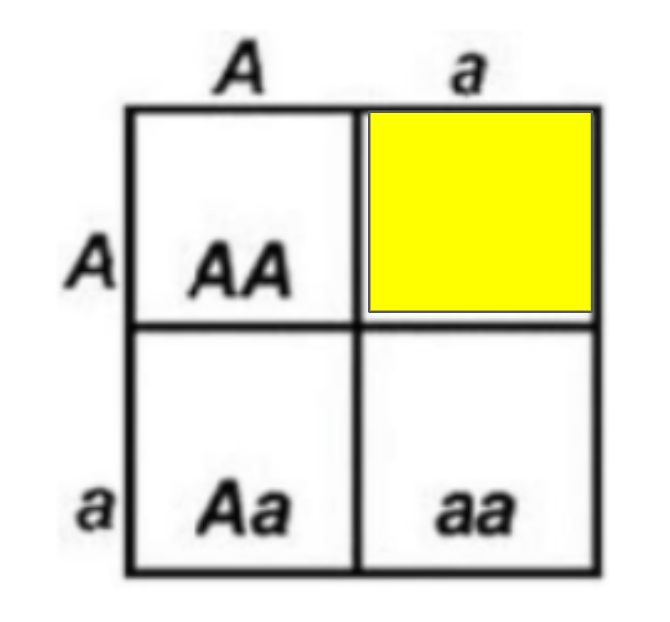
Fill in the Yellow Box

a)

AA

b)

Aa

c)

aa

39.

How chance the offspring born from this cross will have a homozygous dominant genotype?

a)

25%

b)

50%

c)

75%

d)

100%

40.

What is the mother's genotype?

a)

DD

b)

Dd

c)

dd

41.
How many generations are shown in this pedigree?
a)
1
b)
2
c)
3
d)
4
42.
How many kids did the mother and father from the first generation have?
a)
2
b)
4
c)
5
d)
6
43.
This pedigree represents the inheritance of hemophilia in this family. How many of the females have the hemophilia trait?
a)
8
b)
5
c)
2
d)
3
44.
Is this trait (the shaded individuals) dominant or recessive?
a)
dominant
b)
recessive
45.

In this pedigree, which gender can be carriers of colorblindness and not have it?

a)

Just males

b)

Just females

c)

Both genders

46.
If this pedigree shows an autosomal recessive disorder, what MUST the genotype of individual II-3 be?
a)
HH
b)
Hh
c)
hh
d)
None of the above
47.

Huntington's Disease is a dominant trait.

What is the correct genotype for individual I-2?

a)

HH

b)

Hh

c)

hh

d)

H

48.
In the second generation-how many people are carriers of the trait?
a)
2
b)
3
c)
5
d)
6
49.

In the third generation, how many people have at least one mutated copy of the gene associated with the disease traced over the multiple generations?

a)
2
b)
3
c)
5
d)
6
50.
Black hair is dominant to blonde hair which is recessive. 
What is the phenotype for the following genotype? 
BB
a)
Blonde hair
b)
black hair
c)
brown hair 
51.
What percentage of the female offspring will be a carrier for this recessive disease?
a)
0%
b)
50%
c)
100%
d)
25%
52.
Red flower color is dominant to white flower color in rose plants. What is the expected result of a cross between two heterozygous rose plants? 
R - red flower color
r - white flower color
a)
75% red, 25% white
b)
100% red
c)
50% red, 50% white
d)
25% red, 75% white
53.
One parent is heterozygous for a certain trait (Dd). The other parent is homozygous dominant (DD) for that trait.  What is the percent chance that an offspring from this cross will be heterozgyous?
a)
0%
b)
25%
c)
50%
d)
100%
54.

A tongue roller(R) is dominant to a non-roller(r). Complete the following cross:

Homozygous tongue roller crossed with a non-roller.

What is the predicted genotypic ratio?

a)

50% RR, 50% rr

b)

25% RR, 75% rr

c)

75% RR, 25% rr

d)

100% Rr

55.

Free earlobes (F) is dominant to attached earlobes (f). Use this information to cross the following: heterozygous free earlobes crossed with a heterozygous free earlobes. What is the expected PHENOTYPES from this cross?

a)

100% free earlobes

b)

75% free earlobes, 25% attached

c)

75% attached earlobes, 25% free earlobes

d)

100% attached earlobes

56.

In pea plants, round seeds (R) are dominant to wrinkled seeds (r). Which of the following represents the genotype of a pea plant that is homozygous dominant?

a)

RR

b)

round

c)

Rr

d)

wrinkled

e)

rr

57.
What allele combination should go in the missing box?
a)
AA
b)
Aa
c)
aa
d)
none of these
58.

Objective #13

This is a pedigree that follows blue eyes which is a recessive trait. What is the phenotype of the mother (circle) in generation 1?

a)

Brown

b)

Blue

c)

1 blue, 1 brown

59.
If a trait SKIPS a generation, it is an indication that the trait is....
a)
dominant
b)
recessive
c)
incompletely dominant
d)
co-dominant
60.

Objective #13

This is a pedigree that follows blue eyes which is a recessive trait. What is the genotype of the father (square) in generation 1?

a)

Aa

b)

AA

c)

aa

d)

A?

61.

In this pedigree, the shading represents people in the family with dark hair while the unshaded represents blondes. Is dark hair controlled by a dominant or recessive allele?

a)

Dominant

b)

Recessive

62.
In rabbits, black fur (B) is dominant over brown fur (b). If a rabbit has brown fur, what can you conclude about its genotype?
a)
It is BB.
b)
It is Bb
c)
It is brown
d)
It is bb.
63.
What is the phenotype of the offspring? (A-Brown hair; a-blond hair) 
a)
50 % Brown Hair and 50% Blond Hair 
b)
25 % Brown Hair and 75% Blond Hair 
c)
75 % Brown Hair and 25% Blond Hair 
d)
0% Brown Hair and 100% Blond Hair 
64.
What percent of offspring will have the recessive trait?
a)
25
b)
50
c)
75
d)
100
65.
Which of the following genotypes is homozygous dominant?
a)
A
b)
Aa
c)
AA
d)
aa
66.
What is the probability of heterozygous offspring?
a)
25%
b)
50%
c)
0%
d)
100%
67.
What is the probability of homozygous dominant offspring?
a)
0%
b)
100%
c)
50%
d)
25%
68.
Two brown eyed parents (Bb) have a baby. What is the chance the baby is blue eyed?
a)
0 %
b)
25%
c)
50%
d)
75%