Wayground logo

Free Printable Worksheets

Font size

S
M
L
XL
Worksheets

Seasons

Total questions: 71

Worksheet time: 2hrs 26mins

Name
Class
Date
1.
In winter, the axis of the earth is pointed away or toward the sun?
a)
towards
b)
up
c)
down
d)
away
2.
In summer, the axis of the earth is pointed away or toward the sun?
a)
towards
b)
up
c)
down
d)
away
3.
Why is the Equator warmest?
a)
Because it is closest to the sun.
b)
Because it receives the most direct sunlight
c)
Because no clouds form here.
d)
Because it is far from the sun
4.
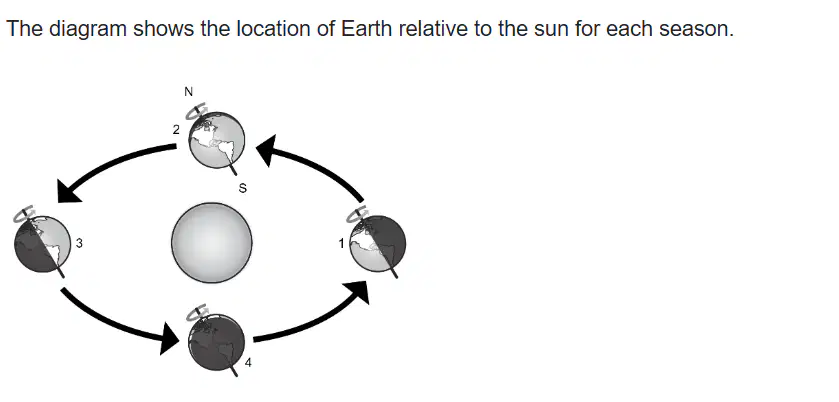
Which season is taking place in the Northern Hemisphere in Position 1?
a)
Winter
b)
Spring
c)
Summer
d)
Fall
5.
Which season is taking place in the Northern Hemisphere in Position 3?
a)
Winter
b)
Spring
c)
Summer
d)
Fall
6.
If its ____ in the Northern hemisphere, then its summer in the Southern hemisphere. 
a)
spring
b)
summer
c)
fall
d)
winter
7.
What are the reasons for the season?
a)
Earth's tilt & rotation
b)
Earth's tilt & revolution
c)
Earth's rotation & size
d)
Earth's tilt & resolution
8.
The term equinox means....
a)
equal amount of day light and equal amount of night
b)
Equal amount of winter and summer
c)
Equal amounts of hot dogs for everyone
d)
The longest day of the year
9.
Why does the area around the equator stay the same temperature all year?
a)
The equator rotates slower than the poles.
b)
The equator remains the same distance from the sun.
c)
The equator always receives direct sunlight.
d)
The equator has 18 hour days.
10.
One rotation of Earth is equal to
a)
a day.
b)
a year.
11.

Use the diagram to find where winter is on the northern and southern hemisphere?

a)

AD

b)

AG

c)

EG

d)

EC

12.

What letters show you Summer for the northern and southern hemisphere?

a)

AG

b)

BH

c)

CE

d)

DF

13.

What season is represented in the northern hemisphere?

a)

Fall

b)

Winter

c)

Spring

d)

Summer

14.

What season is represented in the southern hemisphere?

a)

Summer

b)

Winter

c)

Fall

d)

Spring

15.

What season will come next in the norther hemisphere?

a)

Summer

b)

Winter

c)

Spring

d)

Fall

16.

Which hemisphere will experience shorter days and longer nights?

a)

Northern

b)

Southern

17.

What will the south pole have in this diagram?

a)

50% daylight and night

b)

100% night

c)

100% daylight

18.

What is special about the length of day on the summer solstice?

a)

the shortest amount of day length

b)

the length of day and night are equal

c)

the longest amount of day length

19.

What is special about the length of day on the fall equinox?

a)

the longest amount of day length

b)

the shortest amount of day length

c)

the length of day and night are equal

20.

What are the seasons in order?

a)

spring, summer, winter, fall

b)

spring, fall, summer, winter

c)

spring, winter, fall, summer

d)

spring, summer, fall, winter

21.

During which two seasons is the Earth's axis not tilted toward or away from the sun, giving mild temperatures & equal day and night?

a)

Fall & Spring

b)

Fall & Summer

c)

Spring & Summer

d)

Spring & Winter

22.

 Which part of the Earth receives the most direct sunlight from our Sun?

a)

Equator

b)

North Pole

c)

South Pole

d)

Both Poles

23.

Why are seasons in the reverse order in the Southern Hemisphere compared to the Northern Hemisphere?

a)

The seasons are not reverse, they are the same.

b)

They are reverse because they are farther away from the Sun when we are closer to it.

c)

They are reverse because when we tilt toward the Sun, they tilt away from the Sun.

d)

They are reverse because the Earth spins in the opposite direction in the Southern Hemisphere.

24.
When the North pole is facing toward the Sun, which hemisphere is experiencing winter?
a)
Northern
b)
Southern
25.
The Earth's revolution and the ________ causes seasons.
a)
rotation
b)
orbit
c)
tilt
d)
days
26.

What is an Axis?

a)

An obscuring of the light from a celestial body by the passage of an object between the celestial body and the observer or between the celestial body and its source of illumination

b)

The imaginary line through Earth that extends from the North Pole to the South Pole and is the center of Earth’s rotation

c)

A phenomenon or process that involves multiple steps and repeats itself

27.

Which number on the diagram represents when people in the Northern Hemisphere are experiencing summer?

a)

Location 1

b)

Location 2

c)

Location 3

d)

Location 4

28.

Which position of Earth would experience winter in the northern hemisphere?

a)

1

b)

2

c)

3

d)

4

29.

What season is the northern hemisphere in, in location 1?

a)

Winter

b)

Spring

c)

Summer

d)

Fall

30.

What season is the Southern Hemisphere experiencing in location 3?

a)

Summer

b)

Winter

c)

Fall

d)

Spring

31.
What is the season in the Northern Hemisphere when the North Pole is pointed toward the sun?
a)
Fall
b)
Winter
c)
Spring
d)
Summer
32.
During which season is sunlight the least intense?
a)
Fall
b)
Winter
c)
Spring
d)
Summer
33.
Which location experiences 24 hours of daylight during the summer in the Southern Hemisphere?
a)
Equator
b)
North Pole
c)
South Pole
d)
Tropic of Capricorn
34.

Which location experiences 12 hours of daylight throughout the entire year?

a)

Equator

b)

North Pole

c)

South Pole

d)

Tropic of Capricorn

35.

In spring, the axis of the earth is pointed away or toward the sun?

a)

Towards

b)

Neither away or toward

c)

Away

36.

It is the tilt of the Earth that gives us ___________.

a)

Seasons

b)

Day time

c)

Night time

d)

Both two and three are correct

37.
The hemisphere where you live 
a)
equator
b)
southern
c)
northern
d)
eastern
38.
The Earth is rotating on its axis, creating _____
a)
the 12 months
b)
the years
c)
the seasons
d)
day and night
39.
As the Earth travels around the Sun, it creates a pattern that makes _____
a)
the months
b)
the years
c)
the seasons
d)
day and night
40.

When the Earth completes a full revolution around the Sun, it has completed _____ rotations or days

a)

7

b)

30

c)

91

d)

365

41.
The spinning movement of the Earth about its axis is called the Earth's _____
a)
revolution
b)
rotation
c)
precession
d)
orbit
42.
The movement of the Earth around the Sun is called its _____
a)
revolution
b)
rotation
c)
precession
d)
gyration
43.
Earth has seasons because 
a)
Earth rotates on it's axis
b)
The distance between Earth and the sun changes
c)
The temperature of the sun changes
d)
Earth's axis is tilted as it moves around the sun
44.
Earth is tilted as it revolves around the sun which gives us seasons. Which season would it be in North America at letter D?
a)
Summer
b)
Spring
c)
Winter
d)
Fall
45.

What is the shortest day of the year?

a)

vernal equinox

b)

autumnal equinox

c)

winter solstice

d)

summer solstice

46.

When is the longest day of the year?

a)

winter solstice

b)

summer solstice

c)

vernal equinox

d)

autumnal equinox

47.

Rotation causes ...

a)

equinoxes and solstices

b)

day and night

c)

seasons

d)

years

48.

What occurs when both hemispheres experience an equal amount of daylight and nighttime hours?

a)

solstice

b)

equinox

c)

season

d)

perihelion

49.
What season is letter A in the northern hemisphere?
a)
Winter
b)
Summer
c)
Spring
d)
Fall
50.
Which season is taking place in the Northern Hemisphere in Position 1?
a)
Winter
b)
Spring
c)
Summer
d)
Fall
51.
Which body has the greater effect on Earth's tides?
a)
Sun
b)
Saturn
c)
Moon 
d)
Venus
52.

Wha type of tide would this arrangement of earth-moon-sun create?

a)

full moon tide

b)

new moon tide

c)

neap tide

d)

spring tide

53.
What type of tides would this arrangement of earth-moon-sun create?
a)
neap tide
b)
spring tide
c)
new moon tide
d)
full moon tide
54.
Tides are caused by
a)
strong winds that blow over ocean waters.
b)
the interaction of Earth, the moon and the sun.
c)
the shifting of the plates on the ocean floor.
d)
variations in the salinity of ocean water
55.
What causes tides?
a)
gravity
b)
wind
c)
spring
d)
neap
56.
What do we call the small tides that happen when the sun and moon are at right angles to each other?
a)
Neap Tide
b)
Spring Tide
c)
Larger Change
d)
Smaller Change
57.
The Moon has a greater influence on Earth tides than the Sun because...
a)
it is smaller than the Sun
b)
it revolves around the Earth
c)
it is closer to the Earth
58.
A neap tide is a tide with the greatest difference between low and high tides
a)
true
b)
false
59.
What is a difference between spring and neap tides?
a)
Spring tides occur when the earth and sun are IN LINE with the new or full moon. 
b)
Spring tides occur when moon in 3rd or 1st quarter phases
c)
Spring tides are LOWER than neap tides
d)
Spring tides occur in Spring and neap tides can occur in any season
60.

What is seen here?

a)

Picture of a spring tide.

b)

Picture of a lunar eclipse.

c)

Picture of a neap tide.

d)

Picture of a solar eclipse.

61.

Neap tides are the ________ tides.

a)

strongest

b)

weakest

62.

What is the tide that occurs during a first quarter and a third quarter moon?

a)

neap tide

b)

low tide

c)

spring tide

d)

high tide

63.
What type of tide occurs during a new and full moon?
a)
Neap tides
b)
Spring tides
c)
Normal tides
64.
What type of Tide is this?
a)
Spring Tide
b)
Neap Tide
65.

A neap tide occurs during which two lunar phases?

a)

Full Mooon and New Moon

b)

Waxing Crescent and Waning Crescent

c)

Waxing Gibbous and Waning Gibbous

d)

1st Quarter and 3rd Quarter

66.

_____ refers to the difference between high tide and low tide levels.    

a)

High Tide

b)

Low Tide

c)

Intermediate Tide

d)

Tidal Range

67.

Why are seasons in the reverse order in the Southern Hemisphere compared to the Northern Hemisphere?

a)

The seasons are not reverse, they are the same.

b)

They are reverse because they are farther away from the Sun when we are closer to it.

c)

They are reverse because when we tilt toward the Sun, they tilt away from the Sun.

d)

They are reverse because the Earth spins in the opposite direction in the Southern Hemisphere.

68.

 Which part of the Earth receives the most direct sunlight from our Sun?

a)

Equator

b)

North Pole

c)

South Pole

d)

Both Poles

69.

During which two seasons is the Earth's axis not tilted toward or away from the sun, giving mild temperatures & equal day and night?

a)

Fall & Spring

b)

Fall & Summer

c)

Spring & Summer

d)

Spring & Winter

70.

What causes the seasons on Earth?

a)

The movement of the moon around the Earth

b)

The movement of the Sun around the Earth

c)

The tilt of the Earth's axis is it goes around the sun

71.

The term used to describe when the Earth spins on an axis is...

a)

revolution

b)

rotation

c)

orbit

d)

retrograde