wayground logo

Free Printable Worksheets

Font size

S
M
L
XL
Worksheets

Unit 8- Evolution

Total questions: 50

Worksheet time: 25mins
Name
Class
Date
1.
Inherited trait that helps an organism survive is a(n) __________.
a)
Fossil
b)
Adaptation
c)
Ancestor
d)
Natural selection
2.
Survival of the fittest or when favorable adaptations reproduce faster is called what?
a)
Evolution
b)
Adaptation
c)
Natural selection
d)
Fossilization
3.
Structures with the same parts have different functions; suggests that organisms share a common ancestry
a)
vestigial structures
b)
homologous structures
c)
adaptive radiation
d)
fossil
4.
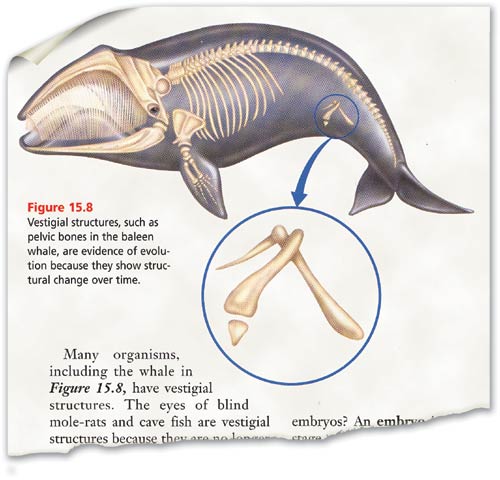
Which of the following is an example of a vestigial structure?
a)
the wings of a red-tailed hawk
b)
the hind limbs of a house cat
c)
the fins of sharks
d)
the tailbone of a human
5.
The diagram shows fossils in different rock layers. Which of these statements about the age of these fossils is most likely correct?
a)
Fossil A and C are the same age
b)
Fossil B is older than fossil C
c)
Fossils A is older than fossil B
d)
Fossil D is older than fossil C
6.

What do we call a change in a species over time?

a)

Adaptation

b)

Evolution

c)

Extinction

d)

Environmental influences

7.
When an organism completely dies out, it is called.....
a)
Adaption
b)
Extinction
c)
Fossilization
d)
Mutation
8.
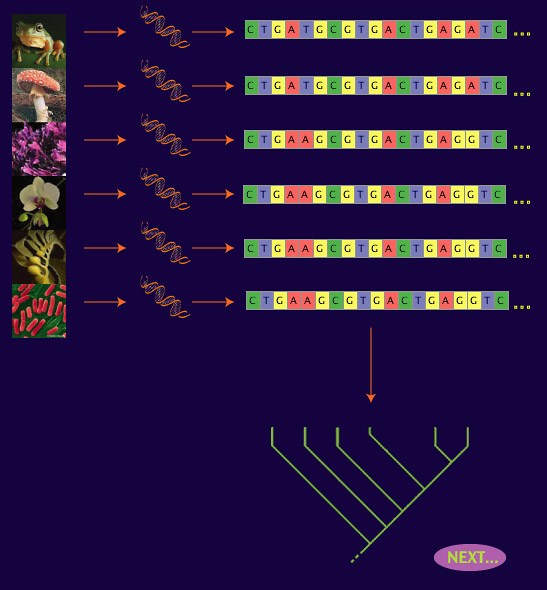
Two organisms that are closely related would have
a)
very similar DNA sequence
b)
exactly the same DNA sequences
c)
no proteins in common
d)
completely different DNA sequence
9.
Comparing human hemoglobin of chimpanzees, horses, kangaroos, and chickens, reveal that humans have the fewest amino acid differences with 
a)
Kangaroos
b)
Horses
c)
chickens
d)
chimpanzees
10.
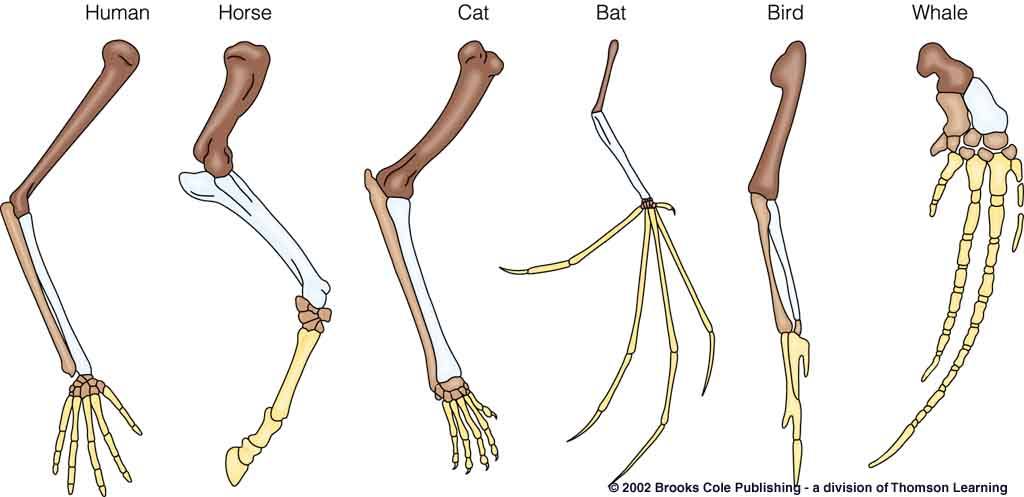
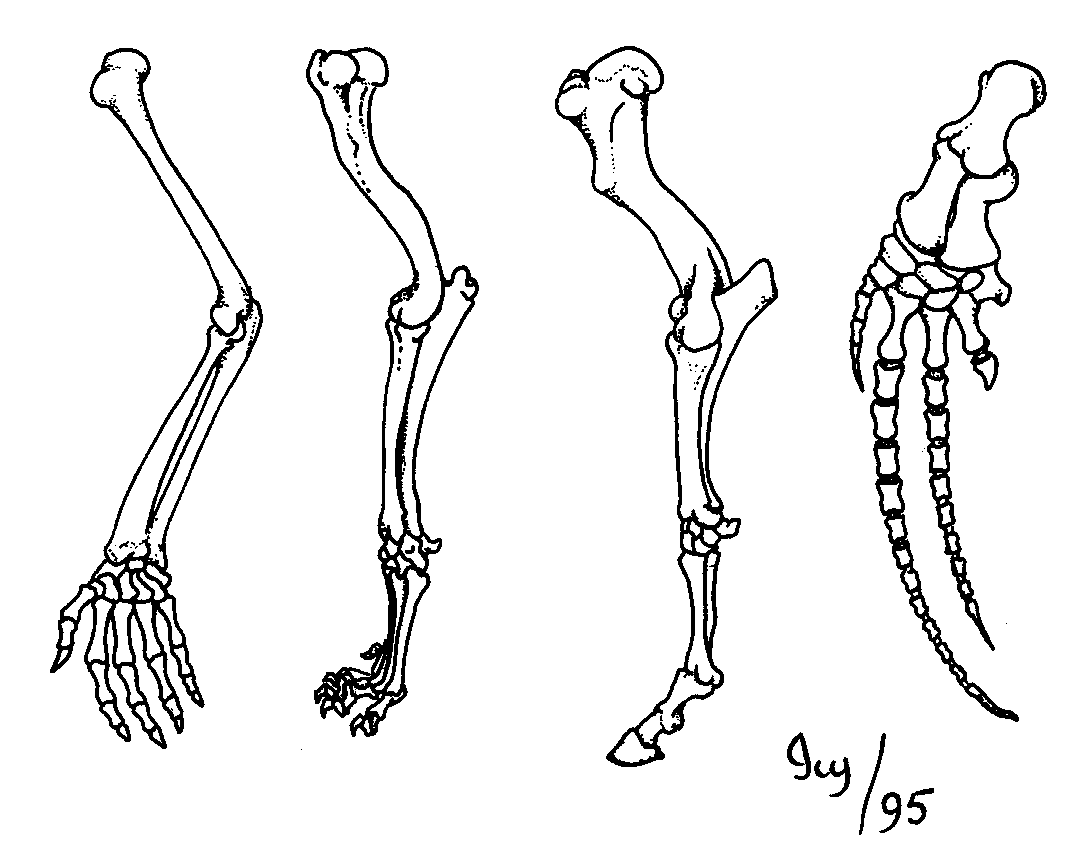
The structures shown are_________
a)
homologous
b)
heterologous
c)
analogous
d)
vestigial
11.

Many different groups of organisms have wings, even though they do not share a recent common ancestor. This is because they evolved in environments with similar selective pressures. Wings are an example of a(n) ______________ structure.

a)

vestigial

b)

analogous

c)

homologous

12.
Mutations are important because they bring about
a)
death of the organism in which they develop
b)
genetic variation needed for a population to evolve
c)
benefits for the individual, not for the population
d)
Hardey-Weinberg equilibrium within a population
13.
This mechanism of evolution occurs when populations migrate.
a)
Extinction
b)
Gene flow
c)
Genetic drift
d)
Natural Selection
14.

What is speciation?

a)

when a population reaches a balance and change is no longer occuring

b)

when populations move away from each other

c)

when species begin to pass on acquired traits and change their behavior

d)

when two species can no longer interbreed

15.

In a population of ladybugs, black bugs are more successful in escaping predators. Overtime, this gene becomes more popular in the population and the ladybug population loses its red color. This is an example of?

a)

Natural Selection

b)

Mutation

c)

Genetic Drift

d)

Gene Flow

16.

Humans evolved from chimpanzees

a)

True

b)

False

17.

There was a forest fire that wiped out birch trees randomly and left a few dispersed throughout the forest. The surviving trees evolve overtime changing the gene pool. This is an example of?

a)

gene flow

b)

bottleneck effect

c)

founders effect

d)

genetic flow

18.

The bottleneck effect and founder effect are results of

a)

gene flow

b)

genetic drift

c)

natural selection

d)

non-random mating

e)

mutations

19.

Which one does not increase variation?

a)

Gene flow

b)

Migration

c)

Mitosis

d)

Crossing Over

20.

When unrelated species evolve similar characteristics because they live in similar

environments

a)

Divergent Evolution

b)

Speciation

c)

Convergent Evolution

d)

Punctuated equilibrium

21.

A number of different species arise from one common ancestor

- New environments caused differences to evolve in populations

a)

Convergent Evolution

b)

Divergent Evolution

c)

Coevolution

d)

Gradualism

22.
Why are advantageous traits more likely to be passed onto offspring?
a)
Because they are more likely to survive and reproduce.
b)
Because they come from dominant alleles.
c)
Because they come from recessive alleles.
d)
Because the trait is an acquired phenotype.
23.
Which best describes mutations?
a)
Always helpful
b)
Always harmful
c)
Can be helpful or harmful
d)
Always neutral
24.
Study of embryos of various organisms to show a common ancestor because of similarities in development
a)
natural selection
b)
embryology
c)
speciation
d)
evolution
25.
The ability of an organism to survive and reproduce in its specific environment 
a)
diversity.
b)
evolution
c)
adaptation
d)
 fitness
26.
What type of selection is depicted in the picture? 
a)
stabilizing 
b)
directional 
c)
disruptive 
d)
the answer is not here
27.
What type of selection?
a)
Directional 
b)
Stabilizing
c)
Disruptive
28.
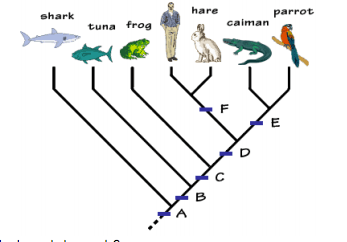
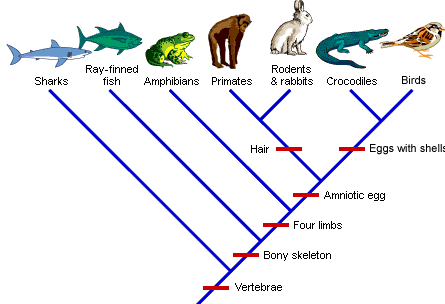
On the cladogram, which organism is the closest relative of the human?
a)
Frog
b)
Hare
c)
Caiman
d)
Parrot
29.
Which species’ DNA is most similar to the DNA of the toothed whale? 
a)
Hippopotamus 
b)
Baleen Whale
c)
Grazing Mammals
d)
Camels
30.
What type of evolution where there is a sudden, rapid change then no change for a long time?
a)
Co-Evolution
b)
Punctuated Equilibrium
c)
Divergent Evolution
d)
Convergent Evolution
31.

Evolution occurring gradually and slowly over long periods of time

a)

Homeostasis

b)

Stasis

c)

Punctuated Equilibrium

d)

Gradualism

32.

The hypothesis that the evolution of a species occurs in periods of rapid change separated by periods of little or no change is called:

​ (a)  

Choose from the below words
Divergence
Gradualism
Isolation
Punctuated Equilibrium
33.
What is the difference between gradualism and punctuated equilibria?
a)
Gradualism is slowly but surely and P.E. are rapid changes preceeded followed by long periods of little or no change
b)
P.E. is slowly but surely and Gradualism are rapid changes preceeded followed by long periods of little or no change
c)
Gradualism had no intermediate forms of species
d)
punctuated equilibria has intermediate forms of species
34.

Genetic drift causes a loss of

a)

genetic diversity

b)

populations

c)

isolations

d)

offspring

35.

A gene pool is

a)

all of the alleles in an individual

b)

all of the alleles in a population

c)

a body of water filled with fish

d)

all of the bases in one strand of DNA

36.
A few deer wander out of their native woods into a completely new park where no deer had ever been before. They go on to create an entirely new population.
a)
gene pool 
b)
founder effect
c)
bottleneck
d)
mutation
37.

Label the natural selection graphs correctly...

a)

1 Stabilizing, 2 Directional, 3 Disruptive

b)

1 Disruptive, 2 Stabilizing, 3 Directional

c)

1 Directional, 2 Stabilizing, 3 Disruptive

38.

Which of the following would an animal breeder use to increase the number of cows that give the most milk?

a)

overproduction

b)

genetic isolation

c)

acquired characteristics

d)

artificial selection

39.

Based on the image above, what type of Isolation is shown?

a)

Geographic Isolation

b)

Behavioral Isolation

c)

Temporal Isolation

40.

Fireflies make a pattern of flashes that attract mates of their own species. What type of isolation is this?

a)

Geographic Isolation

b)

Behavioral Isolation

c)

Temporal Isolation

41.

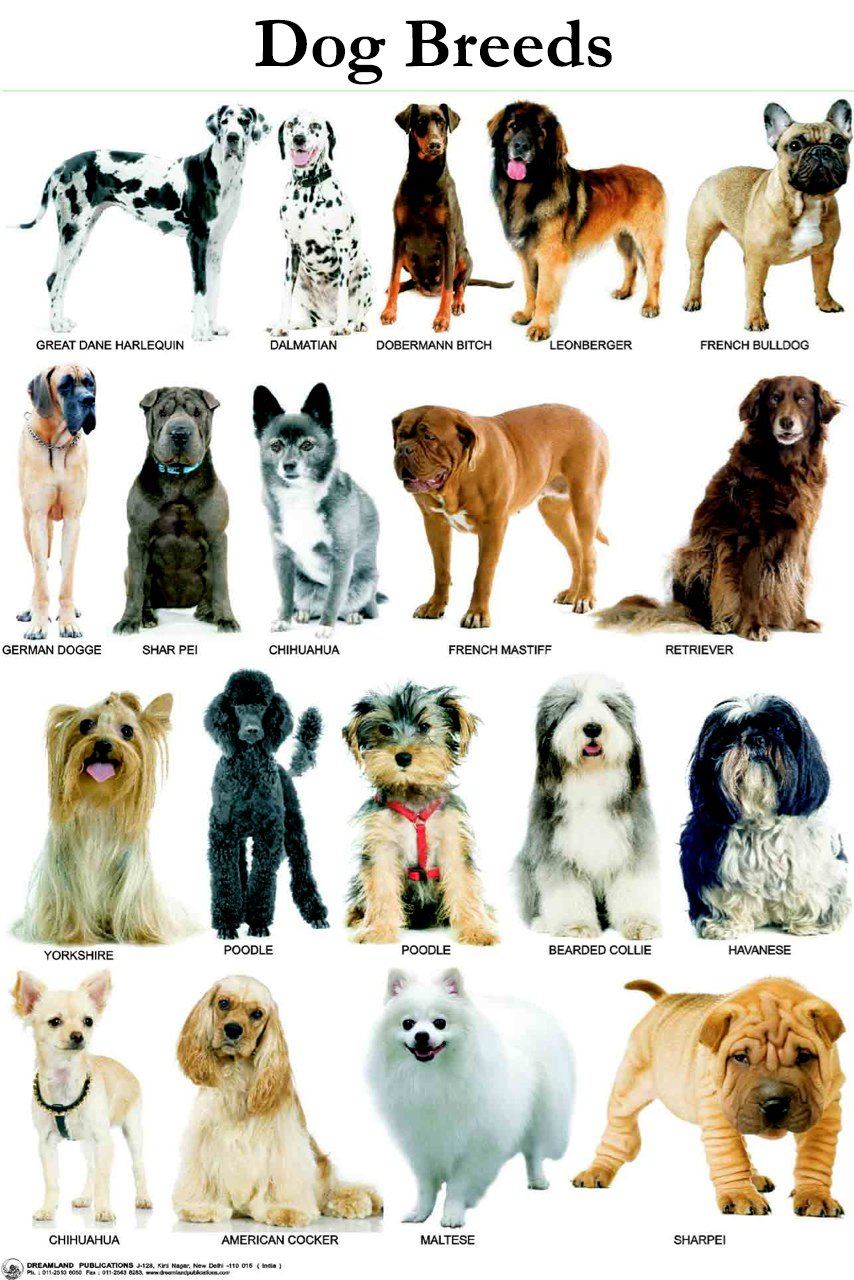
Dog breeding is an example of

a)

natural selection

b)

genetic drift

c)

speciation

d)

artificial selection

42.
What is the purpose of gel electrophoresis?
a)
helps cut DNA
b)
count the genes in DNA
c)
separates DNA based on size
d)
allows for an exact replicated organism
43.
A population is...
a)
A group of one species in one area
b)
Multiple species that live in one area
c)
All of the living and nonliving things in an area
d)
None of these
44.

Which answer best describes macroevolution?

a)

Largest-scale evolutionary changes via speciation or extiniction that occur over time

b)

A scientist who classifies organisms into groups and makes a hypothesis on whether they are a different species based on the evidence

c)

Identification of species by differences in their appearances

d)

AP biological trait evolves in two unrelated species as a result of exposure to similar environments

45.

During early stages of development, dolphin embryos begin to develop hind limbs. By the time the dolphin fetuses are fully developed, the hind limbs have disappeared.

Which statement best explains the early development and then disappearance of hind limbs in dolphins?

a)

Dolphin fetuses change their development to adapt to an aquatic environment.

b)

The genes that control the development of hind limbs are destroyed as the fetus develops.

c)

The early ancestors of dolphins had hind limbs.

d)

Dolphins are evolving to become terrestrial animals.

46.
Which of the following organisms the kingdom animalia are not closely related?
a)
mouse and hagfish
b)
mouse and lizard
c)
mouse and pigeon
d)
mouse and chimp
47.
Natural selection results in change over time by acting on traits that are
a)
heritable
b)
new
c)
mutated 
d)
better than the best
48.
Which two orgainsms have hair? 
a)
Sharks & Ray Finned Fish
b)
Primates & Rodents
c)
Birds & Crocodiles
d)
Rabbits & Birds
49.

Which of the following is required for a population to diverge into two separate species?

a)

The two populations must have evolved different physical appearances.

b)

The two populations must have mutated at least 10 times.

c)

The two populations must have become reproductively isolated.

d)

The two populations must have evolved analogous structures.

50.

A new river forms and splits two populations, causing ______________ speciation

a)

Sympatric

b)

Allopatric

c)

Extreme

d)

Convergent