
 Worksheets
EL Physical science part 2 midterm review
Total questions: 119
Worksheet time: 3hrs 38mins

How many VALENCE ELECTRONS does Chlorine have?
2
7
8
10
17

Ionic bonds are formed when electrons get
Shared between two atoms
Removed from both atoms
Transferred from one atom to another
Added to both atoms

Ionic bonds typically form between
A metal and a nonmetal
Two nonmetals
Two metals
A metalloid and a metal

What is the correct formula for Sodium Chloride?
SCl
NaCl
SC
NaCl2

Name this ionic compound: Al2O3
Dialuminum oxide
Aluminum oxygen
Oxygen Aluminide
Aluminum oxide

Cations _______ electrons, becoming _______ charged.
Gain; positively (+)
Gain; negatively (-)
Lose; positively (+)
Lose; negatively (-)

Anions ____ electrons, becoming _____ charged.
Gain; positively (+)
Gain; negatively (-)
Lose; positively (+)
Lose; negatively (-)

Write the chemical formula for a compound formed by K and Br (potassium bromide).
KBr
K2Br
KBr3
KBr2

Metals (like Na) typically _____ electrons in the formation of ionic bonds.
Gain
Lose
Keep the same

Nonmetals (like Cl) typically ____ electrons when they form ionic bonds.
Gain
Lose
Keep the same

Using the model for the formation of Scandium Fluoride (an ionic compound), can you guess its chemical formula?
Sc3F
Sc3F3
Sc+3F-1
ScF3
In formation of ionic compounds, the electrons from a particular atom are transferred so that the atom can attain stable configuration of a noble element. What noble configuration does Sodium ion attain?
Hellium
Neon
Argon
Krypton
The name of FeCl₂ is
iron chloride
iron (II) chloride
iron (I) chloride
iron dichloride
LiBr is called
lithium bromine
lithium (I) bromine
lithium bromide
lithuim (I) bromide
Name the ionic compound SnSe2
Tin diselenide
Tin (IV) Selenide
Tin selenide
Tin (II) triselenide
Name the following ionic compound: Cs2S
cesium sulfide
cesium sulfate
cesium II sulfate
cesium II sulfide
When naming ionic compounds with transition metals you need to include roman numerals to show the _____ of the metal..
atomic number
mass number
charge
ionization energy
When naming a compound, which of these is written first?
Metal
Nonmetal
Anion
Cation
What is the name of the compound Na2(SO4)?
Sodium sulfate
Sodium sulfide
Sodium sulfite
Sodium sulfuroxide
What is the name of the compound Sc(OH)3?
Scandium (III) hydroxide
Scandium (I) hydroxide
Scandium (II) hydroxide
Scandium hydroxide
The name of the compound Ca3(PO4)2
calcium phosphate
tricalcium diphosphate
calcium phosphorus oxide
calcium phosphide
By looking at the formula of an ionic compound, we can determine the charge (oxidation state) of a transition metal.
True
False
What is the charge of Cobalt (III)
3+
2+
8+
3-
What is the correct formula for Aluminum Suflite
Al2SO4
Al2SO3
Al2(SO4)3
Al2(SO3)3

What type of chemical bond is being shown in the F2 molecule?
single covalent bond
double covalent bond
triple covalent bond
quadruple covalent bond

The element nitrogen (N) has ___ valence electrons and needs ___ electrons to complete its octet.
5 , 3
3 , 5
6 , 2
2 , 6

Atoms form bonds in order to have an electron configuration similar to a ___________.
noble gas
alkali metal
friend
neighbor
Which of the following elements will make 3 covalent bonds?
Oxygen
Phosphorous
Fluorine
Germanium
How many Valence Electrons does Oxygen have?
2
7
6
1
What types of atoms make a covalent bond?
2 Nonmetals
1 Nonmetal & 1 Metal
2 Metals
2 Noble Gases

What is the name of Br6F10 ?
Bromium fluoride
Hexabromine fluoride
Bromium decafluoride
Hexabromine decafluoride
What is the name of this compound C3Cl10 ?
Tricarbon Decachloride
Carbon Chloride
Decacarbon Trichloride
Carbon (III) Chloride
What is the chemical name of Ag2O?
Disilver monoxide
Silver (II) Oxide
Silver (I) Oxide
Silver Oxide
What is the chemical name for MnCl3?
Manganese (I) Chloride
Manganese Trichloride
Manganese Chloride
Manganese (III) Chloride
What is the chemical formula for Dinitrogen Trioxide?
N3O2
NO
N6O5
N2O3
What is the chemical formula for Tetrasulfur Pentoxide?
SO
S5O4
S4O5
S3O7
N2+O2--> _NO
Which equation is balanced?
PbO2 + 2H2
SO2 + H20 --> H2SO4
2Na + 2H2O --> 2NaOH + H2
Balance this equation
_Al +_HCl --> _H2 +_AlCl3
2,6,3,2
it's already balanced
4,12,3,4
2,1,4,5
What are the coefficients that would properly balance this equation?
__Ca + __H2O --> __Ca(OH)2 + __H2
2,1 --> 2,1
1,2 --> 1,1
1,2 --> 2,4
1,2 --> 2,1
What are the coefficients that would properly balance this equation?
__AgNO3 + __H2S --> __Ag2S+ __HNO3
2,1 --> 1,2
1,2 --> 1,1
1,2 --> 1,2
1,2 --> 2,1
What are the coefficients that would properly balance this equation?
__H2 + __S --> __H2S
1,1 --> 1
2,2 --> 2
1,2 --> 1
1,2 --> 2
What are the coefficients that would properly balance this equation?
__Al + __O2--> __Al2O3
4,1 --> 2
4,3 --> 4
3,4 --> 1
4,3 --> 2
Determine the coefficients to make the following equation balanced?
__N2 + __O2--> __NO
1, 1, 1
1, 1, 2
2, 2, 2
1, 2, 2
Determine the coefficients to balance the equation.
__Al +__HCl --> __H2 +__AlCl3
2,6,3,2
it's already balanced
4,12,3,4
2,1,4,5
Balance the the following equation.
__Zn+__HCl -->__ZnCl2 +__H2
1,1,2,1
1,1,1,2
1,2,1,1
2,1,1,1
What type of reaction is the equation C + O2 → CO2?
Synthesis
Decomposition
Single Replacement
Double Replacement
What type of reaction is the equation
2NaCl → 2Na + Cl2?
Synthesis
Decomposition
Single Replacement
Double Replacement
What type of reaction is the equation
Cu + 2Ag(NO3) → 2Ag + Cu(NO3)
Synthesis
Decomposition
Single Replacement
Double Replacement
What type of reaction is the equation
MgCl2 + Li2CO3 → MgCO3 + 2 LiCl
Synthesis
Decomposition
Single Replacement
Double Replacement
What type of reaction is the equation
3Pb + 2H3PO4 → 3H2 + 1Pb3(PO4)2
Synthesis
Decomposition
Single Replacement
Double Replacement
What type of reaction is the equation
3 HBr + 1 Al(OH)3 → 3 H2O + 1 AlBr3
Synthesis
Decomposition
Single Replacement
Double Replacement
What type of reaction is the equation
2 RbNO3 + BeF2 → Be(NO3)2 + 2 RbF
Synthesis
Decomposition
Single Replacement
Double Replacement
What type of reaction is the equation
P4 + 3 O2 → 2 P2O3
Synthesis
Decomposition
Single Replacement
Double Replacement
What equation has the following general formula:
AB → A + B
Synthesis
Decomposition
Single Displacement
Double Displacement
Combustion
What equation has the following general formula:
AB + CD → CB + AD
Synthesis
Decomposition
Single Displacement
Double Displacement
Combustion
What equation has the following general formula:
CxHy + O2 → CO2 + H2O + E
Synthesis
Decomposition
Single Displacement
Double Displacement
Combustion
What type of equation is shown by the following:
C11H24+17O2 → 11CO2 + 12H2O + E
Synthesis
Decomposition
Single Displacement
Double Displacement
Combustion
PCl5+_ H2O→_ HCl+H3PO4
_Zn+_HCl-->_ZnCl2 +_H2
_Mg + _Cl2 --> _MgCl2
_N2 + _H2 --> _NH3
What type of reaction is the equation
2NaCl → 2Na + Cl2?
Synthesis
Decomposition
Single Replacement
Double Replacement
What type of reaction is the equation
Cu + 2Ag(NO3) → 2Ag + Cu(NO3)
Synthesis
Decomposition
Single Replacement
Double Replacement
What type of reaction is the equation
MgCl2 + Li2CO3 → MgCO3 + 2 LiCl
Synthesis
Decomposition
Single Replacement
Double Replacement
Example: H2
_CF4 + _Br2 -- _CBr4 + _F2
Identify the type of reaction:
ZnCl2 + Mg --> Zn + MgCl2
Precipitate
Single Replacement
Double Replacement
Decomposition
Identify the reaction type for the following equation:
K + F2 --> KF
Double replacement
Single Replacement
Synthesis
Decomposition
Identify the reaction type:
C2H6 + O2 --> CO2 + H2O
Double replacement
Synthesis
Acid base
Combustion
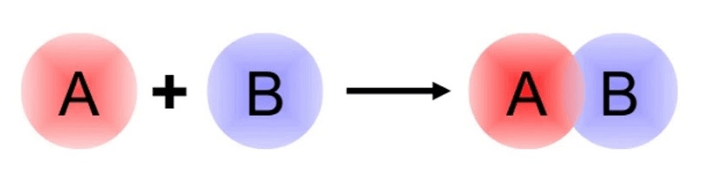
What is the type of reaction shown above?
Synthesis
Decomposition
Single Replacement
Double Replacement
_Zn+_HCl-->_ZnCl2 +_H2
Which side of a chemical equation is the product side?
What mathematical function do coefficients perform in a balanced equation?
addition
multiplication
subtraction
division
Which of the following is an example of a synthesis reaction?


Which of the following is an example of a decomposition reaction?
Which of the following is an example of a single replacement reaction?
Which of the following is an example of a double replacement reaction?

The red numbers in the image represent
subscripts
coeffiecients
roman numerals
none of the answer options are correct
The blue numbers in the image represent
subscripts
coeffiecients
roman numerals
none of the answer options are correct
(Check ALL answers)
Al + O2 → 2Al2O3
Balance this reaction:
____ Na3PO4 + ____ KOH ---> ____ NaOH + ____ K3PO4
1,3,3,1
1,3,2,1
2,3,3,1
1,1,3,1
Which type of reaction is:
2 H3AsO4 → As2O5 + 3 H2O
Which type of reaction is:
2 NaBr + Ca(OH)2 → CaBr2 + 2 NaOH
Balance the following:
____ H2SO4 + ____ NaNO2 → ____ HNO2 + ____ Na2SO4
In the equation, 2Mg + O2 ---> 2MgO, which are the reactants?
Mg and O2
MgO
Mg and MgO
O and MgO

Balance this equation:
(a) Fe + (b) O2 --> (c) Fe2O3
What are the coefficients that would properly balance this equation?
__C3H8 + __O2 --> __CO2 + __H2O
2, 7 --> 6, 8
1, 5 --> 3, 4
2, 5 --> 4, 6
1, 4 --> 2, 3
Identify the type of reaction:
2Na + Cl2 --> 2NaCl
Single Replacement
Double replacement
Synthesis
Decomposition
Determine the coefficients to balance the equation.
__Fe + __O2 --> __Fe2O3
1, 1 --> 1
2, 1 --> 1
4, 3 --> 2
3, 2 --> 1

