wayground logo

Free Printable Worksheets

Font size

S
M
L
XL
Worksheets

Grade 11 Biology Unit Review

Total questions: 108

Worksheet time: 2hrs 7mins

Name
Class
Date
1.
What do you call the physical expression of a gene?
a)
genotype
b)
dominant
c)
phenotype
d)
allele
2.
A red flowered plant (RR) breeds with a White flowered plant (WW). The gene for petal color in these plants expresses incomplete dominance.  What percentage of the offspring will have pink (RW) flowers?
a)
0%
b)
25%
c)
50%
d)
100%
3.
The different forms of a gene are called
a)
traits
b)
pollinators
c)
alleles
d)
hybrids
4.

A genotype where only recessive alleles

were passed on from both parents for one trait is called:

(examples: bb aa tt ll)

a)

Heredity

b)

Homozygous Dominant

c)

Homozygous Recessive

d)

Phenotype

5.

A genotype where one dominant and one recessive allele was passed on from both parents for one trait is called:

(examples: Bb Aa Tt Ll)

a)

Allele

b)

Homozygous Dominant

c)

Homozygous Recessive

d)

Heterozygous

6.

When red snapdragons are crossed with white snapdragons, the offspring produce pink flowers. This is an example of:

a)

complete dominance

b)

incomplete dominance

c)

codominance

d)

polygenic inheritance

e)

multiple alleles

7.

When red cows are crossed with white cow, the offspring have a mix of red hair and white hair. These cows are called roan. This is an example of:

a)

complete dominance

b)

incomplete dominance

c)

codominance

d)

polygenic inheritance

e)

multiple alleles

8.

Human eye color is controlled by three different genes, and affected by a dozen more. This is an example of:

a)

complete dominance

b)

incomplete dominance

c)

codominance

d)

polygenic inheritance

e)

multiple alleles

9.

The gene for human blood type has three alleles, A, B and O. This is an example of:

a)

complete dominance

b)

incomplete dominance

c)

codominance

d)

polygenic inheritance

e)

multiple alleles

10.

This flower is produced by crossing a pink-flowering plant and a white-flowering plant. This is an example of:

a)

complete dominance

b)

incomplete dominance

c)

codominance

d)

polygenic inheritance

e)

multiple alleles

11.

If a dark brown horse and a white horse are bred, the offspring are palomino (tan). This is an example of:

a)

complete dominance

b)

incomplete dominance

c)

codominance

d)

polygenic inheritance

e)

multiple alleles

12.

Checkered chickens have an allele for black feathers and an allele for white feathers. This is an example of:

a)

complete dominance

b)

incomplete dominance

c)

codominance

d)

polygenic inheritance

e)

multiple alleles

13.

People come in a wide variety of heights. What is the best explanation for this?

a)

complete dominance

b)

incomplete dominance

c)

codominance

d)

polygenic inheritance

e)

multiple alleles

14.

Mom was black. Dad was white. What is the most likely explanation?

a)

complete dominance

b)

incomplete dominance

c)

codominance

d)

polygenic inheritance

e)

multiple alleles

15.

Mom and dad are star belly sneeches. Baby does not have a star. What is the best explanation for this?

a)

complete dominance

b)

incomplete dominance

c)

codominance

d)

polygenic inheritance

e)

multiple alleles

16.
What is NOT a possible genotype for someone with type B blood?
a)
IBIB
b)
IAIB
c)
IB i
d)

All of these are examples of type B blood

17.

Which of the following is true about blood type O?

a)

It contains antigen A only.

b)

It contains antigen B only.

c)

It contains both antigen A and antigen B.

d)

It doesn’t contain antigen A or antigen B.

18.

Who is known as the "father of genetics"?

a)

Charles Darwin

b)

Karl Ernst von Baer

c)

Gregor Mendel

d)

Francis Franklin

19.

A HETEROZYGOUS individual would have the genotype:

a)

Hh

b)

hh

c)

HH

d)

Hi

20.

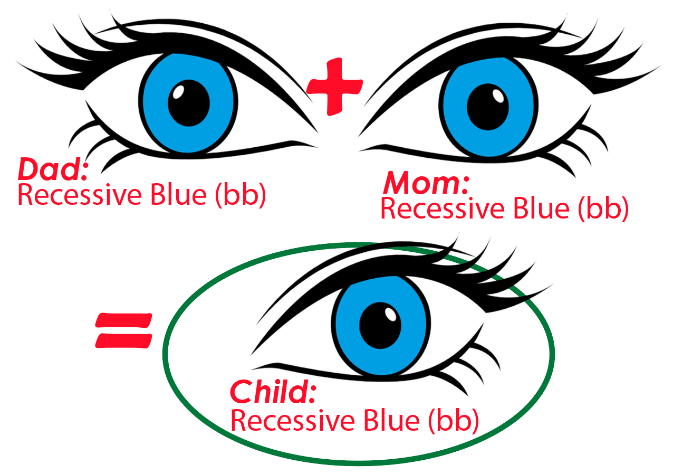
In humans, blue eyes are a recessive trait. What genotype would a blue eyed child have?

a)

BB

b)

Bb

c)

bb

d)

None of the above, brown eyes are dominant.

21.

In pea plants, tall (T) plant alleles are dominant to short (t) plant alleles. If two tall plants (each with the genotype Tt) are crossed, what is the probability that the cross would result in a short pea plant?

a)

25%

b)

50%

c)

75%

d)

100%

22.

Genes determine the characteristics, or __?__, that an individual can have.

a)

chromosomes

b)

cells

c)

genetics

d)

traits

23.

Sections of DNA on a chromosome are called:

a)

nuclei.

b)

RNA.

c)

genes.

d)

traits.

24.
What do we call the result of the genotype (for example, the color of the peas)?
a)
Visible traits
b)
Physiotrait
c)
Genotype 2
d)
Phenotype
25.
If green is dominant over purple, then what is the genotype for this individual?
a)
Purple
b)
Green
c)
GG
d)
gg
26.
If a pea plant were homozygous recessive for height, how would its alleles be represented?
a)
TT
b)
Tt
c)
tt
d)
tT
27.
The letters on the TOP AND SIDE of a punnett square represent ______________.
a)
The combination of alleles in offspring.
b)
The possible alleles given by the parents following meiosis.
c)
The genotype and phenotype of offspring.
d)
The results of genetic mutations in offspring.
28.

What is the predicted percentage of homozygous recessive offspring in this cross?

a)

0%

b)

25%

c)

50%

d)

75%

29.

The same gene can come in different versions, the different versions of a gene are called

(a)  

Choose from the below words
Alleles
Chromosomes
Traits
30.
Which combination is Homozygous Dominant
a)
HH
b)
Hh
c)
hh
d)
hH
31.

If your genotype is Bb, then you can only pass a B or b to your child but you can't pass both.

a)

Law of Dominance

b)

Law of Segregation

c)

Law of Independent Assortment

32.

A recessive allele is only expressed when a dominant allele is not present

a)

Law of dominance

b)

Law of inheritance

33.

Different traits are inherited independently of each other

a)

Law of independent assortment

b)

Genetics law

34.
In pea plants, the trait for tall stems is dominant over the trait for short stems. If two heterozygous tall plants are crossed, what percentage of the offspring would be expected to have the same phenotype as the parents?
a)
100%
b)
75%
c)
50%
d)
25%
35.
In snapdragons, Tallness (T) is dominant to dwarfness (t). In a cross between two plants that are homozygous for the recessive allele, the percent of offspring expected to exhibit tallness is
a)
 25%
b)
 75%
c)
100%
d)
0%
36.
What is the percentage of a homozyogus dominant offspring?
a)
75%
b)
50%
c)
25%
d)
0%
37.

Based off this punnett square, what fraction of the offspring will have wrinkled, yellow seeds?

a)

9/16

b)

3/16

c)

1/16

d)

16/16

38.
What do we call the result of the genotype (for example, the color of the peas)?
a)
Visible traits
b)
Physiotrait
c)
Genotype 2
d)
Phenotype
39.
If green is dominant over purple, then what is the genotype for this individual?
a)
Purple
b)
Green
c)
GG
d)
gg
40.
What did Mendel call the two kinds of traits exhibited by the pea plants (one coming from the father, one from the mother)?
a)
Genesis
b)
Elective traits
c)
Alleles
d)
Quadrants
41.
Another word for homozygous is...
a)
purebred
b)
hybrid
c)
heterozygous
d)
dominant
42.
Tt is-
a)
homozygous dominant
b)
homozygous recessive
c)
heterozygous
d)
none of these
43.
If a pea plant were homozygous recessive for height, how would its alleles be represented?
a)
TT
b)
Tt
c)
tt
d)
tT
44.
A __________ is a segment of DNA that codes for a particular protein, which leads to a particular trait.
a)
Gene
b)
Allele
c)
Codon
d)
Nucleotide
45.
Which of the following best describes a GENOTYPE?
a)
The allele/genetic makeup of an organism.
b)
The physical expression of a trait.
46.
Which of the following is an example of a heterozygous genotype?
a)
RR
b)
Rr
c)
rr
47.
The letters on the TOP AND SIDE of a punnett square represent ______________.
a)
The combination of alleles in offspring.
b)
The possible alleles given by the parents following meiosis.
c)
The genotype and phenotype of offspring.
d)
The results of genetic mutations in offspring.
48.

What is the predicted percentage of homozygous recessive offspring in this cross?

a)

0%

b)

25%

c)

50%

d)

75%

49.
The dominant trait in this punnett square is
a)
yellow pea seeds
b)
green pea seeds
c)
there is no dominant seed
50.
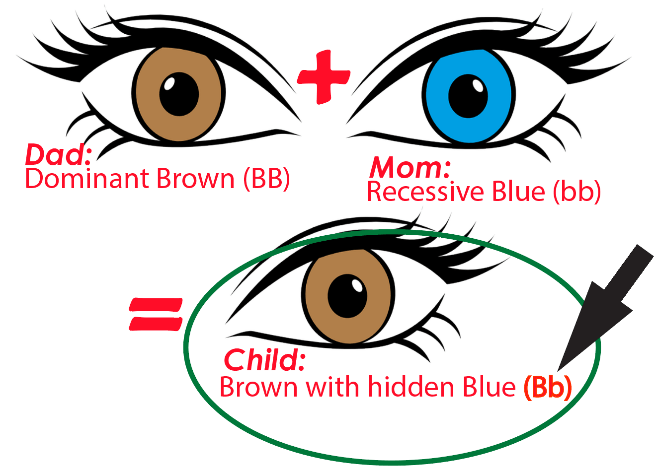
Two brown eyed parents (Bb) have a baby. What is the chance the baby is blue eyed?
a)
0 %
b)
25%
c)
50%
d)
75%
51.
A heterozygous long-tusked elephant is crossed with a homozygous recessive short-tusked elephant. What is the probability of the offspring having short tusks?
a)
0%
b)
25%
c)
50%
d)
75%
52.
What is the probability of a purple-horned unicorn if a heterozygous pink-horned unicorn is crossed with a heterozygous pink-horned unicorn?
a)
0%
b)
25%
c)
50%
d)
75%
53.
Leonardo bet his friend Olivet that two heterozygous green-eyed sea monsters could not have a recessive blue-eyed baby sea monster. Olivet said they can have a blue-eyed sea monster.
Who wins the bet?
a)
Leonardo
b)
Olivet
c)
Both
d)
Neither
54.

B = brown eyes

b = blue eyes

One brother has genotype BB and the other brother has genotype Bb.

Which statement is true about these two brothers?

a)

They have same phenotype and genotype

b)

They have different phenotypes and genotypes

c)

They have same phenotype, but different genotypes

d)

They have different phenotypes, but the same genotype

55.
Which of the following genotypes is heterozygous?
a)
Bb
b)
BB
c)
bb
d)
B
56.

Which of the following genotypes is homozygous recessive?

a)

Tt

b)

tt

c)

TT

d)

tT

57.

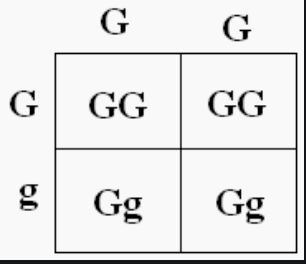
The punnett square is used to tell the color of a frogs skin. "G" means green skin and "g" means brown skin. What is the chance the baby frogs will have brown skin?

a)

0%

b)

25%

c)

50%

d)

100%

58.

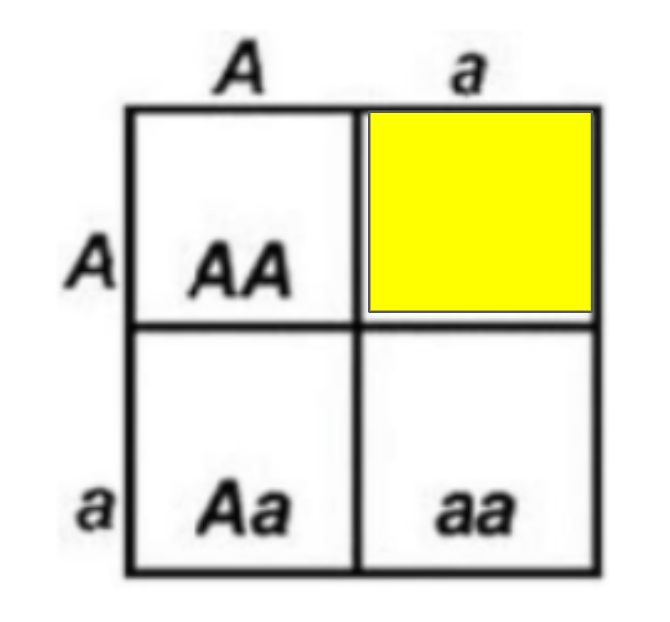
Fill in the Yellow Box

a)

AA

b)

Aa

c)

aa

59.
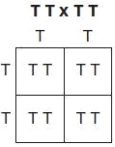
In a certain species of plant, the color purple (P) is dominant to the color white (p).
According to the Punnett Square, what is the probability of an offspring being purple?
a)
25%
b)
0%
c)
100%
d)
50%
60.
A student did an experiment to determine the genetic ratios between tall pea plants (Dd) and a dwarf pea plant (dd). What phenotypic ratio is expected from the cross between the plants?
a)
2 tall pea plants, 2 dwarf pea plants
b)
3 dwarf pea plants, 1 tall pea plant
c)
3 tall pea plants, 1 dwarf pea plant
d)
4 tall pea plants, 0 dwarf pea plants
61.

What is ratio of the offspring from the cross shown will be homozygous recessive for the trait of tallness? T = tall t = short

a)

0 in 4

b)

1 in 4

c)

2 in 4

d)

4 in 4

62.

Black fur(B) in guinea pigs is dominant over white fur(b). Find the probability of an offspring with the same phenotype as its parents in a cross between a homozygous black and a heterozygous black guinea pig.

a)

0%

b)

25%

c)

50%

d)

75%

e)

100%

63.
What are the possible genotypes for this cross?
(Click the picture to see it without the text)
a)
TT = 25% Tt= 50% tt=25%
b)
all tall
c)
TT= 75% tt = 25%
d)
Tt = 100%
64.

Which of the following is an example of a polygenic trait?

a)

Eye color

b)

Blood type

c)

Hemophilia

d)

Colorblindness

65.

What is the term used to describe a trait that is governed by two or more genes?

a)

Polygenic

b)

Incomplete dominance

c)

Codominance

d)

X-linked

66.

Which of the following is an example of incomplete dominance?

a)

Red and white flowers producing pink flowers

b)

Blue and yellow flowers producing green flowers

c)

Black and white fur producing gray fur

d)

Red and yellow flowers producing orange flowers

67.

What is the term used to describe a trait in which both alleles are expressed together (like stripes)?

a)

Codominance

b)

Polygenic

c)

Incomplete dominance

d)

X-linked

68.

Which of the following is an example of a X-linked genetic disorder?

a)

Colorblindness

b)

Hair color

c)

Eye color

d)

Height

69.

Which of the following is NOT a genotype for Type A blood?

a)

AA

b)

AO

c)

IAi

d)

IAIB

70.

Which of Queen Victoria's children had hemophilia?

a)

Leopold

b)

Edward

c)

Alice

d)

Irene

71.
This is an example of ___________?
a)
Incomplete dominance
b)
Co-Dominance
72.

Some flowers are controlled by codominance. Red flowers (RR), blue flowers (BB) and Speckled flowers (RB).


Cross a red flower with a speckled flower. What is the phenotypic ratio?

a)

2 red, 2 speckled

b)

2 red, 2 blue

c)

2 blue, 2 speckled

73.

In cattle red coats are represented as RR, and white coats are represented as WW.


What is the genotype for Roan color?

a)

RR

b)

RW

c)

WW

74.
this image is an example of
a)
codominance
b)
dominance
c)
incomplete dominance
75.
How many alleles does an individual have for each trait?
a)
1
b)
2
c)
3
d)
4
76.
If two parents are heterozygous for type A blood, what is the probability that their offspring would have type O blood?
a)
100 %
b)
75%
c)
50%
d)
25%
77.
If two parents have type AB blood, what is the probability that their child will have type O blood?
a)
0%
b)
25%
c)
50%
d)
100%
78.

If this pedigree shows an autosomal recessive disorder, what MUST the genotype of individual II-3 be?

a)

HH

b)

Hh

c)

hh

d)

None of the above

79.
How are individuals III-2 and II-4 related?
a)
Cousins
b)
Dad and Daughter
c)
Uncle and Niece
d)
Grandpa and Granddaughter
80.

If this pedigree shows a recessive disorder, what MUST the genotype of individual 4 be?

a)

HH

b)

Hh

c)

hh

81.
In a pedigree, what shape represents a male?
a)
circle
b)
square
c)
triangle
d)
diamond
82.
How many generations are shown in this pedigree?
a)
1
b)
2
c)
3
d)
4
83.
How many kids did the mother and father from the first generation have?
a)
2
b)
4
c)
5
d)
6
84.
There are no carriers for Huntington's Disease- you either have it or you don't. Is Huntington's disease caused by a dominant or recessive trait?
a)
Dominant
b)
Recessive
85.
Huntington's Disease is a dominant trait.
What is the correct genotype for individual I-2?
a)
HH
b)
Hh
c)
hh
d)
H_
86.
Does this pedigree show a dominant or recessive trait?
a)
Dominant
b)
Recessive
87.
What do half colored symbols represent?
a)
The individual is a carrier (heterozygous).
b)
The individual expresses the trait.
c)
The individual has both recessive alleles.
d)
The individual has both dominant alleles.
88.

How many alleles does a person carry for a trait?

a)

1

b)

2

c)

3

d)

4

89.

How many alleles does a child get from each parent for a trait?

a)

1

b)

2

c)

3

d)

4

90.

Dominant alleles are represented by a ---

a)

capital letter.

b)

lowercase letter.

91.

Aa, DD, Bb, yy are all examples of ---

a)

genotypes.

b)

phenotypes.

92.
What is this?
a)
Pedigree
b)
Karyotype
c)
Venn diagram
d)
Punnett Square
93.
What do we use pedigrees for?
a)
To look at families
b)
To make determinations about the offspring
c)
To track traits in families
d)
Nothing
94.
What does a filled in square represent?
a)
Not affected Female
b)
Not affected Male
c)
Affected Male
d)
Affected Female
95.
What does a horizontal line between a square and a circle mean?
a)
They are siblings
b)
They are cousins
c)
They are married ("together")
d)
They are the children
96.
What does a vertical line coming down from a square and circle that are connected by horizontal line indicate?
a)
They are cousins
b)
The children
c)
Aunts and Uncles
97.
aa always shows up as
a)
dominant
b)
recessive
98.

Is this trait (the shaded individuals) dominant or recessive?

a)

dominant

b)

recessive

99.

What is a mutation?

a)

A change in genetic material

b)

A change in the number of chromosomes

c)

A change in the shape of red blood cells

d)

A change in the number of DNA bases

100.

What is a frameshift mutation?

a)

A mutation that changes the reading frame of codons

b)

A mutation that alters the amino acid sequence

c)

A mutation that affects DNA replication

d)

A mutation that causes a problem with meiosis

101.

Which of the following is an example of a chromosomal mutation?

a)

Duplication

b)

Substitution

c)

Insertion

d)

Deletion

102.

What is nondisjunction?

a)

When chromosomes don't separate completely during meiosis

b)

When chromosomes break off and attach to another chromosome

c)

When extra copies of genes are generated

d)

When a base is added or removed in DNA

103.

What is sickle cell anemia?

a)

A disorder that affects the shape of red blood cells

b)

A disorder caused by excessive radiation

c)

A disorder that affects DNA replication

d)

A disorder that alters the amino acid sequence

104.
What process is shown here?
a)

Genetic Randomization

b)

Crossing Over

c)

Allele Switching

d)

Cross Pollination

105.

What is the result of crossing over?

a)
Prophase I
b)

recombination

c)

diploid gametes

d)

mutations

106.
The process of crossing over occurs in what phase of meiosis?
a)
anaphase 1
b)
prophase 1
c)
prophase 2
d)
telophase 1
107.

When are homologous chromosomes separated?

a)

Anaphase I

b)

Anaphase II

c)

Telophase I

d)

Telophase II

108.

Meiosis is needed in order to

a)

Create diploid gametes

b)

Create haploid gametes

c)

Create identical new cells

d)

Synthesise proteins