
 Worksheets
Bioenergetics and Kingdom Fungi
Total questions: 131
Worksheet time: 44mins

glucose and oxygen
light, water, and carbon dioxide
Glucose and carbon dioxide
Water and oxygen

Which of the following best explains the result of cellular respiration / aerobic respiration?
Respiration produces glucose, which stores chemical energy in its bonds.
Respiration produces glucose, which stores radiant energy in its bonds.
Respiration produces ATP, which stores chemical energy in its bonds.
Respiration produces ATP, which stores radiant energy in its bonds.
Which of the following best describes the location where aerobic respiration occurs in the cell?
Aerobic respiration begins in the cytoplasm, and ends in the mitochondria
Aerobic respiration begins in the mitochondria, and ends in the cytoplasm
Aerobic respiration occurs in the mitochondria
Aerobic respiration occurs in the cytoplasm
Which of the following is a similarity between aerobic and anaerobic respiration?
Both forms of respiration produce usable energy
Both forms of respiration require oxygen
Both forms of respiration require the same reactants
Both forms of respiration produce equivalent levels of ATP

Cellular respiration occurs in the __________ .
Photosynthesis is an exothermic reaction.
True
False
What are the products of photosynthesis?
glucose
oxygen
carbon dioxide
water
What is the pigment responsible for absorption of light in photosynthesis?
Chlorophyll
Chloroplasts
Carotenoids
Chromophore
Name the cell layer that is responsible for most photosynthesis in the leaf.
Palisade
Mesophyll
Guard cell
Epidermis
Glucose combines with ammonia to form amino acids.
True
False
Name the molecule used to build cell walls.
Cellulose
Starch
Glycogen
Protein
What part of the plant is involved in gas exchange?
Leaf
Stem
Roots
What class of molecule is found in seeds as an energy store?
Lipids
Protein
Carbohydrate
Mineral ions
Aerobic respiration transfers more energy from glucose than anaerobic respiration.
True
False
Anaerobic respiration releases energy
True
False
Yeast respire anaerobically to produce lactic acid.
True
False
Light intensity is directly proportional to distance.
True
False
Why is glucose not stored in the leaf?
it is soluble
it is sweet
it is reactive
Which type of muscle can tire?
Smooth muscle
Cardiac muscle
Skeletal muscle
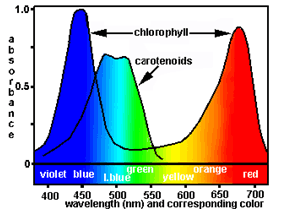
Red and blue light support the highest rates of photosynthesis because
Only wavelength that carotenoid cannot absorb
Chlorophylls absorb light of these wavelengths more then other wavelengths
Light of these wavelengths have the highest energy in the visible spectrum
Light of these wavelengths activate ATP synthase enzyme
Cyclic photophosphorylation differs from non-cyclic photophosphorylation in that ___________ is not made from the process
ATP
PGAL
NADH
NADPH

Flattend sacs of internal membranes associated with photosynthesis are called
Chloroplasts
The stroma
Cristae
Thylakoids
The role of water molecule in light dependent reaction is to
Hydrolyse NADP+ at the end of the ETC
Involve directly in the production of ATP
Replace the excited electron of reaction centre molecule in photosystem II
Involve directly in Calvin Cycle
Which of the following molecule below is fixed during light dependent reaction?
Oxygen
Carbon dioxide
ATP
NADPH
Which of the following plants fixes carbon dioxide at night?
Sugarcane
Cactus
Oryza sativa
Hibiscus rosa-sinensis
How many carbon dioxide molecule must be added to RuBP to make a single molecule of glucose?
3
4
5
6
In C4 plants, reactions that fix CO2 into four carbon compounds occur in
Guard cells
Epidermal cells
Mesophyll cells
Bundle-sheath cells
Intermediate metabolite which is formed during the light independent reaction in photosynthesis is
NADH
Oxygen
Ribulose bisphosphate
Water
In green plant photosynthesis, the electron donor for the light dependent reaction is
carbon dioxide
oxygen
RuBP
water
The main function of the light dependent reactions is
Produce glucose from CO2 and water
Produce ATP and NADPH
Produce NADPH only
Convert light energy to chemical energy
Calvin cycle takes place in
Stroma
Thylakoid membrane
Cytoplasm
Chlorophyll
Why C4 plants are able to carry out photosynthesis efficiently?
They do not involve in Calvin cycle
They use PEP carboxylase to fix carbon dioxide
They are adapted to cold climates
They conserve water efficiently
Photorespiration lowers the efficiency of photosynthesis by preventing the formation of
Carbon dioxide molecules
3-phosphoglycerate molecules
ATP molecules
Ribulose bisphosphate molecules
In the Hatch Slack pathway, the first carbon dioxide acceptor is
malate
oxaloacetate
phosphoenolpyruvate
ribulose bisphosphate
Rubisco binds with both carbon dioxide and oxygen in
C3 plants
C4 plants
CAM plants
C4 plants
CAM plants keep stomata closed in daytime, thus reducing the loss of water. They can do this because
fix CO2 into organic acids during the night
fix CO2 into sugars in the bundle-sheath cells
fix CO2 into pyruvate in the mesophyll cells
use the enzyme phosphofructokinase, which outcompetes rubisco for CO2
The reaction- center chlorophyll of photosystem is known as P700 because
there are 700 chlorophyll molecules in the center
the pigment best at absorbing light with a wavelength of 700 nm
there are 700 photosystem I components to each chloroplast
it absorbs 700 photons per microsecond
Oxygen produced by photosynthesis comes directly from
Light
Carbon dioxide
Glucose
Water
Which of the following does NOT occur during the Calvin Cycle
carbon fixation
oxidation of NADPH
release of oxygen
regeneration of the carbon dioxide acceptor


The NADP+ is
oxidized during the light reaction
reduced during the light reaction
oxidized during the Calvin cycle
reduced during the Calvin cycle
Plants obtain CO2 into the chloroplast by
active transport
diffusion
facilitated diffusion
endocytosis
Which plant would have the most oxygen produced in 1 hour?
plant given red light only
plant given blue light only
plant given white light
plant given green light only
CO2 is used in the Calvin cycle to make molecules of
NADPH
glycogen
G3P
Rubisco
The correct word equation for aerobic respiration is
carbon dioxide + water (+ energy) → glucose + oxygen
water + oxygen → carbon dioxide + glucose (+ energy)
glucose + oxygen → carbon dioxide + water (+ energy)
glucose + water → carbon dioxide + water (+ energy)
What are the uses of the energy produced in respiration? Tick all that apply.
To build larger molecules from smaller molecules.
To break down smaller molecules into larger molecules.
To maintain our body temperature.
To allow muscles to contract.
Which chemical symbol represents a product of aerobic respiration?
C6H1206
02
CO2
True or False? "Aerobic respiration occurs in plants and animals all of the time."
True
False
Respiration is an...
exothermic reaction
endothermic reaction
What is the overall equation for aerobic respiration?
C3H4O3 + 6O2 -> 6CO2 + 6H2O +
26-28ATP
C6H12O6 + 6O2 -> 6CO2 + 6H2O +
30-32ATP
C6H12O6 + 6O2 -> 6CO2 + 6H2O +
36-38ATP
C6H12O6 + 6H2O -> 6CO2 + 6O2 +
32-34ATP
What are the inputs for glycolysis (select all that apply)
Glucose
2 ADP
FAD
O2
NAD+
Which of the following are outputs of glycolysis? (select all that apply)
2ATP
NAD+
NADH
FADH2
CO2
What are the inputs for the Krebs cycle (select all that apply)
O2
Acetyl Co-A
2 ADP
FAD
NAD+
Which of the following are outputs of the Krebs cycle? (select all that apply)
CO2
O2
NADH
FADH2
2 ATP
What are the inputs of the Electron Transport Chain (select all that apply)
NAD+
26-28 ADP
FAD
NADH
O2
Which of the following are outputs of the Electron Transport Chain?
26-28 ATP
30-32 ATP
H2O
NAD+
FAD
Which of the following are inputs in fermentation in plants? (select all that apply)
Glucose
Pyruvate
NAD+
NADH
Acetyldehyde
Which of the following are outputs of fermentation in plants? (select all that apply)
Acetaldehyde
CO2
Lactic acid
Ethanol
NAD+
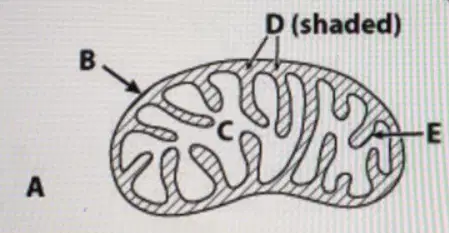
What structures/regions does each label show?
A: Matrix
B: Cell membrane
C: Cytosol
D: Inner membrane/ cristae
E: Intermembrane space
A: Matrix
B: Cell membrane
C: Cytosol
D: Intermembane space
E: Inner membrane/ cristae
A: Cytosol
B: Outer membrane
C: Matrix
D: Inner membrane/ cristae
E: Intermembrane space
A: Cytosol
B: Outer membrane
C: Matrix
D: Intermembrane space
E: Inner membrane/ cristae
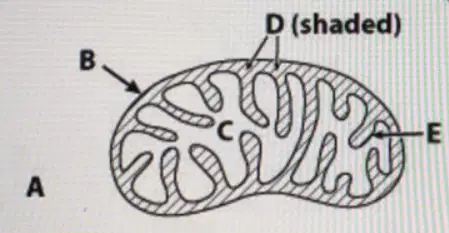
Match the biochemical pathways in cellular respiration to the labels in the image.
A: Glycolysis
B: Fermentation
C: Krebs Cycle
D: Electron Transport Chain
A: Glycolysis
B: Fermentation
D: Krebs Cycle
E: Electron Transport Chain
A: Glycolysis and Fermentation
C: Krebs Cycle
E: Electron Transport Chain
A: Glycolysis and Fermentation
C: Krebs Cycle
D: Electron Transport Chain
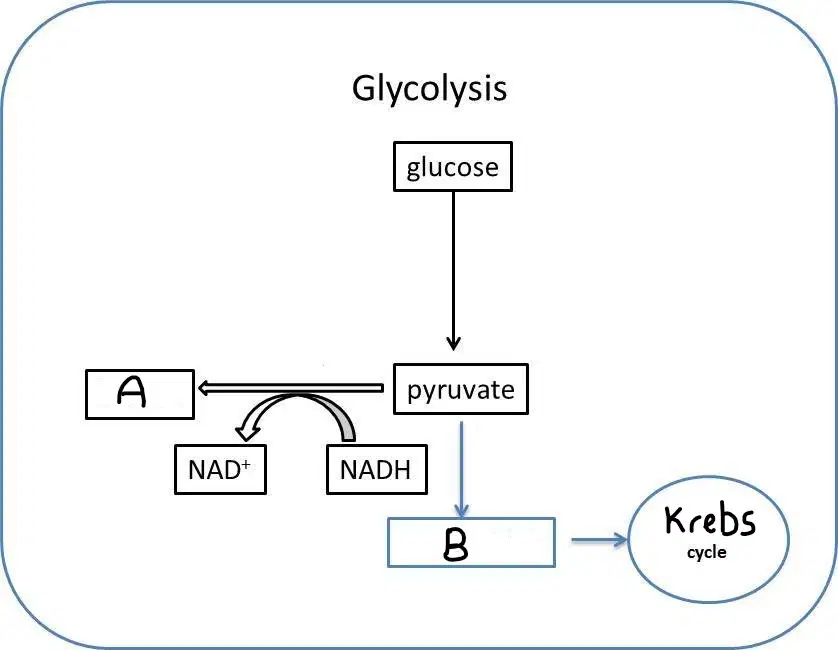
What products are depicted by A and B in animals?
A: Lactic acid
B: Acetyl Co-A
A: Lactic acid
B: CO2
A: Ethanol
B: Acetyl Co-A
A: Ethanol
B: CO2
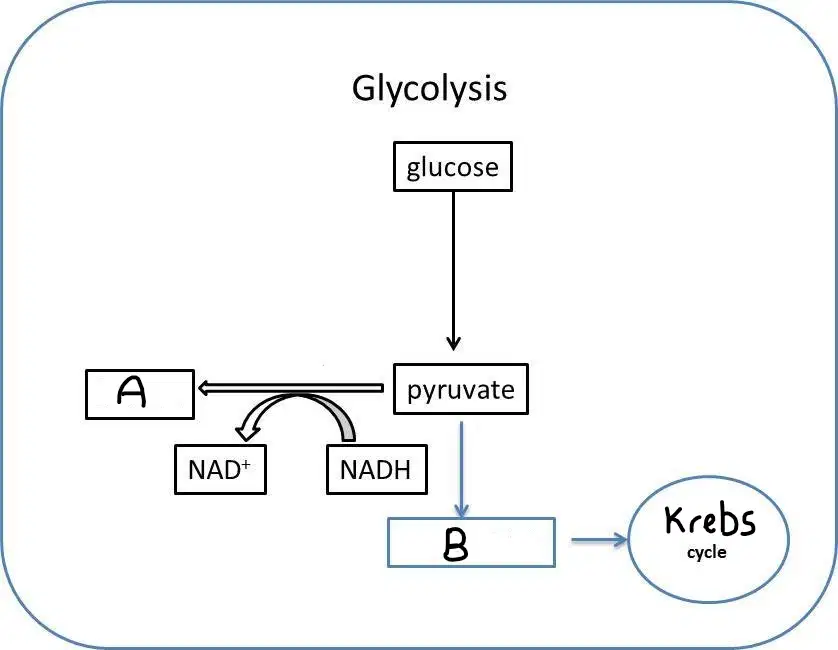
Which of the following would increase the rate that A is produced? (select all that apply)
NADH
Presence of oxygen
FAD
Pyruvate
Which of the following would increase the rate that B is produced? (select all that apply)
NAD+
Presence of oxygen
FAD
Pyruvate
Which of the following would reduce the rate of the Krebs cycle in the mitochondria?
Presence of ADP
Absence of pyruvate
Presence of O2
pH of between 6 and 8
Temperatures between 40C and 45C
What is the purpose of the following reaction in the Electron Transport Chain? (select all that apply)
2 H+ + 2 e- + 1/2 O2 -> H2O
To create a strong H+ concentration gradient between the matrix and the intermembrane space
To hydrate the body during exercise
To get rid of electrons involved in earlier reactions in the ETC
To ensure that oxygen doesn't build up in the mitochondria
Fungi obtain energy
Directly from the sun
From inorganic (unnatural) materials in their environment
By absorbing organic (natural) materials
From nuclear fusion
Fungi are important to an ecosystem as
Producers
Controllers
Decomposers
Regulators
Which is not true about fungi?
All are consumers
All are multicellular
Are eukaryotic
Can be useful to humans
Fungi are _____, which means they cannot make their own food.
Autotrophs
Heterotrophs
Carnivores
Omnivores
Fungi are like plants in many ways except fungi
Do not have cellulose
Do not grow upward out of the soil
Cannot make their own food
Do not have eukaryotic cells
The fungi which derive their food directly from dead organic matter are known as
Predators
Decomposers
Mutualists
Parasitic fungi
This group is used to represent pathological fungi
Penicillium
Truffles, mushrooms and morels
Smuts, rusts and moulds
All of the above


Fungi are important to an ecosystem as
Producers
Controllers
Decomposers
Regulators
Fungi obtain energy
Directly from the sun
From inorganic (unnatural) materials in their environment
By absorbing organic (natural) materials
From nuclear fusion
Fungi are _____, which means they cannot make their own food.
Autotrophs
Heterotrophs
Carnivores
Omnivores
These are fungi
Rhizopus sp.
Penicillium sp.
Agaricus sp.
Polytrichum sp.
Which of these is/are correctly matched?
Ascomycota - Penicillium sp.
Zygomycota - Agaricus sp.
Basidiomycota - Rhizopus sp.
Which of these is/are spore bearing structure for phyla of fungi?
zygosporangium
ascus
basidium
hyphae
Importance of fungi are
decomposers
symbionts
pathogen
commercial importance in food production
in pharmaceutical
Fungi is decomposers because
it is saprophytic
it is heterotrophic
it has hyphae
it is parasite

