
 Worksheets
SCI 230 - MS-PS1-2: Chemical Properties of Matter (Q - BANK)
Total questions: 55
Worksheet time: 1hrs 23mins
Chemical properties of matter describe the ways a substance reacts with another substance. In a chemistry lab, it is very important for scientists to know the chemical properties of substances. Mixing substances without knowing how they will react might cause harm to the lab equipment or the people in the lab. For example, most substances do not react with water. However, mixing pure potassium and water can create a violent explosion!
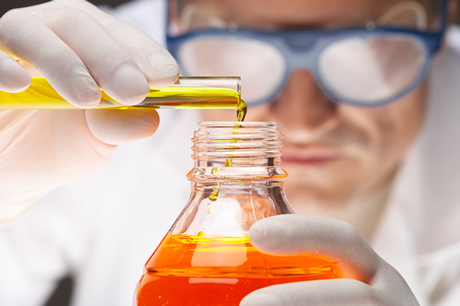
This scientist wears gloves and safety goggles to protect his skin and eyes from any dangerous reaction.
Chemical properties also help scientists identify unknown substances when they are combined under safe conditions. For example, if a scientist needed to identify a solid, she might add a drop of water to its surface. If the water bubbles, sizzles, or evaporates, the scientist can rule out every substance that is not supposed to react with water. However, no one should mix unknown substances without help from a teacher or scientist.
What do chemical properties of matter describe?
The ways a substance reacts with another substance
The physical appearance of a substance
The temperature at which a substance melts
The density of a substance
Why is it important for scientists to know the chemical properties of substances in a lab?
To prevent harm to lab equipment and people
To make the lab look more organized
To increase the temperature of reactions
To decrease the cost of experiments
What might happen if pure potassium is mixed with water?
A violent explosion
Nothing will happen
The water will freeze
The potassium will dissolve
Chemical properties describe the way a substance (a) .
Gene is a fifth grader. He found some unmarked bottles under his bathroom sink. He wants to find out what they are.
Should he mix them together?
yes, because mixing unknown substances is very safe
yes, because mixing unknown substances can help him figure out what the bottles contain
no, because mixing unknown substances could be very dangerous
no, because Gene does not know how to mix the substances safely

Flammability and corrosion are two kinds of chemical properties.

What are two kinds of chemical properties mentioned in the passage?
Flammability and corrosion
Flammability and melting
Corrosion and freezing
Melting and freezing
Which elements are mentioned as highly flammable in the passage?
Hydrogen and cesium
Oxygen and nitrogen
Iron and copper
Gold and silver
What happens to steel when it is exposed to water and oxygen according to the passage?
It rusts
It melts
It evaporates
It freezes
Which of the following aWhich of the following are chemical properties?
flammability
corrosion
volume
density

Both of these images are examples of chemical properties. Which example shows flammability?
the burning wood
the rusting bridge
Both of these images are examples of chemical properties. Which example shows corrosion?
the burning wood
the rusting bridge
Check for Understanding
Chemical properties of matter describe the ways a substance reacts with another substance.
Chemical properties can help scientists identify unknown substances.
Some reactions can be dangerous, so you should never mix chemicals without the help of a teacher or scientist.
Flammability is the ability for a material to burn.
Corrosion occurs when metals react with the environment and wear away.
What do chemical properties of matter describe?
The ways a substance reacts with another substance
The physical appearance of a substance
The density of a substance
The melting point of a substance
Why should you never mix chemicals without the help of a teacher or scientist?
Some reactions can be dangerous
It is illegal to mix chemicals
Chemicals are expensive
Mixing chemicals is always safe
What is flammability?
The ability for a material to burn
The ability for a material to dissolve in water
The ability for a material to conduct electricity
The ability for a material to reflect light
What happens during corrosion?
Metals react with the environment and wear away
Metals become shiny and new
Metals change color permanently
Metals become stronger

The periodic table helps us learn more about the way elements react, or how quickly they experience a chemical reaction. The periodic table is divided into sections that group elements with similar chemical properties. Select the buttons below to learn more about some of these groups.


What is the main purpose of the periodic table?
To group elements with similar chemical properties
To list elements in alphabetical order
To show the atomic mass of elements
To display the color of elements
Which group of elements is known for being very reactive?
Alkali metals
Noble gases
Transition metals
Lanthanide series
What characteristic is shared by noble gases?
They are very stable and do not react easily
They are highly reactive
They are metals
They are liquids at room temperature
Which of the following is a characteristic of transition metals?
They react very slowly
They are gases at room temperature
They are highly reactive
They are non-metals
Label the groups on this periodic table.

Match the following chemical elements with the correct property.
Transition Metals
Mildly Reactive
Alkali Metals
Very Reactive
Noble Gases
Very Stable
Alkaline Earth Metals
React Slowly
The noble gases rarely react with other elements, so they are (a) . The alkali metals are not stable and will quickly react with other elements; they are (b) . The alkaline earth metals will also react mildly with other elements. The transition metals will react with other (c) , but they will react more slowly than the alkali metals or alkaline earth (d) .
Helium is a noble gas. This means it is
(a) .

Select the orange element that reacts slowly.
(Click on the image to make it larger.)
K
Ba
Rh
S
Rn
A long time ago, blimps were filled with hydrogen to make them float in order to carry passengers. However, this was dangerous because hydrogen is very reactive and can explode easily. Now, blimps are filled with helium, a noble gas.
Why do you think it is safer to use helium instead of hydrogen?
Check for Understanding
The periodic table is broken up into groups that share chemical properties. Some of those groups include
alkali metals: very reactive substances
alkaline earth metals: mildly reactive substances
transition metals: substances that react slowly
noble gases: very stable substances that do not react easily
Which group in the periodic table is known for being very reactive?
Alkali metals
Alkaline earth metals
Transition metals
Noble gases
What characteristic is shared by noble gases according to the passage?
Very reactive
Mildly reactive
React slowly
Very stable
Which of the following groups reacts slowly as per the passage?
Alkali metals
Alkaline earth metals
Transition metals
Noble gases
Chemical properties help categorize elements, molecules, and compounds. Some chemical properties are influenced by ions.
Ions are atoms that have lost or gained an electron. Losing or gaining electrons causes ions to become charged. Losing an electron gives the particle a positive charge. Gaining an electron gives the particle a negative charge.

What happens to an atom when it loses an electron?
It becomes a positively charged ion.
It becomes a negatively charged ion.
It remains neutral.
It becomes a different element.
What is the charge of an ion that has gained an electron?
Negative
Positive
Neutral
Double positive
Why are the oxygen atoms in the passage considered ions?
They have different numbers of electrons.
They have 8 protons in their nuclei.
They are part of a compound.
They are in a gaseous state.

Two important kinds of compounds that are influenced by ions are acids and bases. Select the buttons to learn more.

What happens to a hydrogen atom when it loses its electron?
It becomes a positively charged ion.
It becomes a negatively charged ion.
It becomes neutral.
It becomes a molecule.
Which of the following is an example of an acid?
Hydrochloric acid
Ammonia
Baking soda
Sodium bicarbonate
What is the main characteristic of bases according to the passage?
They have too few hydrogen ions and attract additional ones.
They have extra hydrogen ions and donate them.
They are neutral compounds.
They have a balanced number of hydrogen ions.
Acidic substances have an excess of, or (a) , hydrogen ions. Basic substances have a lack of, or (b) , hydrogen ions.

Match each description with the correct substance.
Bleach
Base
Lemon
Acid
Blank
Blank

How can we tell whether a substance is an acid or a base? Litmus paper and the pH scale are two useful ways to measure this information.

What color does blue litmus paper turn when it comes into contact with an acid?
Red
Blue
Green
Yellow
What is the pH value of a neutral substance?
7
0
14
5
Which of the following substances is considered highly basic?
A substance with a pH of 14
A substance with a pH of 0
A substance with a pH of 7
A substance with a pH of 5
Correctly label this pH scale.

Select the most acidic substance on this pH scale.

Lemon Juice
pH = 2

Soda
pH = 3

Coffee
pH = 5

Baking Soda
pH = 9.5

Dr. Link is testing the pH of three unknown substances with litmus paper strips. He dips the bottom of each strip into the substances.
Which of the following are true based on the litmus results above?
Substance 1 is acidic.
Substance 2 is acidic.
Substance 3 is acidic.
Substance 1 is basic.
Substance 2 is basic.

Dr. Link decides to run one more litmus test on unknown substance 3. Based on his results shown above, substance three must be
(a) .
Check for Understanding
Ions are atoms with a charge that have lost or gained an electron.
Acids are compounds with extra hydrogen ions.
Bases are compounds with too few hydrogen ions.
The pH (potential of hydrogen) scale measures how acidic or basic a substance is.
The pH scale goes from 0 (highly acidic) to 14 (highly basic).
Water and other neutral compounds have a pH of 7.
What is an ion?
An atom with a charge that has lost or gained an electron
A compound with extra hydrogen ions
A compound with too few hydrogen ions
A neutral compound with a pH of 7
What does the pH scale measure?
The acidity or basicity of a substance
The number of ions in a compound
The temperature of a solution
The density of a liquid
What is the pH of a neutral compound like water?
7
0
14
7.5
Which of the following describes a base?
A compound with too few hydrogen ions
A compound with extra hydrogen ions
An atom with a charge
A neutral compound with a pH of 7
If acids have a positive charge and bases have a negative charge, do the opposites ever attract each other, like magnets? Yes! When certain elements combine due to their opposite charges, a solid is formed called a salt. A salt is a brittle substance made from the ions. Water is also formed in this reaction. When an acid and a base combine to create a salt and water, this process is called neutralization.
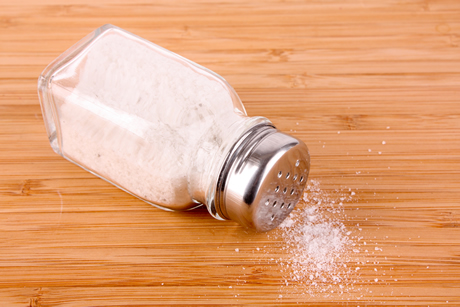
Ordinary table salt is made up of a sodium ion with a positive charge (Na+) and a chlorine ion with a negative charge (Cl—). The two ions bind together to form NaCl, which has a neutral charge. Water is also produced in this process. There are also many other types of salts that are produced in this way. When formed, some salts are solids, and some are dissolved in the water produced by the reaction.
What is formed when an acid and a base combine?
Salt and water
Salt only
Water only
Gas
What charge does a sodium ion have in table salt?
Positive
Negative
Neutral
No charge
What is the process called when an acid and a base create a salt and water?
Neutralization
Ionization
Sublimation
Condensation
What type of charge do bases have according to the passage?
Negative
Positive
Neutral
No charge
Which of the following combine to create a salt?
(Select 2)
a neutral acid
a negatively charged acid
a positively charged acid
a negatively charged base
a neutral base
Neutralization happens when an acid and a (a) combine and create a (b) and water. The salt is made up of (c) from the (d) and the base.

Which of these substances would create a salt when combined with lemon juice?
bleach
soda
pure water
Check for Understanding
Positive ions in acids and negative ions in bases help these substances bind together.
When acids and bases combine, they create a salt and liquid water. In some reactions, the salt is dissolved in the water.
Neutralization is the process of acids and bases combining to create salts and water.
What type of ions do acids contain?
Positive ions
Negative ions
Neutral ions
No ions
What is formed when acids and bases combine?
Salt and water
Salt and oil
Acid and base
Water and oil
What is the process called when acids and bases combine to create salts and water?
Neutralization
Ionization
Dissolution
Evaporation
What is a chemical property?
one way a substance reacts when it sits alone
a solid that forms when certain elements combine due to their opposite charges
something that can be observed with just the five senses
one way a substance reacts with another
What is flammability?
the color of a substance
when metals react
with the environment and wear away
the ability for a substance to form a salt
the ability for a substance to burn
When does corrosion happen?
when a substance is left alone
when metals react with the environment and wear away
when an acid and a base combine to create a salt and water
when metals react with one another to create a new substance
What are alkali metals?
mildly reactive substances
substances that react slowly
very reactive substances
very stable substances that do not react easily
What are alkaline earth metals?
substances that react slowly
mildly reactive substances
very reactive substances
very stable substances that do not react easily
What are transition metals?
very stable substances that do not react easily
substances that react slowly
substances that only react with themselves
substances that only react with metals
What are noble gases?
substances that create salts when they react
gases that sometimes react quickly and sometimes do not react quickly
very flammable gases
very stable substances that do not react easily
What is an acid?
a compound with too much salt in it
a compound with extra hydrogen ions
a compound without hydrogen ions
a compound with too few hydrogen ions
What is a base?
a compound with extra hydrogen ions
a compound with too few hydrogen ions
a compound with too much salt in it
a compound without hydrogen ions
When does neutralization happen?
when an acid is left alone
when an acid and a base combine to create a salt and water
when metals react with the environment and wear away
when a base is left alone
What is a salt?
a solid that forms when a substance burns
a solid that forms when acids sit alone
a solid that forms when certain elements combine due to their opposite charges
a solid that forms when bases sit alone
Chemical properties of matter describe the ways a substance reacts with another substance.
The periodic table is broken up into groups that share chemical properties.
Acids are compounds with extra hydrogen ions.
Bases are compounds with too few hydrogen ions.
When acids and bases combine, they create a salt and liquid water.
What do chemical properties of matter describe?
The ways a substance reacts with another substance
The physical appearance of a substance
The melting point of a substance
The density of a substance
What happens when acids and bases combine?
They create a salt and liquid water
They form a gas
They produce electricity
They become neutral
What are bases in terms of hydrogen ions?
Compounds with too few hydrogen ions
Compounds with extra hydrogen ions
Neutral compounds
Compounds with no hydrogen ions
Dr. Link has noticed that an unknown substance in his lab catches on fire. Which of the following is a chemical property of this substance?
mass
flammability
corrosion
acidity

(a) are very reactive substances. (b) are mildly reactive substances. (c) react slowly. (d) are very stable substances.
What happens if an acid and a base are combined?
(Select 3)
neutralization
the formation of ions
the formation of a salt
the formation of water
Chemical properties are based on __________.
how substances react
how substances feel
how substances look
how substances smell
Dr. Link is testing unknown substances and learns that one of the substances wears away metal.
Which of the following properties describes this unknown substance?
flammable
dense
corrosive
litmus
Which of the following are groups of the periodic table?
Check all that are true.
transition metals
noble gases
alkali metals
alkaline earth metals
Neon and helium are elements that are very stable and do not react easily with other elements. Which group do they belong to?
noble gases
alkali metals
alkaline earth metals
transition metals
_____________ are compounds with an excess of hydrogen ions. _____________ are compounds with a lack of hydrogen ions.
Ions; Bases
Acids; Bases
Bases; Acids
Acids; Ions
What allows acids and bases to bond with each other?
Check all that are true.
the acid's positive charge
the base's negative charge
the base's neutral charge
the acid's negative charge
A salt and water form __________.
Check all that are true.
when acids and bases combine
when they become flammable
during a litmus test
during neutralization

