
Font size
 Worksheets
Chemistry Test
Total questions: 67
Worksheet time: 46mins
What is the oxidation number of Nitrogen in N2O3?
0
+1
-3
+3
Ca+2 is an ion. What is it's oxidation number?
-2
0
+2
+4
Cations are _________________ and anions are _______________
metals, nonmetals
nonmetals, metals
Anions are
Negative ions
Neutral ions
Positive ions
Cations are
negative ions
neutral electrons
positive ions
When an atom loses a valence electron, it becomes a(n) _____________ ion.
positive
negative
neutral

An atom becomes _________ when it gains electrons.
Positive
Negative
Neutral
How many valence electrons does Oxygen (O) contain?
6
5
8
2
Which of the following ions have a NO charge?
Helium (He)
Neon (Ne)
Fluorine (F)
Sulfur (S)
Which of the following ions have a +3 charge?
Boron (B)
Aluminum (Al)
Calcium (Ca)
Lithium (Li)
Which of the following ions have a -3 charge?
Nitrogen (N)
Aluminum (Al)
Phosphorous (P)
Sulfur (S)
How many valence electrons are needed to fulfill the octet rule?
2
4
6
8
Which of the following ions have a -2 charge?
Oxygen (O)
Magnesium (Mg)
Fluorine (F)
Sulfur (S)
How many valence electrons do Group 2 atoms have?
1
2
3
4
Valence Electrons of Silicon
1
2
3
4
How many valence electrons do the boron group elements have?
1
2
3
4
How many valence electrons do the alkaline earth metals have?
1
2
3
4
How many valence electrons do the alkali metals have?
1
2
3
4
How many valence electrons do the noble gases have?
5
6
7
8
what is the oxidation number for the alkali metals?
+1
+2
+3
+4
what is the oxidation number for the alkaline earth metals?
+1
+2
+3
+4
what is the oxidation number for the carbon group elements?
+/- 5
+/- 3
+/- 4
+/- 8
Match the following
an expression that identifies the types and #s of elements present in a compound
chemical formula
a strong force of attraction that holds the atoms of a compound together
chemical bond
an atom or group of atoms that has a charge
ion
a molecule made of 2 atoms of the same element
diatomic molecule
molecule with an equal charge distribution
nonpolar molecule
Match the following
a molecule with a balanced charge that is not equally distributed
polar bond
type of bond in which valence electrons are shared between atoms
covalent bond
force of attraction between oppositely charged ions
ionic bond
group of atoms that are covalently bound and have a charge, CN-
polyatomic ion
Covalent bonds develop when electrons are shared between two nonmetals.
True
False

Name the following covalent molecule:
N2O5
dinitrogen pentoxide
binitride pentoxygen
mononitrogen trioxide
nitrogen monoxide
What is the molecular formula for tricarbon hexahydride?
CH
C3H6
CH2
CHOO
Which group of elements is least likely to react with other elements?
Noble Gases
Metalloids
Inner transition metals
alkali metals
Determine if compound is ionic or covalent
CaCl
ionic
covalent
Determine if compound is ionic or covalent
SO
ionic
covalent
What is the name of P2H4?
(a)

What is the name of the compound LiCl?
Lithium Chlorine
Lithiide Chloride
Lithiide Chlorine
Lithium Chloride
What is the name of the following compound: K2SO4
potassium sulfur
potassium sulfate
potassium(I) sulfate
potassium(II) sulfide
Which two elements would NOT form an ionic bond?
calcium and lithium
calcium and oxygen
lithium and oxygen
calcium and carbon
Na1+ F1-
When dissolved in water, the solution is a good conductor of electricity.
ionic compounds
molecular compounds
If an aluminum atom has 13 protons (+) and 10 electrons (-), what is it's charge?
Al3-
Al3+
Al2-
Al10+
Which of the following occurs in an ionic bond?
Oppositely charged ions attract.
Two atoms share more than two electrons.
Two atoms share two electrons.
Like-charged ions attract.
What is the formula of calcium phosphate, which is made up of the ions Ca2+ and PO43–?
Ca6PO4
Ca2(PO4)3
Ca3(PO4)2
Ca3PO4
What is the formula for Iron (III) Oxide
Fe6O
Fe3O2
Fe2O3
FeO
What charge does a metal form when it loses electrons?
They become positive
They become negative
They become neutral
They become variable
When naming a transition metal ion that can have more than one charge, what indicates the charge?
Suffix
Prefix
superscript after the name
Roman numeral following the name
What are chemical bonds?
The glue that holds atoms together
The separation of metal and nonmetal atoms
The connection between two metals
The connection between two nonmetals
In a double covalent bond, 2 atoms share
2 electrons (Single bond)
4 electrons (double bond)
6 electrons (Triple bond)
Coordinate covalent bond
Why do atoms share electrons in covalent bonds?
to acquire a full valence shell (octet)
to become ions and attract each other
to become more polar
to increase their atomic number
What is the goal of each element?
To have the outermost shell/energy level full
To form compounds with noble gases
To gain stability by losing electrons
To attract electrons to the nucleus
What is the formula for nonafluorine monochloride?
F9Cl
FCl9
F9Cl9
N9Cl
What is the correct molecular formula for tetraphosphorous decaoxide is:
PO
P4O4
P4O10
P10O4
The properties of a compound are _________ the properties of the elements that form it.
similar to
different from
identical to
derived from
Which of the following is the reason why atoms of sodium and chlorine attract each other in a salt crystal?
Sodium has a positive charge and chlorine has a negative charge
Sodium has a negative charge and chlorine has a positive charge
Both have a positive charge
Both have a negative charge
Which of the following is a similarity between ionic and covalent bonds?
Both include the gaining and losing of electrons
Both include the sharing of electrons
Both make the elements more stable
Both are typically found as solids at room temperature
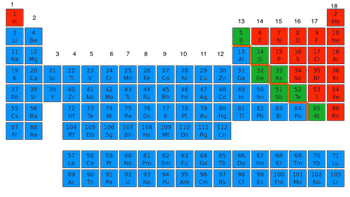
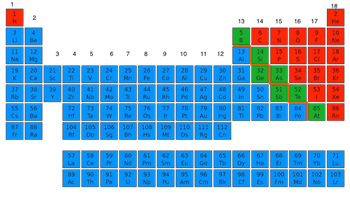
Match the polyatomic molecules

sulfate

sulfite

Cyanide

phosphate

acetate
The Average Atomic Mass is
Protons + Neutrons
Average of isotopes
Always accurate
Masses
ionic bonds
metal and nonmetals
metals and poly atomics
transitional and polyatomic
Metal and Noble gases

