
 Worksheets
Nursing Advanced Skills Review
Total questions: 50
Worksheet time: 1hrs 1mins
Once obtained from the lab, how long does the nurse have to start the blood infusion?
1 hour
30 minutes
5 minutes
4 hours
Once the Packed Red Blood Cells (PRBC) start to infuse, how long do you have to infuse the entire bag?
30 minutes
12 hours
4 hours
1 hour
The nurse knows that this blood type is the universal recipient:
AB+
O+
O-
AB-
The student nurse knows that the listed critical step in NG tube insertion is:
Verification of placement by x-ray
Applying lubrication to tip of NG tube
Positioning client in supine position
Measure from tip of nose, to clavicle, to sternum
The first step, before performing any procedure, is to:
Introduce yourself as the student nurse.
Provide privacy.
Check the order.
Explain the procedure.
Which skill requires the use of a mask by the nurse?
Inserting a peripheral IV
Inserting a NG tube
Hanging blood
Completing a central line dressing change
Which EKG tracings would require defibrillation? Select all that apply.
Ventricular tachycardia, with a pulse
Ventricular tachycardia, without a pulse
Supraventricular Tachycardia
Ventricular Fibrillation
The nurse knows that this type of fluid will only be hung with blood.
(a)
A nurse is caring for a client with a nasogastric tube (NG) tube placed for gastric decompression. The client reports persistent coughing and discomfort after the tube placement. What is the nurse’s priority action?
Credit: Amanda Binford
Administer an antitussive medication as prescribed.
Assess the placement of the NG tube.
Irrigate the NG tube with sterile water to clear any blockages.
Reposition the client to a high Fowler’s position.
A nurse is taking care of a patient with nasogastric tube who is receiving enteral nutrition daily. Which of the following nursing interventions is most important to ensure the patient’s safety during feeding?
Credit: Ia Hang
Flush the NGT with warm water before and after each feeding.
Monitor patient’s blood sugar levels every two hours during feeding.
Have patient in supine position during feeding.
Check the NGT placement before every feeding.
When placing a nasogastric tube, which steps are important to ensure prior to placement?
Select all that apply.
Credit: Taylor Henthorne
Assess the NG tube
Measure the distance from the tip of the nose to the xiphoid process of the sternum
Place the patient in a supine position
Checking the order
Discuss ways to communicate such as thumbs up or thumbs down
A new nurse on the unit is explaining the nursing interventions for chest tube management. Which statement by the nurse indicates the need for further teaching?
Credit: Merrysa Janzen
Respiratory exam must be completed every 2-4 hours.
Be sure the position of the system is upright and above the client's chest.
Assess chest tube drainage system every 4 hours.
Make sure water seal chamber is filled to two centimeters.
When managing a closed chest tube drainage system, the nurse must follow a specific order when completing the care on the client and equipment. In what order should these tasks be completed? Please write the number to your answers (1-6, with 1 being the first task to be completed).
Credit: Tiffanie Zillmer
Ensure the chest tube drainage system is below the level of the insertion site and upright to prevent back flow of fluid.
Verify the provider’s order regarding chest tube care and management. (Indication and location)
Document the procedure, assessments, and interventions completed.
Confirm the identity of the patient with 2 identifiers.
Assess the dressing over the insertion site, as well as the drainage system to ensure it is working properly.
6. Ensure the prescribed suction is set at the correct level.
What are the possible reasons we would not want to place an NG tube? Select all that apply
Credit: Cortney Johnston
a client who recently had a nasal/sinus surgery
a client who broke their arm in an accident
client taking warfarin
client who has frequent nosebleeds with no known cause
a client who is scared about the procedure
Which of the following are indications for placing an NG tube? Select all that apply.
Credit: Alyssa Heimen
To provide nutrition for patients in cases that oral nutrition is unable to be done
To decompress the stomach in cases of bowel obstruction
To give medications when oral medications are unable to be given
To monitor blood glucose levels in diabetic patients
A client has just had an NG tube placed and taped at 55cm at the nares. Which of the following is a sign that the nasogastric tube has been placed incorrectly?
Credit: Abby Wallace
Bleeding from the nose
Uncontrollable coughing and cyanosis
Brown output from the tube
Aspirate pH of 5.5
The nurse is performing a sterile dressing change for a central venous catheter (CVC). Which of the following actions should the nurse take to maintain asepsis and prevent complications?
Select all that apply.
Credit: Amanda Binford
Perform hand hygiene and don clean gloves before removing the old dressing.
Assess the catheter insertion site for redness, swelling, or drainage.
Clean the insertion site with chlorhexidine for at least 20 seconds.
Allow the chlorhexidine to dry completely before applying the new dressing.
Don sterile gloves before applying the new dressing.
In an emergency situation where the patient’s Rh status is unknown, which type of blood is safest to transfuse?
Credit: Ia Hang
AB positive
A negative
O negative
B positive
A central venous access device (CVAD) can provide long-term access to the venous or arterial system. The nurse knows that this is the most common complication related to CVAD's:
Credit: Taylor Henthorne
Dislodgement of the catheter
Arm pain
Central line associated bloodstream infections
(CLABSI)
GI upset such as nausea, vomiting, or diarrhea
The nurse caring for a client receiving a blood transfusion, hung by gravity, notes that the blood is transfusing too slowly. Which action by the nurse would be appropriate? Select All That Apply
Credit: Merrysa Janzen
Stop the transfusion and obtain new IV access.
Add normal saline.
Check to make sure the blood isn’t over 4 hours old.
Check the IV site for patency.
Call the provider to report adverse reaction.
An 85 year old male patient with a history of heart failure is receiving a blood transfusion for iron deficiency anemia. Near the end of the transfusion he becomes hypertensive and complains of dyspnea and a cough. You note distention in his neck veins and his SPO2 is decreasing. Which transfusion reaction do you suspect?
Credit: Abby Wallace
Acute hemolytic transfusion reaction
Anaphylactic transfusion reaction
Transfusion associated circulatory overload
Transfusion related acute lung injury
A 78 year old patient has been admitted to the medical-surgical floor with a non-tunneled percutaneous central venous catheter that has been placed for short-term medication administration. The nurse enters the client’s room to help the lab in obtaining a blood sample. What task would the nurse complete first?
Credit: Tiffanie Zillmer
Document the procedure, catheter location, patient response, and appearance of the site.
Scrub the connector with an alcohol wipe, use a 3ml syringe to flush the most distal catheter, and then draw back the blood.
Attach a needle adapter, obtain the blood sample, label the tubes, and give them directly to the lab tech.
Identify the patient with 2 identifiers and explain the procedure.
This artery is the only artery in the body to carry deoxygenated blood:
(a)

The following strip is a 6 second strip. What EKG rhythm is displayed here?
Atrial Fibrillation
Asystole
Normal Sinus Rhythm
Sinus Tachycardia

The nurse knows that with this EKG rhythm, an important intervention will be:
Blood coagulation modifiers
CPR
Defibrillation
Administering epinephrine
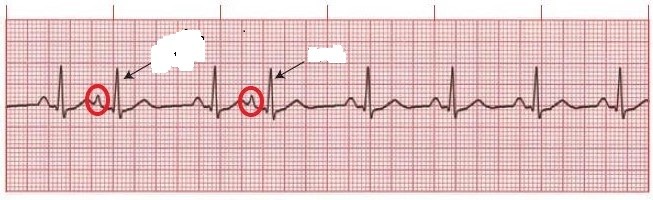
Identify what is occurring at the red circled areas.
Asystole
Normal Sinus Rhythm
Premature Ventricular Contraction
Premature Atrial Contraction

The nurse notes this rhythm on the monitor. What action should the nurse take first?
Perform CPR
Prepare for Synchronized Cardioversion
Prepare for Defibrillation
Check for a pulse

Name this rhythm.
Normal Sinus Rhythm
1st Degree Block
3rd Degree Block
Atrial Flutter

Identify this rhythm.
(a)

Identify this rhythm.
(a)

Identify this rhythm.
(a)
The nurse knows that these are possible signs and symptoms of a blood transfusion reaction:
Select all that apply.
Elevated temperature (usually 2 degrees F or 1 degree C)
Hypertension
Tachycardia
Shortness of breath
Low back pain
A nurse is educating a client about nutritional support options. Which statement best describes the difference between enteral and parenteral nutrition?
Enteral nutrition is delivered directly into the bloodstream, while parenteral nutrition is given through the gastrointestinal tract.
Enteral nutrition requires a functioning gastrointestinal tract, while parenteral nutrition bypasses the digestive system and is administered intravenously.
Enteral nutrition provides only carbohydrates, while parenteral nutrition supplies all essential nutrients.
Enteral nutrition is used only for short-term feeding, while parenteral nutrition is always long-term.
What is the critical step for administering an IV push medication?
Check orders. Wash hands.
Cleanse port with alcohol for 15 seconds. Flush with normal saline.
Perform all med checks. Verify compatibility. Identify patient.
Administer normal saline flush at the same rate the medication was administered.
What are the 3 critical steps in IV insertion?
Engage the needle safety device
Identify client and perform med check.
Prime extension piece using 0.9% sodium chloride flush. Leave the syringe attached.
Insert needle bevel up at a 15 to 30-degree angle.
Secure the catheter and apply dressing.
Continuous bubbling in which chamber of the chest tube drainage system is indicative of an air leak?
Vacuum chamber
Tension chamber
Water-seal chamber
Suction control chamber
During transport, the chest tube gets disconnected from the chest tube drainage system and cannot be reconnected. The nurse should immediately do what with the tubing?
Leave in place and contact the HCP
Wrap in sterile gauze and secure with tape
Immediately immerse in (2cm) sterile water
Lift exposed in above the level of the patient's heart
The nurse knows that lack of bubbling is abnormal in which chamber?
Air leak chamber
Water-seal chamber
Collection chamber
Suction chamber in a wet suction system (Ocean)
A nurse is monitoring a client with a chest tube connected to a water-seal drainage system. The nurse notes tidaling in the water-seal chamber. What is the most appropriate interpretation of this finding?
Tidaling indicates an air leak in the chest tube system.
Tidaling is a normal finding and occurs with the patient’s breathing.
Tidaling suggests the tube is occluded and requires immediate intervention.
Tidaling means the lung has fully re-expanded and the chest tube should be removed.
Chest tubes reestablish what type of pressure?
Water seal pressure
Positive pressure
Equal pressure
Negative pressure
The nurse knows that it is most important to do what prior to the removal of a chest tube?
Explain the care of the insertion site after the removal
Make sure blood products are available
Administer pain Rx 30-60 minutes before procedure
Ensure the patient has normal respirations
The definition of a central line is a line/catheter placed within the venous circulation that ends in the
(a)
A client with a peripherally inserted central catheter (PICC) line complains of pain, swelling, and redness at the insertion site. What is the nurse’s priority action?
Apply a warm compress to relieve discomfort
Continue using the line but monitor for worsening symptoms
Stop the infusion and assess for signs of thrombophlebitis or infection
Flush the catheter with normal saline to clear any occlusion
A nurse is caring for a client with a central line who suddenly develops shortness of breath, chest pain, and hypotension. The nurse suspects an air embolism. What is the priority nursing action?
Place the patient in Trendelenburg position on the left side and administer oxygen
Flush the central line with normal saline to remove the air
Remove the central line immediately to prevent further complications
Notify the provider and continue to monitor vital signs
A nurse is teaching a client with a peripherally inserted central catheter (PICC) line about home care. Which statement by the patient indicates the need for further teaching?
"I will wash my hands before touching my PICC line."
"I will cover my PICC line with plastic when I shower."
"I will flush my PICC line with normal saline once a day to keep it from clotting."
"If I notice swelling or drainage at the site, I will just monitor it for a few days before calling my provider."
The nurse administered ceftriaxone 1 gram via IV push, which was 4 mL (250 mg/mL) over 5 minutes. If the nurse was to flush 10 mL of normal saline after giving the antibiotic, all at the same rate, how long would it take to flush the 10 mL?
10 minutes
5 minutes
15 minutes
12.5 minutes
A nurse is inserting an IV catheter and observes blood return in the flashback chamber. What is the next step the nurse should take?
Remove the needle and apply pressure to the site
Lower the angle of the catheter and advance 1/4 inch more
Flush the catheter with normal saline to ensure patency
Secure the catheter and begin IV fluid administration
A nurse is caring for a client with a newly inserted peripheral IV catheter. Which of the following findings requires immediate intervention?
Slight redness at the IV site
Patient reports mild discomfort when moving the arm
Cool, swollen skin around the IV insertion site
A few small air bubbles in the IV tubing
A nurse is administering an IV push medication through a saline lock (a capped IV catheter). What is the correct sequence of steps for safe medication administration?
Flush with saline, administer medication, then flush again with saline
Administer the medication, then flush with saline
Flush with saline, administer the medication, then flush with heparin
Flush with heparin, administer medication, then flush with normal saline
A nurse is caring for a client receiving an IV push opioid for pain management. What is the most important assessment to perform before and after administration?
Blood pressure and heart rate
Respiratory rate and level of consciousness
Urine output and bowel sounds
IV site condition and patient’s ability to move the extremity

