
 Worksheets
Chemical Reaction Pre
Total questions: 55
Worksheet time: 55mins
What is a chemical reaction?
A process in which new substances are formed
A process in which no new substances are formed
A process in which atoms disappear
A process in which atoms change shape
What is the Law of Conservation of Matter?
Matter can be created or destroyed
The number of atoms before and after a chemical reaction changes
Atoms can only rearrange themselves in a chemical reaction
Matter can change its properties in a chemical reaction
What is a physical change?
A change in the properties of matter with a chemical change
A change in the properties of matter without any physical change
A change in state of matter where new substances are formed
A change in state of matter where no new substance is formed
What do chemical engineers and material scientists study chemical reactions for?
To create new elements
To advance space exploration, make medicines, and form new products
To study the properties of matter
To understand the behavior of atoms
How is a physical change different from a chemical change?
In a physical change, new substances are formed. In a chemical change, new substances are formed
In a physical change, no new substances are formed. In a chemical change, new substances are formed
In a physical change, new substances are formed. In a chemical change, no new substances are formed
In a physical change, no change occurs. In a chemical change, new substances are formed
How do you know a chemical reaction has happened?
If a new substance is not formed, it has different properties
If a new substance is not formed, it has the same properties
If a new substance is formed, it has the same properties
If a new substance is formed, it has different properties
Give an example of a chemical change.
Freezing water to form ice
Boiling water to form steam
Melting ice to form water
Steel wool burning, which causes the iron to combine with oxygen and form iron oxide
What is the purpose of balancing a chemical equation?
To make the equation look more aesthetically pleasing
To change the chemical properties of the substances involved
To make the equation easier to memorize
To ensure that the law of conservation of mass is obeyed.
In a combustion reaction, what are the reactants and products?
The reactants in a combustion reaction are a fuel and a catalyst, while the products are typically nitrogen and oxygen.
The reactants in a combustion reaction are water and carbon dioxide, while the products are typically a fuel and an oxidant.
The reactants in a combustion reaction are a fuel and a reducing agent, while the products are typically sulfur dioxide and nitrogen oxide.
The reactants in a combustion reaction are a fuel and an oxidant, while the products are typically carbon dioxide and water, along with heat and light energy.
What is the general form of a synthesis reaction?
A + B → AB
AB → A + B
A + B → A + B
A + B → BA
Give an example of a synthesis reaction.
Combination of hydrogen gas and oxygen gas to form water
Combination of carbon dioxide and water to form glucose
Combination of hydrogen gas and nitrogen gas to form water
Combination of sodium chloride and water to form salt
What is the general form of a single displacement reaction?
A + BC → BA + C
A + BC → AC + B
A + BC → AC + C
A + BC → AB + C
Provide an example of a single displacement reaction.
Iron metal reacting with sulfuric acid to form iron sulfate and hydrogen gas
Zinc metal reacting with hydrochloric acid to form zinc chloride and hydrogen gas
Copper metal reacting with nitric acid to form copper nitrate and oxygen gas
Aluminum metal reacting with hydrochloric acid to form aluminum chloride and hydrogen gas
What is the Correct general form of a double displacement reaction?
AB + CD → AD + BC
AB + CD → AD + CB
AB + CD → BD + AC
AB + CD → AC + BD
Give an example of a double displacement reaction.
NaCl + AgNO3 -> NaNO3 + AgCl
NaCl + H2O -> NaOH + HCl
HCl + NaOH -> NaCl + H2O
AgNO3 + NaCl -> AgCl + NaNO3
All of these are examples of DR reactions
What are the signs of a chemical reaction?
Formation of a gas, change in texture, change in taste
Formation of a solid, change in odor, change in shape
Change in temperature, change in pressure, change in volume
Formation of a precipitate, release of gas, change in color, production of heat or light, formation of a new substance
What is the difference between a reactant and a product in a chemical equation?
A reactant is formed as a result of a chemical change, while a product undergoes a chemical change.
A reactant is a solid substance, while a product is a liquid or gas in a chemical equation.
A reactant undergoes a chemical change, while a product is formed as a result of the chemical change.
A reactant and a product are the same thing in a chemical equation.
How do you balance a chemical equation?
By adding or removing atoms from the reactants and products
By changing the chemical formula of the reactants and products
By adjusting the coefficients of the reactants and products to ensure that the number of atoms of each element is the same on both sides of the equation.
By randomly adding coefficients to the reactants and products
What is the purpose of balancing coefficients in a chemical equation?
To make the equation look more balanced.
To increase the reaction rate.
To make the equation easier to understand.
To ensure the law of conservation of mass is obeyed.
What is the main characteristic of a combustion reaction?
Rapid combination of a fuel with oxygen
Slow combination of a fuel with oxygen
Combination of a fuel with water
No combination of a fuel with oxygen
What happens during a synthesis reaction?
During a synthesis reaction, the total mass of the reactants decreases.
A synthesis reaction involves the breakdown of a compound into two or more simpler substances.
Two or more substances combine to form a new compound.
A synthesis reaction occurs when two or more substances react to produce a gas.
What is the difference between a single displacement and a double displacement reaction?
In a single displacement reaction, positive ions of two compounds exchange places, while in a double displacement reaction, one element is replaced in a compound.
In a single displacement reaction, positive ions of two compounds exchange places, while in a double displacement reaction, negative ions of two compounds exchange places.
In a single displacement reaction, negative ions of two compounds exchange places, while in a double displacement reaction, positive ions of two compounds exchange places.
In a single displacement reaction, one element is replaced in a compound, while in a double displacement reaction, positive ions of two compounds exchange places.

The compound with a pink square is known as a ___.
Reactant
Product

In order for this equation to be balanced, what number must be written as a coefficient for the substance in the blue box?
1
2
4
0

Which type of reaction is shown?
Combustion
single replacement
double replacement
decomposition

What must be done to this equation for it to be balanced?
change the subscript to 3 in the reactants
change the subscript to 3 in the products
no change; it's balanced as is
change the coefficients to 2

What type of reaction is shown?
Decomposition
Single replacement
Combustion
Combination (or Synthesis)

To balance this equation, what coefficient belongs in the red box?
3
2
1
0

What type of reaction is this?
Combination (or Synthesis)
Single replacement
Double replacement
Decomposition

To balance this equation, what coefficient must be written in the yellow box?
0
1
2
3

Which type of reaction is shown?
Combustion
Combination (or Synthesis)
Decomposition
Double replacement

To balance this equation, what coefficient must be written in the blue box?
1
2
3
4
Which type of chemical reaction involves the production of a single complex compound from several simpler reactants?
Decomposition
Combustion
Combination (or Synthesis)
Single replacement
Which type of chemical reaction involves the production of a single complex compound from several simpler reactants?
Decomposition
Combustion
Combination (or Synthesis)
Single replacement
What are the products of a combustion reaction?
a single complex compound
several simpler elements
carbon dioxide and water
carbon dioxide and hydrogen
Which element is always present in the reactants of a combustion reaction?
oxygen
hydrogen
carbon
water

Which type of reaction is shown?
Single replacement
Double replacement
Combustion
Decomposition

To balance this equation, what coefficient must be written in the red box?
1
2
4
5
Which type of reaction involves a carbon compound reacting with oxygen to create a lot of heat and energy, water and carbon dioxide?
Synthesis
Combustion
Acid-Base Reaction
Decomposition
Which type of reaction involves 2 pairs of ionic compounds trading their elements?
Single Replacement
Double Replacement
Synthesis
Decomposition
Which type of reaction involves an element replacing a different element in another compound
Double Replacement
Synthesis
Decomposition
Single replacement
Which type of reaction involves the breakdown of a reactant into simpler products?
Synthesis
Combustion
Decomposition
Acid-Base
What is the generic formula for a decomposition reaction
AB --> A + B
A + BC --> B + AC
A + B --> AB
AB + CD --> CB + AD
Which of the following examples shows that a chemical reaction has occurred?
A rock breaks into smaller pieces when it is struck with a hammer.
Rust forms on a hammer that has been left outside to long.
A cup of water turns pink when a few drops of red food coloring are added.
A solid is formed when heat is removed from a sample of water.
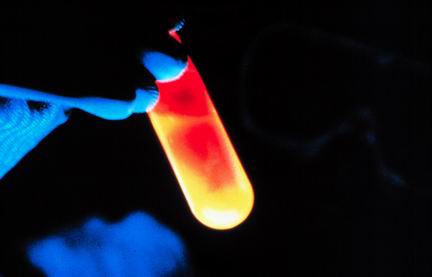

The student inferred that a chemical reaction occurred. What evidence supports this inference?
The zinc metal remained silver-colored and shiny


How many atoms in all are in a molecule of serotonin?
C10H12N2O

Look at the following chemical equations. What evidence can you find that a chemical reaction actually occurred?
There was a change in temperature
A Precipitate was formed
There was a change in color
Light was produced

