
Font size
 Worksheets
POST Dissection Quiz (Cow Eye and Sheep Brain)
Total questions: 122
Worksheet time: 2hrs 18mins
Which part of the sheep brain is primarily responsible for coordinating voluntary movements and maintaining balance?
Medulla Oblongata
Cerebellum
Thalamus
Hypothalamus
Compare the size of the olfactory bulb in sheep brains to that in human brains and explain the significance of this difference.
The olfactory bulb is larger in sheep, indicating a stronger reliance on the sense of smell.
The olfactory bulb is smaller in sheep, indicating a lesser reliance on the sense of smell.
The olfactory bulb is the same size in both, indicating similar reliance on the sense of smell.
The olfactory bulb is absent in sheep, indicating no reliance on the sense of smell.
Identify the structure in the sheep brain that connects the two cerebral hemispheres.
Corpus Callosum
Pons
Amygdala
Hippocampus
Explain how the structure of the sheep brain's cerebrum differs from that of the human brain and the implications of these differences on cognitive abilities.
The sheep cerebrum is more convoluted, indicating higher cognitive abilities.
The sheep cerebrum is less convoluted, indicating lower cognitive abilities.
The sheep cerebrum is the same as the human cerebrum, indicating similar cognitive abilities.
The sheep cerebrum is larger, indicating higher cognitive abilities.
Which brain region is primarily involved in regulating autonomic functions such as heart rate and breathing in the sheep brain?
Cerebellum
Medulla Oblongata
Thalamus
Hippocampus
Analyze the role of the thalamus in the sheep brain and how it integrates sensory information.
The thalamus processes and relays sensory information to the cerebral cortex.
The thalamus generates motor commands for voluntary movements.
The thalamus regulates emotional responses and memory.
The thalamus controls autonomic functions like heart rate.
Which pathway in the sheep brain is responsible for transmitting visual information from the retina to the brain?
Optic Nerve
Auditory Nerve
Olfactory Tract
Spinal Cord
Evaluate the significance of the hippocampus in the sheep brain in terms of memory formation and spatial navigation.
The hippocampus is crucial for processing auditory information.
The hippocampus is involved in regulating autonomic functions.
The hippocampus plays a key role in memory formation and spatial navigation.
The hippocampus is responsible for voluntary motor control.
Identify the primary function of the hypothalamus in the sheep brain.
Regulating emotional responses
Controlling voluntary movements
Maintaining homeostasis and regulating endocrine functions
Processing visual information
Discuss the comparative size and function of the cerebellum in sheep and humans, and how this reflects their respective motor skills and balance.
The cerebellum is larger in sheep, indicating superior motor skills and balance.
The cerebellum is smaller in sheep, indicating less complex motor skills and balance.
The cerebellum is the same size in both, indicating similar motor skills and balance.
The cerebellum is absent in sheep, indicating no motor skills and balance.
Label these brain features

Longitudinal fissure

Pineal gland/body

Arbor vitae

Hypothalamus

Thalamus

The "grooves", or valleys, on the surface of the brain, are called ______.
Gyri
Sulci
Cerebri
Cerebelli

Identify the Corpus Callosum.
D
E
K
T

Identify the Medulla Oblongata
A
C
J
K

A convoluted ridge or fold between anatomical grooves.
Gyrus
Sulcus
Central Sulcus
Lobe

What part is #2
Cerebrum
Cerebellum
Spinal cord
Brain stem

What part is #1
Cerebrum
Parietal lobe
Longitudinal fissure
Dura mater

What part is #3
Frontal lobe
Occipital lobe
Parietal lobe
Temporal lobe

What part is #4
Central sulcus
Longitudinal fissure
Meninges
Cerebrum

What part is #5
Parietal lobe
Frontal lobe
Temporal lobe

What part is #6
Occipital lobe
Central sulcus
Brain stem
Parietal lobe

What part is #7
Temporal lobe
Spinal cord
Corpus callosum
Medulla oblongata

What part is #8
Brain stem
Spinal cord
Medulla
Cerebellum

What part is #9
Spinal cord
Brains stem
Cerebellum
Oc

What part is #10
Longitudinal fissure
Parietal lobe
Occipital lobe
Cerebrum
The gyris are
Are folds of the superficial tissue
The grooves found Between
The sulci are
The folds of the superficial tissue
The grooves

What is #1
Cerebrum
Cerebellum
Corpus callosum
CSF

What # is the cerebellum
12
3
2
14

What # is the arbor vitae (tree of life)
2
16
3
13

What #is the corpus callosum
6
5
7
4

What part is # 7
Thalamus
Hypothalamus
Pineal body
Pons

What part is #8
Infundibulum
Thalamus
Pineal body
Hypothalamus

What part is #9
Pons
Mammillary body
Mid brain
Thalamus

What part is #10
Pineal body
Brain
Pons
Fourth ventricle

Midbrain
7
11
16
13

Cerebral aqueduct
16
9
13
1

Pons
14
15
35
2

Medulla oblongata
5
20
15.5
15

Identify the Cerebellum.
A
B
G
H

Identify the Frontal Lobe.
B
M
N
S
Identify the Temporal Lobe.
B
M
O
S
Identify the Occipital Lobe.
B
M
O
S
Identify the Olfactory Bulbs.
A
C
K
R
Identify the Brain Stem.
A
C
K
L

Identify the Spinal Cord.
A
C
D
L
Identify the Thalamus.
B
C
E
F
Identify the Pinal Gland.
B
C
E
F
Identify the Midbrain.
C
D
K
F
Identify the Medulla.
A
C
J
K

brain stem
cerebellum
cerebrum

A is
white matter
gray matter

The brain's "sensory relay station": directs sensory messages to proper area of the brain

Controls motivational behaviors, including: hunger, fight-flight response
Match the following
Frontal Lobe
Involved in reasoning and speaking
Parietal Lobe
Processes Temperature and Pain
Temporal Lobe
Hearing and Memory
Occipital Lobe
Visual Information
Cerebrum
Contains 4 lobes and is the largest part of the brain
coordination and balance and muscle tone
The part of the brain that controls higher mental activities such as learning, perception, memory and making decisions also controls body temperature
Pick three difference between a sheep and a human brain is
The occipital lobe in the human brain controls sight; in a sheep, the parietal controls it
The sheep's olfactory bulb is larger relative to the humans
A sheep's frontal lobe is proportionally smaller than a human's frontal lobe
A humans brain stem points downward (vertically) while a sheep's points backward (horizontally)
Which of these is a similarity between the human and sheep brains?
The wrinkling in the human brain and sheep brain are of similar depth and number.
The lobes of both brains are in the same general locations.
The olfactory bulbs in both brains are located below the temporal lobe.
The corpus callosum in both brains is located in the brain stem.
tough outermost meninge that encloses the brain and spinal cord
dura mater
arachnoid
pia mater
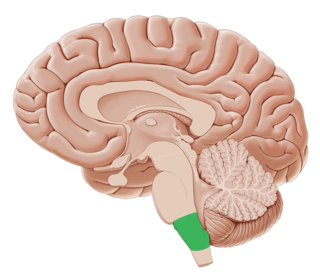
Brain stem consist of
mid brain
pons
medulla oblongata
cerebellum
What is the purpose of the sulcus and gyrus?
decrease SA and increase brain activity
increase SA and increase brain activity
decrease SA and decrease brain activity
increase SA and decrease brain activity
What was the purpose of the longitudinal fissure?
separates the brain into 2 hemispheres right and left
separates the brain into 2 hemispheres front and back
separates the brain into 3 hemispheres front, middle and back
separates the brain into 3 hemispheres left, middle and right
A clear fluid that helps the cornea keep its rounded shape
aqueous humor
blind spot
cones
cornea
A clear fluid that helps the cornea keep its rounded shape
aqueous humor
blind spot
cones
cornea
The place where all nerves from the retina join to form the optic nerve. Each eye has a _____ _____ where there are no light-sensitive cells
aqueous humor
blind spot
cones
cornea
A tough, clear covering over the iris and the pupil that helps protect the eye. Light bends as it passes through the _______ before making its way to the lens.
aqueous humor
blind spot
cones
cornea
A muscle that controls how much light enters the eye. It is suspended between the cornea and the lens. Human ________ come in many colors, including brown, blue, green, and gray.
iris
lens
myelin
optic nerve
A clear flexible structure that makes an image on the eye’s retina. The _____ is flexible so that it can change shape, focusing on objects that are close up and objects that are far away.
iris
lens
myelin
optic nerve
The bundle of nerve fibers that carry information from the retina to the brain.
iris
lens
myelin
optic nerve
The _________ is the dark circle in the center of your iris. It’s a hole that lets light into the inner eye.
pupil
retina
rods
sclera
The layer of light-sensitive cells at the back of the eye. The _________ detects images focused by the cornea and the lens and is connected to the brain by the optic nerve.
pupil
retina
rods
sclera
The thick, tough, white outer covering of the eyeball.
pupil
retina
rods
sclera
The colorful, shiny material located behind the retina. Found in animals with good night vision, the ________ reflects light back through the retina.
tapetum
vitreous humor
The thick clear jelly that helps give the eyeball its shape
aqueous humor
vitreous humor

This structure is in human eyes
False
True

Identify #1
Choroid
Cornea
Pupil
Sclera

Identify #2
Choroid
Cornea
Pupil
Sclera

Identify #4.
cornea
Iris
Pupil
Tapetum Lucidum
Identify #5.
Ciliary Body
Iris
Pupil
Tapetum Lucidum

Identify # 11.
Iris
Lens
Pupil
Retina

Identify #3.
Choroid
Ciliary Body
Optic Nerve
Tapetum Lucidum

Identify #9 the reflective colorful part at the back of the eye.
Ciliary Body
Optic Nerve
Tapetum Lucidum
Vitreous Humor

Identify #10 the balloon like material that holds the liquid of the vitreous humor.
Choroid
Cornea
Retina
Sclera

What is the jelly-like fluid that occupies the middle of the eye is the:
Tears
Vitreous humor
Saline solution
Blood
Where is the lens in relation to the cornea?
In front of the cornea
Behind the cornea
Next to the cornea
Inside the cornea

The blind spot occurs where the _____ exits the eye.
tapetum
optic nerve
cornea
muscles

The opening in the middle of the iris is called the:
Pupil
Cornea
Lens
Sclera
How many muscles does a cow's eye have?
Six
Four
Two
Eight
What is the primary function of the fat around the cow's eye?
To move the eye
To protect the eye
To cushion the eye
To provide nutrients
What is the cornea's role in the eye?
To focus light
To protect the eye and bend light
To give the eye its color
To detect light
What is the aqueous humor's function?
To detect color
To bring nutrients to the eye
To cushion the eye
To move the eye
What part of the eye gives it its color?
Retina
Iris
Lens
Cornea
What is the main difference between a cow's iris and a human's iris?
Cow's iris is round, human's is oval
Cow's iris is oval, human's is round
Cow's iris is larger
Human's iris is larger
What is the vitreous humor composed of?
Blood and cells
Protein and water
Nutrients and enzymes
Fat and muscle
What does the retina detect?
Light
Nutrients
Pressure
Movement
What is the function of the optic nerve?
To transmit visual information to the brain
To move the eye
To detect color
To cushion the eye
Identify #2
Choroid
Cornea
Pupil
Sclera
Identify #4.
cornea
Iris
Pupil
Tapetum Lucidum
Identify #5.
Ciliary Body
Iris
Pupil
Tapetum Lucidum
Lens
Identify # 11.
Iris
Lens
Pupil
Retina
Identify #3.
Choroid
Ciliary Body
Optic Nerve
Tapetum Lucidum
Sclera
Identify #9 the reflective colorful part at the back of the eye.
Ciliary Body
Optic Nerve
Tapetum Lucidum
Vitreous Humor
Identify #10 the balloon like material that holds the liquid of the vitreous humor.
Choroid
Cornea
Retina
Sclera

The clear, most anterior part of the eye is called...
Cornea
Iris
Pupil
Sclera
Conjunctiva

The white part of the eye is the:
Retina
Sclera
Iris
Tapetum

The thin layer of cells at the back of the eye that resembles skin is the:
Cornea
Optic nerve
Sclera
Retina
The tube-like structure on the dorsal side of the eye is referred to as...
cornea
optic nerve
lens
blind spot
sclera

What is the name of the holographic blue layer at the posterior aspect of the eye?
Tapetum
Retina
Collagen
Keratin
Choroid
What is the name of the black layer shown?
Tapetum
Retina
Collagen
Keratin
Choroid
What is the name of the wrinkled up tan layer that is pictured?
Tapetum
Retina
Collagen
Keratin
Choroid

What structure of the eye resembles a mentos candy?
Sclera
Cornea
Retina
Lens
What jelly-like structure is the lens sitting in?
Sclera
Aqueous Humor
Retina
Vitreous Humor
Posterior Chamber
Which allow you to smell
cochlea cells
olfactory cells
optic nerve cells
Which part of the brain is involved in higher-order functions such as decision making and problem-solving?
Medulla Oblongata
Cerebellum
Frontal Lobe
Hypothalamus

