wayground logo

Free Printable Worksheets

Font size

S
M
L
XL
Worksheets

Quiz #4 - Sun layers and a few other things

Total questions: 147

Worksheet time: 4hrs 39mins

Name
Class
Date
1.
What moon phase is this picture?
a)
This is the full moon phase.
b)
This is the waxing gibbous moon phase.
c)
This is the waning gibbous moon phase.
d)
This is the first quarter moon phase.
2.
What moon phase is this picture?
a)
This is the waning crescent phase.
b)
This is the waxing gibbous phase.
c)
This is the waning gibbous phase.
d)
This is the new moon phase.
3.
What is this moon phase?
a)
This is the waxing crescent phase.
b)
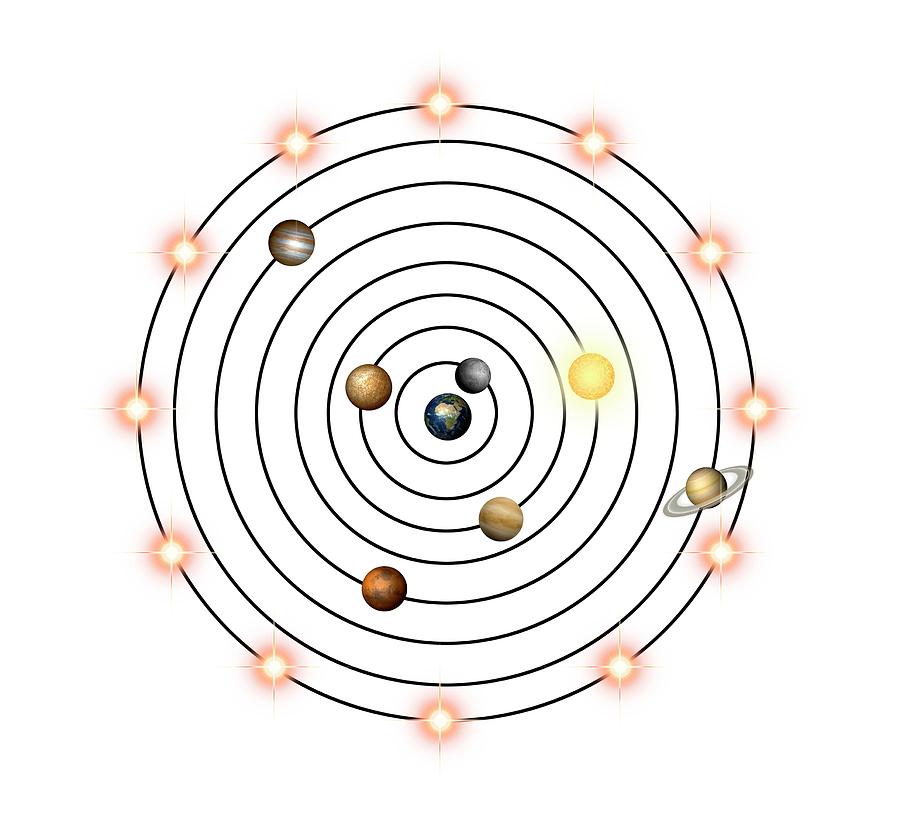
This is the full moon phase.
c)
This is the waxing gibbous phase.
d)
This is the last quarter moon.
4.
What is this moon phase?
a)
This is the waxing gibbous moon phase.
b)
This is the last quarter moon phase.
c)
This is the first quarter moon phase.
d)
This is the new moon phase.  
5.
What moon phase is this picture?
a)
This is the full moon phase.  
b)
This is the waxing crescent moon phase.
c)
This is the waning gibbous moon phase.
d)
This is the waning crescent moon phase.
6.
What moon phase is this picture?
a)
This is the new moon phase.
b)
This is the waxing crescent moon phase.
c)
This is the waxing gibbous moon phase.
d)
This is the waning crescent moon phase.
7.
What moon phase is this image?
a)
This is the full moon phase.
b)
This is the last quarter moon phase.
c)
This is the waxing gibbous moon.
d)
This is the new moon phase.
8.
What phase of the moon is this image?
a)
This is the last quarter moon phase.
b)
This is the full moon phase.
c)
This is the first quarter moon phase.
d)
This is the waxing gibbous moon phase.
9.
What is the difference between a gibbous moon and a crescent moon?
a)
The gibbous shows more than half of the bright side of the moon.
b)
The crescent shows more than half of the bright side of the moon.
c)
The gibbous shows less than half of the bright side of the moon. 
10.
The moon seems to change shape from day to day in a cycle that lasts about a month as it goes through _.
a)
revolutions
b)
phases
c)
rotations
d)
eclipses
11.
As the moon's shape appears to get smaller, we say that the moon is _.
a)
swelling
b)
waxing
c)
waning
d)
disappearing
12.
Phases of the moon in which the moon appears to be getting larger are referred to as _.
a)
waxing
b)
waning
c)
new
d)
eclipse
13.
The cycle of the moon lasts about a _.
a)
day
b)
year
c)
week
d)
month
14.
How long is a lunar month?  
a)
30
b)
29.5
c)
27
d)
27.3
15.
If the last full moon was on April 4th, when can you expect to see the next full moon? 
a)
April 29th
b)
July 4th
c)
May 4th
d)
September 12th
16.

What is the missing phase?

a)
b)
c)
d)
17.

What is the missing phase?

a)
b)
c)
d)
18.

What is the missing phase?

a)
b)
c)
d)
19.

What happens as the moon revolves around the earth?

a)

The shadow gets darker and darker.

b)

The illuminated (lit) side gets lighter and lighter.

c)

The shadow slowly disappears until it's fully lit, then the lit part slowly disappears until it's completely dark.

20.

What moon phase comes after this?

a)
b)
c)
d)
21.

True or False: The moon is always half lit by the sun.

a)

True

b)

False

22.

Which of these astronomers believed the EARTH was center of universe?

a)

Galileo

b)

Copernicus

c)

Aristotle

d)

Ptolemy

23.

Which astronomer created the idea the SUN was the center of the universe?

a)

Ptolemy

b)

Galileo

c)

Aristotle

d)

Copernicus

24.

This scientist found the 4 moons on Jupiter and that Venus has different phases

a)

Johanees Kepler

b)

Galileo

c)

Ptolemy

d)

Copernicus

25.

Which scientist discovered that orbits were elliptical

a)

Kepler

b)

Galileo

c)

Ptolemy

d)

Copernicus

26.

Which scientist discovered that orbits were elliptical

a)

Kepler

b)

Galileo

c)

Ptolemy

d)

Copernicus

27.

This scientist found the 4 moons on Jupiter and that Venus has different phases

a)

Johanees Kepler

b)

Galileo

c)

Ptolemy

d)

Copernicus

28.

Which astronomer created the idea the SUN was the center of the universe?

a)

Ptolemy

b)

Galileo

c)

Aristotle

d)

Copernicus

29.

Which of these astronomers believed the EARTH was center of universe?

a)

Galileo

b)

Copernicus

c)

Aristotle

d)

Ptolemy

30.

What is at the middle of a Heliocentric system?

a)

Mars

b)

Moon

c)

Sun

d)

Earth

31.

What is at the middle of a Geocentric system?

a)

Sun

b)

Neptune

c)

Earth

d)

The Universe

32.

Who supported the Geocentric system?

a)

Ptolemy

b)

Aristotle

c)

Copernicus

d)

Galileo

33.

Who proposed the Heliocentric system?

a)

Copernicus

b)

Ptolemy

c)

Aristotle

d)

Galileo

34.

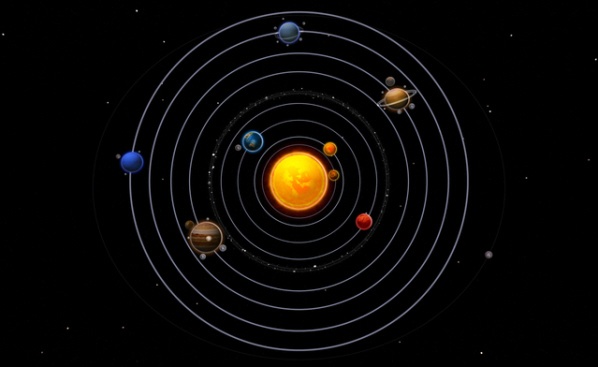
What does the Geocentric system look like?
a)
b)
c)
d)
35.

What does the Heliocentric system look like?

a)
b)
c)
d)
36.

What is the biggest difference between the Geocentric Model and the Heliocentric Model?

a)

the shape of the planets' orbits

b)

the movement of the moon

c)

the center of the solar system

37.

Kepler's first law states that the orbits of the planets are in the shape of a/an...

a)

perfect circle

b)

ellipse

c)

spiral

38.
  What does "geo-" mean?
a)
Earth
b)
sun
c)
Center
39.
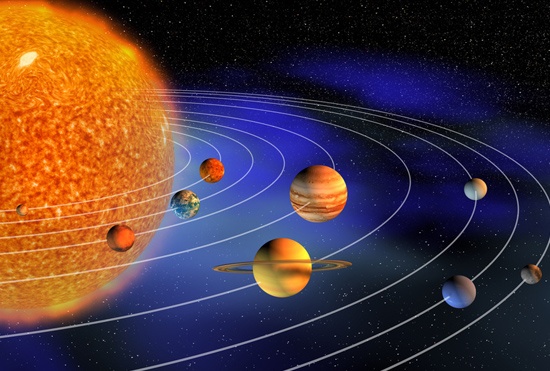
This image shows the:
a)
Geocentric Solar System
b)
Heliocentric Solar System
40.

Whose book was published about the heliocentric model of the universe just after he died?

a)

Ptolemy

b)

Copernicus

41.

Who came up with this model?

a)

Copernicus

b)

Kepler

c)

Galileo Galilee

d)

Ptolemy

42.

Which scientific instrument did Galileo use to change the world?

a)

telescope

b)

spyglass

c)

mirror

d)

magnifying glass

43.

Which object is the center of the solar system according to Galileo?

a)

Earth

b)

Moon

c)

Sun

d)

Neptune

44.

Who supported Copernicus's Heliocentric Model

a)

Galileo

b)

Plato

c)

Ptolemy

d)

No one

45.

Which astronomer first observed the phases of Venus and Jupiter's moons with the help of a telescope?

a)

Gailieo

b)

Aristarchus

c)

Kepler

d)

Aristotle

e)

Copernicus

46.

Who discovered the shape of a planet's orbit is actually an ellipse?

a)

Ptolemy

b)

Copernicus

c)

Kepler

d)

Galileo

47.

Who used a telescope to prove that the Earth could not be the center of the universe?

a)

Ptolemy

b)

Copernicus

c)

Kepler

d)

Galileo

48.
Any object with mass has gravity.
a)
True
b)
Sometimes
c)
False
d)
Never
49.

A person would jump higher on the Moon than on the Earth because . . .

a)
Moon has more mass, and therefore more gravity
b)
Moon has less mass, and therefore more gravity
c)
Moon has more mass, and therefore less gravity
d)
Moon has less mass and therefore less gravity
50.

Which of the following is required for planets to stay in orbit around the Sun?

a)

Gravity

b)

Inertia

c)

Friction

d)

Gravity AND Inertia

51.

What force stops planets from crashing into the Sun?

a)

Gravity

b)

Weight

c)

Friction

d)

Inertia

52.

__________ pulls all of the planets toward the sun.

a)
Force
b)
Motion
c)
Weight
d)
Gravity
53.

What force stops planets from drifting off into space?

a)

Gravity

b)

Weight

c)

Friction

d)

Forward Motion

54.

Without gravity, the stars, planets and all objects in the universe would _______.

a)

continue to orbit each other

b)

move in a random direction

c)

move in a straight line

d)

stop moving

55.

Because of inertia, a moving object will ________.

a)

stop on its own

b)

keep moving

c)

turn around

d)

break

56.

Because of inertia, an object that is not moving will ________.

a)

stay still

b)

start moving

c)

turn around

d)

break

57.

What would happen to Earth if there were no inertia?

a)

Earth would crash into the sun

b)

Earth would fly out to space

c)

Earth would collapse

d)

Earth would orbit the moon

58.

What would happen to Earth if there were no gravity?

a)

Earth would crash into the sun

b)

Earth would fly out to space

c)

Earth would collapse

d)

Earth would orbit the moon

59.
What is gravity?
a)

A force that keeps things moving

b)

A force that pushes objects away

c)

A force that pulls objects together.

d)

A force that pulls things down

60.

What keeps each planet in orbit around the Sun?

a)

a balance of inertia and gravity

b)

more gravity than inertia

c)

more inertia than gravity

d)

a balance of weight and mass

61.
Any object with mass has gravity.
a)
True
b)
Sometimes
c)
False
d)
Never
62.
What would happen to the planets in the solar system if the sun’s gravitational force were to suddenly disappear?
a)
They will stop moving and become static.
b)
They will stop spinning.
c)
They will fly away in straight lines.
d)
They will start moving toward the Sun
63.
Why do all of the planets orbit the sun rather than Earth?
a)
the sun has more mass
b)

the sun is closer to all the planets than Earth
c)
the Earth is heavier
d)
the sun is in the middle of the milky way
64.

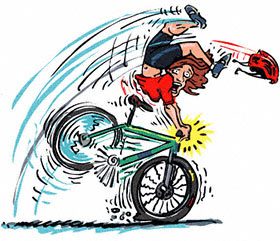
When Sean was riding his bike and braked suddenly, he kept moving forward due to

a)

gravity

b)

friction

c)

inertia

d)

weight

65.

Inertia tells us that we need ____________ to get an object moving or to make it stop.

a)

a force

b)

gravity

c)

friction

d)

strength

66.

What would happen to Earth if there were no inertia?

a)

Earth would crash into the sun

b)

Earth would fly out to space

c)

Earth would collapse

d)

Earth would orbit the moon

67.

The green arrow represents ​ ​ (a)  

The red arrow represents ​ (b)  

Choose from the below words
gravity
inertia
68.
Gamma radiation is a kind of electromagnetic radiation emitted by the Sun
a)
True
b)
Fals
69.
Label part 1
a)
#1 Core
b)
#1 Radiation zone
c)
#1 Convection zone
d)
#1 Photosphere
70.
Label Part 2
a)
#2 Core
b)
#2 Radiation zone
c)
#2 Convection zone
d)
#2 Corona
71.
Label Part 3
a)
#3 Chromosphere
b)
#3 Radiation zone
c)
#3 Convection zone
d)
#3 Photosphere
72.
Label part 4
a)
#4 Chromosphere
b)
#4 Radiation zone
c)
#4 Convection zone
d)
#3 Photosphere
73.
Label part 5
a)
#5 Chromosphere
b)
#5 Radiation zone
c)
#5 Convection zone
d)
#5 Photosphere
74.
Label part 6
a)
#6 Prominences
b)
#6 Corona
c)
#6 Sunspots
d)
#6 Photosphere
75.
Label part 7
a)
#7 Prominences
b)
#7 Corona
c)
#7 Sunspots
d)
#7 Photosphere
76.
In what form does the Sun's energy travel to Earth?
a)
Heat
b)
Electrical energy
c)
Electromagnetic radiation
d)
Mechanical energy
77.
What protects life on Earth from gamma rays, X rays, and particles emitted by the Sun?
a)
The ozone layer in the stratosphere
b)
The ionosphere
c)
The magnetosphere (Earth's magnetic field)
d)
Clouds
78.
What is the definition of CONDUCTION?
a)
When heat is transferred from objects like rays of light or electromagnetically.
b)
a  hot liquid or air that  expands, becomes less dense, and rises or becomes more dense, and sinks.
c)
When heat transfers from objects that are touching.
d)
When heat transfers through the heater or AC in your house.
79.
What is the definition of CONVECTION
a)
When heat transfers through the heater or AC in your house.
b)
When heat transfers from objects that are touching.
c)
a  hot liquid or air that  expands, becomes less dense, and rises or becomes more dense, and sinks.
d)
 hot liquid or air that  expands, becomes less dense, and rises or becomes more dense, and sinks.
80.
What is the definition of RADIATION
a)
 hot liquid or air that  expands, becomes less dense, and rises or becomes more dense, and sinks.
b)
When heat is transferred from objects like rays of light or electromagnetically.
c)
When heat transfers from objects that are touching.
d)
When heat transfers through the heater or AC in your house.
81.
What heat transfer happens when you burn your hand by touching a fire?
a)
Radiation
b)
Conduction
c)
Convectio
d)
I don't know!!!!!!!!!!!
82.
This is a lava lamp. When the light bulb heats the wax, the wax rises. When the wax cools, it falls. This cycle of rising/falling is an example of:
a)
Conduction.
b)
Convection.
c)
Radiation.
83.
Warm air rises and the cool air sinks demonstrates this type of heat transfer. 
a)
conduction
b)
convection
c)
radiation
d)
Insolation 
84.
The baby chickens are kept warm from the heat lamps demonstrates this type of heat transfer. 
a)
conduction
b)
convection
c)
radiation
85.
Walking on the warm sand sand with your bare feet demonstrates this type of heat transfer. 
a)
conduction
b)
convection
c)
radiation
86.
Warm air is __________ dense than cold air and rises creating convection currents.
a)
more
b)
less
87.
which of the following does NOT belong in the electromagnetic spectrum:
a)
X-ray
b)
sound wave
c)
ultra violet rays
d)
microwaves
88.
Electromagnetic waves________________travel through space.
a)
Never
b)
Cannot
c)
Can
d)
Wish they could
89.
The blue section of the wave is measuring _________________.
a)
wavelength
b)
crest
c)
trough
d)
amplitude 
90.
_____________________light is the only type of EM wave detected by the human eye.
a)
Red
b)
Gamma
c)
Microwave
d)
Visible
91.
This type of Electromagnetic wave shows a break in bones.
a)
gamma ray
b)
x-ray
c)
brokenometer
d)
radio wave
92.
Select the correct order of waves on the Electromagnetic Spectrum
a)
Radio, Micro, Infra, Visible, Ultra, X-ray, Gamma
b)
Gamma, X-ray, Ultra, Vis, Infra, Micro, Radio
c)
Vis, Micro, Infra, Ultra, X-ray, Gamma, Radio
d)
Micro, Radio, Vis, Infra, Ultra, X-ray, Gamma
93.
Cancer can be treated with_______________waves.
a)
Penicillin
b)
Radio
c)
Infrared
d)
Gamma
94.
Sunspots are?
a)
Dots on my grandpa's face.
b)
Huge loops of gas.
c)
Areas of gas on the sun's surface that are cooler than the gases around them.
d)
Where the sun appears.
95.
What features can you see on the sun
a)
sunspots, prominences, and solar flares
b)
The core
c)
The moon 
d)
Earth
96.
What two things does the Sun give off
a)
Light and Heat
b)
Air and light
c)
Heat and rain
d)
None of the above
97.
Is the Sun a solid, liquid, or gas?
a)
Solid
b)
Liquid
c)
Gas
d)
Moon
98.
What process produces energy for the sun?
a)
solar wind
b)
solar flare
c)
CME
d)
fusion
99.
Where does fusion occur?
a)
corona
b)
photosphere
c)
core
d)
chromosphere
100.

How long does it take for the Earth to make one full revolution around the Sun?

a)

one day

b)

one week

c)

one month

d)

one year

101.

The movement of the Earth around the Sun is called its _____

a)

revolution

b)

rotation

c)

precession

d)

regression

102.
When the part of the world that you're living in is leaning towards the Sun, its _____
a)
winter
b)
spring
c)
summer
d)
fall
103.
The invisible line that passes through the North Pole and the South Pole is called Earth's ____
a)
axis
b)
equator
c)
ecliptic
d)
prime meridian
104.
Earth is tilted on its
a)
axis
b)
side
c)
oval
d)
pole
105.

The amount of time it takes Earth to rotate on its axis is

a)

365 days

b)

24 hrs

c)

month

d)

year

106.
In this simple diagram, the motion of both the blue and yellow dots can best be described as -
a)
Rotation
b)
Revolution
107.

In this diagram, the motion of the yellow satellite can best be described as -

a)

Rotation

b)

Revolution

108.
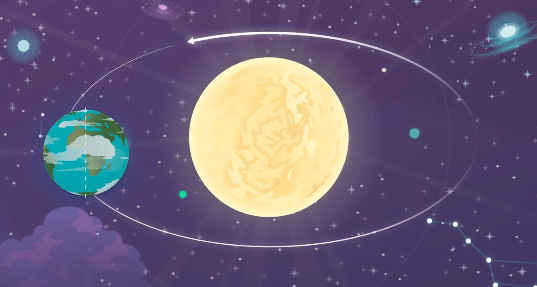
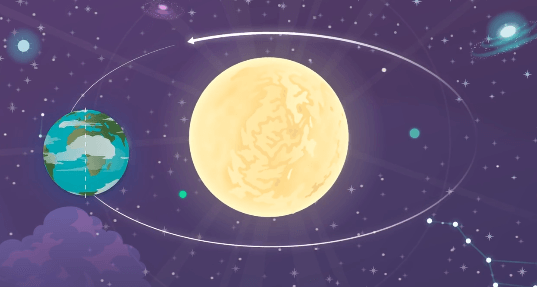
In this diagram, the motion of the Earth can best be described as -
a)
Rotation
b)
Revolution
109.
The earth orbits around...
a)
the sun.
b)
the moon
c)
other planets
d)
the Milky Way
110.
Which term describes the motion of the planets around the sun?
a)
rotation
b)
revolution
c)
completion
d)
galaxy
111.
The process of Earth spinning on its axis is referred to as
a)
revolution
b)
ionization
c)
rotation
d)
ellipse
112.
How many seasons are there in the United States
a)
4
b)
5
c)
6
d)
7
113.
When the hours of daylight and darkness are equal everywhere on Earth, the following occurs
a)
solstice
b)
summer
c)
eclipse
d)
equinox
114.

The sun APPEARS to move across the sky, during the day. Which of the following causes shadows to change length throughout the day?

a)

earth's rotation

b)

earth's revolution

c)

sun's revolution

d)

earth's orbit

115.

How long does it take for the Earth to make one full revolution around the Sun?

a)

one day

b)

one week

c)

one month

d)

one year

116.
The invisible line that passes through the North Pole and the South Pole is called Earth's ____
a)
axis
b)
equator
c)
ecliptic
d)
prime meridian
117.

The amount of time it takes Earth to rotate on its axis is

a)

365 days

b)

24 hrs

c)

month

d)

year

118.
In this simple diagram, the motion of both the blue and yellow dots can best be described as -
a)
Rotation
b)
Revolution
119.

In this diagram, the motion of the yellow satellite can best be described as -

a)

Rotation

b)

Revolution

120.
The earth orbits around...
a)
the sun.
b)
the moon
c)
other planets
d)
the Milky Way
121.

The sun doesn't go anywhere. It seems to leave because the Earth is rotating/spinning and sometimes we face the sun and sometimes we don't

a)

true

b)

false

122.

If you are on the side of the Earth facing TO THE SUN it is _____.

a)

day

b)

night

123.
What looks to be the motion of the Sun in the sky is really caused by the motion of _____
a)
the Earth
b)
the stars
c)
the planets
d)
the Earth's axis
124.
How many seasons are there in the United States
a)
4
b)
5
c)
6
d)
7
125.
Which part of Earth is experiencing night?
a)
A
b)
B
c)
C
d)
D
126.
If the earth didn't rotate on its axis.  What natural cycle would this affect?
a)
seasons
b)
tides
c)
day and night
d)
moon phases
127.
If the earth rotated slower, how would that affect the length of the day?
a)
longer day
b)
shorter day
c)
same time,  24 hours
128.
Earth's axis is tilted at - 
a)
23.5 degrees
b)
33.5 degrees
c)
28 degrees
d)
90 degrees
129.
Which answer correctly labels each letter as day and night? 
a)
X = night
Y = day
b)
X = day
Y = night
130.
Why is the Equator warmest?
a)
Because it is closest to the sun.
b)
Because it receives the most direct sunlight
c)
Because no clouds form here.
d)
Because it is far from the sun
131.
Why do globes lean sideways?
a)
To allow them to spin easier.
b)
To demonstrate the tilt of Earth's axis.
c)
To demonstrate the effects of gravity.
d)
To demonstrate day and night.
132.
Objects in the sky appear to move from _______ to _______.
a)
East to West
b)
West to East
c)
North to South
d)
South to North
133.

What season is the northern hemisphere experiencing in the photo?

a)

Fall

b)

Spring

c)

Winter

d)

Summer

134.
When the Northern Hemisphere of Earth is Leaning away from the Sun, What season is the Southern Hemisphere experiencing?
a)
Summer
b)
Winter
c)
Spring
d)
Fall
135.
What is the longest day of the year?
a)
winter solstice
b)
summer solstice
c)
fall equinox
d)
spring equinox
136.
What causes day and night?
a)
revolution of Earth
b)
rotation of Earth
c)
orbit of Earth
d)
The moon blocks the Sun
137.
How long does it take for Earth to rotate on its axis one time?
a)
24 hours
b)
24.25 hours
c)
365 days
d)
365.25 days
138.
Period of 24 hours or the time it takes Earth to make one complete spin on its axis
a)
Rotation
b)
Compass
c)
Sundail
d)
Movement
139.
What causes the sun to look like it is rising in the east and setting in the west?
a)
moon's orbit
b)
sun's rotation
c)
Earth's revolution
d)
Earth's rotation
140.

The sun doesn't go anywhere. It seems to leave because the Earth is rotating/spinning and sometimes we face the sun and sometimes we don't

a)

true

b)

false

141.

As the Earth travels around the sun one complete time, it makes one -

a)

revolution

b)

rotation

c)

day

d)

month

142.

In this diagram, the motion of the Earth can best be described as -

a)

Gravity

b)

Inertia

c)

Revolution

d)

Rotation

143.

What two things determine the gravity of an object?

a)

mass & weight

b)

mass & distance

c)

density & mass

d)

volume & distance

144.
The EARTH REVOLVES around the:
a)
Sun
b)
Moon
c)
The Earth doesn't revolve
d)
The sun rotates
145.
The MOON REVOLVES around the:
a)
Sun
b)
Earth
c)
The Moon doesn't revolve
d)
The Earth and Sun 
146.
Which happens in one year’s time?
a)
The moon makes one complete revolution around Earth.
b)
Earth makes one complete revolution around the sun.
c)
Earth makes one complete spin on its axis.
d)
The sun makes one complete spin on its axis.
147.

What does Revolution cause?

a)

day and night

b)

dizziness

c)

the seasons

d)

a rainbow