Wayground logo

Free Printable Worksheets

Font size

S
M
L
XL
Worksheets

Science End of the Year Test

Total questions: 60

Worksheet time: 52mins

Name
Class
Date
1.

Which of these pieces of equipment is beaker?

a)
b)
c)
d)
2.

What is the name of this piece of equipment?

a)

Beaker

b)

Conical flask

c)

Measuring cylinder

d)

Evaporating Basin

3.

What is the name of this piece of equipment?

a)

Heat proof mat

b)

Beaker stand

c)

Gauze

d)

Tripod

4.

Which of these should be used for stirring a solution?

a)
b)
c)
d)
e)

Any of these

5.

Which piece of equipment should be used to hold a hot test tube?

a)
b)
c)
d)
6.

I would like to heat a beaker of water over a Bunsen burner flame, I will need...

a)

A tripod, gauze and heatproof mat

b)

Retort stand, heatproof mat and clamp

c)

Nothing else, I'll hold the beaker in my hand.

d)

I can hold the beaker in the flame using tongs.

7.

What tool is this??

a)

Flask

b)

Tunnel

c)

Funnel

d)

Beaker

8.

What tool is this??

a)

Spring Scale

b)

Thermometer

c)

Temperature

d)

Heater

9.

What tool is this??

a)

Test Tube Clamp

b)

Tongs

c)

Squeezers

d)

Beakers

10.

What tool is this??

a)

Bunsen Burner

b)

Flame Thrower

c)

Gas Guzzler

d)

Fire Frenzy

11.

What tool is this??

a)

master and pestle

b)

mortar and pencil

c)

mortar and pestle

d)

crusher

12.
What protects the scientist and the scientist's clothes from hazardous or hot chemicals?
a)
goggles
b)
eye dropper
c)
ring clamp
d)
lab coat/apron
13.

What is the correct scientific definition for gravity?

a)

A pushing force that holds us on Earth

b)

A force that pushes us away from something we are in contact with

c)

A force of attraction between two objects

d)

A movie starring Sandra Bullock

14.

Who created the initial theory of gravity?

a)

da Vinci

b)

Isaac Newton

c)

Einstein

d)

Mr Rhys

15.

Which is not a Force?

a)

A lever

b)

Air Resistance

c)

Friction

d)

Gravity

16.

What is the correct order of planets from the sun?

a)

Pluto, Planet X, Earth

b)

Neptune, Uranus, Saturn, Sun, Venus, Mercury, Mars

c)

Mercury, Venus, Earth, Mars, Jupiter, Saturn, Uranus, Neptune

d)

Earth, Sun, Mars, Milky way

17.

The arrow that is shaded in the diagram below is showing a force referred to as:

a)

Drag

b)

Thrust

c)

Gravity

d)

Lift

18.
A ____________ is a push or a pull on an object.
a)
friction
b)
force
c)
magnet
d)
gravity
19.
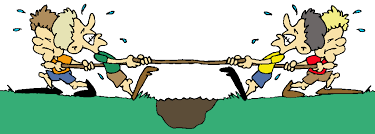
If these teams are pulling with the same amount of force what will happen?
a)
The boy in blue will win.
b)
They will not move at all.
c)
The boy in red will win.
d)
Both will fall down.
20.
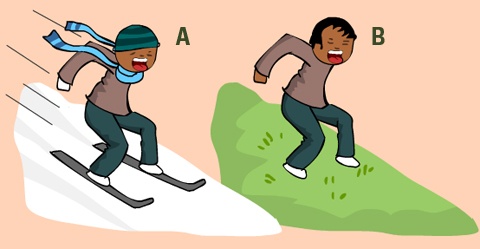
Why is it harder for the boy in Image B to get down the hill?
a)
Motion
b)
Friction
c)
Work
d)
Displacement
21.
Scientific questions have to be...
a)
Measurable 
b)
Easy
c)
Interesting
22.
What is a hypothesis?
a)
A hypothesis is the right answer to an experiment.
b)
A hypothesis is the wrong answer to an experiment.
c)
A hypothesis is an educated guess.
d)
I don't know.
23.
The summary at the end of an experiment that explains the results. 
a)
conclusion
b)
procedures
c)
materials
d)
responding variable
24.
This is the outcome of the experiment. We get data and results from this.
a)
Independent Variable
b)
Dependent Variable
c)
Control
d)
Constant
25.
How often does the moon revolve around the earth?
a)
Once a week
b)
Once a day
c)
Every 28 days
d)
Once a year
26.
If side A of the Earth is facing the sun, in 24 hours will Side A be receiving day or night?
a)
Day
b)
Night
27.
Check labels and equipment instructions carefully. 
a)
True
b)
False
28.
Keep hands away from your face, eyes, and body. ___ your hands at the conclusion of the lab. 
a)
Put
b)
Wash
c)
Dirty
d)
Touch
29.
Know the ___ of the safety equipment in the lab. 
a)
chair
b)
table
c)
square
d)
location
30.
What does earth's rotation cause? 
a)
Hibernation
b)
Day and Night
c)
Four Season
d)
Flowers to grow 
31.
How long does it take the Earth to make one REVOLUTION around the Sun?
a)
12 hours
b)
24 hours
c)
365 1/4 days
d)
29.5 days
32.
The earth orbits around...
a)
the sun.
b)
the moon
c)
other planets
d)
the Milky Way
33.
Day and night is caused by the _____________ of earth on its axis.
a)
revolution
b)
orbit
c)
rotation
34.
Which season, or seasons, have the shortest daylight hours?
a)
Summer
b)
Fall
c)
Winter
d)
Spring
35.

Which of the following are in the 5 kingdoms

a)

Bacteria

b)

Animal

c)

Protist

d)

Plants

e)

Fungi

36.
Unicellular means...
a)
An organism is made of many cells
b)
An organism is made of one cell
c)
An organism is made of no cells
37.

Which of the following are in the 5 kingdoms

a)

Bacteria

b)

Animal

c)

Protist

d)

Plants

e)

Fungi

38.
Heterotroph is when an organism...
a)
Has to eat other things
b)
has to make it's own food
39.
Autotroph is when..
a)
An organism makes it's own food
b)
An organism has to eat other things
40.

Multicellular means:

a)

only one cell

b)

has many cells

c)

has no cells

41.

When the Moon is directly between the Sun and the Earth, what phase would the Moon be in?

a)

Full Moon

b)

New Moon

c)

Half Moon

d)

Waxing Crescent

42.
The moon cycle (lunar cycle) takes approximately _______________ to complete.
a)
14 days
b)
28 days/approximately one month
c)
58 days
d)
1 week
43.

Where does the Moon gets its light from

a)

It reflects the Earth's light

b)

It reflects the other stars' light

c)

It reflects the Sun's light

d)

It makes its own light

44.

What term is associated with the moons that are increasing in size (more light on them) each day?

a)

Waxing moons

b)

Waning moons

c)

Crescent moons

d)

Gibbous moons

45.
Which of the following are explanations for summer?
a)
Hemisphere is tilted towards Sun, Earth is closer to the Sun, Daylight hours are longer
b)
Earth's axial is 23.5 degrees, hemisphere is tilted towards the Sun, Daylight hours are longer
c)
Hemisphere is tilted away from Sun, Daylight hours are shorter, Earth's axial tilt of 23.5 degrees
d)
Hemisphere is tilted away from Sun, Daylight hours are longer, Earth's axial tilt of 23.5 degrees
46.

All of the living things (plants, animals and organisms) in a given area, interacting with each other, and also with their non-living environments (weather, earth, sun, soil, climate, atmosphere) are called:

a)

a species.

b)

a phylum.

c)

a predator.

d)

an ecosystem.

47.

A _____________ contains a variety of elements and compounds that are not chemically combined with each other.

a)

Compound

b)

Molecule

c)

Element

d)

Mixture

48.
A gas
a)
has a definite shape but no definite volume
b)
has a definite volume but no definite shape
c)
has fast-moving particles
49.
What is evaporization?
a)
a gas becoming a liquid
b)
a liquid becoming a solid
c)
a gas becoming a solid
d)
a liquid becoming a gas
50.
______________________ takes place when a liquid changes to a solid.
a)
freezing
b)
melting
c)
boiling
d)
sublimation
51.
What happens to particles when they are heated?
a)
They speed up and spread out
b)
They slow down and compress
c)
They stop moving
d)
They move closer together and speed up
52.
These contain only one kind of atom. 
a)
element 
b)
compound 
c)
mixture 
d)
water 
53.
Carbon Dioxide is a ______ 
a)
compound 
b)
element 
c)
mixtures 
d)
Battle of Bunker Hill 
54.
What is an observation?
a)
A scientific statement based on ideas
b)
Using your senses to notice what is going on around you
c)
A prediction of what will happen in the future
55.

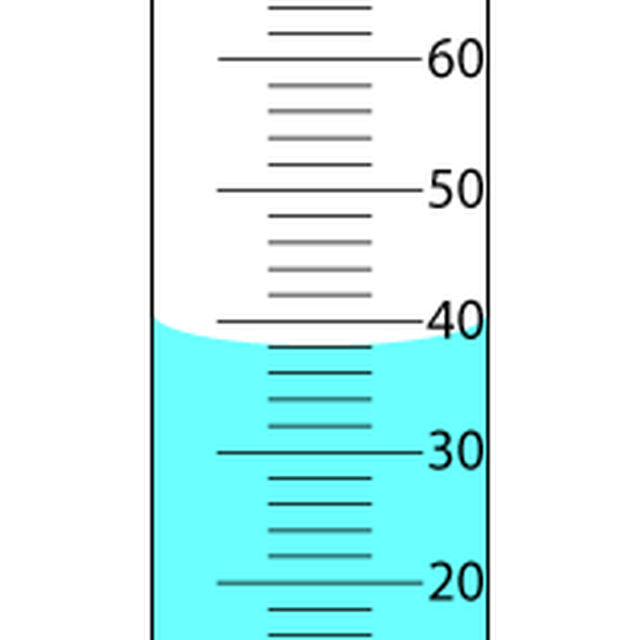
Which recorded measurement is correct?

a)

39mL

b)

40mL

c)

38mL

d)

34.0mL

56.
What is an inference? 
a)
Just a guess.
b)
A statement based off of your observations. 
c)
The same as an observation. 
d)
Examples of something. 
57.

Before beginning a lab, students with long hair should

a)

Comb their hair so the follicles don't contaminate the experiment

b)

Tie their hair back

c)

Ask the teacher what to do

d)

Ask their partner to do the lab

58.

Select all of the following statements that are correct about Code of Conduct in a laboratory

a)

Never eat or drink in a laboratory

b)

Bench tops must be left clean and dry after experiments

c)

Students are permitted in preparation rooms or storerooms

d)

Walking around the laboratory during an experiment to see other groups working is fine

e)

Rubbish must not be left in sinks, on benches or on the floor

59.

What is the purpose of controlled variables

a)

To control what happens in the investigation

b)

To make the investigation valid

c)

To make the investigation reliable

60.
What are the three states of matter?
a)
Rock, Brick, Shoe
b)
Solid, Liquid, Gas
c)
Liquid, Water, Soda
d)
Rain, Sleet, Snow