Font size
 Worksheets
Chemical Reactions
Total questions: 58
Worksheet time: 1hrs 20mins
Which of the following 2 are chemical reactions?
sugar dissolving in water
water turning into steam
burning wood
mixing baking soda and vinegar
tearing paper

How many Carbons are present on the reactant side?
1
2
3
4

How many Hydrogens are on the product side of this chemical equation?
1
2
3
4

Why are chemical equations always balanced? Select ALL that apply.
Matter cannot be created.
Matter cannot be destroyed.
Matter can only be rearranged/conserved.
Matter doesn't matter.

In a chemical reaction, if the reactants are heated, the reaction usually happens
slower
faster
at the same rate
in a smaller volume

Some chemical reactions require a substance called a catalyst. The purpose of a catalyst is
to warm up the reaction
to speed up the reaction
to create more reactants
to stop the reaction
What does it mean for a reaction to be endothermic? Choose 2 of the following.
When two substances react, the temperature of the mixture decreases.
When two substances react, the temperature of the mixture increases.
There is less energy going into the reactant to break the bond than there is energy leaving the product.
There is more energy going into the reactant to break the bond than there is energy leaving the product.
The amount of energy entering and leaving is the same.
What does it mean for a reaction to be exothermic? Choose 2 of the following.
When two substances react, the temperature of the mixture decreases.
When two substances react, the temperature of the mixture increases.
There is less energy going into the reactant to break the bond than there is energy leaving the product.
There is more energy going into the reactant to break the bond than there is energy leaving the product.
The amount of energy entering and leaving is the same.

Is this chemical equation balanced? Why or why not? Choose the BEST answer.
Yes, the amount of atoms for each element are equal on both the reactant and product side.
No, the carbons are not the same number on both the reactant and product side.
No, neither the carbons or hydrogens are the same amount on both the reactant and product side.
No, none of the elements (carbon, hydrogen, or oxygen) are the same amount on both the reactant and product side.

What type of reaction is illustrated below?
FeS + HCl --> H2S + FeCl
synthesis
decomposition
single replacement
double replacement
__K + __Br2 --> __KBr
__HNO2 + __O2 --> __HNO3
2HI --> H2 + I2
What type of reaction is illustrated below?
Zn + H2S --> ZnS + H2
synthesis
decomposition
single replacement
double replacement

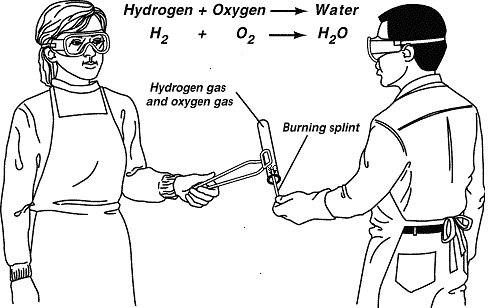
H2 + O --> H2O
Example: H2
_Zn+_HCl-->_ZnCl2 +_H2
_SeCl6+_O2>_SeO2+_Cl2
_Mg + _Cl2 --> _MgCl2
_N2 + _H2 --> _NH3

Cu(NO3)2 is ...
KClO3 → KCl + O2
Fe2(SO4)3 + KOH → K2SO4 + Fe(OH)3
Al + HCl → AlCl3 + H2
Which is the correctly balanced equaition?
Cl2 + 2NaI → 2NaCl + I2
Cl2 + 2NaI → NaCl + 2I2
Cl2 + NaI → NaCl + I2
2Cl2 + NaI → 2NaCl + I2