
 Worksheets
Meteorology and Oceanography
Total questions: 75
Worksheet time: 38mins
Name
Class
Date
1.
On a summer day in July, Marsha stepped barefoot onto the hot sand from the cool ocean water. Why did the sand seem so much warmer?
a)
The sand has a lower specific heat and heats up rapidly
b)
The water has a lower specific heat and heats up slowly
c)
The sand has a higher specific heat and heats up slowly
d)
The ocean has a higher specific heat and heats up rapidly
2.

Based on the weather map, which city will most likely experience increasing temperatures during the next 24 hours?
a)
Denver, because it is raining there
b)
Minneapolis, because a cold front is approaching
c)
Atlanta, because a warm front is approaching
d)
Houston, because it is in a high pressure area
3.

What direction is the warm front moving?
a)
northwest
b)
northeast
c)
southwest
d)
southeast
4.
If a cold front is currently passing through the city of Denver, what type of weather conditions is Denver most likely experiencing?
a)
warm, foggy weather
b)
cooler, dry weather
c)
hot, dry weather
d)
thunderstorms
5.

If both air masses met and stalled in St. Louis, what type of front and weather would St. Louis be experiencing?
a)
cold front with thunderstorms
b)
warm front with prolonged showers
c)
stationary front with clouds and precipitation
d)
occluded front with snowstorms
6.

Hurricanes and similar storm systems begin over oceans. The map below shows average surface
temperatures of the oceans in the summer. Based on the map, which area probably
produced the most violent storm systems?
a)
Area 1
b)
Area 2
c)
Area 3
d)
Area 4
7.

Based on the given model of the Earth, which of these locations is an area of low pressure? (NOTE: the Tropic of Cancer and Tropic of Capricorn are located at 30o latitude)
a)
Equator
b)
North Pole
c)
Tropic of Cancer
d)
Tropic of Capricorn
8.
A student heard the weather forecaster on television say that an area of low pressure was located over his region of the state. What type of weather is the area most likely to experience?
a)
sunny skies
b)
clear skies
c)
cloudy skies
d)
none of these
9.
A light rain system with thin clouds has moved through Oklahoma. What has occurred to produce this type of precipitation?
a)
a warm front
b)
a massive buildup of high air pressure
c)
a hurricane is forming in the Gulf of Mexico
d)
a cold front
10.
Why do oceans have a greater impact on the weather than areas over the continents?
a)
ocean waves move more easily than continental rock
b)
the oceans contain a wider variety of organisms than the continents
c)
the oceans store and transfer more heat than the continents
d)
ocean water contains more salt than most continental lake water
11.
Which of these drives the energy to produce winds?
a)
water
b)
fossil fuels
c)
the sun
d)
hydroelectricity
12.
Which of the following best explains why a hot air balloon rises
a)
The heating of the air causes the pressure inside the balloon to decrease
b)
the heated air inside the balloon is less dense than the cooler air outside the balloon
c)
less dense air wants to be on top of more dense air
d)
all of these
13.
Which of these is most responsible for a city located near the ocean to have a smaller temperature range than a city located in the middle of the US?
a)
daily high wind speeds
b)
slow moving cold fronts
c)
heat from deserts
d)
nearby coastal waters
14.
When air moves from an area of high pressure to an area of low pressure, it causes-
a)
an increase in temperature
b)
rain
c)
wind
d)
a decrease in elevation
15.
On hot sunny days, the temperature over the land is warmer than the temperature over the water. The warmer air rises and the cooler air moves over the land, producing sea breezes. This means that-
a)
soil warms up more slowly than water
b)
water has a higher specific heat capacity than land
c)
the air above the land becomes cool and rises
d)
land has a higher specific heat capacity than water
16.
As air cools, it tends to ___ forming an area of ___ pressure.
a)
sink; low
b)
rise; high
c)
rise; low
d)
sink; high
17.
Why do certain areas of the globe receive more direct sunlight than others?
a)
sunspots on the surface of the sun
b)
interference of other planets
c)
tilt of the Earth's axis
d)
lines of latitude and longitude
18.
Which of the following occurs in our oceans as a result of the unequal heating across our globe?
a)
winds
b)
waves
c)
gravity
d)
ocean currents
19.
Differences in ___ cause air to move from one place to another.
a)
air pressure
b)
rainfall
c)
weather
d)
elevation
20.

A front is moving across Oklahoma and Texas bringing warm humid air behind it. Which of the following labels should be used to mark this front on a map?
a)
IV only
b)
II and III
c)
II only
d)
I and III
21.

A front is moving across Oklahoma and Texas bringing cold air behind it. Which of the following labels could be used to label the air behind the front?
a)
III only
b)
I and II
c)
II and IV
d)
I and III
22.
The ocean plays an important role in the formation of storm systems such as hurricanes because...
a)
the wide, open area allows strong winds to develop
b)
the warm, tropical waters provide the energy that drives the storm
c)
the high tides push the water higher on the beaches
d)
salt water holds thermal energy longer than fresh water
23.

Based on the information provided in the weather map, which city shown most recently saw a drop in temperature?
a)
Boise
b)
Denver
c)
Louisville
d)
Shreveport
24.
An area of low pressure
has formed in the Texas Gulf. News reports concerning the warm surface
temperatures of the ocean water and the rotational movement of the clouds are
announced hourly. What may be forming?
a)
a blizzard
b)
a tornado
c)
a hurricane
d)
a tsunami
25.
When isobars are closer together, what does that signify?
a)
stronger winds
b)
an area of no wind
c)
clear skies
d)
clouds
26.

Which location is most likely experiencing the greatest wind speeds?
a)
Location A
b)
Location B
c)
Location C
d)
Location D
27.
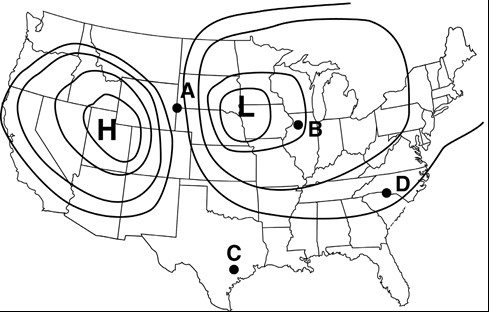
Which of the following best describes the weather conditions of location B?
a)
cloudy
b)
windy
c)
clear skies
d)
hurricane
28.
What direction would the wind be blowing in a high pressure system in the northern hemisphere?
a)
clockwise
b)
counterclockwise
c)
upwards
d)
none of these
29.
A cool and dry air mass would be named ___ and have ___ pressure.
a)
continental polar; high
b)
maritime polar; low
c)
continental polar; low
d)
maritime polar; high
30.

Which location on the map is experiencing cool temperatures and clear skies?
a)
Location A
b)
Location B
c)
Location C
d)
Location D
31.
In what direction would the wind be blowing in a low pressure system?
a)
inwards
b)
outwards
c)
downwards
d)
none of these
32.
What is one condition that is necessary for a hurricane to form?
a)
a strong cold front
b)
warm ocean water
c)
cold ocean water
d)
a strong warm front
33.
A student heats salt water in a beaker on a hot plate to model how ocean currents are generated. What is the most important way in which this model fails to accurately show how ocean currents are generated?
a)
oceans have fresh, not salt water
b)
oceans are heated from the top, not the bottom
c)
water in the ocean cannot move up and down
d)
ocean water is not contained within something solid
34.
How are tropical storms in the Northern Hemisphere different from tropical storms in the Southern Hemisphere?
a)
the winds spin faster in the Southern Hemisphere
b)
tropical storms cause more rain in the Southern Hemisphere
c)
tropical storms don't turn into hurricanes in the Southern Hemisphere
d)
the winds spin in opposite directions
35.
What can you infer about low- and high-pressure air masses?
a)
low pressure systems are associated with stormy weather
b)
high pressure systems are associated with cyclones
c)
low and high pressure systems must meet to form a hurricane
d)
low pressure systems are associated with the southern hemisphere
36.
What happens immediately after a hurricane makes landfall?
a)
it gets stronger
b)
it gets weaker
c)
its winds pick up speed
d)
it starts hailing
37.
A large body of air characterized by a similarity of temperature and moisture is referred to as a(n)-
a)
air cell
b)
air mass
c)
front
d)
pressure system
38.
The boundary that separates different air masses is called a(n)-
a)
storm
b)
air mass
c)
front
d)
cyclone
39.
The temperature condition of an air mass is described using the terms Maritime and Continental.
a)
Trure
b)
False
40.
How are air masses described?
a)
by their size and number of clouds
b)
by their temperature and speed
c)
by their location and altitude
d)
by their temperature and moisture content
41.
High pressure systems are associated with what type of weather?
a)
cool, wet weather
b)
clear, dry weather
c)
cloudy, wet weather
d)
cloudy, dry weather
42.
What would a warm, dry air mass be named?
a)
maritime Polar
b)
maritime Tropical
c)
continental Polar
d)
continental Tropical
43.
What would a maritime Tropical air mass be described as?
a)
warm, dry
b)
warm, moist
c)
cold, dry
d)
cool, moist
44.
When a rapidly moving cold air mass replaces and pushes up on a slower-moving warm air mass, the result is a(n)-
a)
stationary front
b)
cold front
c)
warm front
d)
occluded front
45.
When a warm air mass and a cold air mass meet and neither can move the other, the result is a(n)-
a)
warm front
b)
stationary front
c)
cold front
d)
occluded front
46.
When a warm air mass overtakes a retreating cold air mass, it forms a(n)-
a)
stationary front
b)
cold front
c)
warm front
d)
occluded front
47.
From the center of a high pressure system, winds spiral-
a)
outward toward areas of lower pressure
b)
inward toward areas of lower pressure
c)
upwards towards areas of lower pressure
d)
none of these
48.
A(n) ___ is a fast-moving front that often brings thunderstorms followed by clear skies.
a)
cold front
b)
warm front
c)
occluded front
d)
stationary front
49.
Where a warm air mass is caught between two cooler air masses, a(n) ___ front occurs
a)
cold
b)
warm
c)
stationary
d)
occluded
50.
A(n) ___ front may bring many days of rain because neither air mass can move the other.
a)
occluded
b)
warm
c)
cold
d)
stationary
51.
Which of the following is NOT a method of heat transfer?
a)
conduction
b)
condensation
c)
convection
d)
radiation
52.
What causes the winds to veer to the right in the northern hemisphere and to the left in the southern hemisphere?
a)
rotation of the Earth
b)
orbit of the Earth around the sun
c)
moon phases
d)
air resistance
53.
The phenomenon that causes straight line winds to curve is called the-
a)
Butterfly Effect
b)
Coriolis Effect
c)
Newton's First Law
d)
Greenhouse Effect
54.
Why is the equator so much warmer than the poles?
a)
The sun's rays are coming in at a steep angle and are more concentrated
b)
The sun's rays are coming in at a shallow angle and are spread out over a large area
c)
The Greenhouse Effect traps a greater amount of gases around the equator
d)
Convection currents in the Earth's mantle are more focused on the equator
55.
Why does cool air sink over the poles?
a)
the air warms and becomes less dense
b)
the air warms and becomes more dense
c)
the air cools and becomes more dense
d)
the air cools and becomes less dense
56.
Electromagnetic energy traveling through empty space (vacuum) is an example of-
a)
conduction
b)
convection
c)
radiation
d)
potential
57.
in which of the following can convection currents be set up?
a)
air
b)
plastic
c)
a vacuum (void of matter)
d)
solid aluminum
58.
During a house fire, the smoke flames rise up, but the air down near the floor is cooler and less smoky. This is an example of what type of heat transfer-
a)
radiation
b)
conduction
c)
convection
d)
microwave
59.
What factors influence deep ocean currents
a)
temperature
b)
salinity
c)
density
d)
all of these
60.
Energy transfer through convection is primarily restricted to-
a)
fluids
b)
liquids
c)
gases
d)
all of these
61.
When convection occurs in the atmosphere...
a)
warm air sinks and cool air rises
b)
warm air rises and cool air sinks
c)
cool air and warm air sink
d)
cool air and warm air rise
62.
Thermal energy is-
a)
heat
b)
water
c)
matter
d)
light
63.
Where does warm water originate from on our planet?
a)
North Pole
b)
South Pole
c)
Equator
d)
Both the North and South Pole
64.
Which of the following occurs because of convection within the ocean?
a)
algae blooms
b)
waves
c)
gravity
d)
ocean currents
65.
The wind direction is-
a)
always from an area of low pressure toward high pressure
b)
always from an area of high pressure toward low pressure
c)
always toward the ocean
d)
always toward the land
66.
High temperature means faster moving particles.
a)
True
b)
False
67.
The sun DIRECTLY heats the air in our atmosphere.
a)
True
b)
False
68.
Wind does not affect ocean surface currents.
a)
True
b)
False
69.
Faster moving particles are cooler.
a)
True
b)
False
70.

The general pattern of winds around a high pressure area is clockwise, outward. The general pattern of winds around a low pressure area is counterclockwise, inward. Based on the information provided, which Texas city shown will most likely have winds from the east?
a)
Abilene
b)
Tyler
c)
Houston
d)
San Antonio
71.

In general, one can expect clear skies with a high pressure area and cloudy conditions in areas of low pressure. Based on this information, and that provided in the following map, which city shown most likely is currently experiencing clouds but will see clearer skies in the near future?
a)
Atlanta
b)
Cleveland
c)
Omaha
d)
Los Angeles
72.
If the numbers above are temperature readings in Fahrenheit, what type of front is represented on this map? (Hint: the front is moving south)
a)
Cold
b)
Warm
73.
A student planning to visit the rainforest in Cuba packed cool clothing for the hot, humid climate. Why does Cuba have warm and muggy weather?
a)
to attract tourists
b)
a lack of snowfall
c)
cold ocean currents
d)
warm ocean currents
74.
What type of air mass would be associated with the formation of a hurricane?
a)
maritime Tropical
b)
maritime Polar
c)
maritime Continental
d)
continental Tropical
75.
Tierra del Fuego at the southern tip of South America is very cold with not much vegetation. What could cause this type of climate?
a)
cold ocean currents
b)
warm ocean currents
c)
a lack of mountainous terrain
d)
a lack of sea ice in the area
100 %

