
 Worksheets
Topic 8 USA Review The Dynamic Earth
Total questions: 99
Worksheet time: 2hrs 3mins
Earthquakes


When matter gains energy (gets hotter), how does that affect the density?
The matter becomes less dense.
The matter becomes more dense.
Density isn't affected.

Which of the following occurs because of convection current?
Tectonic plates on the crust move.
Pressure in the crust increases.
The mantle increases in size.
Pressure in the crust decreases.

What happens to magma that is heated by the core?
It rises.
It sinks.
Plate Tectonics
It becomes part of the inner core.
When matter loses energy (gets cooler), how does that affect density?
The matter becomes less dense.
The matter becomes more dense.
Density isn't affected.

Look at the image. The two continental plates are colliding. Why is the Indian Plate moving under the Eurasian Plate?
It's larger.
It's molten.
It's more dense.
It's less dense.


Which mechanical/physical layer is letter A?
Mesosphere
Asthenosphere
Core
Lithosphere

The scientist that came up with the Theory of Continental Drift
Albert Einstein
Alfred Wegener
Sir Ian McKellan
Sir Isaac Newton

The name of the Super Continent Wegener proposed
Wakanda
Pandora
Pangaea
Milky Way
Volcanoes most often occur at or around subduction zones.
True
False
The Mid Atlantic Ridge is responsible for continents moving closer and closer towards each other.
True
False
where one plate is pushed under another.
Supercontinent
Fault Zone
Subduction Zone
Continental drift
Ocean Ridge
the movement of continents from plate tectonics
Supercontinent
Fault Zone
Subduction Zone
Continental drift
Ocean Ridge
come together
Diverge
Converge
Volcano
Volcanic arc
Ocean Trench
separate
Diverge
Converge
Volcano
Volcanic arc
Ocean Trench
a curved line of volcanoes at plate boundaries
Diverge
Converge
Volcano
Volcanic arc
Ocean Trench
a vent in Earth’s crust where magma travels to the surface and becomes lava.
Diverge
Converge
Volcano
Volcanic arc
Ocean Trench
Which of the following was evidence that Alfred Wegener discovered in support of Pangaea?
Matching fossil records from different continents
Similar rock layers from millions of years ago from different continents
The coastlines of certain continents matched up like a jigsaw puzzle
All of the above
None of the above
Mountain chains from the U.S. and Europe match. What conclusion can you draw from this?
the mountains formed after Pangaea separated
this mountain chain was once one during Pangaea
the mountain chain is still forming due to convergence
none of the above
What is Pangaea?
an ancient reptile Wegener used as evidence of Continental Drift
and ancient fern Wegener used as evidence of Continental Drift
the name of an underwater mountain range
the supercontinent theorized by Wegener
What was the name of the theory that Alfred Wegener proposed to explain the movement of the continents?
Pangea
seafloor spreading
continental drift
plate tectonics
What happens to the temperature and density in the Earth's layers as the depth increases?
they both decrease
they both increase
they stay the same
temperature decreases and density increases
The asthenosphere is part of which layer of Earth?
crust
mantle
outer core
inner core
We journeyed to the center of the Earth, and when we got there we discovered that the core has two parts. One part is liquid and is called the __________________. The other part is dense and solid and is called the __________________.
outer core, inner core
inner core, outer core
mesosphere, asthenosphere
asthenosphere, mesosphere
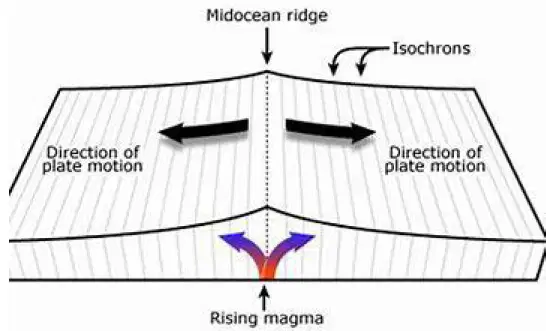
What is created at the mid ocean ridge during sea floor spreading?
Old oceanic crust
New continental drift
Old contiental crust
New oceanic crust
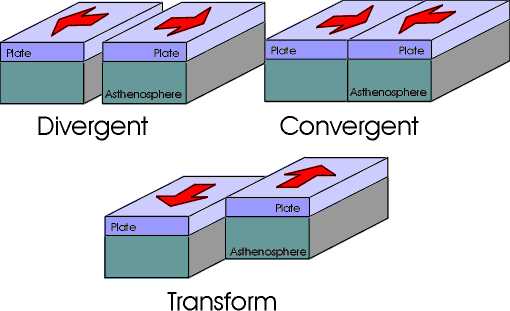
At which type of plate boundary do two tectonic plates move past each other horizontally, causing earthquakes?
convergent
divergent
transform
none of the above
What role do convection currents in the mantle play in the process of plate tectonics?
they cause earthquakes
they pull plates apart at divergent boundaries
they push plates past each other at divergent boundaries
they create magnetic fields in the core
What is the main reason behind the movement of tectonic plates?
Earth's rotaion
Magnetic poles
Solar Radiation
Convection Currents
The geological theory that states that pieces of Earth's lithosphere are in constant, slow motion is the theory of
subduction
plate tectonics
deep-ocean trenches
seafloor spreading

What geological event can be created in the plate boundary shown below?
Rift Valley
Sea Floor Spreading
Earthquakes
Volcanoes

The diagram illustrates the movements of tectonic plates on Earth. Which statement best describes this diagram?
It shows the convection currents in the mantle.
It shows the convection currents in the outer core.
It shows the radiation of heat through the mantle.
It shows the conduction of heat in the mantle.
Which of the following statement best summarizes the Theory of Plate Tectonics?
The continents don't move and stay in their current locations.
There are convection currents in the mantle that move the Earth’s tectonic plates
The Earth’s lithosphere contains convection currents that move the mantle below.
The Earth is broken into sections that fit together into one super-continent.

A teacher used a pot of boiling water and wood blocks to demonstrate plate tectonics. In the demonstration, the wood blocks represent
convection currents
lithospheric (tectonic) plates
boats
the mantle

Two plates that move away from each other are..
Divergent
Converging
Transforming
None of the above
Mountains are formed at ______ plate boundaries
transform
divergent
convergent
None of the above
Convection currents in the Earth's ______ cause the lithosphere plates to move
Crust
Core
Asthenosphere
Land
The theory of ______ states that the Earth is broken up into pieces that move because of convection currents that happen in the asthenosphere
volcanoes
sea floor spreading
continental drift
Plate tectonics
Explain HOW nature works.
hypothesis
theory
law
A ___ is observed and describes in the natural world what seems to be always true.
hypothesis
theory
law
A scientific theory explains how or why things happen in nature.
True
False
Which of the following is the a picture of a ocean to ocean convergent boundary?


None of those show a ocean to ocean convergent
At which boundary is crust DESTROYED (when melting in the mantle!)?
Continent- continent Convergent
Transform boundaries
Subduction zones
All convergent boundaries
Process by which new ocean crust forms.
Seafloor spreading
Continental drift
Mid-ocean ridge
Rift
What was Wegener's theory?
the earth is flat
the continents were once joined together

Tectonic Plate movement is caused by ______________.
the rotation of the Earth
ocean tides
convection currents in the mantle
the moon's gravity

What type of Boundary is this? What event will occur at this boundary?
Transform / Earthquakes
Subduction / Volcano Eruption
Tornado / Rain
Mountain Building / Volcanism
Earthquake waves are detected, measured, and recorded by instruments called
Chronometers.
Seismographs.
Richter scales.
oscilloscopes.
indirect evidence from seismic waves
indirect waves from rock samples
direct evidence from rock waves
indirect evidence from seismic rocks
The Earth's lithosphere contains
The upper mantle
The oceanic crust
The continental crust
All are correct
The creation of new sea floor occurs at _____________________ plate boundaries.
transform
divergent
convergent
continental-continental
Sea-floor spreading begins at the
Deep ocean trench
Mid-ocean ridge
Continent's edge
The crust and upper mantle make up Earth's ____.
asthenosphere
lithosphere
core
continents
Seafloor spreading occurs because ____.
new material is being added to the asthenosphere
earthquakes break apart the ocean floor
sediments accumulate at the area of spreading
molten material beneath Earth's crust rises to the surface

What particular event is shown on the picture?
mid-ocean ridge
subduction zone
transform boundary
divergent boundary
In sea-floor spreading, molten material rises from the mantle and erupts
in deep-ocean trenches
along the edges of all the continents
along mid-ocean ridges
at the north and south plate
The process of ___________ continually adds new crust to the ocean floor along both sides of the mid-ocean ridge.
plate tectonics
seafloor spreading
continental drift
convection
The scientist credited with sea-floor spreading is _________
Alfred Wegener, a German scientist
Harry Hess, an American geologist
J.Tuzo Wilson, a Canadian scientist
Kenn Bulaso, a Filipino educator

What is seafloor spreading?
continental crust-continental crust
rift valleys
seafloor spreads
ocean spreads and magma rises to fill in gaps creating a Mid Ocean Ridge

At the Mid-Ocean Ridge and active volcanoes you can find:
fault lines
earthquakes
older crust
newest crust

What kind of plate boundary is shown here? When two plates slide past one another. Example: San Andres Fault
divergent
convergent
transform
submergent
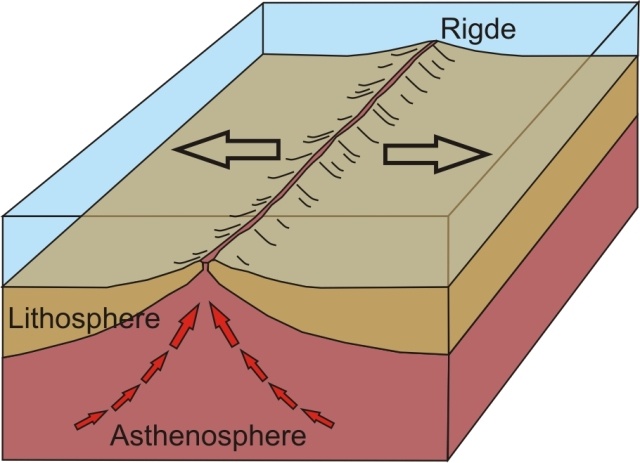
What kind of plate boundary is shown here? When two plates are moving away from one another (divide).
divergent
convergent
transform
subducting

What kind of plate boundary is shown here? When two plates move toward one another (collide).
divergent
convergent
transform
strike slip
What type of event will most likely occur at this type of boundary?
Earthquake
Volcano Eruption
Tornado
Mountain Building
Volcanic islands can form from magma which is pushed up at a __________ plate boundary
Divergent
Convergent
Transform
Mountain ranges are created when....
Two continental plates collide
Two oceanic plates collide
An oceanic plate subducts under a continental Plate
Two continental plates pull apart
The mechanism to explain how the continents drifted that Harry Hess contributed is called ___________________.
plate tectonic theory
continental drift
seafloor spreading
hot spot formation

