
 Worksheets
Open Sci Ed Unit 8.2
Total questions: 45
Worksheet time: 2hrs 53mins

Definition of Vibration:
when objects jump around
When objects move back and forth
When objects stop moving
when objects run away
The more an object vibrates when greater force is applied, the softer the sounds is made.
True
False
Pitch is
the music box
the number of vibrations of the sound
the low point on a wave
the highness or lowness of a sound
lower amplitude = softer sound
False
True

Air near the sound source moves all the way from the sound source to our ears.
True
False

Sound can travel through (choose all that apply)
empty space with no matter
gases
liquids
solids

Amplitude is the
distance from the starting position to a peak or valley
the number of peaks or valleys in one second
the number of waves in one second
How high you are in the mountains

Frequency is
something very odd
the distance from starting position to a peak or valley
the number of waves in one second
the number of peaks or valleys in one second
Waves of bigger amplitude transfer more energy than waves with less amplitude.
True
False

Hearing loss is caused when one of the structures in your ear is healed.
True
False

Which structure sends the signal to the brain when you hear a sound?
eardrum
auditory canal
auditory nerve
cochlea
Loud music can damage your hearing.
True
False

The sound source from the truck speakers vibrates the particles/molecules in the air causing the window to shake.
True
False
What is being passed/moving from the sound source (truck speakers) to the window?
air
energy
particles
dust
Sound is a form of
music
pitch
volume
energy
Sound is caused by?
vibrations
force
instruments
jumping beans

What kind of sound would be heard with this type of wave?
Quiet, low pitch
Loud, low pitch
Quiet, high pitch
Loud, high pitch

What kind of sound would be heard with this type of wave?
Quiet, low pitch
Loud, low pitch
Quiet, high pitch
Loud, high pitch

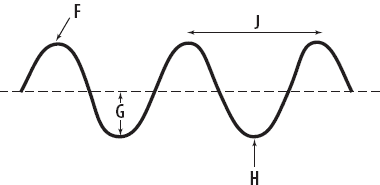
What is being labeled in this picture?
Amplitude
Frequency
Wavelength
Peak

What part of the wave is labeled here?
Amplitude
Frequency
Peak
Wavelength

What part of the wave is labeled here?
Amplitude
Frequency
Peak
Wavelength

What part of the wave is labeled here?
Amplitude
Frequency
Wavelength
Valley

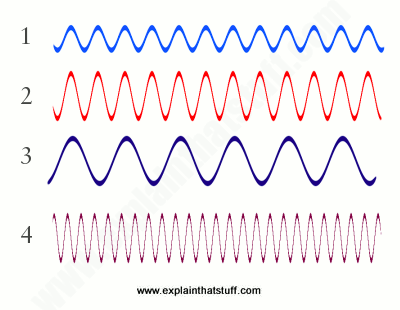
Which wave has a lower frequency?
Left
Right

When the wavelength is longer the frequency is
slower/lower
faster/higher
wavelength and frequency aren't related

Which wave would be the result of higher energy transfer?
left
right

When the speaker vibrates, why do the air particles move?
The air particles move because the speaker pushes on the air particles.
The air particles move because of the sound.

How do the air particles between the speaker and sound detector move?
The particles travel across the whole space to the sound detector.
The particles vibrate back and forth.

What moves across the whole sound wave?
Air particles
Energy

How is energy transferred through the medium?
The air particles collide into each other over the space between the speaker and the sound detector.
The speaker sends out energy.

How would hair cells react to a low pitch sound?
The hair cells would vibrate slowly.
The hair cells would vibrate quickly.
The hair cells would move back and forth farther.
The hair cells would move back and forth less far.

Why does the sound detector vibrate?
It vibrates because the speaker is playing sound.
It vibrates because the air molecules are pushing on the sound detector.
What role does the outer ear play in hearing?
captures sound waves
transmits sound waves from air to fluid
converts sound saves into electrical signals
removes high and low sound waves that are harmful

The vibrating string shown produces a sound. If the same string produced a louder sound, how would the string's appearance change?
The string would vibrate to a lower height.
The string would vibrate to a higher height.
The string would vibrate over a longer distance.
The string would vibrate over a shorter distance.
True or False:
Sound transfers energy but not matter
True
False
A place where no sound exists is...
in the air.
under water.
space.
all of the above

When you increase the amplitude of a wave, its frequency _____
increases
decreases
stays the same
The part of the ear is a thin muscle that vibrates is called the
ear drum
ear canal
hammer

lower amplitude = softer sound
False
True
The more an object vibrates when greater force is applied, the softer the sounds is made.
True
False

