
 Worksheets
Intro to the Integumentary System
Total questions: 55
Worksheet time: 34mins
An organ is a group of tissues that perform a specific function. What is the largest organ of the integumentary system?
Heart
Liver
Skin
Lungs
The structure of the layers of skin is described as:
Epidermis, Dermis, Hypodermis
Dermis, Epidermis, Hypodermis
Hypodermis, Epidermis, Dermis
Epidermis, Hypodermis, Dermis
The factors that determine skin color are:
Genetics, sun exposure, and diet
Only genetics
Only sun exposure
Only diet
The prefix 'Cut' in medical terminology refers to:
Skin
Bone
Muscle
Nerve
The meaning of 'Derm' in the context of skin anatomy is:
Skin
Bone
Muscle
Nerve
The prefix 'Epi-' is relevant to the epidermis because it means:
Above or over
Below or under
Inside or within
Around or surrounding
What does 'Follic' signify in relation to hair development?
A type of hair color
A phase of hair growth
A hair care product
A part of the hair structure
Kerat is defined as a ______ in the epidermis.
protein
lipid
carbohydrate
nucleic acid
What does 'Melan' indicate in terms of pigmentation?
Light pigmentation
Dark pigmentation
No pigmentation
Red pigmentation
The term 'Seb' is associated with which type of glands?
Sweat glands
Sebaceous glands
Endocrine glands
Salivary glands
The function of 'Sudor' in the context of sweat glands is:
To produce sweat
To regulate body temperature
To secrete hormones
To protect the skin
What is an organ?
A single tissue type
A body structure composed of two or more different tissue types that perform specific functions
A type of cell
A type of protein
What are the two main tissues of the skin?
Muscle and nerve tissue
Epithelial and connective tissue
Bone and cartilage
Blood and lymph
Fill in the blank: Skin is the largest organ in the body by _______.
weight
volume
length
height
Which of the following are accessory structures of the skin?
A) Bones and muscles
B) Hair, nails, glands, and sensory receptors
C) Blood vessels and nerves
D) Teeth and gums
Fill in the blank: Skin acts as a barrier between the internal environment and the _______ environment.
external
internal
cellular
microscopic

Did you know? The surface area of the skin in a 150-pound person is approximately how many square feet?
15 square feet
20 square feet
25 square feet
30 square feet
What are the two major layers of the skin?
Which layer of the skin is the thin, outer layer of stratified squamous epithelium?
The thin, outer layer of the skin is the epidermis.
The thin, outer layer of the skin is the dermis.
The thin, outer layer of the skin is the hypodermis.
The thin, outer layer of the skin is the subcutaneous layer.
What is the function of the epidermis?
Protection against environmental damage
Photosynthesis
Nutrient absorption
Water transport
Which layer of the skin contains connective tissue, blood vessels, smooth muscle, and nervous tissue?
The dermis.
The epidermis.
The hypodermis.
The stratum corneum.
What is the subcutaneous layer also known as?
subcutaneous layer
epidermis
dermis
hypodermis
Which tissues make up the subcutaneous layer?
Adipose tissue and areolar tissue
Epithelial tissue and muscle tissue
Nervous tissue and bone tissue
Cartilage and blood tissue
What is the function of adipose tissue in the subcutaneous layer?
Insulation and energy storage
Protection against UV radiation
Production of sweat
Synthesis of vitamin D
Does the subcutaneous layer contain major blood vessels that supply the skin?
True
False
Which layer of the skin contains the sweat gland duct?
The sweat gland duct is located in the dermis layer of the skin.
The sweat gland duct is located in the epidermis layer of the skin.
The sweat gland duct is located in the hypodermis layer of the skin.
The sweat gland duct is located in the subcutaneous layer of the skin.
The function of the sebaceous gland is to:
produce sweat
secrete sebum
filter blood
absorb nutrients
Which of the following is found in the dermis layer?
Stratum corneum
Hair follicle
Basement membrane
Stratum basale
Identify the layer where the arrector pili muscle is located.
The arrector pili muscle is located in the dermis layer of the skin.
The arrector pili muscle is located in the epidermis layer of the skin.
The arrector pili muscle is located in the hypodermis layer of the skin.
The arrector pili muscle is located in the subcutaneous layer of the skin.
What type of epithelium does the epidermis consist of?
Simple squamous
Stratified squamous
Cuboidal
Columnar
Does the epidermis contain blood vessels?
Yes
No
How many layers does the epidermis consist of in most areas?
2 layers
3 layers
4 layers
5 layers
The deepest layer of the epidermis is called the _______.
Stratum basale (or stratum germinativum)
Stratum corneum
Stratum lucidum
Stratum granulosum
What is the process called when keratinocytes migrate outward, harden, dehydrate, and die?
Keratinization
Mitosis
Photosynthesis
Respiration
Which layer of the epidermis is found only in the thick skin of the palms and soles?
Stratum lucidum
Stratum corneum
Stratum granulosum
Stratum spinosum
What is the outermost layer of the epidermis called?
Stratum corneum
Stratum lucidum
Stratum granulosum
Stratum spinosum
Which layer of the epidermis is located between the stratum granulosum and the stratum corneum?
Stratum lucidum
Stratum basale
Stratum spinosum
Stratum granulosum
What is the layer of the epidermis that is continually being shed from the outer skin surface?
Stratum corneum
Stratum lucidum
Stratum granulosum
Stratum spinosum
Identify the layers of the epidermis in the diagram.
Identify the part labeled as 'Dermal papilla' in the diagram of the epidermis.
Identify the part labeled as 'Dermis' in the diagram of the epidermis.
What is the characteristic of the Stratum corneum?
Dead cells with a hard protein envelope
Keratin fibers and lamellar bodies accumulate
Cells divide by mitosis
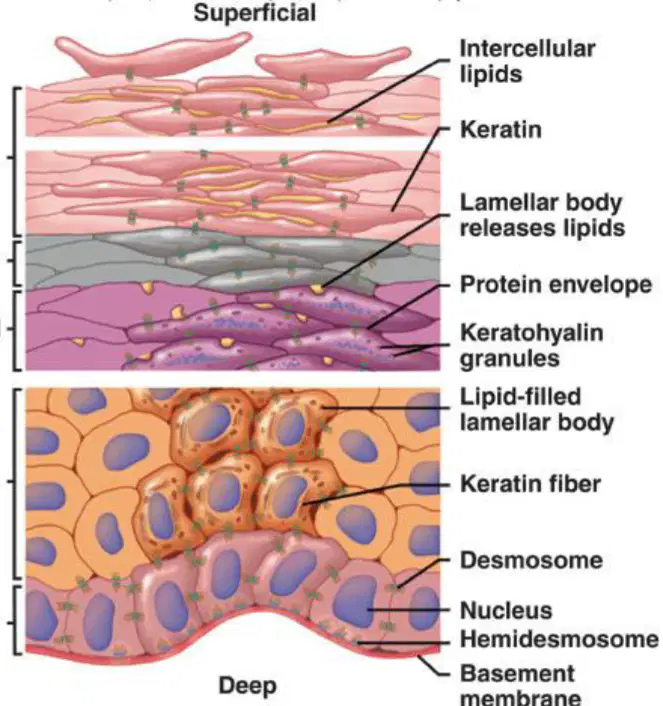
Fill in the blank: In the Stratum spinosum, _______ fibers and lamellar bodies accumulate.
Keratin
Collagen
Elastin
Reticulin
Fill in the blank: In the Stratum basale, cells divide by _______ and some of the newly formed cells become the cells of the more superficial strata.
mitosis
meiosis
binary fission
budding
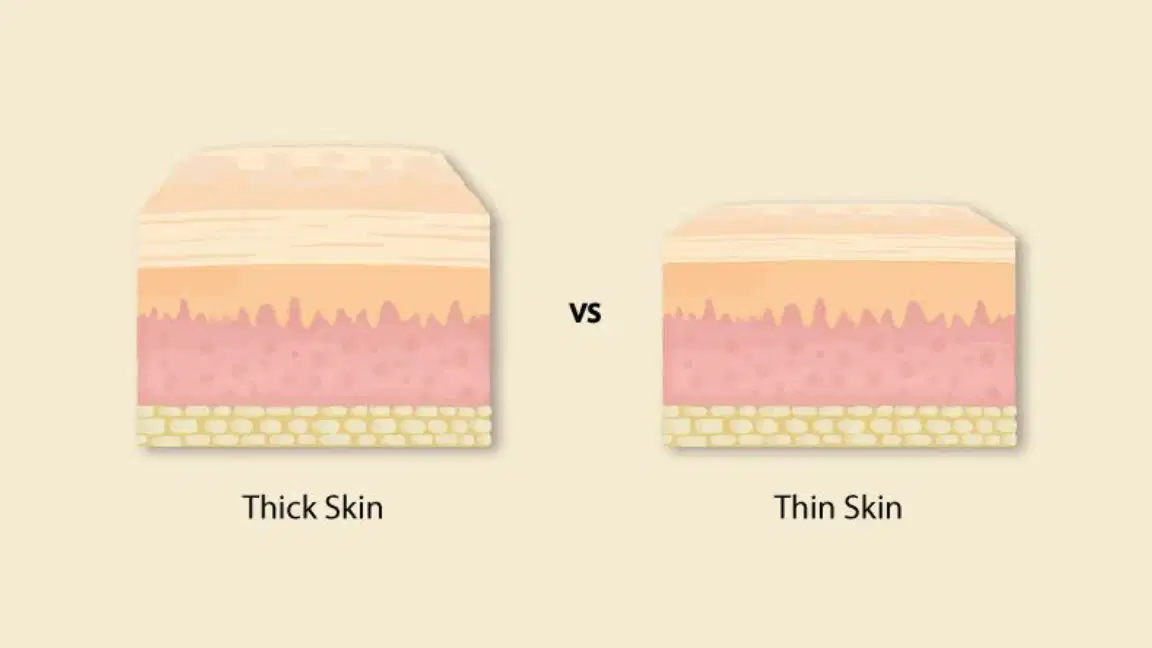
What is the main difference between thick skin and thin skin?
Thick skin has more layers than thin skin.
Thin skin has more layers than thick skin.
Both have the same number of layers.
Thick skin is less dense than thin skin.
Thick skin is characterized by its ability to provide Protection and Wear Resistance. Which of the following best describes this characteristic?
High durability and resistance to abrasion
Increased sensitivity and flexibility
Enhanced moisture retention
Improved elasticity and softness
Thick skin is characterized by the absence of which type of gland?
Sweat glands
Sebaceous glands
Endocrine glands
Exocrine glands
The characteristic of thin skin in terms of Stratum Corneum Thickness is:
Thicker than thick skin
Thinner than thick skin
Same thickness as thick skin
Variable thickness
What is the function of the Stratum basale in the thick skin?
Cell division and regeneration
Protection against UV radiation
Production of sweat
Storage of fat
Which layer of the epidermis is directly above the stratum basale?
Stratum corneum
Stratum lucidum
Stratum spinosum
Stratum granulosum
The _______ is the layer of the skin that contains the dermal papilla.
Dermis.
Epidermis.
Hypodermis.
Stratum corneum.
What are melanocytes?
(a)
What does melanin protect the DNA of skin cells against?
UV radiation
Bacteria
Viruses
Fungi
How do melanin granules protect the nucleus of a cell?
By absorbing ultraviolet radiation
By producing vitamin D
By generating heat
By reflecting visible light
What effect does the amount of melanin have on skin and hair color?
Darker skin and hair
Lighter skin and hair
No effect on skin and hair color
Only affects hair color

