
 Worksheets
Unit 8 Study Guide - Evidence of Evolution - Biology 1
Total questions: 67
Worksheet time: 2hrs 59mins
What do fossil records provide?
Predictions about future evolutionary changes
A window into the past showing the evolution of life
A complete record of all organisms that ever lived
A detailed history of human evolution
Which organisms had better odds of becoming a fossil?
Large land-dwelling organisms
Organisms with only soft body tissues
Hard-shelled marine species
Airborne species
The two main types of fossils are (a) and (b) .
In which type of rock are most fossil formations found?
Basalt rock
Igneous rock
Sedimentary rock
Metamorphic rock
What does the law of fossil succession state?
Fossils from the same era are found together
Younger fossils succeed older fossils vertically in rock strata
Younger fossils are found below older fossils
Fossils are randomly distributed in rock strata
What is absolute dating?
A method to find the exact age of a fossil using radiometric dating
Dating based on the fossil's location in the sediment
Estimating the age of a fossil based on its depth
Using historical records to date fossils
Match the following structures with their corresponding types.
vestigial
A structure that has lost its original function over time
homologous
A structure that is similar across different species due to common ancestry
adaption
A trait that has evolved to help an organism survive in its environment
variation
Differences in physical traits among individuals of a species
What is the study of organisms at the early stages of development?
DNA studies
embryology
extinction
fossil record
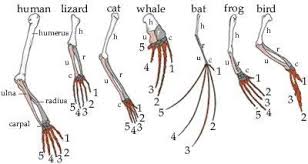
What is this an example of?
vestigial structures
embryology
homologous structures
fossil record

What is this an example of?
vestigial structures
fossil record
homologous structures
embryology
Remains of ancient organisms are called
Extinctions
Fossils
Mutations
Variations
What are the evidences for Evolution?
Fossil Records
Embryology
Similar body structure
All the above

Some organisms that share a common ancestor have features that have different functions, but similar structures. These are known as
vestigial structures
analogous structures
homologous structures
fossil structures

Two organisms that are closely related would have
very similar DNA sequence
exactly the same DNA sequences
no proteins in common
completely different DNA sequence
A bat wing and a butterfly wing are both used for flying but they are made differently. What type of structure is this?
Homologous structure
Analogous structure
Vestigial structure
Fossil structure
A human arm and a whale fin have similar bone structure but the whale fin is used for swimming and the arm is used for reaching and grabbing. What type of structures are these?
Homologous structures
Analogous structures
Vestigial structures
Fossil structures
Most recent ancestral species from which two different species evolved
common ancestor
relative dating
fossil record
analogous structures
What are Cladistics?
A system of classification that groups organisms together according to the characteristics that have evolved most recently
A system of classification that groups organisms together according to the characteristics that have appeared most recently
A system of classification that groups organisms together according to the characteristics that have evolved elsewise in relation to other species
A system of classification that separates organisms from each other according to the characteristics that have evolved most recently
What are Cladistics
A group of organisms that have evolved from a common ancestor
The other answer seems quite right to me
This is not the answer
What is a Homologous trait?
A trait/structure that is derived from the same part of a common ancestor
Eyes are an example of a homologues trait trait
Characteristics that may have the same function but not necessarily the same structure and they are not derived from a common ancestor
Wings are an example of a homologous trait

A
B
C
D

F
G
H
J

A
B
C
D

G. Atlantica and G Stehlini are the least closely related
G. Simonyi and G. Bravoana are the most closely related
G. Galloti eisentrauti and G galloti palmae are the most closely related
G galloti eisentrauti and G. galloti galloti are the least closely related
Bactrian Camels, dromedaries, llamas, and alpacas are all members of the same taxonomic family, Camelidae. Members of this family all have two toes, no hooves, true canine teeth, and a split upper lip. The family Camelidae originated in North America. The physical features of animals in this family's geographical origin provide that all these animals ______
live in the same type of ecosystem
have slowly evolved to become herbivores
exchanged DNA at some point in the past
Have a common ancestor

Where is the alligator and T. rex's common ancestor?
Point A
Point B
Point C
Point D
The evolutionary history for a group of species
taxon
phylongeny
cladistics
taxonomy

Using the Data Table 1, which organism is least related to rabbits?
Fly
Bat
Tree
Bacterium

Which organisms are closely related?
American badger and leopard
coyote and gray wolf
european otter and leopard
coyote and american badger
A clade contains
all organisms with similar appearances.
organisms living within the same ecosystem.
an ancestral species and all the organisms that came before it.
an ancestral species and all its descendants.

Which of these is a clade?
blue
green
all of these are clades
red

Which of the following conclusions is best supported by the cladogram above?
Species P and Q are equally related to species T.
Species P and T do not share a common ancestor.
Species S evolved from species R.
Species S is more closely related to species T than to species R.
The fewer the number of nodes between two groups of organisms, the more ___________ related they are expected to be.
closely
distantly

Where is the sponge and mouse's most common ancestor?
Point E
Point B
Point C
Point D
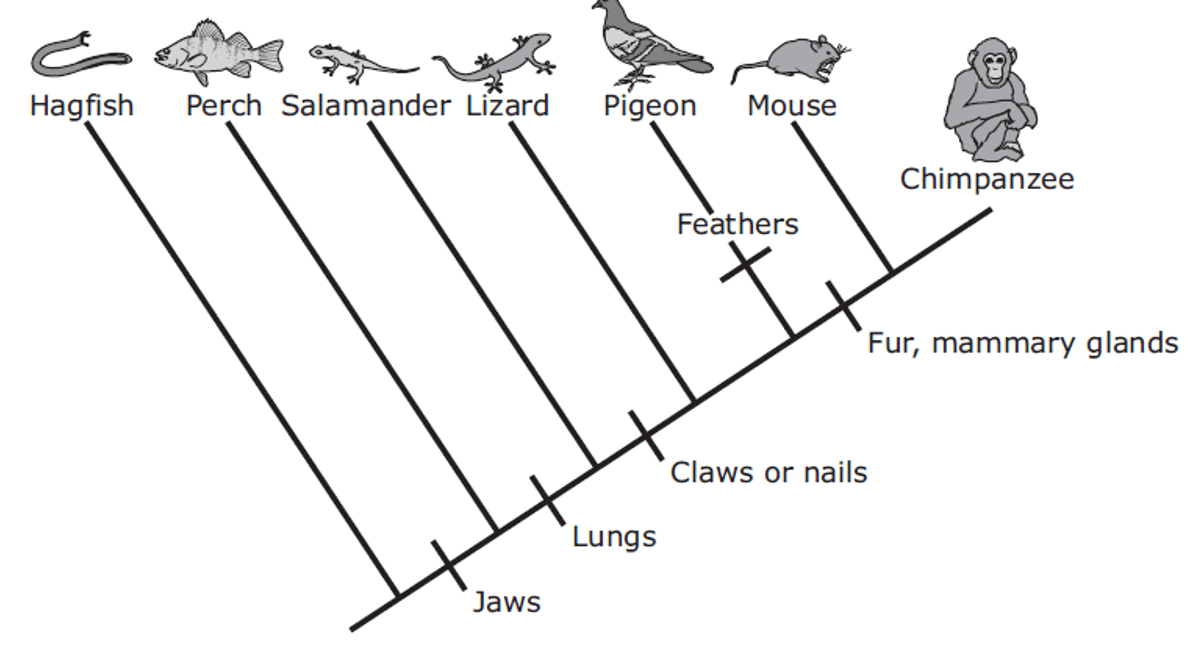
All the animals to the right of the hagfish would have the common characteristic of -
Fur
Claws or nails
Lungs
Jaws
If species A and B have very similar genes and proteins, what is probably TRUE?
species A and B share a relatively recent common ancestor
species A evolved independently of species B for a long period
species A is younger than species B
species A is older than species B
Which organisms are most closely related?
Equus caballas (Horse) & Equus burchellii (Zebra)
Cyanea artica (Jellyfish) &
Ctenodiscus crispatus (Mud Starfish)
Naja naja (cobra) & Glycine max (soya bean)
Ophiocomina nigra (black brittle star) & Brassica nigra (black mustard)
Where are most fossils found?
A. In sand dunes
B. In volcanoes
C. In igneous rocks
D. In sedimentary rocks
How are fossils created?
A. Traces of organisms harden like rock.
B. Dead organisms are quickly buried for millions of years.
C. Animals get trapped.
D. All of the above
The gradual change in living things over time is..
transition
evolution
age
revolution

The correct sequence of the layers of rocks from oldest to youngest is (a) .
A,B,C,D
D,C,B,A
A bumble bee has just enough weight to open up the snapdragon flower and get the nectar/pollen inside. Other insects cannot do this. This adaption is an example of........
convergent evolution
co-evolution
divergent evolution
speciation
Which best describes punctuated equilibrium?
Speciation occurs due to natural selection
Speciation occurs due to isolation
Speciation occurs slowly in geologic time, followed by long periods with very fast evolutionary change.
Speciation occurs suddenly and rapidly in geologic time, followed by long periods with little evolutionary change.
The large-scale events of speciation are called...
macroevolution
simplification
adaptation
microevolution
Which of the following lines of evidence shows that whales are descended from a land-dwelling, four-legged ancestor?
Whales have bone structures in their forelimbs and pelvis that are similar to those of terrestrial mammals
Whale embyros have similar structure to embryos of land-dwelling mammals, birds, and reptiles.
An analysis of DNA shows that whales' closest living relatives are hippopotamuses.
A, B, and C

The hypothesis that evolution of a species occurs gradually over time as a slow and constant process is known as
speciation
punctuated equilibrium
gradualism
microevolution

What type of structures are these an example of?
Analogous because they are used for movement
Homologous because they are used for movement
Homologous because the are all the same structure
Vestigial because they are remnants of the a past structure
Match the following types of evolution with their descriptions based on environmental conditions.
convergent evolution
Unrelated species begin to appear similar due to similar environmental pressures.
coevolution
Two or more species reciprocally affect each other's evolution.
adaptive radiation
One species evolves into multiple different forms to adapt to different environments.
divergent evolution
Related species evolve different traits and become more dissimilar over time.

The idea that evolution seems to occur in spurts of time.
stabilizing selection
gradualism
disruptive selection
puntuated equilibrium
The Endosymbiotic Theory explains
the origin of prokaryotes
how bacteria lives
the origin of eukaryotes
how species develop

Bacteria are an example of a ____ cell.
prokaryotic
eukaryotic
plant
animal
_____ and _____ are organelles that arose from endosymbiosis
nucleus and cell membrane
mitochondria and chloroplasts
cell wall and chloroplasts
mitochondria and nucleus
Which of the following is evidence to support the endosymbiotic theory?
Mitochondria and chloroplasts have their own DNA, which is similar to prokaryotic DNA.
Fossil evidence shows that the first forms of life were prokaryotic cells.
All eukaryotic cells have a double-layered membrane composed of phosplipids and proteins.
Prokaryotes have the same number and types of enzymes as eukaryotes.

The diagram shows fossils in different rock layers. Which of these statements about the age of these fossils is most likely correct?
Fossil A and C are the same age
Fossil B is older than fossil C
Fossils A is older than fossil B
Fossil D is older than fossil C
Based upon the conditions of the early Earth, which forms of live most likely appeared first?
Prokaryotic and aerobic
Prokaryotic and anaerobic
Eukaryotic and aerobic
Eukaryotic and anaerobic
The theory of Endosymbiosis explains...
The origin of eukaryotes
How species develop
How bacteria evolved
Why cells rely on one another
The Miller-Urey experiment of 1953 was designed to test the hypothesis that lightning supplied the energy needed to turn atmospheric gases into organic molecules such as amino acids. Which of the following describes why the Miller-Urey theory is widely accepted today?
Amino acids spontaneously form from molecules in the atmosphere today
Organic molecules are present today in extremely high concentrations
The process of synthesizing organic molecules from a mixture of gases has been successfully modeled in the laboratory
No other alternative hypotheses have been introduced

The two extant species that are closely related to each other are __.
A and B
B and C
C and D
D and E
According to the theory of endosymbiosis, how did cells acquire mitochondria?
A eukaryotic cell engulfed a virus
A large aerobic cell engulfed a chloroplast
A large anaerobic cell engulfed a small aerobic bacterium
A large anaerobic cell engulfed a photosynthetic bacterium
Match the following descriptions with the correct evolutionary process according to the theory of endosymbiosis.
An anaerobic cell engulfed a chloroplast
A process where a non-oxygen using cell incorporates a chloroplast.
An aerobic, eukaryotic cell engulfed a photosynthetic bacterium
A process where a cell with a nucleus and mitochondria incorporates a photosynthetic bacterium.
An anaerobic cell engulfed a small aerobic bacterium
A process where a non-oxygen using cell incorporates a small oxygen-using bacterium.
A large anaerobic cell engulfed a photosynthetic bacterium
A process where a large non-oxygen using cell incorporates a photosynthetic bacterium.
How are mitochondria and chloroplasts like bacteria cells?
They divide by meiosis
They can make their own food
They have the same membrane-bound organelles
They contain their own DNA
What was formed in the Miller-Urey experiments?
amino acids
proteins
living cells
DNA
The correct sequence of these events, from earliest to most recent, in the evolution of life on Earth is: (a)
1. origin of mitochondria
2. origin of multicellular eukaryotes
3. origin of chloroplasts
4. origin of cyanobacteria
5. origin of fungi and animals
4, 3, 2, 1, 5
4, 1, 2, 3, 5
4, 1, 3, 2, 5
Which of the following supports the hypothesis of an “RNA world” on early Earth?
Some RNA molecules are important catalysts in modern cells.
The oldest known fossils contain trace amounts of RNA.
Single-stranded RNA molecules are linear and do not form three-dimensional shapes.
RNA is the primary genetic material of many viruses.
Why do some scientists believe that RNA, rather than DNA, was the first genetic material?
RNA probably mutated into DNA
RNA has both information storage and catalytic properties.
RNA can replicate more accurately than DNA.
RNA contains uracil in place of thymine.
Experimental evidence shows that the process of glycolysis is present and virtually identical in organisms from all three domains, Archaea, Bacteria, and Eukarya. Which of the following hypotheses could be best supported by this evidence?
All organisms carry out the Krebs cycle in mitochondria.
Glycolysis is a universal energy-releasing process and is present in a common ancestor for all forms of life.
Across the three domains, all organisms are made up of cells.
The presence of glycolysis as an energy-releasing process in all organisms suggests that convergent evolution occurred.
True or False. Nucleotides could have been brought to Earth from a meteorite in the form of nucleobases billions of years ago.
True
False
Which of the following could form a fossil?
Bone
Shell
Seeds
All of the above
Why are there more animal fossils than plant fossils?
Plants are bigger than animals.
There were more ancient animals than plants.
Animals would eat the plants.
Plants have softer body parts than animals.
Of the following, which is the most abundant source of fossil evidence?
amber, because a large portion of Earth is vegetated and insects often become trapped in sap
sedimentary rock, because such rock forms in areas sediment moved by water can cause the burial of organisms
mud, because such material is heavy and organisms cannot escape from it easily
ice, because most of Earth has been covered in ice at some point or another

The type of evidence shown with the diagram above is (a) .
Molecular
Anatomical
Embryological
Fossil
The diagram shows fossils in different rock layers. Which of these statements about the age of these fossils is most likely correct? (a)
Fossil A and C are the same age
Fossil B is older than fossil C
Fossils A is older than fossil B
Fossil D is older than fossil C

