
 Worksheets
CBA Review Mechanism of Evolution
Total questions: 100
Worksheet time: 2hrs 23mins
Reindeer from a rancher in Alaska escape from their pen during an enormous snow storm. After their escape, they mate with wild caribou that are migrating across the land. The offspring of these have traits for short legs and have tame behavior.
Gene Flow
Genetic Drift
Non-Random Mating
Natural Selection
Males of the bighorn sheep species fight one another to show females who is the dominant male and are more likely to mate with females.
Natural Selection
Mutation
Genetic Drift
Non-Random Mating
During a hurricane, a population of beetles almost gets completely wiped out. The only beetles that survived were lucky that they were in their nest at the time of the hurricane and had enough food to survive.
Natural selection
Genetic Drift
Gene Flow
Non-Random Mating
Insects become resistant to pesticides very quickly, sometime in one generation. If an insect is resistant to the chemical, most of the offspring will also be resistant. Considering that insect generations can be a matter of weeks, insects in an area can become immune to a chemical within months.
Mutation
Natural Selection
Genetic Drift
Gene Flow
A chemical spill causes the offspring of ladybugs to have blue dots instead of black dots.
Natural Selection
Genetic Drift
Mutation
Gene Flow
The country of Sweden is known for having people with blonde hair and blue eyes. One day a family moves from Sweden to India where dark hair and dark eyes are very common. A female from Sweden marries a male from India and their offspring now have blonde hair and blue eyed traits.
Natural Selection
Mutation
Non-Random Mating
Gene Flow
A certain type of plant can produce blue or yellow flowers. During a fire, many yellow flowers are destroyed and now since blue is the dominant trait, the plant reproduces offspring that produce only blue flowers.
Non-Random Mating
Gene Flow
Mutation
Genetic Drift
Reindeer from a rancher in Alaska escape from their pen during an enormous snow storm. After their escape, they mate with wild caribou that are migrating across the land. The offspring of these have traits for short legs and have tame behavior.
Gene Flow
Genetic Drift
Non-Random Mating
Natural Selection
Males of the bighorn sheep species fight one another to show females who is the dominant male and are more likely to mate with females.
Natural Selection
Mutation
Genetic Drift
Non-Random Mating
During a hurricane, a population of beetles almost gets completely wiped out. The only beetles that survived were lucky that they were in their nest at the time of the hurricane and had enough food to survive.
Natural selection
Genetic Drift
Gene Flow
Non-Random Mating
Insects become resistant to pesticides very quickly, sometime in one generation. If an insect is resistant to the chemical, most of the offspring will also be resistant. Considering that insect generations can be a matter of weeks, insects in an area can become immune to a chemical within months.
Mutation
Natural Selection
Genetic Drift
Gene Flow
A chemical spill causes the offspring of ladybugs to have blue dots instead of black dots.
Natural Selection
Genetic Drift
Mutation
Gene Flow
The country of Sweden is known for having people with blonde hair and blue eyes. One day a family moves from Sweden to India where dark hair and dark eyes are very common. A female from Sweden marries a male from India and their offspring now have blonde hair and blue eyed traits.
Natural Selection
Mutation
Non-Random Mating
Gene Flow
Which combination of characteristics in a population would provide the greatest potential for evolutionary change?
Small population, low mutations rates
Large population, low mutation rates
Small population, high mutation rates
Large population, high mutation rates

Researchers studying medium ground finches on the island of Daphne Major in the Galapagos Islands collected the data below on the survival rates of finches with different sized beaks over a three-year period that included a drought.
Which statement about the finches in this environment is best supported by the data?
Finches with large beaks are more fit for the environment than finches with small beaks are
Finches with large beaks had more genes than the other finches did.
Finches with small beaks reproduce more quickly than finches with large beaks.
Finches with medium beaks had more mutations than the other finches did.

Select the best answer based on the image.
Gene Flow
Genetic Drift
Northern elephant seals have reduced genetic variation probably due to the effects humans inflicted on them in the 1890s. Hunting reduced their population size to as few as 20 individuals at the end of the 19th century. What evolutionary concept is displayed in this example?
Bottleneck Effect
Founder Effect
Directional Selection
Frequency Dependent Selection

gene flow
natural selection
bottleneck effect
founder effect

gene flow
natural selection
bottleneck effect
founder effect
Why are advantageous traits more likely to be passed onto offspring?
Because they are more likely to survive and reproduce.
Because they come from dominant alleles.
Because they come from recessive alleles.
Because the trait is an acquired phenotype.
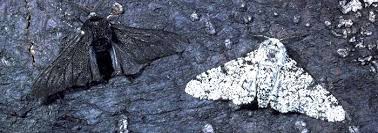
Predict which moth would increase in population
light
dark
they would be 50:50 due to random variation

Little finger = (a)
Ring finger = (b)
Middle finger= (c)
index finger = (d)
thumb = (e)
During a hurricane, a population of beetles almost gets completely wiped out. The only beetles that survived were lucky that they were in their nest at the time of the hurricane and had enough food to survive.
Natural selection
Genetic Drift
Gene Flow
Non-Random Mating
Insects become resistant to pesticides very quickly, sometime in one generation. If an insect is resistant to the chemical, most of the offspring will also be resistant. Considering that insect generations can be a matter of weeks, insects in an area can become immune to a chemical within months.
Mutation
Natural Selection
Genetic Drift
Gene Flow
A chemical spill causes the offspring of ladybugs to have blue dots instead of black dots.
Natural Selection
Genetic Drift
Mutation
Gene Flow
A group of polar bears migrates from the ice floes where they live to the nearby forest, where they interbreed with the brown bears there. This is an example of...
Genetic drift
Gene flow
Natural Selection
Founder Effect

A forest fire ignites in the Sam Houston State Forest and kills many members of a population of pigmy rattlesnakes.
Gene Flow
Genetic Drift
Select the best answer based on the image.
Gene Flow
Genetic Drift

Select the best answer based on the image.
Gene Flow
Genetic Drift
What occurs when members of one population migrate and interbreed with another population.
Mutation
Gene Flow
Bottle Neck Effect
Even distribution of traits
Non-Random Mating occurs when:
Organisms may prefer to mate with others of the same genotype or of different genotypes
Organisms and gametes enter a population with new alleles
Mutations occur more frequently
An organism's biological fitness decreases
69.7% accuracy: There are two populations of salamanders living on nearby islands. If some of the salamanders from Island A were able to reach Island B and join the salamander population there, which of the following would result?
an increase in genetic variation on Island A
an increase in genetic variation on Island B
genetic drift on Island A
natural selection on Island A
A population is
a group of similar species in different areas
a group of the same species in the same geographic area.
a group of several species in the same geographic area
a group of several species along with their abiotic factors in a small area.
61% accuracy: In rock pocket mice, for thousands of years the dominant fur color is lighter colored fur. Occasionally a mouse will be born with a change in the MC1R gene, which causes a darker fur color. This change is an example of a(n)...
gene flow
natural selection
mutation
artificial selection
Insects become resistant to pesticides very quickly, sometime in one generation. If an insect is resistant to the chemical, most of the offspring will also be resistant. Considering that insect generations can be a matter of weeks, insects in an area can become immune to a chemical within months.
Mutation
Natural Selection
Genetic Drift
Gene Flow
What do we call a change in the genome over time?
Evolution
Adaptation
Extinction
Environmental influences

According to the diagram, what is the common ancestor of ALL organisms on the phylogenetic tree?
B
C
D
E

According to this cladogram, birds are LEAST related to - (a)
Which numbered location on the phylogenetic tree identifies characteristics shared by Species B, C, and D?

Which group of animals on this tree are most closely related to birds?
Saurischian dinosaurs
Ornithischian dinosaurs
Crocodiles
None of these are related to birds

Which organism is the most distantly related to all the others?
Raccoon
Dog
Giant Panda
Sun Bear
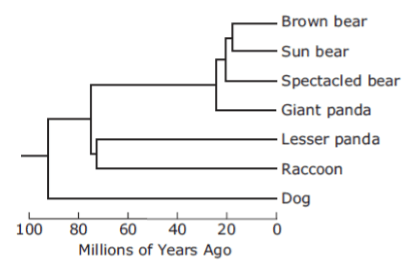
Who is the closest relative to the brown bear?
Giant panda
Dog
Lesser panda
Sun bear

What is the common ancestor of Letters A, B, C, D, E?
1
2
3
4

Who is most closely related to Taxidea taxus?
Lutra lutra
Panthera pardus
Canis latrans
Canis lupus

Cytochrome c is a protein made up of 104 amino acids. It is found in the mitochondria and aides in the electron transport chain during cellular respiration. The data table represents the number of amino acid differences in cytochrome c between organisms A, B, C, and D.
The phylogenetic trees represent possible interpretations of the data in the chart.
Which two phylogenetic trees represent the data most accurately? (choose 2)


What is the best inference about biochemical relationships that could be made from this model?
The amino acid sequences of a lancelet and a tuna are more similar than that of a tuna and a salamander. This is due to the lancelet and the tuna both residing entirely in water while the salamander can survive on land.
The amino acid sequences of a salamander and a turtle are less similar than that of a turtle and a leopard. This is due to the turtle and the salamander both being adapted to life in water or land.
The amino acid sequences of a lancelet and a tuna are less similar than that of a tuna and a salamander. This is due to the lancelet and the tuna splitting from a common ancestor longer ago.
The amino acid sequences of a salamander and a turtle are more similar than that of a turtle and a leopard. This is due to the turtle and the salamander both being adapted to life in water or land.

The lizard has all these derived characteristics EXCEPT
Jaws
Lungs
Bipedal

What separates rodents and primates from crocodiles on this cladogram?
Bony Skeleton
Vertebrae
Eggs with shells and hair
Four Limbs

Which organism's DNA will differ the most from the bird?
Rodents
Raufinned fish
Sharks
Amphibians
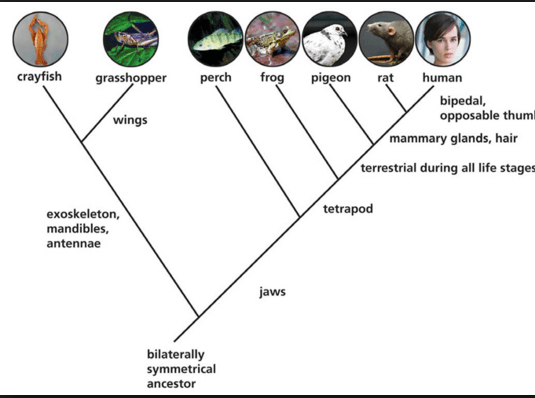
Which term is defined as: a branching diagram showing relationships between organisms that are connected by a common ancestor
Fossil Records
Descent Graph
Cladograms
Phylogenetic Tree
Which term is defined as: a specific type of tree that includes traits of species on the tree
Fossil Records
Descent Graph
Cladograms
Phylogenetic Tree
Which of the following is a phylogenetic tree? (choose all that apply)


Which number represents the common ancestor of all species on the tree?
1
2
3
4
Which number(s) do species C and D have in common?
1
2
3
4
Which number(s) do species B and D have in common?
1
2
3
4
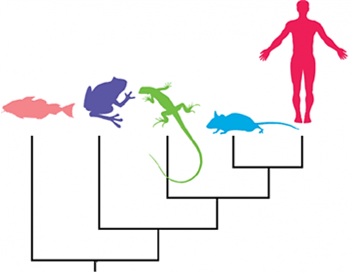
According to this phylogenetic tree, which creature is the least related out of all pictured?
Fish
Frog
Salamander
Human
Who is the closest relative to the brown bear?
Giant panda
Dog
Lesser panda
Sun bear

Which trait (adaptation) was developed most recently?
tetrapod limbs
feathers
amnion
They developed at the same time

According to this image, which two domains of life are most related?
Bacteria & Archaea
Archaea & Eukarya
Eukarya & Bacteria
According to this phylogenetic tree, which creature is the least related out of all pictured?
Fish
Frog
Salamander
Human

What do you call the traits shown on phylogenetic trees, such as "four limbs" or "vertebrae"?
Derived characteristics
Speedy Lambofeeties
Branching elements
Harmonious changes
Which group of animals on this tree are most closely related to birds?
Saurischian dinosaurs
Ornithischian dinosaurs
Crocodiles
None of these are related to birds

What number is the common ancestor of C and D
1
2
3
4

From the picture above, What do the species all have in common?
Back bone
Same father
Common ancestor
Feathers

Phylogeny is usually represented by a tree diagram called a _________ - _____
Genetic Line
Phylogenetic Tree
Photographic Queue
Future Babies
What is the common ancestor of Letters A, B, C, D, E?
1
2
3
4
Who is the closest relative to the brown bear?
Giant panda
Dog
Lesser panda
Sun bear
Which organism is the most distantly related to all the others?
Raccoon
Dog
Giant Panda
Sun Bear
Which group of animals on this tree are most closely related to birds?
Saurischian dinosaurs
Ornithischian dinosaurs
Crocodiles
None of these are related to birds
On a phylogenetic tree, what do the branch lengths represent?
The age of the organisms
amount of genetic change since divergence
amount of genetic change since convergence
The age of divergence
Natural Selection
Process where traits and organisms that are best adapted to the environment survive and reproduce.
Adaptation
A variation in a plant or animal that increases it chance of survival in its environment.
Development
The process by which animals and plants grow and develop.
Diversity
The variation of life forms present in different ecosystems.
Species
Organisms that can reproduce, have similar characteristics, and have a common gene pool.

Diversity

Natural Selection

Adaptation

Species

Development
A process in nature where traits and organisms that are best adapted to the environment survive and reproduce.
(a)
A variation in a plant or animal that increases it chance of survival in its environment.
(a)
The process by which animals and plants grow and develop.
(a)
The evolutionary tendency of organisms with a common ancestor to develop different adaptations or traits and become less related.
(a)
A taxonomic category referring to organisms that can reproduce with one another, have similar characteristics, and have a common gene pool.
(a)
Lots of offspring and limited resources causes competition for those resources.
Overproduction of offspring
Natural selection
variation
adaptation
(a) is when some organisms are more suited to their (b) . Fittest means the ability of an individual to (c) and (d) in its specific (e) .

Process by which individuals that are better suited to their environment survive and reproduce most successfully; also called natural selection. (a)
The fossils found closer to the surface of the ground are generally -
(a)
A bat wing and a butterfly wing are both used for flying but they are made differently. What type of structure is this?
Homologous structure
Analogous structure
Vestigial structure
Fossil structure
A human arm and a whale fin have similar bone structure but the whale fin is used for swimming and the arm is used for reaching and grabbing. What type of structures are these?
Homologous structures
Analogous structures
Vestigial structures
Fossil structures
When comparing the DNA of two different organisms, the more differences in the DNA base pairs the more-
Closely related they are.
Distantly related they are.
It doesn't prove anything.
They look alike.

The moth wing and the bat wing are example of structures.
(a)

Which of the pictures above would be examples of homologous structures? (pick 2)
1
2
3

What type of evidence is shown with the diagram above?
Molecular
Anatomical
Embryological
Fossil

The similarities of bone structure in the diagram provide evidence of what?
The organisms probably use there forelimbs for the same thing.
The organisms evolved from a common ancestor.
The organisms have the same DNA.
All vertebrate species have identical forelimbs.
Analogous Structure
Same function different structure
Homologous Structure
Same structure different function
Comparative Embryology
Comparing embryological development of different species
Biochemical Evidence
Comparing DNA and amino acid sequences of different species
Vestigial Structures
Structures in the body of an organism that no longer work.

Match the following

Fossil Evidence

Homologous Structures

Analogous Structure

Embryology

Biogeochemical Evidence
Recently, scientists have been able to use ___________to find common proteins and amino acids to determine how closely related species are.
DNA
Vestigial structures
Fossils
Homologous structures

