Worksheets
Circular Motion
Total questions: 110
Worksheet time: 2hrs 55mins

Centripetal force is an acceleration of an object moving in circular path whose direction is _________________________of the circular path and whose magnitude is equal to the square of the speed divided by the radius.
towards the tangent
towards the centre
towards the minimum point
towards the maximum point
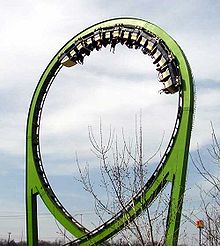
Where is the net force when the rollercoaster is at the top of the loop?
Towards the sky
Towards the Right
Towards the left
Towards the center of the circle
In uniform circular motion, the magnitude of the _______________________of an object is constant but the __________ is continually changing.
speed, acceleration
speed, direction
acceleration, speed
acceleration, velocity
________________________ defined as the number of revolutions (cycles/rotations) completed in one second.
frequency
period
distance
centripetal acceleration
If an object is spinning around on a string and the string was suddenly cut, the object would move in a
curved path
straight line
Why does an object experiencing uniform circular motion have an acceleration?
because it ir changing speed
because it is changing direction
because it is moving n a straight line
because it has mass

The _______________________ supplies the centripetal force requirement for the car to move in a horizontal circle. Without it, the car would turn its wheels but would not move in a circle (as is the case on an icy surface).
friction force
centrifugal force
normal force
applied force

In this diagram, what do the red arrows represent?
the acceleration vector
the velocity vector
the centripetal force vector
the force of gravity
moving or tending to move toward a center...
centripetal force
centrifugal force
Tangent
Curvature

the process or act of turning or circling around something
Curvature
Rotation
Radius
Orbit

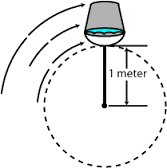
Which bucket has more inertia?
The bucket on the left because it has less mass
The bucket on the right because it has more mass
They have the same inertia
The bucket on the right because it has less mass
Which bucket would take less force?
The bucket on the left because it has less mass
The bucket on the right because it has more mass
They have the same inertia
The bucket on the left because it has more mass


When two equal forces act in opposite directions on an object, they are called ______________________.
frictional force
balanced force
centripetal force
gravitational force
When an unbalanced force acts on an object, the force ______________________.
changes the motion of the object
is cancelled by another force
does not change the motion of an object
is equal to the weight of the object

The picture is an example of Newton's...
1st Law
2nd Law
3rd Law


When a car goes around a circular curve on a level road, ...
no frictional force is needed because the car simply follows the road.
the frictional force of the road on the car increases when the car's speed decreases.
the frictional force of the road on the car increases when the car's speed increases.
the frictional force of the road on the car increases when the car moves to the outside of the curve.
Calculate the velocity of an object moved around a circle with a radius of 1.65 m and an acceleration of 3.5m/s2 .
2.4 m/s
3.6 m/s
3.9 m/s
4.2 m/s
When moving in a horizontal circular path, what direction is acceleration?
In the opposite direction of motion
Tangential to the circle in the direction of motion
Outwards from the center of the circle
Towards the center of the circle

How is acceleration seen in circular motion?
Velocity increases as the object travels in a circle.
Velocity decreases as the object travels in a circle.
The object changes direction as it travels in a circle.
There is no acceleration as an object travels in a circle.
A 10kg car travels at a constant speed of 20.0 m/s around a horizontal circular track. Which diagram correctly represent the direction of the car's velocity (v) and the direction of the centripetal force (Fc) acting on the car at a particular moment?


A bicycle has a period of 0.3s . What is the
speed of its tires if their radius is 30 cm?
6 m/s
3 m/s
60 m/s
30 m/s

What causes centripetal acceleration?
Change in magnitude
Change in the direction of the velocity vector
Change in angular displacement
change in position
Centrifugal force is a ______
force that pushes you to the outside of a circle during uniform circular motion.
fictitious force that is really just the linear motion of an object in uniform circular motion.
The force that keeps the planets in orbit
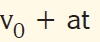
What is the velocity formula for uniform circular motion?


A) No, if the speed is constant then the acceleration is equal to zero. B) No, an object can accelerate only if there is a net force acting on it.
C) Yes, although the speed is constant, the direction of the velocity can be changing.
D) Yes, if an object is moving it can experience acceleration
A) Both vectors point in the same direction.
B) The vectors point in opposite directions.
C) The vectors are perpendicular.
D) The question is meaningless, since the acceleration is zero
A) in the same direction as the velocity vector.
B) in the opposite direction of the velocity vector.
C) is directed toward the center of the circular path. D) is directed away from the center of the circular path.
B) in the opposite direction of the motion of the object.
C) is directed toward the center of the circular path. D) is directed away from the center of the circular path.
Which law determines the direction of an object's velocity as it is moving in uniform circular motion?
Newton's First Law
Newton's Second Law
Newton's Third Law
The Universal Law of Gravitation
Which law determines the direction of an object's acceleration as it is moving in uniform circular motion?
Newton's First Law
Newton's Second Law
Newton's Third Law
The Universal Law of Gravitation
The term centripetal means
circular motion
center accepting
center seeking
center fleeing
The term centrifugal means
circular motion
center accepting
center seeking
center fleeing
A 10kg car travels at a constant speed of 20.0 m/s around a horizontal circular track. Which diagram correctly represent the direction of the car's velocity (v) and the direction of the centripetal force (Fc) acting on the car at a particular moment?
Identify the force that determines the centripetal force as a car is turning a corner.
Friction Force
Tension Force
Normal Force
Centripetal Force
Other than gravity what is the other force that is contributing to the net force of the coaster at the top of the loop?
Tension Force
Friction Force
Centripetal Force
Normal Force

A pilot experiences centripetal acceleration of 2g's (2 x 9.8 m/s2) while maneuvering a loop at a speed of 400 m/s. What is the radius of the loop?
203 m
8163 m
80,003 m
23 m

A satellite of mass m and speed v orbits the Earth at a distance r from the center of the Earth. The gravitational acceleration due to the Earth at the satellite is equal to.
v/r
v2/r
mv/r
mv2/r
Centripetal force is...
the inward force acting on a body moving at constant speed in a circle
the outwards force acting on a body moving at constant speed in a circle

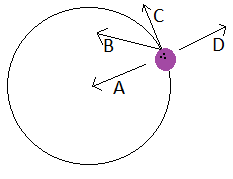
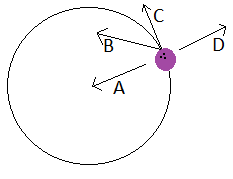
A ball is moving at constant speed around the circle. Which letter represents the acceleration of the ball?
A
B
C
D
Nonsense. The ball can't be accelerating while moving at a constant speed.


Why do objects experience centripetal acceleration even though they can have a constant speed?
Because they are speeding up as they move in a circle
Because they are constantly changing direction and hence, velocity changes, and that net change is directed inward.
Because they are constantly changing both speed and direction
Because when you have 100 people pedaling, you can speed up more easily.
The linear velocity is always _____ to the line of a circle.
outwards
towards the center
tangent
faster
Calculate the velocity of an object moved around a circle with a radius of 1.65 m and an acceleration of 3.5m/s2 .
2.4 m/s
3.6 m/s
3.9 m/s
4.2 m/s
A bicycle has a period of 0.3s . What is the
speed of its tires if their radius is 30 cm?
6 m/s
3 m/s
60 m/s
30 m/s
A 0.50 kilogram object moves in a horizontal circular path with a radius of 0.25 meter at a constant speed of 4.0 meters per second. What is the magnitude of the object’s acceleration?
8 m/s2
32 m/s2
16 m/s2
64 m/s2

Ali is rotating a stone suspended by a thread of a length r . If the speed of rotation is 2m/s and the periodic time is 0.5s. What is the length of the thread ?
r= 0.16 m
r= 6.28 m
r= 1 m
r= 0.31 m
If a rubber stopper completes 20 revolutions in 10 seconds, what is the period?
0.5 s
2 s
10 s
20 s
A race car completes three laps of a circular track with a radius of 35 m in 9.0 seconds. Determine the speed of the car.
3.9 m/s
73.3 m/s
24.4 m/s
1.0 m/s
A particle of mass 0.01 kg moves in a horizontal circle of diameter 1 m with an angular velocity of 3π
rad s-1.
What is the magnitude of the force responsible for this motion?
0.03 π
0.09 π
0.03 π2
0.09 π2
A particle of mass 0.01 kg moves in a horizontal circle of diameter 1 m with an angular velocity of 3π
rad s-1.
What is the magnitude of the force responsible for this motion?
0.03 π
0.09 π
0.03 π2
0.09 π2
A particle of mass 0.01 kg moves in a horizontal circle of diameter 1 m with an angular velocity of 3π
rad s-1.
What is the direction of the force responsible for this motion?
away from the centre of the circle
towards the centre of the circle
along a tangent to the edge of the circle
in a circle
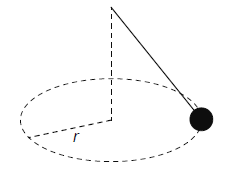
The mass at the end of a pendulum is made to move in a horizontal circle of radius r at constant speed. The magnitude of the net force on the mass is F.
What is the direction of F during half a revolution?
towards the centre of the circle
away from the centre of the circle
along a tangent to the circle
in a circle
The mass at the end of a pendulum is made to move in a horizontal circle of radius r at constant speed. The magnitude of the net force on the mass is F.
What is the work done by F during half a revolution?
0
πrF
(πrF)2
2πrF
An object of mass m at the end of a string of length r moves in a vertical circle at a constant angular speed ω.
What is the tension in the string when the object is at the bottom of the circle?
m(ω2r + g)
m(ω2r –g)
mg(ω2r + 1)
mg(ω2r +-1)
An object of mass m moves in a horizontal circle of radius r with a constant speed v. What is the rate at which work is done by the centripetal force?
rmv3
2πrmv3
4πrmv3
zero
An object rotates in a horizontal circle when acted on by a centripetal force F. What is the centripetal force acting on the object when the radius of the circle doubles and the kinetic energy of the object halves?
4F
2F
F
2F
The maximum speed with which a car can take a circular turn of radius R is v. The maximum speed with which the same car, under the same conditions, can take a circular turn of radius 2R is
2v
v√2
4v
2v√2
A satellite X of mass m orbits the Earth with a period T. What will be the orbital period of satellite Y of mass 2m occupying the same orbit as X?
2T
T
T2
2T

Two particles, X and Y, are attached to the surface of a horizontally mounted turntable.
The turntable rotates uniformly about a vertical axis. The magnitude of the linear velocity of X is v and the magnitude of its acceleration is a. Which of the following correctly compares the magnitude of the velocity of Y and the magnitude of the acceleration of Y with v and a respectively?
Y velocity = v
Y acceleration < a
Y velocity > v
Y acceleration < a
Y velocity = v
Y acceleration > a
Y velocity > v
Y acceleration > a