wayground logo

Free Printable Worksheets

Font size

S
M
L
XL
Worksheets

Physics February Review

Total questions: 113

Worksheet time: 2hrs 53mins

Name
Class
Date
1.

The acceleration during the whole trip, on the horizontal component, is always...

a)

0 m/s2

b)

3.6 m/s2

c)

5 m/s2

d)

-9.8 m/s2

2.

In a projectile motion like the shown on the picture, the velocity with which the projectile hits the ground is...

a)

0 m/s

b)

the same as the initial velocity

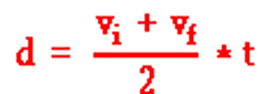
c)

unknown

d)

9.8 m/s

3.
The more mass an object has, the faster it will fall.
a)
True
b)
False
4.
At the instant a ball is thrown horizontally with a large force, an identical ball is dropped from the same height. Which ball hits the ground first? 
a)
Neither- they hit at the same time
b)
the horizontally thrown ball
c)
the dropped ball
d)
None of these
5.
In the absense of air resistance, as an object travels through the air, its horizontal velocity
a)
changes continuously
b)
not enough information
c)
remains the same
6.
If you throw a baseball straight up, what is its acceleration at the highest point?
a)
-9.8 m/s2
b)
-9.8 m/s
c)
0 m/s2
d)
0 m/s
7.

At what point is vy= 0 m/s?

a)

A

b)

B

c)

C

d)

D

e)

None of these points

8.

Which vector pair (arrow pair) correctly represents the acceleration and velocity at point P?

a)
b)
c)
d)
9.

Suppose Lemming A runs off the edge of the cliff at 2 m/s and Lemming B runs off the edge at 1 m/s. Which will hit the ground first?

a)

A

b)

B

c)

Both at the same time

10.

Suppose Lemming A runs off the edge of the cliff at 2 m/s and Lemming B runs off the edge at 1 m/s. Which will hit the ground farther from the base of the cliff?

a)

A

b)

B

c)

Both at the same distance

11.
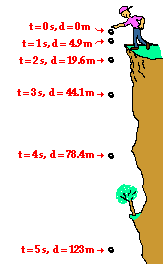
If you drop a banana, how fast is it going after 2 seconds?
a)
4.9m/s
b)
9.8m/s
c)
19.6m/s
d)
29.4m/s
12.
What is the height of a horizontal projectile if it takes 3 seconds to hit the ground?
a)
3.00 m
b)
29.4 m
c)
44.1 m
d)
88.3 m
13.

-9.8m/s2

a)

Magnitude

b)

Acceleration due to gravity

c)

Displacement

d)

Speed

14.
A vector is a quantity that had
a)
magnitude and time
b)
time and direction
c)
magnitude and direction
d)
direction and rhythm 
15.
A scalar is a quantity that had
a)
direction
b)
magnitude
c)
time
d)
color
16.
T/F The length of the vector represents magnitude. 
a)
True
b)
False
17.
T/F The orientation of a vector shows the direction. 
a)
True
b)
False
18.
T/F Mass is a vector quantity. 
a)
True
b)
False
19.
Velocity is both ____ and _____. 
a)
speed , direction 
b)
direction, mass
c)
volume, density 
d)
direction, magnitude 
20.
Which of the following is a unit for acceleration?
a)
km/s
b)
m/s2
c)
mi/hr
d)
ft
21.
65mi/hr South is an example of...
a)
Speed
b)
Velocity
c)
Acceleration
d)
Direction
22.
Km (kilometers) is a unit for...
a)
Speed
b)
Distance
c)
Time
d)
Direction
23.
Acceleration is defined as the CHANGE in 
a)
time of motion to another place. 
b)
velocity 
c)
distance 
d)
speed
24.
What is speed?
a)
how far you go
b)
how much distance is covered over a period of time
c)
how fast you accelerate
d)
the change in the location of a object
25.
Changes in our speed, direction or both are called _________.
a)
gravity
b)
changes
c)
acceleration
d)
displacement
26.

The total length of the path of a moving object.

a)

distance

b)

speed

c)

displacement

d)

acceleration

27.

The distance between a moving object's final position and its starting position.

a)

speed

b)

reference point

c)

velocity

d)

displacement

28.

In Newtonian physics, ________________ is any motion of a body where gravity is the only force acting upon it.

a)

kinematics

b)

free fall

c)

mechanics

d)

velocity

29.

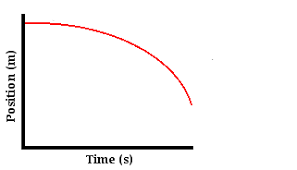
Which of the following graphs best represents free fall motion?
a)
b)
c)
d)
30.

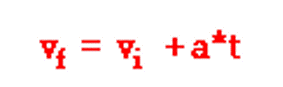
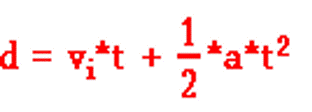
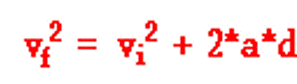
A man drops his camera off of the top of the oil derrick tower at Six Flags. Which of the following kinematic equations would he use in order to calculate the speed the camera was travelling when it hit the ground?
a)
b)
c)
d)
31.

Juan is standing on the top observation deck of the Eiffel Tower in Paris at a height of 300 meters. He drops his cell phone. How fast will the phone be traveling when it hits the ground? Ignore the effect of air resistance.

a)

9.8 m/s

b)

76.68 m/s

c)

149.76 m/s

d)

46.99 m/s

32.

If an object is in free fall for three seconds, how fast will it be falling?

a)

9.8 m/s

b)

19.6 m/s

c)

29.4 m/s

d)

39.2 m/s

33.
Which would hit the ground first if dropped from the same height in a vacuum—a feather or a metal bolt?
a)
the feather
b)
the metal bolt
c)
They would hit the ground at the same time.
d)
They would be suspended in a vacuum.
34.
What happens to the velocity of a ball as it is dropped off a cliff? 
a)
It decreases at a uniform rate 
b)
It increases at a uniform rate 
c)
It is constant 
d)
It increases at a non-uniform rate
35.
A pumpkin is dropped from a 35 m building. What is its initial velocity (vi)?
a)
9.8 m/s2
b)
35 m
c)
0 m/s
d)
9.8 m/s
36.
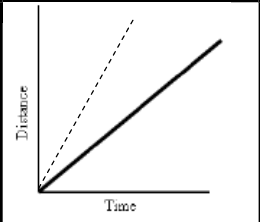
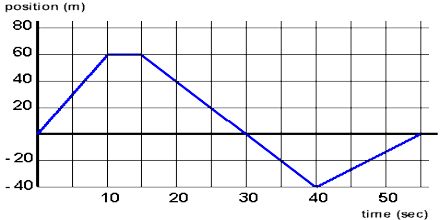
What does this graph represent?
a)
Constant Speed
b)
Acceleration
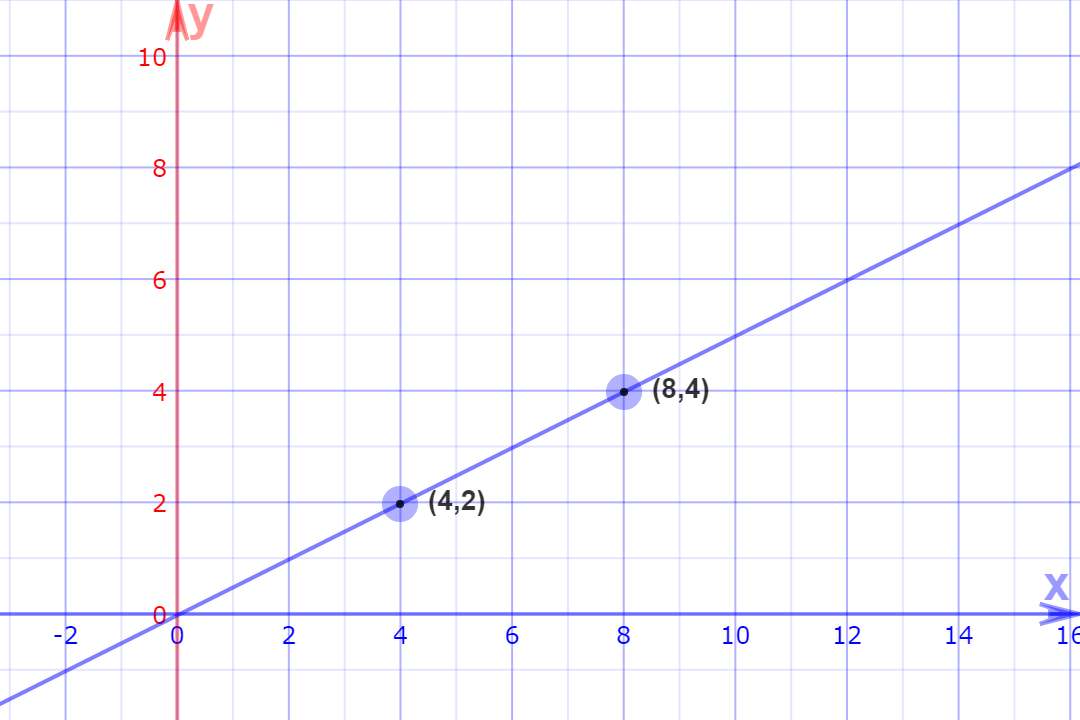
c)
Not moving
37.
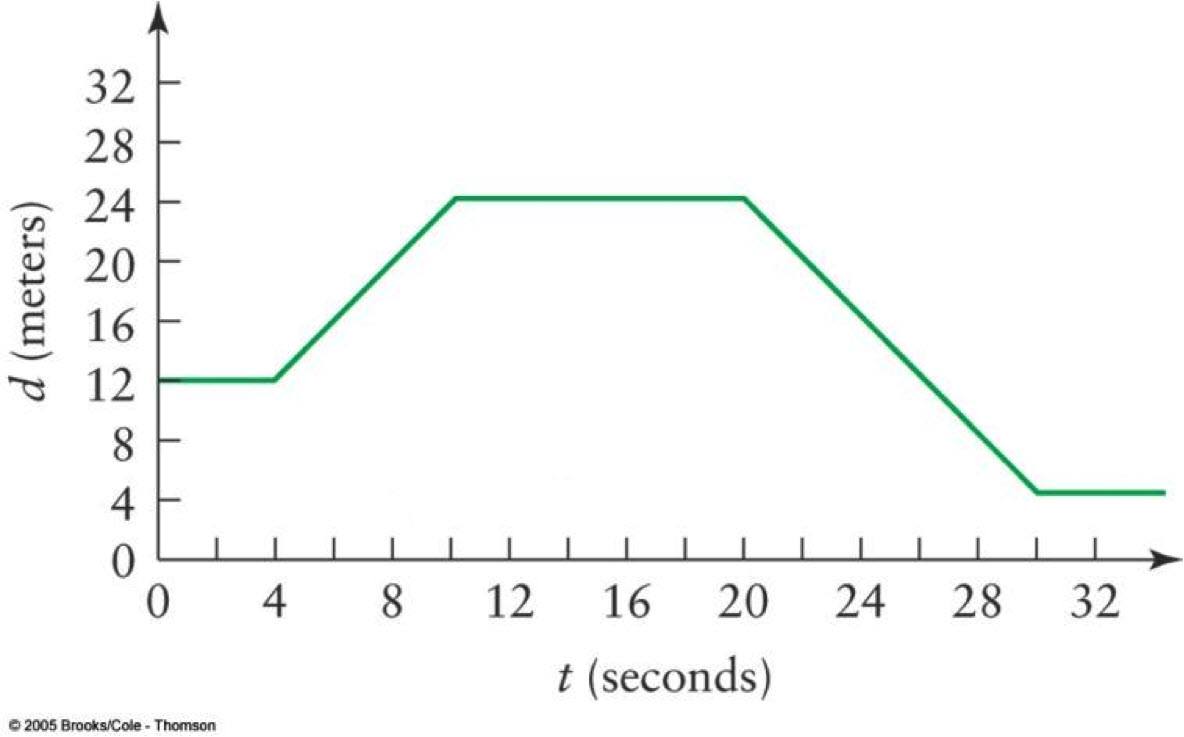
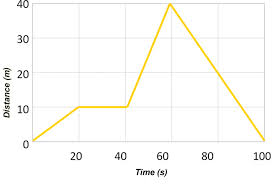
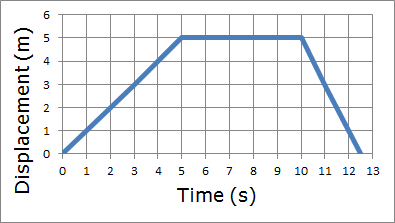
How long did it take this object to travel back to its reference/starting point?
a)
20 s
b)
30 s
c)
60 s
d)
100 s
38.
According to the graph how far does the person travel in the first 5 seconds?
a)
2 m
b)
10 m
c)
0 m
d)
5 m
39.
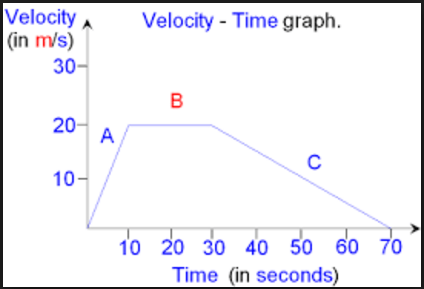
This is a velocity-time graph.  What is the object doing in segment B?
a)
Positive acceleration
b)
Negative acceleration
c)
Constant Velocity
d)
Not moving
40.
Do free falling objects move at constant velocity or do they accelerate?
a)
Falling objects accelerate at -9.8 m/s2
b)
Falling object move at constant velocity
c)
Falling objects accelerate at 100 m/s2
d)
It depends on the mass: heavy objects accelerate, light objects do not
41.

Uniform motion means that I am traveling at what type of rate?

a)

Accelerated

b)

Constant

c)

Variable

d)

Sinusoidal

42.

If something is in free fall, that means that it must be going towards the ground.

a)

True

b)

False

43.

If I jump with an initial vertical velocity of 3m/s. About how long does it take me to reach the maximum height of my jump.

a)

0.5s

b)

0.9s

c)

0.3s

d)

0.7s

44.

I can find displacement of an object using a velocity vs. time graph

a)

True

b)

False

45.

What is the definition of velocity?

a)

A change in position over a given time

b)

A change in time over a given position

c)

How fast something is going

d)

A change in motion over a given time

46.

Speed and velocity are the same exact thing

a)

True

b)

False

47.

Distance is the amount of ground you cover where as displacement is the amount your position has changed and in what direction.

a)

True

b)

False

48.

Δx = change in position = displacement = xf - xi

a)

True

b)

False

49.

If air resistance is not negligible our horizontal acceleration will be 0 m/s2.

a)

True

b)

False

50.

You are standing 10 meters from your friend playing catch. If you throw the ball in such a way that it ends up taking 2.3s to reach your friend. Your friend is also conveniently catching the ball at the same height in which you threw it from. What is the initial velocity in the x direction, vx0?

a)

0.23m/s

b)

11.27m/s

c)

4.35m/s

d)

5.01m/s

51.

Given the following graph:

What type of motion is being represented?

a)

Speeding up in the positive direction

b)

Slowing down in the positive direction

c)

Speeding up in the negative direction

d)

Slowing down in the negative direction

52.

Say you are driving along and you slam on the brakes because there is a cute little chipmunk in the road. If it takes you a total of 0.9s to come to a complete stop from traveling at a rate of 30m/s. What is the rate of acceleration and how far did you travel within that time?

a)

33m/s2

13.64m

b)

33m/s2

23.03 m

c)

52m/s2

23.03m

d)

66m/s2

13.64m

53.

What is the definition of Acceleration?

a)

A change in velocity over a given time

b)

A change in position over a given time

c)

A change in time over a given acceleration

d)

A change in time over a given position

54.
______ forces affect the motion of an object by speeding it up, slowing it down, or changing the direction of it.
a)
Balanced
b)
Strong
c)
Unbalanced
d)
WeaK
55.
Which law of motion states that an object in motion will stay in motion and an object at rest will stay at rest unless acted upon by an unbalanced force?
a)
Newton's 1st Law of Motion
b)
Newton's 2nd Law of Motion
c)
Newton's 3rd Law of Motion
56.
An object's resistance to its change in motion is its
a)
Friction
b)
Inertia
c)
Gravity
d)
Pressure
57.
Which law of motion is explained by the equation:
Force = Mass x Acceleration
a)
Newton's 1st Law of Motion
b)
Newton's 2nd Law of Motion
c)
Newton's 3rd Law of Motion
58.
As the force applied to an object increases, its acceleration______
a)
decreases
b)
increases
c)
stays the same
d)
does not exist
59.
As the mass of an object decreases, its acceleration _______
a)
decreases
b)
increases
c)
stays the same
d)
does not exist
60.
Which law of motion explains how a rocket lifts off the ground?
a)
Newton's 1st Law of Motion
b)
Newton's 2nd Law of Motion
c)
Newton's 3rd Law of Motion
61.

Is the object in equillibrium?

a)

Yes

b)

No

c)

Not enough information

62.

Is the object in equillibrium?

a)

Yes

b)

No

c)

Not enough information

63.

Is the object in equillibrium?

a)

Yes

b)

No

c)

Not enough information

64.

If the object in this picture is in equilibrium, What is the force of friction?

a)

0

b)

12

c)

8

d)

4

65.

If the object in this picture is in equilibrium, What is the Normal Force?

a)

0

b)

10

c)

19

d)

28

66.

A hiker pushed on a large rock, but it did not move. He pushed 300 N to the left. How much force does he feel from the rock?

a)

Less than 300

b)

300

c)

More then 300

67.
The combination of all forces acting on an object is called __________
a)
Parallelogram Rule
b)
Net Force
c)
Vector Quantity
d)
All the Jedi's using their abilities together
68.
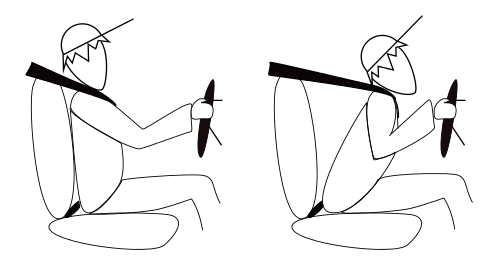
What Newtons law does this picture represent
a)
Newtons 2nd law 
b)
Law of gravity 
c)
Newtons 1st law
d)
Newtons 5th law
69.
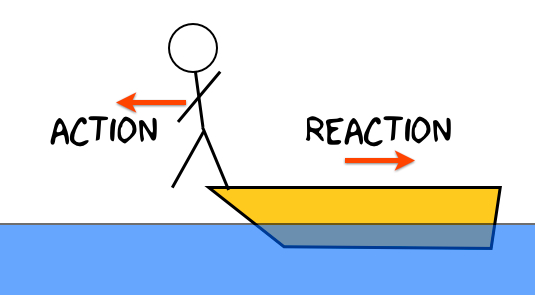
What law of motion does this picture represent?
a)
Newtons 1st law
b)
Newtons 4th law 
c)
Newtons 3rd law 
d)
Newtons 2nd law
70.
A 20 kg bike accelerates at 10 m/s2.  what was the force?
a)
25 Newtons
b)
20 Newtons
c)
200 Newtons
d)
10 Newtons
71.
Calculate the velocity of an object moved around a circle with a radius of 1.65 m and an acceleration of 3.5 m/s2.
a)
2.4 m/s
b)
3.6 m/s
c)
3.9 m/s
d)
4.2 m/s
72.
Which of the following depict the speed of the blowing ball?
a)
A
b)
B
c)
C
d)
D
73.
Calculate the centripetal force required to make a 5 kg ball move 4 m/s in a circle with a radius of 2 m.
a)
10 N
b)
20 N
c)
30 N
d)
40  N
74.
Centripetal acceleration acts towards the ___________ of the circular motion
a)
center
b)
circumference
c)
outside
d)
radius
75.
What object experiences uniform circular motion?
a)
A car speeding up as it turns left
b)
A car traveling around a roundabout at a constant speed
c)
A car slowing down as it crests a tall hill
d)
A car traveling down the road at a constant speed
76.
a)
1
b)
2
c)
3
d)
4
77.
Calculate the centripetal force required to make a 5 kg ball move 4 m/s in a circle with a radius of 2 m.
a)
10 N
b)
20 N
c)
30 N
d)
40  N
78.
Which represents the acceleration of the ball?
a)
A
b)
B
c)
C
d)
D
79.
What is the force that causes centripetal acceleration when a car goes around a curve?
a)
Friction
b)
Gravity 
c)
Normal
d)
Tension
80.
What is the velocity of the car?
a)
4.4 m/s
b)
27.9 m/s
c)
37.6 m/s
d)
89 m/s
81.
The velocity is always _____ to the line of a circle. 
a)
outwards
b)
towards the center
c)
tangent
d)
faster
82.
You are moving a ball in a circle using 72 N of centripetal force. What would the force be if you doubled the radius of the circle.
a)
18 N
b)
36 N 
c)
72 N
d)
144 N
83.
A test car moves at a constant speed around a circular track.  If the car is 48.2 m from the track's center and has a centripetal acceleration of 8.05 m/s2, what is the car's tangential speed?
a)
19.7 m/s
b)
5.99 m/s
c)
0.17 m/s
d)
388.01 m/s
84.
a)
1
b)
2
c)
3
d)
4
85.
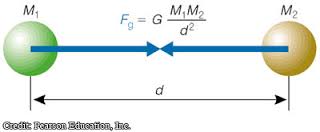
Which of the following is Newton's Law on Gravitation?
a)
F=Gm1m2/r
b)
F = Gm1m2/r2
c)
F = Gm1m2/2r
d)
F = m1m2/2r
86.
Two factors effecting the magnitude of the force of gravity between 2 objects are...
a)
mass and distance 
b)
mass and matter
c)
distance and weight 
d)
weight and mass
87.
If I double the distance between two objects, what happens to their gravitational Force?
a)
4x bigger
b)
4x smaller
c)
2x bigger
d)
2x smaller
88.
If I double the mass of one object, but don't change anything else... WHat happens to the gravitational force between two objects?
a)
Doubles
b)
Quadruples
c)
Cut in Half
d)
4x Smaller
89.
Complete the following statement: The farther away two planets are the _______ the gravitational force between them.
a)
more
b)
same
c)
dosen't matter
d)
less
90.

Calculate the gravitational force between two objects when they are 0.750m apart. Each object has a mass of 5.00kg.

a)

2.96x10⁻⁹N

b)

3.00x10⁻⁶N

c)

2.22x10⁻⁹N

d)

2.23x10⁻⁸N

91.

If the distance between 2 masses is increased then the force of gravitation between them will...

a)

increase

b)

decrease

c)

stay the same

92.

The momentum of an object depends upon the object's ___________&_____________.

a)

size and shape

b)

mass and speed

c)

mass and veloctiy

d)

mass and energy

93.

Which one of the following units represents the standard metric units of momentum

a)

Newtons * meter / second

b)

Kilograms * meter / second2

c)

meter / second

d)

Kilograms * meter / second

94.

Which one of the following units represents the standard metric units of impulse

a)

Kilograms * meter / second2

b)

Newton * meter

c)

meter / second2

d)

Newton * second

95.
The law of conservation of momentum states that, 
a)
p before is less than p after
b)
p before is the same as p after
c)
p before is more than p after
96.
When the speed of an object is doubled, its momentum
a)
remains unchanged in accord with the conservation of momentum.
b)
doubles
c)
quadruples
d)
decreases
97.

An object that has momentum can be described as _________

a)

a) changing its velocity

b)

b) moving fast

c)

c) resisting changes in its state of motion

d)

d) having its mass in motion

e)

e) encountering a net force

98.
Softer landings tend to
a)
increase impact force
b)
increase force
c)
increase collision time
d)
increase change in momentum
99.
In any collision (crash) the ______ is ALWAYS constant.
a)
Total Momentum
b)
total speed
c)
total Velocity
d)
Energy
100.
Which takes more force  to catch, a bowling ball or a ping pong ball?
a)
bowling ball because it has more momentum
b)
ping pong ball because it has more momentum
c)
both require the same amount of force when catching
d)
bowling ball because it has less momentum
101.
A 0.250 kg cart moving at 0.400 m/s has how much momentum?
a)
0.1 kg-m/s
b)
1 kg-m/s
c)
10 kg-m/s
d)
100 kg-m/s
102.
A runner has a momentum of 670 kg m/s and is traveling at a velocity of 9 m/s. What is his mass?
a)
6030 kg
b)
0.0134 kg
c)
74.4 kg
d)
80 kg
103.

A 5 N force is applied to a 3 kg ball to slow it down from 9 m/s to 3 m/s. What is the impulse on the ball?

a)

-2.5 N⋅s

b)

-10 N⋅s

c)

-18 N⋅s

d)

-45 N⋅s

104.

Energy is

a)

how fast you do something.

b)

the ability to do work.

c)

confusing.

d)

how fast you lift something.

105.

If you use 30 J of energy to move an object, you have done ____ J of work.

a)

3

b)

10

c)

30

d)

0

106.

Jane carries a 5 kg box and Lorie carries a 10 kg box up a set of stairs, who did more work?

a)

Jane because his box was lighter.

b)

Lorie because her box weighed more.

c)

Can't tell.

107.

You push a crate with a force of 100 N for 5 meters. How much work did you do?

a)

500 J

b)

100 J

c)

50 J

d)

5 J

108.

Work is done only if

a)

a force is applied.

b)

the force applied causes the object's motion.

c)

an object is in motion.

109.

On a work vs time graph, you can calculate the power by

a)

the area.

b)

the y-axis.

c)

the y-intercept.

d)

the slope.

110.

How much work is done?

a)

9 J

b)

18 J

c)

27 J

d)

36 J

111.

What is the kinetic energy of a 10 kg ball moving at 3 m/s?

a)

15 J

b)

30 J

c)

45 J

d)

90 J

112.

A 5 kg cat falls off a 3 m tall fridge. What is the cat's PE as it starts to fall?

a)

15 J

b)

30 J

c)

150 J

d)

1470 J

113.

A 5 kg cat falls off a 3 m tall fridge. What is the cat's KE just before it lands on the floor?

a)

15 J

b)

30 J

c)

150 J

d)

1470 J