Wayground logo

Free Printable Worksheets

Font size

S
M
L
XL
Worksheets

Electrons Test - Review

Total questions: 132

Worksheet time: 7hrs 6mins

Name
Class
Date
1.
Select the correct order of waves on the EMS 
a)
Radio, Micro, Infra, Visible, Ultra, X-ray, Gamma
b)
Gamma, X-ray, Ultra, Vis, Infra, Micro, Radio
c)
Vis, Micro, Infra, Ultra, X-ray, Gamma, Radio
d)
Micro, Radio, Vis, Infra, Ultra, X-ray, Gamma
2.
According to the Bohr Model, electrons are only found in specific orbits around the nucleus called __________________________
a)
Energy Levels
b)
Electron Lanes
c)
Electron Places
d)
Atomic Mass
3.

When electrons of an element reach an "excited" state, ___ lines are produced.

a)

dark

b)

emission (bright)

c)

continuous

d)

invisible

4.

In which state does an electron have the least amount of energy?

a)

Excited state

b)

Ground state

c)

Orbital

d)

Bohr model

5.
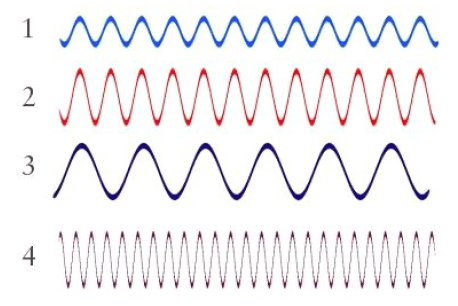
Which wave in the diagram has the greatest wavelength?
a)
1
b)
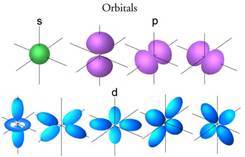
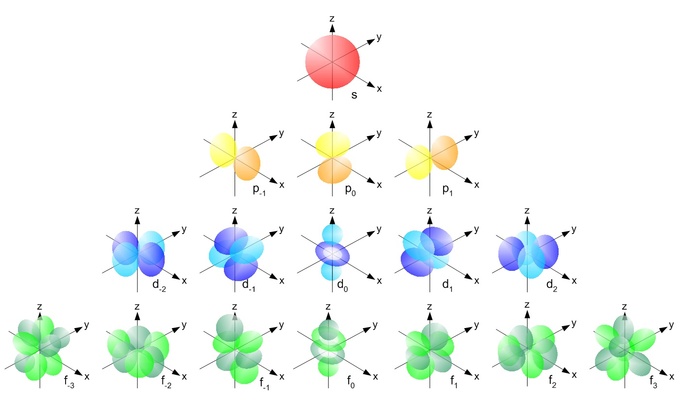
2
c)
3
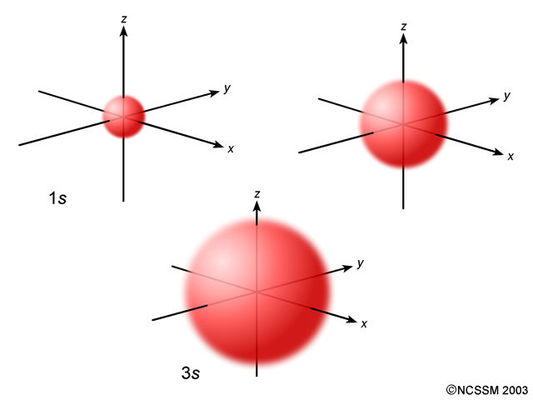
d)
4
6.

Which electromagnetic wave has the least amount of energy

a)

radio

b)

Gamma Ray

c)

Infrared

d)

Visible light

7.

Which electromagnetic wave has the longest waves

a)

radio

b)

visible

c)

ultraviolet

d)

microwave

8.

Which electromagnetic wave is the only one we can see?

a)

Gamma Rays

b)

Ocean

c)

Visible

d)

Infrared

9.
_______ carry the greatest amount of energy. 
a)
x-rays
b)
gamma rays
c)
infrared rays
d)
visible light
10.
The higher the frequency the ______ the energy. 
a)
higher
b)
lower
c)
neither, stays the same
11.
Put the visible light colors in order from longest wavelength to shortest wavelength
a)
Violet, Indigo, Blue, Green, Orange, Yellow, Red
b)
Red, Yellow, Green, Orange, Violet, Blue, Indigo
c)
Red, Orange, Yellow, Green, Blue, Indigo, Violet
d)
Yellow, Blue, Orange, Violet, Red
12.
If you're moving from gamma rays to microwave, describe how the energy level changes
a)
Increases
b)
Decreases
c)
Energy level doesn't change
d)
We never talked about it
13.
A wave with a large wavelength will have a ______ frequency and _____ energy
a)
high, low
b)
high, high
c)
low, high
d)
low, low
14.
As an electron moves from n=1 to n=4, is energy absorbed or released?
a)
Absorbed
b)
Released
15.
As an electron moves from n=4 to n=1, is energy absorbed or released?
a)
absorbed
b)
released
16.
Which statement regarding light is true?
a)
it travels at a constant speed
b)
its speed depends on temp
c)
slows down as it moves
d)
travels fastest through water
17.
Which wave has a greater frequency?
a)
A
b)
B
18.
Which kind of wave has the greatest frequency?
a)
gamma rays
b)
infrared
c)
ultraviolet
d)
microwaves
19.
The distance from one point to the next corresponding point on a wave is called the ________________.
a)
waveform
b)
peak
c)
amplitude
d)
wavelength
20.

How did the Heisenberg Uncertainty Principle affect the quantum mechanical model?

a)

You can't know the speed and position of the electron at the same time.

b)

You can know the speed and position of the electron at the same time.

c)

You can't know the mass and charge of an electron at the same time.

d)

You can't know the frequency and wavelength at the same time.

21.

According to the Octet Rule, atoms of elements react with each other in order to attain ____ electrons in their outermost energy level or shell.

a)

2

b)

4

c)

6

d)

8

e)

10

22.
Electrons occupy orbitals of lowest energy first is part of what electron configuration rule?
a)
Hund’s Rule
b)
Aufbau Principle
c)
Pauli Exclusion Principle
23.

What does Pauli exclusion principle state ?

a)

states that each electron occupies the lowest energy orbital available

b)

states that -no two electrons in the same orbital can have the same spin

c)

states that single electrons electrons with the same spin must occupy each-energy orbital before additional electrons with opposite spins can occupy the same orbitals

24.

Which area on the periodic table represents the electrons in the "d" sublevel?

a)

representative elements

b)

columns 3-8

c)

rare earth elements

d)

transition elements

25.
All orbitals of equal energy are occupied by one electron before any single orbital is occupied by a second electron.
a)
Aufbau principle
b)
Pauli exclusion principle
c)
Hund’s rule
d)
Core Notation
26.

Hydrogen being an exception to the octet rule, needs _____ electrons in its outer energy level to be stable.

a)

4

b)

6

c)

8

d)

2

27.

How many connection points does carbon have to bond?

a)

2

b)

4

c)

6

d)

8

28.

By replacing the element symbol, this could be a diagram of which element?

a)

Li

b)

Al

c)

C

d)

Be

29.

How many valence electrons should boron (B) have around its lewis dot structure?

a)

5

b)

6

c)

4

d)

3

30.

Which is the correct lewis dot structure for Ne?

a)

A

b)

D

c)

F

d)

H

31.

What usually forms a positive ion?

a)

metal

b)

nonmetal

c)

metalloid

d)

there is no way to tell

32.

What do atoms that form positive ions tend to do?

a)

lose electrons

b)

gain electrons

c)

lose protons

d)

gain protons

33.

Ionic bonding involves

a)

transfer of electrons

b)

sharing of electrons

c)

holding onto electrons

d)

electrons are not involved

34.

What is a valence electron?

a)

electron found in a middle shell

b)

electron found in outermost shell

c)

electron found in innermost shell

d)

electron not found in a shell

35.

Covalent compounds

a)

contain a sea of electrons

b)

share electrons

c)

transfer electrons

d)

conduct electricity

36.

What 2 types of atoms make a covalent bond?

a)

2 metals

b)

2 noble gases

c)

2 nonmetals

d)

1 metal & 1 nonmetal

37.

What type of bond forms between Be & F?

a)

no bond forms

b)

covalent bond

c)

ionic bond

d)

metallic bond

38.

Why do all bonds form?

a)

so the number of protons equals the number of electrons

b)

so an atom can become unstable

c)

to fill the outermost energy level

39.
Covalent bonds are between...
a)
Metal and Non-metal
b)
Non-metal and Non-metal
c)
Metal and Metal
40.
Atoms are most stable when their outer shell is complete.
a)
true
b)
false
41.
How are covalent bonds formed?
a)
Sharing of electrons
b)
Transfer of electrons
42.

Which of the following will form an anion?

a)

Titanium

b)

Iron

c)

Calcium

d)

Sulfur

43.

Which of the following will form an anion?

a)

Tin

b)

Lead

c)

Chlorine

d)

Zinc

44.

Which of the following will form a cation?

a)

Barium

b)

Phosphorous

c)

Tellurium

d)

Selenium

45.

What is a cation?

a)

a positive ion

b)

a negative ion

c)

an electrically charged cat

46.
An atom becomes _______ when it loses electrons.
a)
Positive
b)
Negative
c)
Neutral
d)
Invinsible
47.
An atom becomes _________ when it gains electrons.
a)
Positive
b)
Negative
c)
Neutral
d)
Invinsible
48.
What is the charge of an atom that has lost one electron?
a)
-1
b)
-2
c)
+1
d)
+2
49.
What is the charge of an atom that has gained one electron?
a)
-1
b)
-2
c)
+1
d)
+2
50.

Nitrogen will...

a)

lose electrons.

b)

gain electrons

51.

Which of the following will form a cation?

a)

Tellurium

b)

Iodine

c)

Nitrogen

d)

Nickel

52.

Which of the following elements will form a cation?

a)

Arsenic

b)

Copper

c)

Bromine

d)

Fluorine

53.

Light is emitted when an electron moves from the ________ state to the _________ state.

a)

excited, ground

b)

ground, excited

54.
The _______________ determines the color of visible light. 
a)
wavelength
b)
speed
c)
amplitude
d)
light
55.
When an atom has all of its electrons in the lowest energy orbitals available, the atom is  
a)
in ground state
b)
in excited state
c)
giving off light energy
d)
unstable
56.
For an electron to change from ground state to an excited stated it must...
a)
Absorb energy
b)
Release energy
57.

What is the reaction involved if the electron moves from position 1 to 2?

a)

Light will be emitted

b)

Light will be absorbed

c)

The electron will become less excited

d)

The electron will decrease a quantum

58.

Which wave has a high frequency, a short wavelength, and high energy?

a)

A

b)

B

c)

Not enough information to determine

59.
What is the shape of a p atomic orbital?
a)
an asterik
b)
a sphere
c)
a starburst
d)
a dumbbell or elliptical
60.
Emission of light from an atom occurs when the electron ________.
a)
moves within its atomic orbital
b)
jumps from a lower to a higher energy state
c)
falls into the nucleus
d)
drops from a higher to a lower energy state
61.
What is a photon?
a)
When radiation burst through electric waves
b)
The emission of electrons from a metal caused by light striking the metal
c)
The rate at which a waves energy flows through a given unit of area.
d)
packets of electromagnetic energy
62.

What is the shape of an s orbital?

a)
sphere
b)
dumbbell
c)
double dumbbell
d)
TOO COMPLEX TO KNOW IT.
63.

What makes it possible for two electrons to exist in the same energy orbital?

a)

Orbitals are big enough to fit both

b)

Electrons will move in opposite directions

c)

Electrons can't exist in the same energy orbital ,

64.
How many d orbitals are there in a given sublevel?
a)
1
b)
3
c)
5
d)
7
65.
How many electrons can the d sublevel hold?
a)
8
b)
10
c)
2
d)
4
66.
How many total electrons can the f orbitals in a sublevel hold?
a)
2
b)
14
c)
6
d)
10
67.
Which orbital has the least amount of energy? 
a)
p orbital
b)
d orbital
c)
s orbital 
d)
What is an orbital?
68.
What element is this?
a)
Helium
b)
Hydrogen
c)
Argon
d)
Silver
69.
How many dots would a Lewis Dot structure of Helium have?
a)
1
b)
2
c)
8
d)
0
70.
How many valence electrons are in Phosphorus?
a)
15
b)
4
c)
5
d)
31
71.
?
a)
Lithium
b)
Boron
c)
Carbon
d)
Neon
72.
How many electrons should Hydrogen have around its Lewis dot model?
a)
1
b)
2
c)
7
d)
8
73.
How many electrons can the first energy level hold?
a)
1
b)
2
c)
8
d)
0
74.
The electron configuration of an atom is 1s22s22p6.  The number of electrons in the atom is 
a)
3
b)
6
c)
8
d)
10
75.
Which electron configuration belongs to Chlorine (Cl)?
a)
1s2 2s2 2p6 3s2 3p5
b)
1s2 2s2 2p6 3s2 3p6
c)
1s2 2s2 2p6 3s2 3p7
76.
What atom matches this electron configuration?
1s22s22p63s23p64s23d10
a)
Zinc
b)
Copper
c)
Nickel
d)
Germanium
77.
What electron configuration matches an oxygen atom?
a)
1s22s22p63s2, 3p64s23d104p5
b)
1s22s22p4
c)
1s22s22p6
d)
1s22s22p63s23p64s23d1
78.
How many electrons can the s sublevel hold?
a)
14
b)
10
c)
2
d)
6
79.

Which area on the periodic table represents the electrons in the "d" sublevel?

a)

representative elements

b)

columns 3-8

c)

rare earth elements

d)

transition elements

80.

Each row on the periodic table represents:

a)

an energy level

b)

a sublevel

c)

an electron

d)

an orbital

81.

What element has this orbital notation?

a)

lithium

b)

beryllium

c)

boron

d)

carbon

82.

Which element is represented by this orbital notation?

a)

carbon

b)

nitrogen

c)

oxygen

d)

fluorine

83.

Which element is represented by this orbital notation?

a)

neon

b)

sodium

c)

magnesium

d)

aluminum

84.

Which of the following is the orbital notation for oxygen?

a)
b)
c)
d)
85.
Which guideline, Hund’s rule or the Pauli exclusion principle, is violated in the following orbital diagrams?
a)
Hund's
b)
Aufbau's
c)
Pauli's Exclusive
86.
Which guideline, Hund’s rule or the Pauli exclusion principle, is violated in the following orbital diagrams?
a)
Aufbau's
b)
Hund's
c)
Pauli exclusive
87.
Electrons are paired based on their spin directions, clockwise and counterclockwise, is what electron configuration rule?
a)
Hund’s Rule
b)
Aufbau Principle
c)
Pauli Exclusion Principle
88.

Who proposed that the electrons could also have wavelike behaviors.

a)

Bohr

b)

Heisenberg

c)

de Broglie

89.

Erwin Schrodinger proposed...

a)

The Bohr model of atoms

b)

The quantum mechanical model of atoms

c)

No new discovery

d)

That electrons are actually positive

90.
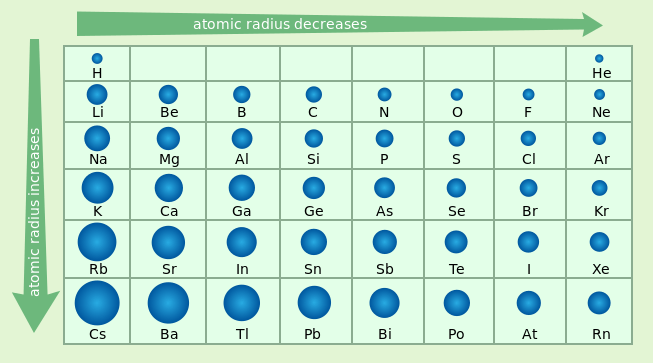
As you move down a group, atomic radius increases because - 
a)
you add more and more neutrons
b)
you add more and more protons
c)
you add more and more shells (energy levels)
d)
you add more atomic mass
91.
The atom with the largest atomic radius in Period 4 (row 4) is - 
a)
K
b)
Kr
c)
Fe
d)
Fe
92.
Francium (Fr) has the lowest ionization energy in Group 1 because - 
a)
it has the smallest number of valence electrons
b)
it has the greatest atomic mass
c)
it has the greatest number of protons, so it attracts its electrons the strongest
d)
its 1 valence electron is very far from the nucleus, so little energy is needed to remove it
93.

Which of the following will have a higher electronegativity than arsenic (As)?

a)

Carbon (C)

b)

Neon (Ne)

c)

Antimony (Sb)

d)

Germanium (Ge)

94.

Which of the following halogens has the greatest electronegativity?

a)

Chlorine (Cl)

b)

Bromine (Br)

c)

Iodine (I)

d)

Astatine (At)

95.

What is the amount of energy required to remove an electron from an atom?

a)

atomic energy

b)

ionization energy

c)

ionic energy

d)

electron energy

96.

What is one-half the distance between the nuclei of identical atoms that are bonded together?

a)

atomic radius

b)

atomic diameter

c)

atomic width

d)

atomic length

97.

What is a measure of the tendency of an atom to attract a bonding pair of electrons when the atom is in a compound?

a)

ionization energy

b)

electropositivity

c)

electronegativity

d)

electron energy

98.
Which atom has the largest atomic radius?
a)
potassium
b)
rubidium 
c)
francium
d)
cesium
99.

The element with the lowest electronegativity in Period 3 is -

a)

Na

b)

Cl

c)

Ar

d)

Mg

100.
Which of the following will have a lower ionization energy than Scandium (Sc)?
a)
Helium (He)
b)
Titanium (Ti)
c)
Calcium (Ca)
d)
Magnesium (Mg)
101.

The common charge on an atom in group 17 would be....

a)

+1

b)

+7

c)

-7

d)

-1

e)

17

102.
Atoms that have a high electronegativity, _______________.
a)
give up their electrons more easily.
b)
hold on to their electrons more tightly.
c)
have more electron shells.
103.

Noble gases are inert because

a)

They are highly reactive

b)

They are unreactive

c)

They are noble

d)

They have 8 electrons in their outer most energy level

104.

Place these elements in order from most reactive to least reactive:

Rubidium, Rb

Neon, Ne

Silicon, Si

Calcium, Ca

a)

Ne, Si, Ca, Rb

b)

Rb, Ne, Ca, Si

c)

Rb, Ca, Si, Ne

d)

Ne, Ca, Si, Rb

105.
The atom with the largest atomic radius in Group 18 is - 
a)
Ar
b)
He
c)
Kr
d)
Rn
106.
As you move across the periodic table atoms tend to get smaller because, ______________.
a)
the atoms have more mass.
b)
the atoms have less mass
c)
the atoms have more protons.
d)
the atoms have less electrons.
107.
Electronegativity is...
a)
the ability of an atom to attract/ accept electrons
b)
the ability of an atom to lose electrons
c)
the energy required to remove an electron from a specific atom
d)
how easy it is to make friends. 
108.

A high level of _________means there are more layers of electrons between the valence level and the nucleus. This makes it ________ to remove electrons from the atom.

a)

Shielding; easier

b)

electronegativity; easier

c)

shielding; harder

d)

electronegativity; harder

109.

Which of the following correctly ranks the atoms in terms of shielding effects from highest to lowest?

a)

Na > Rb > Fr

b)

Fr > Rb > Na

c)

Rb > Na > Fr

d)

Rb > Fr > Na

110.

How does the shielding effect influence an atom's radius?

a)

It decreases the atom's radius.

b)

It increases the atom's radius.

c)

It has no effect on the atom's radius.

d)

It makes the atom's radius zero.

111.

What is the effect of the shielding on the attraction between the nucleus and outer electrons?

a)

It increases the attraction.

b)

It decreases the attraction.

c)

It has no effect on the attraction.

d)

It reverses the attraction.

112.

The electrons in a nonpolar covalent molecule are shared...

a)

Evenly

b)

Unevenly

c)

Electrons are not shared

d)

None of the Above

113.

The electrons in a polar covalent molecule are shared...

a)

Evenly

b)

Unevenly

c)

Electrons are not shared

d)

None of the Above

114.

The electrons in an ionic molecule are shared...

a)

Evenly

b)

Unevenly

c)

Electrons are not shared

d)

None of the Above

115.

In a polar covalent bond, the electrons gather around...

a)

The atom with the Greatest Electronegativity

b)

The atom with the Lowest Electronegativity

c)

Each atom Equally

d)

None of the Above

116.

In a nonpolar covalent bond, the electrons gather around...

a)

The atom with the Greatest Electronegativity

b)

The atom with the Lowest Electronegativity

c)

Each atom Equally

d)

None of the Above

117.

The polarity of a bond is determined by...

a)

The sum of the electronegativities of the two atoms

b)

The difference in the electronegativities of the two atoms

c)

The charges of the atoms

d)

None of the Above

118.

What must the difference in electronegativity between two atoms be in order for the bond between them to be nonpolar covalent?

a)

less than 0.4

b)

greater than 1.7

c)

between 0.4 and 1.7

d)

exactly 0

119.

Order the types of bonds based on the charge of their molecules. (lowest amount of charge to greatest)

a)

Polar Covalent --> Ionic --> Nonpolar Covalent

b)

Ionic --> Nonpolar Covalent --> Polar Covalent

c)

Ionic --> Polar Covalent --> Nonpolar Covalent

d)

Nonpolar Covalent --> Polar Covalent --> Ionic

120.
The most electronegative atom in the periodic table is:
a)
Fluorine
b)
Helium
c)
Neon
d)
Francium
121.
Traveling across a period, from left to right, the atomic radii ______________.
a)
Increases
b)
Decreases
c)
Stays the same
122.

Which electronegativity difference would you expect for a polar covalent bond?

a)

From 0.0 to 0.4

b)

From 1.9 to 3.3

c)

From 0.5 to 1.8

123.

Which electronegativity difference would you expect for a nonpolar covalent bond?

a)

From 0.0 to 0.4

b)

From 1.9 to 3.3

c)

From 0.5 to 1.8

124.

What is the difference in electronegativity for 

SO2SO_2  ?

a)

0.5

b)

1.0

c)

2.0

d)

3.5

125.

What is the difference in electronegativity for HBr?

a)

0.7

b)

1.9

c)

2.0

d)

2.8

126.
What elements have zero electronegativity?
a)
metals
b)
nonmetals
c)
metalloids
d)
noble gases
127.

SO2 is

a)

polar

b)

non-polar

128.

H2O is

a)

polar 

b)

non-polar

129.

NH3 is

a)

polar

b)

non-polar

130.

CH4 is

a)

polar

b)

non-polar

131.

What is used to calculate the magnitude of electric forces between charged objects?

a)

Newton's Law

b)

Coulomb's Law

c)

Ohm's Law

d)

Faraday's Law

132.

Coulomb's law says that the force between any two charges depends

a)

directly on the size of the charges

b)

inversely on the square of the distance between the charges

c)

both are correct