wayground logo

Free Printable Worksheets

Font size

S
M
L
XL
Worksheets

Muscular System Exam

Total questions: 77

Worksheet time: 54mins

Name
Class
Date
1.
The thick filament is composed of: 
a)
Myosin
b)
Actin
2.
The thin filament is composed of: 
a)
Myosin
b)
Actin
3.
Involuntary
a)
skeletal
b)
cardiac
c)
smooth
d)
smooth and cardiac
4.

The gap between the nerve cell and sarcolemma is the ____ ___.

a)

Synaptic cleft

b)

Neurotransmitter

c)

Motor unit

d)

Neuromuscular junction

5.

What is the specific neurotransmitter that stimulates the movement of skeletal muscles?

a)

GABA

b)

Acetylcholine

c)

Serotonin

d)

Dopamine

6.
Region where a motor neuron comes in close contact with a muscle cell.
a)
neurotransmitter
b)
muscular dystrophy
c)
muscle tension
d)
neuromuscular junction
7.

What happens at the neuromuscular junction?

a)

A sensory neuron communicates with a motor neuron

b)

An action potential jumps from the muscle to the neuron

c)

A nerve signal traveling down a motor neuron can jump over to the muscle cell

d)

Muscle cells contract in response to a sensory neuron

8.

Skeletal muscles are voluntary.

a)

true

b)

false

9.

The epimysium covers

a)

the entire muscle

b)

the fascicle

c)

the muscle fiber

d)

the myofibril

10.

Which connective tissue surrounds the fascicle?

a)

epimysium

b)

perimysium

c)

sarcolemma

d)

endomysium

11.

Inherited muscle-destroying diseases characterized by degeneration of individual muscle fibers (usually voluntary)

a)

Lactic acidosis

b)

Muscular dystrophy

c)

Myasthenia gravis

d)

Rigor mortis

12.

autoimmune disease that attacks acetylcholine receptors leading to muscle weakness

a)

Moebius disease

b)

Muscular dystrophy

c)

Myasthenia gravis

d)

Sarin gas exposure

13.

sudden, involuntary contraction of single muscle in large group

a)

fasciculation

b)

fibrillation

c)

spasm

d)

tic

14.

What muscle tissue is voluntary?

a)

Skeletal

b)

Smooth

c)

Cardiac

15.

Smooth and Cardiac Muscle Tissue are

a)

voluntary

b)

involuntary

16.

What is troponin?

a)

thin my-filament

b)

thick my-filament

c)

protein, binds actin and Ca

d)

protein, blocks myosin binding when muscle is relaxed

17.

What is tropomyosin?

a)

thin myofilament

b)

thick my-filament

c)

protein, binds actin and Ca

d)

protein, blocks actin binding when muscle is relaxed

18.
Which muscle type is found in your stomach, bladder, and intestines?
a)
Skeletal
b)
Smooth
c)
Cardiac
d)
Straight
19.
Which type of muscle is found in your heart?
a)
Skeletal
b)
Smooth
c)
Cardiac
d)
Straight
20.
Which muscles are involuntary?
a)
skeletal
b)
cardiac
c)
smooth
d)
smooth and cardiac
21.
When a muscle contracts, it _______
a)
gets longer
b)
gets shorter
c)
gets thinner
d)
grows hair
22.
Which types of muscle tissue are voluntary?
a)
Cardiac
b)
Skeletal
c)
Smooth
d)
Cardiac and Smooth
23.
Skeletal muscles are attached to the _________.
a)
Stomach
b)
Lungs
c)
Bones
d)
Involuntary Muscles
24.
Cardiac muscles are ONLY located in the heart
a)
TRUE
b)
FALSE
25.
Muscles always work in _____
a)
pairs
b)
groups of 3
c)
bones
d)
joints
26.
Voluntary muscle is
a)
muscle that has to be told when to move
b)
muscle that moves automatically
c)
muscle that needs to be stretched regularly
d)
muscle that makes up the heart and stomach
27.
What type of muscle is found in the bladder?
a)
cardiac
b)
skeletal
c)
smooth
d)
involuntary
28.
What is an example of an involuntary muscle? 
a)
Heart
b)
Arms 
c)
Legs
d)
Shoulders
29.
The cardiac muscle is 
a)
Voluntary 
b)
Involuntary 
30.
The smooth muscle is located 
a)
In the heart 
b)
Bones 
c)
Head 
d)
Within organs 
31.
Involuntary muscle is 
a)
muscle found in the heart
b)
muscle found in the organs
c)
muscle that works automatically
d)
all of these are true
32.
Tendons connect __________ to bone.
a)
Cartilage
b)
Bone
c)
Muscle
d)
Ligaments
33.

What muscle is highlighted in the picture?

a)

Triceps

b)

Biceps

c)

Quads

d)

Deltoids

34.

What muscle is highlighted in the picture?

a)

Triceps

b)

Biceps

c)

Quads

d)

Deltoids

35.
What is a voluntary muscle?
a)
You have control over the muscle 
b)
You have no control over the muscle
c)
Muscle works automatically
d)
Muscles fuse together
36.

What muscle is highlighted?

a)

Lats

b)

Abdominals

c)

Pectoralis

d)

Quads

37.

How many types of muscles are there?

a)

2

b)

4

c)

3

d)

1

38.

What are the characteristics of the cardiac muscle?

a)

Involunatary

b)

Found in the heart

c)

Banded Appearance

d)

Dense connective tissue packaging

39.

Smooth Muscle is found in the?

a)

Heart

b)

Facial

c)

Organs

d)

Legs

40.

The connective tissue sheath that surrounds a muscle fasciculus is the

a)

epimysium

b)

endomysium

c)

perimysium

41.

given the following events:

1.acetycholine broken down

2.acetylcholine moves across the synaptic cleft

3.action potential reaches the terminal branch (presynaptic terminal)

4.acetylcholine combines with a receptor molecule on a skeletal muscle (postsynaptic membrane)

5.action potential produced in skeletal muscle cell


Choose the arrangement that lists the events in the order the occur at a neuromuscular injunction

a)

2,3,4,1,5

b)

3,2,4,5,1

c)

3,4,2,1,3

d)

4,5,2,1,3

42.

Muscles that oppose one another are

a)

synergist

b)

hateful

c)

prime movers

d)

antagonists

43.
Muscles are composed of which of the following?
a)
Lipids
b)
Protiens
c)
Carbohydrates
d)
Fats
44.
Which of the following is defined as the ability of an object to quickly return to the original shape and size?
a)
Elasticity
b)
Excitibility
c)
Flexibility
d)
Extensibility
45.
Which of the following is defined as the ability to change or be changed according to circumstances?
a)
Elasticity
b)
Excitability
c)
Flexibility
d)
Extensibility
46.
Which of the following is NOT a type of muscle?
a)
Rough
b)
Smooth
c)
Cardiac
d)
Skeletal
47.
Skeletal muscles are responsible for which of the following?
a)
Movement of the body
b)
Movement of the heart
c)
Movement of the ligaments 
d)
Movement of the extremities
48.
Which of the following describes the sarcomere? 
a)
The basic unit of muscle’s cross-striated myofibril
b)
. A protein band which defines the boundary between one sarcomere 
c)
 Various muscle proteins 
d)
Contains the protein, actin
49.
Which of the following describes muscle bundles? 
a)
Long, multi-nucleated, thread-like cells
b)
Set of muscle fibers grouped together 
c)
Considered to the cell of the muscle 
d)
Organelles which are unique to muscle tissue
50.
Skeletal muscles are attached to which of the following? 
a)
Bones and ligaments 
b)
Ligaments and tendons
c)
Tendons and bones
d)
Bones and fat 
51.

Muscles are needed for what?

a)

movement

b)

decoration

c)

pump blood

d)

no one knows

52.

Smooth muscle is located where?

a)

heart

b)

bones

c)

toes

d)

internal organs

53.

The nerve releases a chemical called a

a)

neurotransmitter

b)

neuron

c)

myofibril

d)

cell

54.
What are the two classifications of muscles in your body?
a)
Voluntary and Controllable
b)
Flabby and Strong
c)
Involuntary and Voluntary
d)
Hard and soft
55.
How do pairs of skeletal muscles work together?
a)
while one contracts, the other returns to original length
b)
both muscles contract at the same time
c)
both muscles relax at the same time
d)
1 muscle pulls on the bone and the other pulls on the first muscle
56.
Which 2 systems work together to help a person stand erect?
a)
skeletal / muscular
b)
skeletal / digetive
c)
skeletal / respiratory
d)
skeletal / cardiovascular
57.

What system does the muscular system work in conjunction with to allow our body to move?

a)

Digestive

b)

Respiratory

c)

Skeletal

d)

Circulatory

58.
Muscles give us shape and help us maintain good posture?
a)
True
b)
False
59.
This muscle is an involuntary muscle and moves on it's own. 
a)
Heart
b)
Bicep
c)
Hamstring
d)
Lats 
60.
What are the 3 types of muscle tissue?
a)
Thigh, Calf, & Shoulder
b)
Traps, Forearm, & Abs
c)
Hamstring, Biceps, & Triceps
d)
Smooth Muscle, Cardiac Muscle, & Skeletal Muscle
61.
The main purpose of the muscular system is to....
a)
Keep the heart beating
b)
Move the body
c)
Hit the dab
d)
Transfer oxygen
62.
Which type of Muscles are under are conscious control?  This means we instruct them to perform
a)
Skeletal/Voluntary Muscle
b)
Smooth/Involentary
c)
Cardiac Muscle
d)
Rough Muscle 
63.
Cardiac muscle is only found where? 
a)
Lungs
b)
Heart
c)
Kidney's 
d)
Liver
64.

What are the main functions of muscles?

a)

The main functions of muscles are producing sound, vision, and taste.

b)

The main functions of muscles are thinking, feeling, and sensing.

c)

The main functions of muscles are movement, stability, and posture.

d)

The main functions of muscles are digestion, respiration, and circulation.

65.

Which muscle type is striated and multinucleated?

a)

skeletal muscle

b)

cardiac muscle

c)

adipose tissue

d)

smooth muscle

66.

What is the basic unit of muscle structure?

a)

Nucleus

b)

Mitochondria

c)

Golgi Apparatus

d)

Sarcomere

67.

What is the process called when a muscle shortens and generates force?

a)

muscle contraction

b)

muscle extension

c)

muscle expansion

d)

muscle relaxation

68.

Which protein is responsible for muscle contraction?

a)

keratin and collagen

b)

hemoglobin and myoglobin

c)

insulin and glucagon

d)

actin and myosin

69.

What is the role of calcium ions in muscle contraction?

a)

Calcium ions inhibit the binding of troponin to actin, preventing muscle contraction.

b)

Calcium ions bind to troponin, causing a conformational change that moves tropomyosin away from the myosin-binding sites on actin.

c)

Calcium ions directly bind to myosin, causing muscle contraction.

d)

Calcium ions have no role in muscle contraction.

70.

What is the name of the neurotransmitter that stimulates muscle contraction?

a)

Acetylcholine

b)

Serotonin

c)

Dopamine

d)

GABA

71.
Smooth muscle and cardiac muscle are considered _____ muscles because we can’t control them consciously.
a)
Immovable
b)
Involuntary
c)
Skeletal
d)
none of the above
72.
A ______ is a strong connective tissue that attaches muscle to bone.
a)
Tendon
b)
Ligament
c)
Cartilage
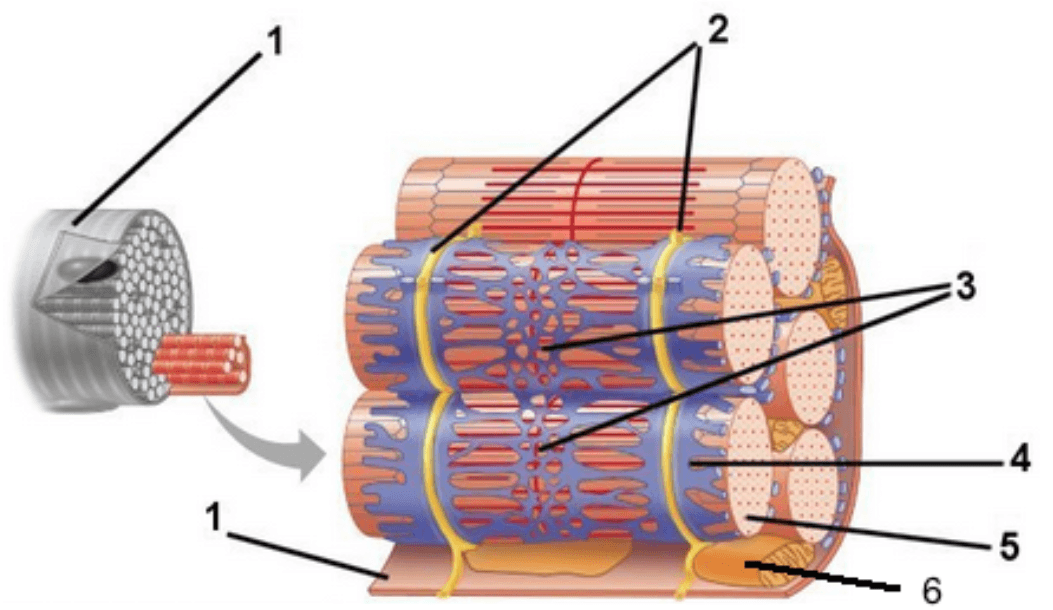
73.

What is shown in the colored part of this diagram?

a)

a whole muscle

b)

five muscle fibers

c)

five muscle fascicles

d)

five myofibrils

74.

What is labeled "4" (the blue/purple part) in the diagram?

a)

sarcolemma

b)

sarcoplasmic reticulum

c)

transverse tubules

d)

myofibril

75.

Name the following in order from largest to smallest:

a)

muscle, muscle fascicle, muscle cell, myofibril, filaments

b)

muscle, muscle fascicle, muscle cell, filaments, myofibril

c)

muscle, muscle cell, muscle fascicle, myofibril, filaments

d)

muscle, muscle cell, muscle fascicle, filaments, myofibril

76.

What is the length between Z-lines of an actin molecule called?

a)

fascicle

b)

sarcomere

c)

myosin binding site

d)

sarcoplasmic length

77.

____________ attaches to actin to form the cross bridge.

a)

Troponin

b)

Tropomyosin

c)

Myosin

d)

Calcium