
 Worksheets
PS Unit 4 Review A
Total questions: 105
Worksheet time: 1hrs 2mins
A person walks 1 mile every day for exercise. On Tuesday, she left her front door at 9:00am and returned to the house at 9:22am. What was the total DISPLACEMENT of her walk?
1 mile
2 miles
0 miles
22 minutes
Instantaneous speed is measured
at the starting point
when the object stops
at a particular instant
over the entire duration of the trip
A car traveled 60 km in 1 hour, 68 km in the next 2 hours, and 72 km in the last hour before reaching its destination. What was the car's average speed?
200 km/hr
60 km/hr
50 km/hr
800 km/hr
The slope of a line on a distance-time graph is
distance
acceleration
speed
displacement
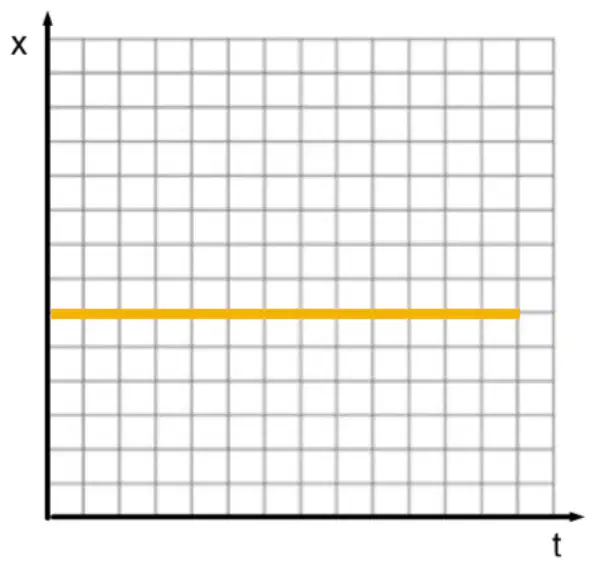
A horizontal line on a distance-time (position-time) graph means
the object is moving at a constant speed
the object is speeding up
the object is slowing down
the object is not moving
The rate at which velocity changes is called
acceleration
speed
motion
displacement
Which example identifies an object that is accelerating?
a speed skater moving at a constant speed on a straight track
a ball moving at a constant speed around a circular track
an object that is not moving
a vehicle moving down a straight street at a constant speed
Objects in free fall near Earth's surface experience
constant speed
constant velocity
constant acceleration
no gravity
An object that is accelerating may be
slowing down
speeding up
changing direction
slowing down, speeding up, or changing direction
The direction and length of a straight line from the starting point to the ending point of an object's motion is called
distance
velocity
displacement
acceleration
The difference between speed and velocity is that
velocity indicates direction and speed does not
velocity never changes
speed indicates direction and velocity does not
speed is constant
A ball thrown straight up will
accelerate upward
accelerate downward
move with constant velocity
not accelerate
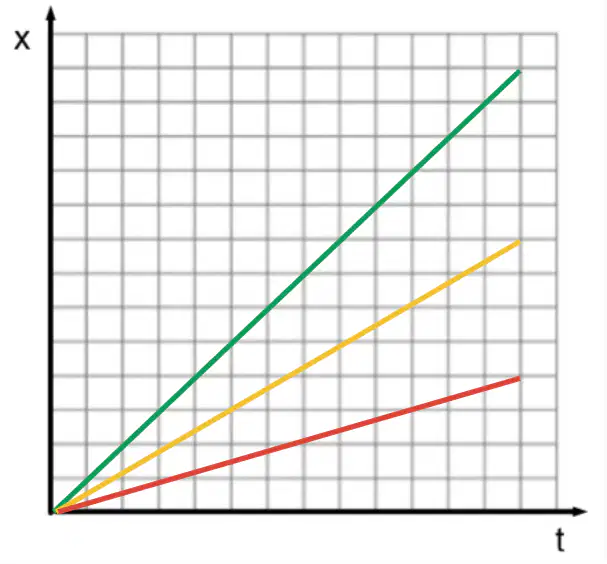
This is a graph of three bubble tubes. Which statement about the graph is true?
all three bubbles moved at the same speed
the red bubble was faster than the yellow bubble
the green bubble is speeding up
the green bubble is the fastest
This is a graph of three bubble tubes. Which statement about the graph is true?
all three bubbles are speeding up
all three bubbles are moving with constant speed
the yellow bubble is the fastest
the red bubble moved the greatest distance
A system of objects that aren't moving with respect to one another.
relative motion
frame of reference
displacement
vector
Movement in relation to a frame of reference.
relative motion
frame of reference
displacement
vector

What is the car's distance travelled?
15m
0m
-15m
-5m
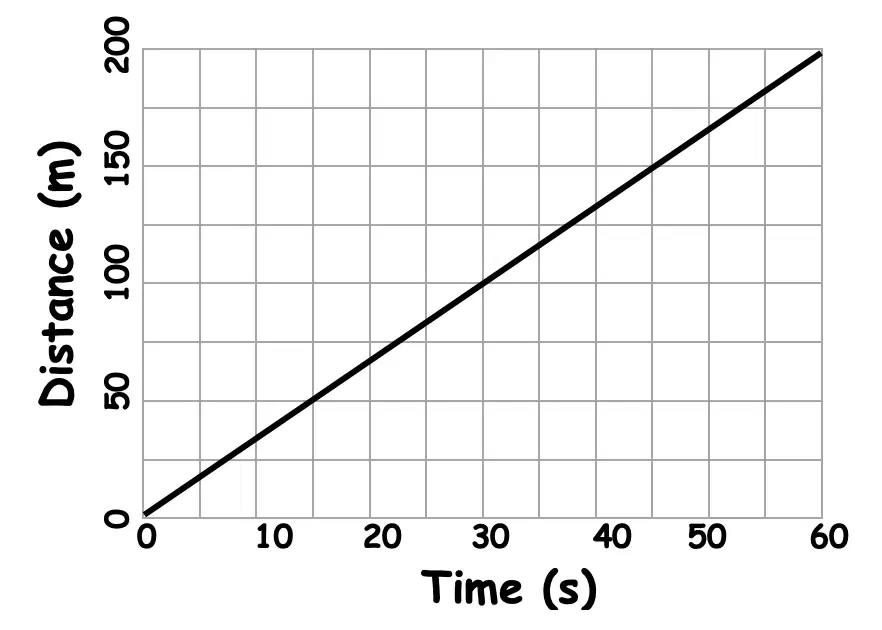
In the graph shown, what is the total distance the object traveled in 60 s?
60 m
200 m
3.33 m
100 m
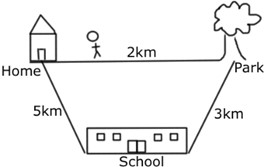
Jerry walked from home to school, then from the school to the park. What is his total displacement?
2 km
5 km
8 km
10 km

The graph shows a position-time graph for two bikers. Which biker moved the fastest?
Biker A
Biker B
Both moved at the same speed.
When an unbalanced force acts on an object,
the object's motion does not change
the object accelerates
the inertia of the object increases
the weight of the object increases
When a pair of balanced forces acts on an object, the net force is
greater in magnitude than both of the forces combined
greater in magnitude than one of the forces
equal in size to one of the forces
equal to zero
The forces acting on a person parachuting are
air resistance and fluid friction
gravity and air resistance
gravity and static friction
normal force and gravity
Projectile motion is caused by
the downward force of gravity
an initial forward velocity
a final vertical velocity
the downward force of gravity AND an initial forward velocity
An orange might roll off of your cafeteria tray when you stop walking suddenly because of
balanced forces acting on the orange
the centripetal force acting on the orange
the friction forces acting on the orange
the orange's inertia
Which universal force acts only on the protons and neutrons in the nucleus of an atom?
electromagnetic
gravitational
strong nuclear
friction
Unbalanced forces acting on an object cause the object to
move
stop
accelerate
stay at rest
Which of the following is NOT one of the four main types of friction?
rolling friction
static friction
sliding friction
standing friction
Which is true of an object dropped vs. an object thrown horizontally at the same time?
the object dropped will reach the ground first
the object thrown forward will reach the ground first
they will reach the ground at the same time
only the object dropped is in free fall
A 10-N falling object encounters 10-N of air resistance. The net force on the object is...
0 N
4 N
6 N
10 N
An object following a straight-line path at constant speed has
a net force acting on it in the direction of motion
zero acceleration
no forces acting on it
constant acceleration
If an object has a mass of 300 kg and accelerates at 1.5 m/s2, what is the net force acting on the object?
F = m × a
450 N
150 N
750 N
350 N
A large boy and a small girl run into each other in the hallway. Which one experiences the greatest amount of force?
the small girl
the large boy
the forces are the same
A baseball bat exerts a force of 1000 N on a baseball. The force that the ball exerts on the bat is
less than 1000 N
more than 1000 N
exactly 1000 N
0 N
Which of the following is NOT true of Newton's third law of motion?
All forces occur in pairs.
Force pairs are equal in magnitude and opposite in direction
Force pairs act on two different objects.
Force pairs always act on the same object.
An object has a large momentum if the product of its ________ is large.
mass and velocity
mass and acceleration
velocity and acceleration
mass and weight
The force associated with charged particles
electromagnetic force
strong nuclear force
gravitational force
weak nuclear force
An attractive force that acts between any two masses.
electromagnetic force
gravitational
force
strong nuclear force
weak nuclear
force
What factors affect gravitational force?
mass and distance
velocity and mass
distance and time
mass and volume
You push a box with 100 N of force but it doesn't move. Which of the following must be true?
the forces are unbalanced
the forces are balanced
there is no friction
static friction is greater than 100N
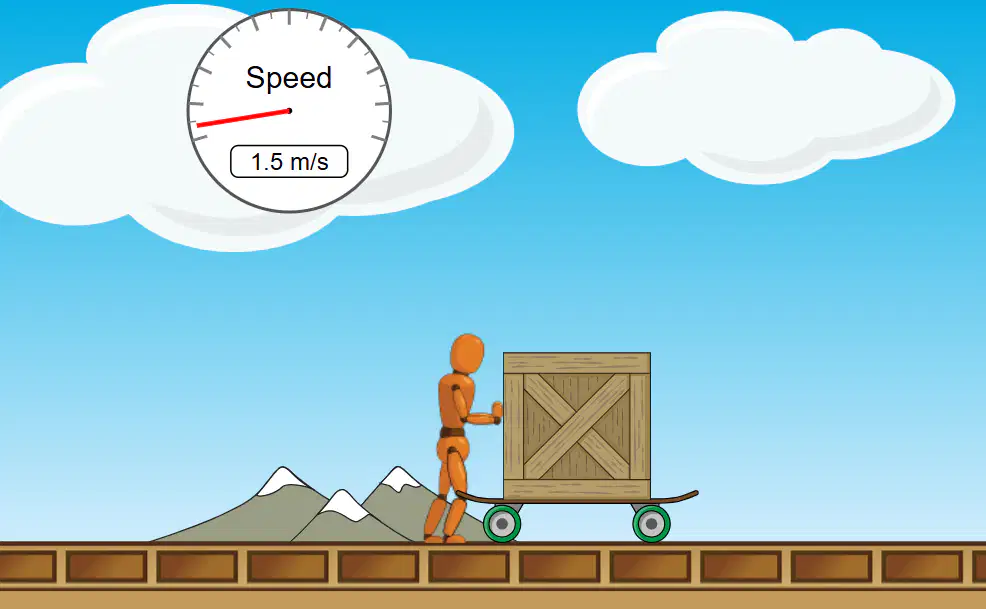
A box is moving at a constant speed of 1.5 m/s. Which of the following must be true?
the forces are unbalanced
the forces are balanced
there is no friction
the box is accelerating
A ball accelerates down a steep driveway. Which of the following must be true?
the forces are balanced
the forces are unbalanced
the net force is zero
the ball is moving with a constant velocity
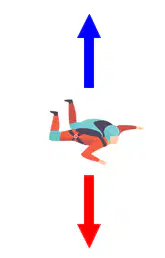
A man parachutes from an airplane and accelerates downward until the upward force of air resistance is the same as the downward force of gravity. What happens when these forces become balanced?
the man stops moving
the man stops accelerating
the man slows down
the man speeds up
The horizontal forces acting on a toy wagon are balanced. Which of the following could be true of the wagon's motion? (CHOOSE ALL THAT ARE CORRECT)
the wagon is speeding up
the wagon is moving at a constant speed
the wagon is not moving
the wagon is slowing down
The horizontal forces acting on a toy wagon are unbalanced. Which of the following could be true of the wagon's motion? (CHOOSE ALL THAT ARE CORRECT)
the wagon is speeding up
the wagon is moving at a constant speed
the wagon is not moving
the wagon is slowing down
The sum of all the forces acting on an object.
balanced forces
unbalanced forces
normal force
The tendency of an object to resist a change in motion.
inertia
velocity
acceleration
gravity
States that an object in motion will remain in motion and an object at rest will remain at rest unless acted on by an unbalanced force.
Newton's 1st Law
Newton's 2nd Law
Newton's 3rd Law
Law of Conservation of Momentum
Describes the relationship between force, mass, and acceleration.
Newton's 1st Law
Newton's 2nd Law
Newton's 3rd Law
Law of Conservation of Momentum
States that action-reaction force pairs are equal in magnitude and opposite in direction.
Newton's 1st Law
Newton's 2nd Law
Newton's 3rd Law
Law of Conservation of Momentum

Are the forces in the picture balanced or unbalanced?
balanced
unbalanced
Examine the diagram. What would be the result if the "Go!" button were pressed?
the cart would accelerate to the left
the cart would accelerate to the right
the cart wouldn't move
the cart would move at a constant speed
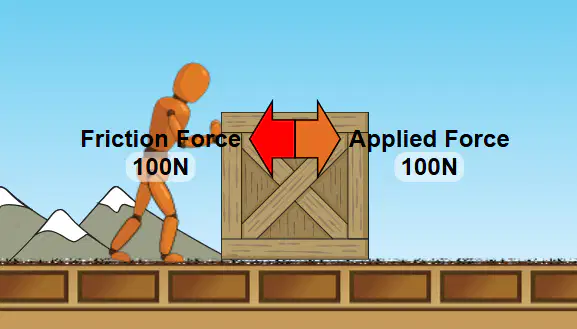
Examine the diagram and determine which of the following statements is NOT true.
the forces are balanced
the net force is zero
the box is not accelerating
the box cannot be moving
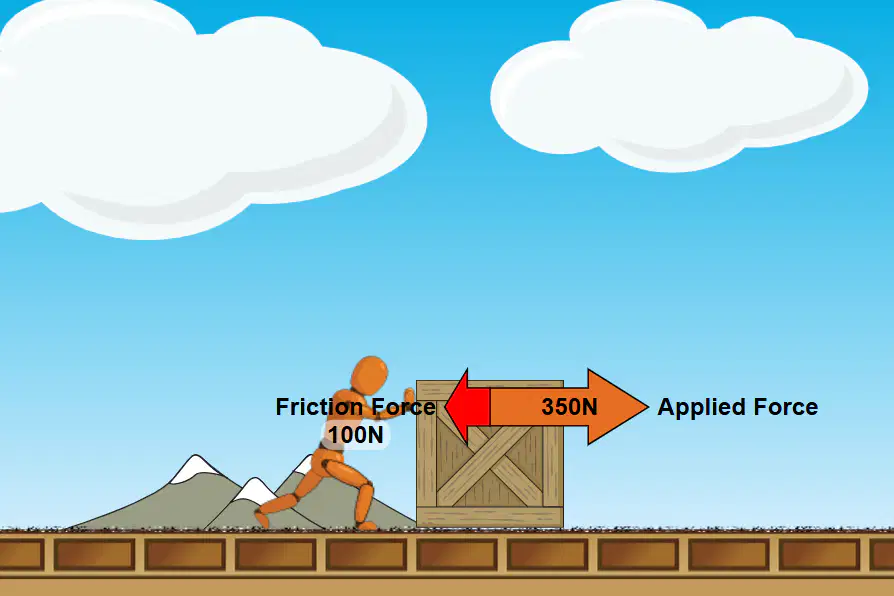
Examine the diagram and determine which of these statements is NOT true.
the forces are unbalanced
the net force is NOT zero
the box is accelerating
the forces are balanced
What is the NET FORCE acting on the box?
100 N
450 N
100 N
250 N
In order to calculate pressure exerted on a surface, what quantity is divided by the surface area?
altitude
force
mass
volume
If the air inside a balloon exerts a force of 1.5N on an area of 0.3 m2, what is the pressure inside the balloon?
1.8 N/m2
6 N/m2
5 N/m2
0.45 N/m2
A substance that assumes the shape of its container.
liquid
gas
pressure
As altitude increases, air pressure _____.
increases
stays the same
doubles
Which of the following is NOT a fluid?
air
steel
gasoline
water
Atmospheric pressure is caused by
air currents
the weight of the atmosphere above a particular location
clouds
altitude above sea level
Where would fluid pressure be the greatest in a swimming pool?
30 cm below the surface
1 m below the surface
2 m below the surface
the pressure is the same at all depths
Which principle states that a change in the pressure at any point in a fluid in a closed container is transmitted equally and unchanged in all directions throughout the fluid?
Archimedes' principle
Bernoulli's
principle
Newton's
principle
Pascal's
principle
The SI unit of pressure is
Newton
square meter
Pascal
Bernoulli
The operation of a hydraulic lift system is explained by
Archimedes' principle
Bernoulli's
principle
Newton's
principle
Pascal's
principle
The hydraulic lift system of a dump truck is designed to multiply
distance
force
pressure
speed
As the speed of a fluid increases, the pressure within the fluid decreases.
Archimedes' principle
Bernoulli's
principle
Newton's
principle
Pascal's
principle
The upward force acting on the wind of an airplane in flight.
gravity
air resistance
friction
Which of the following statements is true about an airplane wing during flight?
air above the wing travels faster than air below the wing
air below the wing travels faster than air above the wing
the wing exerts pressure equally in all directions
the lift acting on the wing reduces the weight of the wing
The upward force acting on an object submerged in a fluid is called
buoyant force
drag
pressure
weight
A brick weighs 23 N. Measured underwater, it weighs 10 N. What is the size of the buoyant force exerted by the water on the brick?
9.8 N
23 N
10 N
13 N
The strength of the buoyant force acting on an object in a fluid depends on the object's
mass
surface area
volume
weight
The buoyant force on an object in a fluid is equal to the weight of the
fluid
fluid surrounding the object
fluid displaced by the object
object
The relationship between buoyant force and weight of a displaced fluid was first stated by
Archimedes
Bernoulli
Newton
Pascal
Which of the following substances will float in corn syrup? (The density of corn syrup is 1.38 g/cm3)
copper
8.9 g/cm3
silver
10.5 g/cm3
iron
7.8 g/cm3
glycerin
1.26 g/cm3
The unit g/cm3 is often used to express _____.
force
mass
volume

Why does the object in the picture sink?
the buoyant force is greater than the force due to gravity (weight)
the force due to gravity (weight) is greater than the buoyant force
the buoyant force and the force due to gravity (weight) are the same
the density force is greater than the buoyant force

Which of the following are true about the object in the picture?
the forces are balanced
the buoyant force is greater
the force due to gravity is greater
the object floats
the object sinks

The volume of the cube is 1.0 L - what is the DENSITY of the cube?
19.3 kg/L
19.3 Pa
9.8 kg/L
38.6 kg/L

What is the amount of buoyant force acting on the object in the picture (in Newtons)?
(a)

What is the amount of buoyant force acting on the block of ice in the picture (in Newtons)?
(a)
In which direction is fluid pressure directed?
Up
Down
Sideways
In all directions
How is pressure calculated in a fluid?
pressure = mass * velocity
pressure = force / area
pressure = volume / area
pressure = density * acceleration
For a fluid that is not moving, what two factors determine the pressure the fluid exerts?
depth and type of fluid
type of fluid and shape of container
shape of container and depth
The apparent loss of weight in a fluid.
buoyancy
density
pressure
lift
You push a box with 100 N of force but it doesn't move. Which of the following must be true?
the forces are unbalanced
the forces are balanced
there is no friction
static friction is greater than 100N
A box is moving at a constant speed of 1.5 m/s. Which of the following must be true?
the forces are unbalanced
the forces are balanced
there is no friction
the box is accelerating
A ball accelerates down a steep driveway. Which of the following must be true?
the forces are balanced
the forces are unbalanced
the net force is zero
the ball is moving with a constant velocity
A small unmanned spacecraft is accelerating in space when it's engines shut off. Describe the motion of the spacecraft once the engines have stopped.
it begins to slow down
it moves at a constant speed
it continues to speed up
it speeds up for a small time and then slows down
The horizontal forces acting on a toy wagon are balanced. Which of the following could be true of the wagon's motion?
the wagon is speeding up
the wagon is moving at a constant speed
the wagon is not moving
the wagon is slowing down
The horizontal forces acting on a toy wagon are unbalanced. Which of the following could be true of the wagon's motion?
the wagon is speeding up
the wagon is moving at a constant speed
the wagon is not moving
the wagon is slowing down
The forces acting on a small block of wood are balanced. Which of the following is true?
the net force is zero
the block is not moving
the block is not acclerating
the net force is
non-zero
A man jumps from an airplane and accelerates downward until the upward force of air resistance is the same as the downward force of gravity. What happens when these forces become balanced?
the man stops moving
the man stops accelerating
the man slows down
the man speeds up
A car is accelerating down a straight road when the forces on the car become balanced.
What happens to the motion of the car?
the car stops moving
the car stops accelerating
the car slows down
the car speeds up
Group the following as either "balanced" or "unbalanced" forces.
not moving
constant speed
speeding up
slowing down
non-zero net force
zero net force
What is required for an object to start moving, stop moving, speed up, slow down, or change directions?
(a)
The sum of all the forces acting on an object.
(a)
When forces are balanced, it means that net force =
(a)
Unbalanced forces acting on an object cause the object to
move
stop
accelerate
stay at rest
When the net force acting on an object is zero, the object will
stop moving
speed up
not accelerate
slow down
Why does the object in the picture sink?
the buoyant force is greater than the force due to gravity (weight)
the force due to gravity (weight) is greater than the buoyant force
the buoyant force and the force due to gravity (weight) are the same
the density force is greater than the buoyant force
Which of the following are true about the object in the picture?
the forces are balanced
the buoyant force is greater
the force due to gravity is greater
the object floats
the object sinks
The volume of the cube is 1.0 L - what is the DENSITY of the cube?
19.3 kg/L
19.3 Pa
9.8 kg/L
38.6 kg/L
What is the amount of buoyant force acting on the object in the picture (in Newtons)?
(a)
What is the amount of buoyant force acting on the block of ice in the picture (in Newtons)?
(a)

