
 Worksheets
PT37
Total questions: 84
Worksheet time: 1hrs 24mins
A 82-year-old man is brought to the GP clinic by his daughter as he has become increasingly confused and distressed over the last 24 hours. He is not aware of where he is and keeps trying to get up and leave. The daughter reports that he has been seeing strangers in the house. He has a history of only T2DM & Osteoarthritis. There are no focal neurological deficits. What is the most likely underlying cause of his mental state?
Delirium
A 29-year-old NZ European male presents to his GP with progressive low back pain, and buttock pain affecting him predominantly in the mornings. He has also recently noted painful swelling of his fingers, painful knees and plantar surface of his heels. He has a history of episodic unilateral painful red eyes with associated visual blurriness. Which predisposing genetic factor is most likely to be implicated in this patient's presentation?
Mr EB is a 27-year-old NZ European male recently diagnosed with schizophrenia. He has been started on Haloperidol IM Depot. He now presents with severe muscle spasms, rigidity and tremor. He is afebrile, his vital signs are normal, CK level is normal.
Which medication is first-line therapy in the treatment of these symptoms?
Radial Nerve
A 14-year-old European girl presents to her General Practitioner with concerns of gaining excessive weight. On detailed history taking, it appears that she is restricting her food intake. She does not have any past medical history and is not taking any regular medications. On general inspection, her Body Mass Index is 16.2. BP is 100/65, HR 55 bpm. Remaining examination findings are normal. Blood tests are as follows: Na 140, K 3.4, Cr 80, FBC N. What is the most likely diagnosis?
Binge Eating Disorder
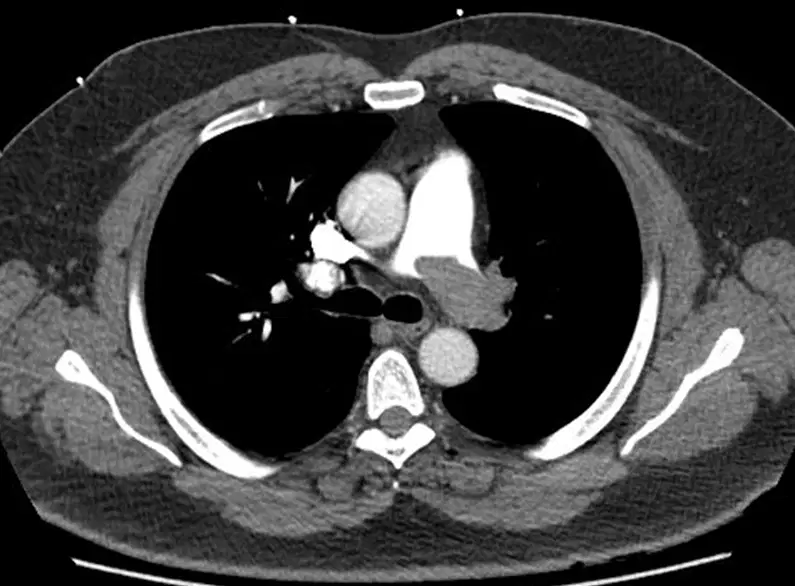
A 40-year-old NZ European man with morbid obesity and CKD Stage 5 presents to hospital with dyspnea, syncope and near falls. He denies chest pain. His BP is unrecordable, and saturations are 87% on RA. CTPA image can be found attached. What is the most appropriate management option for this patient?
Initiate Low Molecular Weight Heparin
Initiate novel anticoagulant
IVC Filter
Thrombolysis followed by long-term anticoagulation with warfarin
Pulmonary Embolectomy
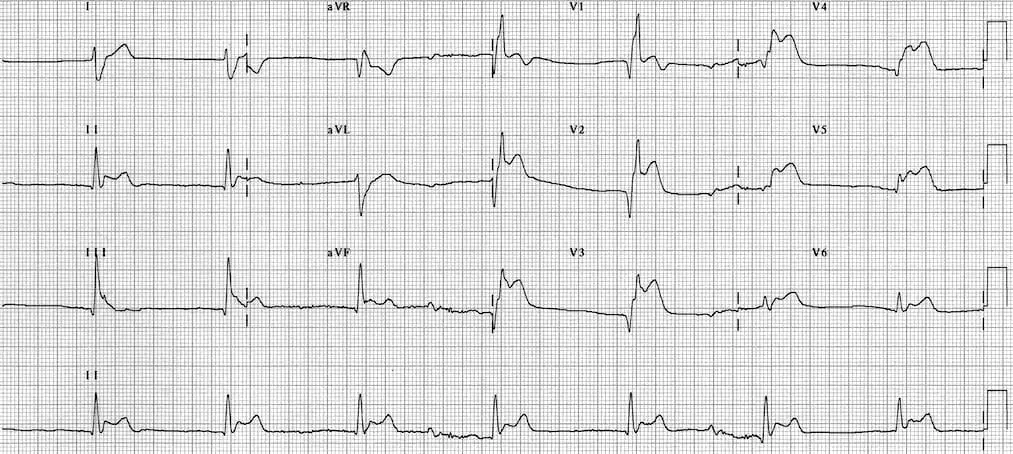
A 74-year-old woman with no prior co-morbidities presents to hospital with severe central chest pain. Her SBP is 130/80 and HR 80bpm. Her ECG can be seen below. She is rushed to angiography which demonstrates mild coronary artery disease. Her echocardiogram shows dyskinesis of the LV apex with preserved basal contraction. What is the most likely diagnosis?
Coronary Artery Spasm
Coronary Microvascular Dysfunction
Coronary Artery Plaque Disruption
Myocarditis
A 50-year-old Samoan woman presents to her GP with a 3-month history of an aching, right lower leg. She reports a bursting sensation while walking and finds that propping her leg up on the bath helps to alleviate these. On examination, the right lower leg shows some non-pitting oedema, some areas of hyperpigmentation, and a slightly painful, 2cm ulcer proximal and posterior to the right medial malleolus. She is a heavy smoker (with a 25-year pack history) and takes metformin for management of her type 2 diabetes. Her most recent Hba1c is 53. What is the most likely diagnosis?
An 81-year-old European man presents to his GP with a history of gradually worsening vision in his right eye over the past 2 months. He describes difficulty reading small print, having distorted vision where straight lines appear wavy, and having a dark patch in the centre of his vision. He has a history of hypertension, Type 2 Diabetes and has heavily smoked for 30 years, although he quit five years ago. On examination, his left eye has normal visual acuity, but his right eye shows decreased acuity. Upon investigation via Fundoscopy, it is revealed that there is sub-retinal fluid and haemorrhages in the macular region. What is the most likely diagnosis?
Diabetic proliferative retinopathy
Wet age-related macular degeneration
A 50-year-old NZ European man presents to his GP with concerns of progressive flexion of his 4th and 5th fingers of his right hand. He denies any history of trauma. On examination, there is thickening of the fascia, and forced manipulation is unable to overcome the fixed flexion of his fingers. Which of the following is the most likely diagnosis?
A 54-year-old NZ European woman is undergoing triple assessment for a suspected diagnosis of breast cancer. As part of the assessment, she has a mammogram, which has 85% sensitivity as a diagnostic test. How do you explain to the patient what this means?
85% of patients who test positive will be truly positive
85% of patients who test negative will be truly negative
A 45-year-old Maori man is admitted to psychiatry unit with catatonia. He is diagnosed with treatment-resistant depression and electroconvulsive therapy (ECT) is being considered for treatment. Which of these is a more likely side effect of ECT that the team should consider discussing with the patient's whanau?
Parkinsonism
Risperidone
Aripiprazole
A 20-year-old woman presents with abdominal pain, intermittent bloating, and diarrhoea. She mentions a family history of coeliac disease. Which is the most appropriate initial investigation?
The Montreal classification is used in gastroenterology frequently to categorise the severity of inflammatory bowel disease. What three factors are used to determine the classification in Crohn's disease?
1. Location of disease within the bowel. 2. Behaviour of disease (stricturing vs penetrating vs perianal) 3. Number of bowel motions a day
1. Age of onset. 2. Location of disease within the bowel. 3. Behaviour of disease (stricturing vs penetrating vs perianal)
1. Presence of blood in the stool. 2. Duration of symptoms. 3. Age of onset
A 54-year-old NZ European truck driver presents with an aching pain in his left leg when walking, which typically occurs at 200m. After he rests, the pain resolves and he can continue walking. On inspection, the L leg has a reduced range of motion and is pale and cool, but peripheral pulses are present. There is reduced distal sensation. What is the most likely diagnosis?
Peripheral Vascular Disease
Sciatica
Critical Limb Ischaemia
Compartment syndrome
A 38-year-old man is brought to the emergency department by his friend after experiencing severe restlessness, sweating, and confusion for the past two hours. He has a history of generalized anxiety disorder and chronic migraines. His medications include fluoxetine, sumatriptan, and propranolol. He also reports to occasional recreational use of MDMA. On examination, his temperature is 38.8ºC, heart rate is 110 bpm, and blood pressure is 148/80 mmHg. He has dilated pupils, increased muscle tone, hyperreflexia, and inducible ankle clonus.
What is the most likely diagnosis?
Anticholinergic Syndrome
Serotonin Syndrome
Neuroleptic Malignant Syndrome
MDMA Withdrawal
Malignant Hyperthermia
A 27-year-old woman presents to the clinic with a three-month history of fatigue and intermittent joint pain. She also reports that her urine has appeared darker on several occasions. She denies any recent infections, fever, or hemoptysis. Over the past few weeks, she has noticed that her face appears puffier in the mornings. On examination, her blood pressure is 152/90 mmHg, and she has mild peri-orbital oedema and a malar rash. There is joint tenderness, but no significant synovitis. Lab findings: - Urinalysis 3+ protein, 2+ blood, RBC casts - Serum creatinine 160 µmol/L What is the next best step in management?
A 46yo New Zealand European man presented to his GP with 1 month of progressive involuntary, irregular movements of his trunk and upper limbs, with associated low mood and apathy. He is usually fit and well. His father, who died aged 55, developed similar body movements and experienced early-onset memory loss. He denies any weakness, numbness, dizziness or incoordination in his limbs. On examination, his vitals were normal.
What is the most likely diagnosis?
Lewy body dementia
Alzheimer's disease
Vascular dementia
A midwife has called you to review a 3 day old term baby who has jaundice. Which of the following tests is most important to perform on the child?
A 75-year-old NZ European female with CKD stage 4 and recent ankle fracture came into the hospital after mobilizing to the bathroom, and suddenly feeling very short of breath and dizzy. Her vitals were: BP:120/66, Pulse of 115bpm, RR: 20, Temp:36.5, pO2 was 90%. CXR was unremarkable. ECG was normal other than the sinus tachycardia. D-dimer measurement of 751 ng/ml (cutoff = 500 micrograms/ml). Serum Creatinine 210µmol/L, baseline for the patient. CTPA demonstrates a filling defect in the right inferior segmental pulmonary artery. What treatment would be used immediate management of this patient?
Dabigatran
Warfarin
Which of the following is false about Hepatitis Delta?
Treatment options also used for hepatitis B infection are effective
Vaccination against hepatits B reduces the risk of hepatitis D
Gout flare
A 4-year-old boy is brought to the emergency department by his parents due to a 5-day history of fever, irritability, and decreased appetite. On examination, he is febrile (39.2°C), with a maculopapular rash over his trunk and extremities, mild conjunctival injection, and cracked, erythematous lips. His hands are swollen, and his cervical lymph nodes are enlarged (one node measuring 2.5 cm). Blood tests reveal a normocytic anaemia, elevated CRP, and thrombocytosis. An echocardiogram is requested. Which of the following is the most appropriate next step in management?
Urinary tract infection, Trimethoprim
Stress urinary incontinence, Pelvic floor physiotherapy
Urge urinary incontinence, Pelvic floor physiotherapy
A 27-year-old man presents with progressive lower back pain and stiffness. On examination, he has a noticeable thoracic kyphosis. He is diagnosed with Ankylosing Spondylitis. Which of the following statements is TRUE regarding his diagnosis?
ESR and CRP on blood workup are usually unremarkable
Rheumatoid Factor is usually positive on blood investigations
A 32-year-old NZ European man with a background of ulcerative colitis (UC), presents to the GP with a worsening of his symptoms. He reports 6-8 bowel motions a day, that are loose and bloody in nature. He feels unwell and is noted to have a temperature of 38.1ºC and HR 96. What is the most appropriate management for this patient?
A 67-year-old NZE man is sent in by his GP to the surgical assessment unit with new onset generalised abdominal pain. The patient has been nauseated since this morning and has vomited once. On examination, the abdomen is generally tender. There is a red lump in the patient's right groin. It is superior and medial to the pubic tubercle. It is tender to touch, non-pulsatile and non-reducible. There is no rash or lymphadenopathy. External genitalia examination is unremarkable.
What is the most likely clinical diagnosis?
A 38yo Burmese woman presents with several weeks of nonspecific symptoms with fevers, low appetite, weight loss, and symmetrical generalised joint pain.
On examination, she looks pale, and has a butterfly-shaped rash across her face and nose. You also note oral ulcers.
Her urinalysis shows mild proteinuria with RBC casts.
Which of the following investigations would be the most helpful in establishing the suspected diagnosis?
Rheumatoid Factor (RF)
HLA-B27
ANA and anti-dsDNA
CRP
Anti-CCP antibodies
A 66-year-old NZE man presents with haemoptysis, shortness of breath, and a productive cough that has worsened over the past 8 months. He also reports a 15 kg weight loss over 3 months.
He is a retired truck driver and has a 40 pack year smoking history.
On examination, you note that he looks cushingoid.
What is your suspected diagnosis?
COPD
Lung Adenocarcinoma
A 48-year-old male with a history of bipolar disorder is brought in for assessment by his sister who is concerned about his mental state. He begins to describe his problem with the following sentence: "I'm here today to talk about a pain in my ankle. The problem is that I lost my phone this morning. Is orange your favourite colour? I love burgers don't you? One day I'm going to go to the moon."
Which of the following signs of thought disorder is this patient demonstrating in his speech?
Thought blocking
A 15-year-old boy presents to ED with sudden-onset severe pain in his right testicle, which started 2 hours ago during rugby practice.
On examination, his right testicle appears swollen, reddish and high-riding, with a horizontal lie. The area is tender on palpation, and the Cremasteric reflex is absent.
Considering the likely diagnosis, what is the most appropriate immediate management option?
Urinalysis
Trial of antibiotics and analgesia
Urgent doppler ultrasound
Urgent urology referral for surgical exploration
Manual detorsion and discharge home
Alice, a 24 year old Pākehā woman, presents to the psychiatric emergency clinic with her partner who reports over the last 10 days, she has been more talkative, loud, restless and irrational than usual. Alice reports she has recently found herself sitting up late at night with 'thousands of ideas’, and that she plans to renovate their house, buy a new car and start a new business. She believes she might be the new Einstein. She finds she is only needing 3-4 hours of sleep to feel fully rested.
What is the most appropriate initial management?
Prescribe olanzapine and admit to hospital
Prescribe diazepam and follow-up closely in clinic
Consider urgent ECT
Check thyroid function
Prescribe sodium valproate and admit to hospital
A 60-year-old man with stage 4 chronic kidney disease, hypertension, and type 2 diabetes presents for routine follow-up. He reports increasing fatigue but no dyspnea or chest pain. Examination is unremarkable.
Bloods show a normocytic normochromic anaemia. There are no acute electrolyte disturbances. Ferritin and transferrin saturation are satisfactory. eGFR is 22 ml/min/1.73m2.
Which of the following is the most appropriate as part of the management of his CKD-related fatigue?
B12 Supplementation
Low dose antidepressant
IV Iron Infusion
Refer for Dialysis
A 12-year-old Māori boy from Tūparehuia, Northland presents to Whangarei ED with a 4-day history of worsening pain in his left leg, fever and difficulty mobilising. His father reports that he received a minor wound on his shin two weeks ago while playing on the trampoline. On examination, he has a fever of 38.5°C, his left tibia is tender, warm and swollen. There is no knee swelling or restricted movement.
Blood tests indicated an elevated WBC and CRP count. An X-ray of the leg leg is normal. What is the most appropriate next step in management?
A physically active 72yo woman with CKD stage 4 presents to your GP clinic after being discharged from hospital following a distal radius fracture. She was previously fully independent and enjoyed gardening. She had a DEXA scan with a T score of -2.5. She is not on any bone protection currently. Her CrCl is 28mL/min. Which of the following medications is most appropriate?
Cholecalciferol
Denosumab
Calcium supplementation
Teriparatide
A 28-year-old woman presents with a firm, mobile breast lump. Breast ultrasonography demonstrates a well circumscribed, ovoid uniformly hypoechogenic mass. It is non-tender and has been stable for 3 months. What is the most likely diagnosis?
Breast abscess
Glossopharyngeal nerve
Accessory nerve
A 45-year-old man attends his GP with headaches for the past 4 months. He reports on further questioning noticing that he has had a small amount of milky discharge from both nipples but has been anxious about getting this seen as his mother had breast cancer. He is also concerned that his hands and feet are swollen as his wedding ring and shoes no longer fit. His observations show a heart rate of 95 beats/min, blood pressure of 165/89mmHg, temperature of 36.6ºC, oxygen saturation of 98% in room air with a respiratory rate of 14/min. His GP refers him for blood tests which show: Hb140 g/L (135-180) Platelets 360 * 109/L (150 - 400) WBC 10.0 * 109/L (4.0 - 11.0) IGF-1 31.6 nmol/L (12.1 - 29.0) What is the most appropriate next investigation?
Oral glucose tolerance test (OGTT) and midnight salivary cortisol level
Serum prolactin level
Serum renin aldosterone ratio
Repeat ultrasound in 3 years
An 80-year-old Maori female presents with fatigue. Her other symptoms include, decreased exercise tolerance, exertional dyspnea, angina and she had an episode of syncope last week. She also reported that sometimes its hard to put the shoes on as they are too tight. Her Vital signs are normal. On examination, and on auscultation, a systolic murmur with a crescendo-decrescendo pattern, is heard throughout the precordium, but loudest at aortic area and radiates to the carotids. Pitting oedema at the ankles is present. The CXR was normal. What is the most likely diagnosis here?
A 4-year-old Tongan child presents to the general practitioner accompanied by their mother with a one-week history of coryzal symptoms, cough and low-grade fever. The mother reports that the cough has a barking quality. The child is up-to-date with all vaccinations. On examination, the child exhibits suprasternal wall retraction at rest but appears alert and responsive. There are no similar symptoms reported in other household members. What is the most likely causative organism of this presentation?
COVID
A 36 year old female presents to the ED with right iliac fossa pain that radiates to the back. She reports multiple episodes of vomiting and feeling nauseous. Obs: HR 83 RR 28 BP 128/92 T 37.2Urine sample shows mild haematuria. Ultrasound Abdo/Pelvis is unremarkable. No concern noted on gynae history. She is otherwise fit and well and has no medical or surgical history. Given the likely diagnosis, what is the next step in management?

If an ABG of your patient shows a pH of 7.05, CO2 of 2.0kPa, HCO3 of 8.0mmol/L, and an anion gap of 16, what kind of acid base disturbance does this patient have and what is the most likely presenting complaint/reason? Normal ranges; pH: 7.35 - 7.45, CO2: 4.7-6.0, HCO3: 22-28
A 60-year-old man with stage 4 chronic kidney disease, hypertension, and type 2 diabetes presents for routine follow-up. He reports increasing fatigue but no dyspnea or chest pain. His BP is 130/65. The rest of his examination is unremarkable. His blood results are as follows: Na 140, K 4.9, Hb 90, MCV 90, WCC 4.5, Ca 2.5, PTH N. Which of the following is the most appropriate as part of the management of his chronic kidney disease?
Cinacalcet
A 78 year old male presents to the GP with a gradual onset headache over the last week. There are no clear triggers. He has been having trouble with his balance and his wife has noticed changes in his speech. He is usually fit and well other than a background of hypertension for which he takes losartan and metoprolol. What is the most likely cause of his presentation?
Posterior circulation stroke
Mr J is a 24 year old Pākehā man who presents to his GP with his partner who reports over the last 10 days, he has been more talkative, loud, restless and irrational than usual. Mr J reports he has recently found himself sitting up late at night with 'thousands of ideas’, and that he plans to renovate their house, buy a new car and start a new business. He finds he is only needing 3-4 hours of sleep to feel fully rested. What is the main differentiating characteristic that is required for a diagnosis of Type II Bipolar Disorder?
A manic episode
If the patient had psychotic episodes
A 12-year-old Māori boy from Tūparehuia, Northland presents to Whangarei ED with a 4-day history of worsening pain in his left leg, fever and difficulty mobilising. His father reports that he received a minor wound on his shin a few weeks ago while playing on the trampoline. On examination, he has a temperature of 38.5°C, his left tibia is tender, warm and swollen, and there is full and painless ROM of his hip/knee/ankle. Blood tests indicate an elevated WBC and CRP count. An X-ray of the left leg is unremarkable. What is the most appropriate next step in management?
Refer to Orthopaedics for immediate debridement in theatre
Perform a joint aspiration of the left knee
A 28-year-old woman presents with a firm, smooth, mobile breast lump. It is non-tender and has been stable for 3 months. What is the most likely diagnosis?
Fibrocystic breast changes
A 90 year old female is admitted to hospital after a mechanical fall at home. She is found to have a neck of femur fracture. She uses a low walking frame around the house and lives independently but relies on home help for cleaning and groceries. Over the last 6 months she has unintentionally lost 4kgs. She suffers from COPD and bronchiectasis and becomes very breathless when lying flat. She also has hypertension and a background of AF on dabigatran. Which factor is likely to be of biggest concern to the treating teams when considering if this patient is a surgical candidate?
A 45-year-old man attends his GP with headaches for the past 4 months. He reports on further questioning noticing that he has had a small amount of milky discharge from both nipples but has been anxious about getting this seen as his mother had breast cancer. He is also concerned that his hands and feet are swollen as his wedding ring and shoes no longer fit. His observations show a HR of 95 beats/min, BP of 165/89mmHg, temperature of 36.6ºC, SP02 of 98% in room air with a RR of 14/min. His GP refers him for blood tests which show: Hb140 g/L (135-180) Platelets 360 * 109/L (150 - 400) WBC 10.0 * 109/L (4.0 - 11.0) IGF-1 37.4 nmol/L (12.1 - 29.0) What are the most appropriate next investigations?
A 36 year old female presents to the ED with right iliac fossa pain that radiates to the back. She reports multiple episodes of vomiting and feeling nauseous. Obs: HR 83 RR 28 BP 128/92 T 37.3. Urine sample shows mild haematuria, no WCC. Bloods and ultrasound are unremarkable. She is otherwise fit and well and has no medical or surgical history. Given the likely diagnosis, what is the next step in management?
An 58 year old European woman presents to her GP progressive exertional dyspnea over the last 3 months. She has a 20 pack-year history and reports a chronic cough over the last several years. On examination the GP notes expiratory wheeze. Given the likely diagnosis, what are the likely findings of a spirometry test?
Reduced FEV1, normal FVC and FEV1/FVC ratio of 65%

A 37 year old female presents with 1 day of severe, central abdominal pain. Clinical examination of the abdomen reveals this finding. What is the most likely diagnosis?
Pancreatitis
Bowel obstruction
Appedicitis
Cholecystitis
Urinary tract infection
A 73 year old man with a history of falls presented to the ED department after another fall that fractured his neck of femur. After surgery to mend this, he was admitted into the ward for rehabilitation. He has a history of hearing loss, rheumatoid arthritis, CKD and hypertension. His most recent eGFR is 25mL/min. He had a DXA scan preformed for the possibility of having osteoporosis. The results of the DXA scan show he has a T score of -3. What does this mean and what is optimal therapy for him?
He has osteoporosis. The first line treatment for him are bisphosphonates such as Fosamax
He has a normal bone scan. First line treatment would be calcium and Vitamin D supplmentation.
A 3-year-old child presents to the emergency department with a 7-day history of fever, irritability and a rash that started on the trunk and has spread distally. On examination, the child has red, bloodshot eyes, dry cracked lips, and a strawberry tongue with peeling skin. The parents report a recent URTI and mention having autoimmune conditions themselves. The child has no significant past medical history. What is the most likely diagnosis?
James Wong is a 72-year-old NZ European man who presents to the neurology clinic with his wife. He was diagnosed with Parkinson’s disease 5 years ago and has been managed with levodopa/carbidopa with good control of his motor symptoms. Over the past year, however, his wife reports increasing forgetfulness, difficulty following conversations, and episodes of visual hallucinations involving “a guardian angel in the living room.” He sometimes acts out his dreams and appears confused in the mornings. He remains independent in most activities of daily living, but his wife is concerned about his safety at home and his recent behavioral changes.
What is the most appropriate medication change that might be considered in this scenario?
Start Ropinirole
Start Haloperidol
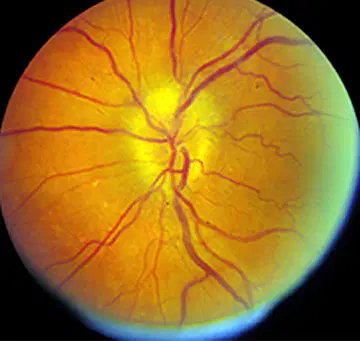
A 35-year-old woman presents with progressive vision loss in her right eye over the past few days. She reports eye pain initially, which has resolved now, but her vision has continued to deteriorate. On examination, she has afferent pupillary defect and a central scotoma in the right eye. Fundoscopy exam is shown. What is the most likely diagnosis?

