wayground logo

Free Printable Worksheets

NEW

Font size

S
M
L
XL
Worksheets

Chem CA Review Day 3

Total questions: 71

Worksheet time: 4hrs 33mins

Name
Class
Date
1.

Formula for barium sulfide

a)

B2S3

b)

BaS

c)

Ba2S

d)

BaS2

2.

Name for Hg2S

a)

mercury (IV) sulfide

b)

mercury (III) sulfide

c)

mercury (II) sulfide

d)

mercury (I) sulfide

3.

Formula for lead (II) chloride

a)

PbCl2

b)

Pb2Cl

c)

Pb2Cl3

d)

Pb3Cl2

4.

Name for PBr2

a)

phosphorus bromide

b)

phosphorus dibromide

c)

phosphorus dibromine

d)

phosphorus bromine

5.

Formula for Disilicon Heptasulfide

a)

SiS6

b)

SiS7

c)

Si2S6

d)

Si2S7

6.

Formula for iron (II) carbonate

a)

FeCO3

b)

Fe2CO3

c)

FeCO2

d)

Fe2CO2

7.
What is the name of Al(NO3)3?
a)
Aluminum trinitrate
b)
Monoaluminum nitrate
c)
Aluminum (III) nitrate
d)
Aluminum Nitrate
8.
As you move down a group, atomic radius increases because - 
a)
you add more and more neutrons
b)
you add more and more protons
c)
you add more and more shells (energy levels)
d)
you add more atomic mass
9.
The atom with the largest atomic radius in Group 18 is - 
a)
Ar
b)
He
c)
Kr
d)
Rn
10.
As you move across the periodic table from left to right, the atomic radius decreases.  This is because - 
a)
the number of protons increases, so attraction to electrons increases
b)
the number of energy levels increases
c)
the number of electrons increases
d)
the atomic mass increases
11.
Francium (Fr) has the lowest ionization energy in Group 1 because - 
a)
it has the smallest number of valence electrons
b)
it has the greatest atomic mass
c)
it has the greatest number of protons, so it attracts its electrons the strongest
d)
its 1 valence electron is very far from the nucleus, so little energy is needed to remove it
12.
The element with the smallest ionization energy in Period 6 is - 
a)
Rn
b)
Cs
c)
Os
d)
Tm
13.
The energy required to remove electrons is the definition of: 
a)
Electronegativity
b)
Atomic Number
c)
Atomic Radius
d)
Ionization
14.
What is the name of family I
a)
Alkaline Earth Metals
b)
Boron Family
c)
Alkali Metals
d)
Halogen Family
15.
Group B is known as the:
a)
Inner Metals
b)
Transition Metals
c)
Weirdos
d)
Changelings 
16.
Families all have similar 
a)
Names
b)
atomic numbers
c)
atomic masses
d)
properties
17.
Electronegativity is...
a)
the ability of an atom to attract/ accept electrons
b)
the ability of an atom to lose electrons
c)
the energy required to remove an electron from a specific atom
d)
how easy it is to make friends. 
18.
Which has the greater Electronegativity: 
N or C?
a)
C
b)
N
19.
Electronegativity __________ from left to right within a period and __________ from top to bottom within a group.
a)
decreases, increases 
b)
increases, increases
c)
increases, decreases 
d)
stays the same, increases
20.

This is a correct dot diagram for neon (Ne)

a)

true

b)

false

21.

Which of these is correct?

a)
b)
c)
22.

According to the diagram below, how many bonds will this atom be able to make?

a)
1
b)
2
c)
3
d)
4
23.

Which is the correct molecular structure for carbon dioxide?

a)
b)
c)
d)
24.

Which of the following compounds has only single bonds?

a)

I only

b)

II only

c)

III only

d)

I and III

e)

III and IV

25.

48.86 g of cobalt is equal to how many moles of cobalt?

a)

2879 moles

b)

8.291 moles

c)

.8291 moles

d)

.829 moles

26.

How many moles of sodium chloride are in a 321.8 g sample?

a)

18810 moles

b)

3.315 x 1024 moles

c)

5.507 moles

d)

4.767 moles

27.

How many formula units of calcium chloride are in a 25.69 g sample?

a)

1.394 x 10²³ F.U.'s

b)

2851 F.U.'s

c)

.2315 F.U.'s

d)

3.845 x 1025 F.U.'s

28.

Convert 86.235 g of diphosphorus pentaoxide to moles.

a)

12240 moles

b)

1.8747 moles

c)

.608 moles

d)

.60755 moles

29.

A sample of AlCl3 contains a total of 4.515 x 1027 atoms of chlorine. What must be the mass of this sample?

a)

2.500 x 10⁵ g

b)

1.000 x 10⁶ g

c)

18.75 g

d)

3.333 x 10⁵ g

30.

What is the molar mass of MgF2?

a)

62.31 g/mol

b)

67.62 g/mol

c)

43.31 g/mol

d)

86.62 g/mol

31.

What is the molar mass of CuBr2?

a)

145.23 g/mol

b)

122.54 g/mol

c)

223.35 g/mol

d)

213.54 g/mol

32.

What is the molar mass of (NH4)2S?

a)

57.18 g/mol

b)

68.17 g/mol

c)

32.07 g/mol

d)

17.04 g/mol

33.
What is an ion?
a)
A Charged Atom
b)
A Large Atom
c)
A Small Atom
d)
A Cute Atom
34.
Why are ions formed?
a)
To make our lives difficult
b)
Because atoms want 8 valence electrons
c)
Because atoms have the same number of protons and electrons
d)
Because atoms gained neutrons
35.
An atom becomes _________ when it gains electrons.
a)
Positive
b)
Negative
c)
Neutral
d)
Invinsible
36.
Group 17 always has ions with a charge of 
a)
+1
b)
+2
c)
-1
d)
-2
37.
What charge will an Oxygen ion have? 
a)
+1
b)
-1
c)
+2
d)
-2
38.
If an element has 3 valence electrons, what charge will likely form on its ion ?
a)
+3
b)
+5
c)
-3
d)
-5
39.
Which of the following has a -3 charge?
a)
Boron
b)
Fluorine
c)
Nitrogen
d)
Neon
40.
Elements on the LEFT side of the periodic table will most likely form:
a)
Positive ions
b)
Negative ions
c)
Neutral Ions
d)
None of these
41.
Anions are...
a)
Positive
b)
Negative
c)
Neutral
d)
Crying
42.
Cations are...
a)
Positive
b)
Negative
c)
Neutral
d)
Purring
43.
Make sure you get enough Potassium in your diet!
a)
Huh?
b)
K
c)
I <3 bananas
d)
Sure
44.
How many sig. fig. are in the number below:
350.540
a)
4
b)
5
c)
6
d)
7
45.
How many sig. fig. are in the number below:
0.0005
a)
1
b)
2
c)
3
d)
4
46.
Which measurement contains 3 sig figs?
a)
200 mL
b)
20.0 mL
c)
0.02 mL
d)
0.020mL
47.
Round 1047.78 to three sig figs
a)
104
b)
105
c)
1050
d)
1050.00
48.
Round 1009 to three sig figs
a)
100
b)
101
c)
1010
d)
1000
49.
How many Significant Figures in the number below?
4.56 x 10³
a)
5
b)
4
c)
6
d)
3
50.
How many Significant Figures in the number below?
0.456
a)
3
b)
4
c)
2
d)
1
51.
How many Significant Figures in the number below?
4,500
a)
3
b)
4
c)
2
d)
1
52.
How many Significant Figures in the number below?
400,506
a)
5
b)
4
c)
6
d)
3
53.
How many Significant Figures in the number below?
4,560
a)
5
b)
4
c)
6
d)
3
54.
How many significant figures does 10.1 cm have?
a)
1
b)
2
c)
3
d)
4
55.
How many significant figures does 0.010 m have?
a)
1
b)
2
c)
3
d)
4
56.
How many significant figures does 10,080 sec have?
a)
3
b)
4
c)
5
d)
6
57.
How many significant figures does 0.025 kg have?
a)
1
b)
2
c)
3
d)
4
58.
Determine the number of sig figs in the following measurement: 
0.036653 m
a)
7
b)
5
c)
2
d)
0
59.
Determine the number of sig figs in the following measurement: 
72,100 g
a)
5
b)
3
c)
6
d)
4
60.
Determine the number of sig figs in the following measurement: 
3,000 mm
a)
1
b)
4
c)
2
d)
3
61.
Determine the number of sig figs in the following measurement: 
25.03 L
a)
4
b)
3
c)
2
d)
1
62.
How many significant figure in 0.007?
a)
4
b)
3
c)
1
d)
0
63.
How many significant figures in 10,097?
a)
3
b)
5
c)
2
d)
0
64.

Which subatomic particle has a positive charge?

a)

Electrons

b)

Neutrons

c)

Protons

d)

Quarks

65.

Which subatomic particle has a negative charge?

a)
neutrons
b)

electrons

c)
protons
d)
isotopes
66.

Which subatomic particle has no charge or is neutral?
a)
Neutrons
b)
Protons
c)
Nucleus 
d)
Electrons
67.
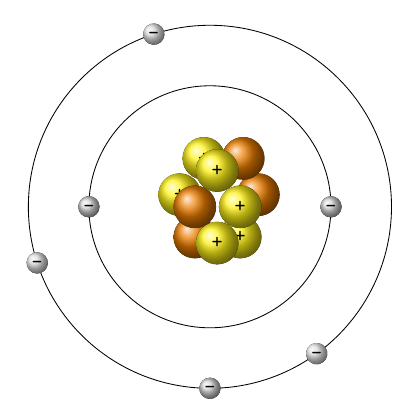
How many protons does this atom have?
a)
3
b)
6
c)
4
d)
2
68.

In a neutral atom,

a)

protons = electrons

b)

protons = neutrons

c)

neutrons = electrons

d)

protons = neutrons = electrons

69.
What is the mass number?
a)
the number of protons
b)
the number of protons and neutrons
c)
the number of neutrons
d)
the number of protons and electrons
70.

What is the mass number of this atom?

a)

1

b)

3

c)

4

d)

7

71.
How is the number of neutrons in the nucleus of an atom calculated?
a)
Add the number of e- and p+ together
b)
Subtract the number of e- from p+
c)

Subtract the number of the atomic number from the mass number

d)
Add the mass number to the number of e-