
 Worksheets
Forces of Motion
Total questions: 93
Worksheet time: 7hrs 43mins
Newton's Law of Inertia (first law) describes the motion of-
Objects that accelerate
Because of inertia, a moving object will keep ________ unless acted on by an unbalanced force.
at rest
moving
in one spot
inertia
Newton's Third Law States that..?
Objects in motion stay in motion and objects at rest stay at rest.
Force is equal to mass times acceleration.
For each action, there is an equal and opposite reaction.
A baseball player bats a ball with a force of 1,000N. The ball exerts a reaction force against the bat of...
1,000N in the opposite direction
Less than 1,000N
More than 1,000N
Only 500N
Name the action - reaction pair.
If the fist hits the wall, then..
(a)
For every action, there is...
an equal and opposite reaction.
mass times acceleration.
food and water.
none of the above.

A football player kicks a 0.5 kg ball with an unknown force it accelerates by 3.0 m/s^2. What is the force of the kick?
(a)
What does the F in the F=m x a equation stand for?
Mass
Force
Acceleration
Pressure
A 14.0 kg cart is being pushed with 538 N of force. What is the acceleration of the cart?
28.4 m/s^2
39 m/s^2
38.4 m/s^2
40 kg
11-12.
Answer the questions below after watching the video
What does Newton's First law of motion state?
Why does the camera and the astronaut fly backwards towards the camera recording?
The acceleration experienced by the rocket makes the objects move upwards
The acceleration experienced by the rocket makes the objects fly in the same direction as thrust
Since only the rocket accelerates the rest of the objects stay in place
Since the rocket and the objects accelerate the objects move with the rocket

The girl on the sled will remain in motion in the same direction unless
her motion is changed by magnetic forces.
she is stopped by an unbalanced force.
she accelerates at a constant speed.
the force of friction forcer her to move faster.


When the force on a car is doubled, the acceleration is doubled.
Newton's 1st Law
Newton's 2nd Law
Newton's 3rd Law

Which law best explains why more force must be applied to the bowling ball to make it accelerate at the same rate as the tennis ball.
Newton's 1st Law
Newton's 2nd Law
Newton's 3rd Law

When a cannon fires a cannonball we observe Newton's third law. Which is the reaction force?
The cannon moving forward
The cannon moving backwards
The cannonball moving backwards
The cannonball moving forward

A skater pushes another skater forward, but the one pushing moves backwards. Explain which of the laws describes this and why does each of the skaters received a different acceleration.
19-28.
Answer the questions below after watching the video
What is the role of gravity when a boy is standing still?
It pushes him upwards
It pulls him downwards
It spins him around
It has no effect
What happens to the motion of an object when balanced forces act on it?
It stays still
It moves faster
It slows down
It remains in motion
What happens when two equal and opposite forces act on an object?
The object rotates
The object vanishes
The object remains stationary
The object moves in the direction of the stronger force
What is required for an object to start moving?
Balanced forces
Magnetic forces
Unbalanced forces
No forces
In a tug of war, what determines if the rope moves?
The rope's length
Equal force on both sides
Greater force on one side
The type of rope used
What causes a ball at rest to start moving?
Wind
Balanced forces
A push or kick
Gravity alone
What happens when the force of a kick on a ball becomes equal to other forces acting on it?
The ball accelerates
The ball stops
The ball changes direction
The ball disappears
Why does a ball stop moving after being kicked?
It hits an obstacle
Balanced forces act again
It deflates
Loss of air
What ensures that a seesaw stays balanced?
Equal weights on both sides
Different weights on each side
No weight on either side
Continuous motion
What is the effect of unbalanced forces on a seesaw?
It levitates
It breaks
It moves towards the heavier side
It remains horizontal
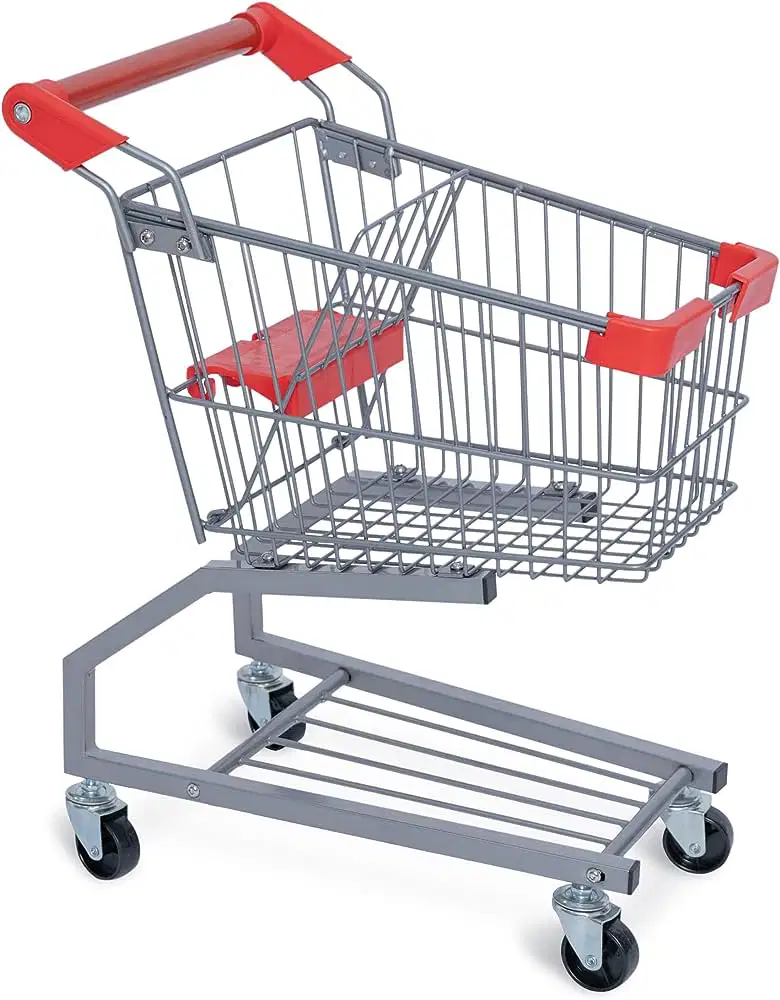
Thomas is pushing a shopping cart with a certain mass at an acceleration. According to Newton's second law of motion, what is the equation that relates the force Thomas applies, the mass of the cart, and the acceleration of the cart?
F=m+a
F=am
F=ma
F=ma
The force that pulls objects toward the center of the Earth is called:
Magnetic force
Gravitational force
Electric force
Nuclear force
What is the primary effect of unbalanced forces acting on an object?
The object moves in a circular path
The object's velocity remains constant
The object accelerates
The object levitates
32-41.
Answer the questions below after watching the video
What does Newton's first law, also known as the law of inertia, state?
For every action, there is an equal and opposite reaction.
An object at rest stays at rest, and an object in motion stays in motion unless acted upon by an external force.
The force on an object is equal to its mass times its acceleration.
An object will change its motion if a force acts upon it.
What is inertia?
The force required to accelerate an object.
The tendency of an object to resist changes in its velocity.
The gravitational pull on an object.
The speed of an object in motion.
How is net force related to mass and acceleration according to Newton's second law?
Net force is the product of mass and velocity.
Net force is the product of mass and acceleration.
Net force is the difference between mass and acceleration.
Net force is the sum of all external forces acting on an object.
What role does mass play in Newton's second law of motion?
Greater mass results in greater net force for the same acceleration.
Greater mass means less acceleration for the same force.
Mass is inversely proportional to force.
Mass has no effect on the acceleration of an object.
What is the acceleration due to gravity on Earth's surface?
10 m/s^2
9.81 m/s
9.81 m/s^2
10 m/s
How can the force of gravity be calculated?
Adding mass to the acceleration due to gravity.
Dividing mass by the acceleration due to gravity.
Multiplying mass by the acceleration due to gravity.
Subtracting the acceleration due to gravity from the mass.
According to Newton's third law, what happens when you exert a force on an object?
The object accelerates in the opposite direction.
The object's mass increases.
The object exerts an equal force back on you.
The object moves in the direction of the force.
What is the normal force?
The force of gravity acting on an object.
The force that acts parallel to the surface.
The force exerted by an object moving in a circular path.
The force acting perpendicular to the surface an object rests on.
What does a free body diagram represent?
The acceleration of an object.
All the forces acting on an object and their directions.
The velocity of an object.
The net force acting on an object.
What determines the tension in a rope holding a suspended object?
The mass of the object and the acceleration due to gravity.
The length of the rope.
The thickness of the rope.
The material of the rope.
What does Newton's First Law of Motion state?
An object at rest stays at rest and an object in motion stays in motion with the same speed and in the same direction unless acted upon by an unbalanced force.
The acceleration of an object is directly proportional to the net force acting on the object and inversely proportional to its mass.
For every action, there is an equal and opposite reaction.
The force of gravity acting on an object is directly proportional to its mass.
What is inertia?
The force that keeps an object moving in a circle
The tendency of an object to resist changes in its velocity
The force that pulls objects toward the center of the Earth
The reaction force that occurs in response to an action force
What is the formula for calculating the force applied to an object, according to Newton's Second Law of Motion?
F=ma
F=am
F=m+a
Which of Newton's Laws explains the principle of action and reaction?
First Law
Second Law
Third Law
47-56.
Answer the questions below after watching the video
What do Newton's Laws help us understand?
How water flows
How plants grow
How stars shine
How objects move
What is another name for Newton's First Law?
Law of Energy
Law of Motion
Law of Inertia
Law of Gravity
According to Newton's First Law, what happens to an object at rest?
It changes shape
It disappears
It starts moving on its own
It remains still unless moved
Why does it take less force to move a bike than a car?
Because a bike is smaller
Because a bike is faster
Because a bike has more wheels
Because a bike is lighter
What happens when you throw a ball against a wall?
It bounces back
It changes color
It breaks
It sticks to the wall
What is motion?
When something changes its position
When something changes its color
When something gets bigger
When something makes a sound
What is force?
A type of sound
A type of energy
A type of motion
An action that causes movement or shape change
What happens when Joan lifts a box?
The box changes color
The box changes place
The box makes a sound
The box gets bigger
What is acceleration?
When something changes color
When something makes a sound
When something speeds up or slows down
When something changes its shape
How can Newton's Laws help us?
To understand the weather
To understand how things move
To understand how plants grow
To understand how stars shine
Based on Newton’s first law of motion, what happens when you slide forward on ice?
You will lose your balance and fall over before you reach the middle.
You will continue to slide until a force makes you stop or change direction.
Gravity keeps you moving until someone makes you stop.
The size of your ice skates affects your speed across the ice.
What does friction do to a moving object?
slows it down
speeds it up
makes it rise
all of the above
What needs to happen to a soccer ball for it to return to someone?
Friction has to be applied to the ball.
Force has to be applied to the ball.
Speed has to be applied to the ball.
Inertia has to be applied to the ball.
What is the rate at which an object’s velocity changes called?
inertia
actualization
acceleration
completion
What is inertia?
the amount of force to start moving an object at rest
an object’s velocity and its friction
what keeps an object steady, at rest or moving consistently
the friction needed to slow an object in motion
When two objects with unequal mass collide, what happens?
accelerate at different rates
accelerate in the same direction
come to a complete stop
continue at the same velocity
When you jump off a small rowing boat onto the shore, the boat moves backward. Which of Newton's laws explains this action?
Newton's First Law of Motion
Newton's Second Law of Motion
Newton's Third Law of Motion
Newton's Law of Universal Gravitation
If you were to push a shopping cart with twice the force you used before, what would happen to the acceleration of the cart?
The acceleration would decrease.
The acceleration would stay the same.
The acceleration would double.
The acceleration would be halved.
80-81.
Answer the questions below after watching the video
When two objects of differnt mass collide, who accelerates the most?
The lighter mass object will accelerate the most.
The heavier mass object will accelerate the the most.
The both accelerate the same.
Neither accelerate.
Newton's third law states that ...
One object will always accelerate more than the other when they colloide.
when two objects collide there is an equal and opposite reaction.
when two objects collide nothing will happen.
Who cares about Newton?
What does the gravitational force between two objects depend on?
The mass of the first object only
The mass of both objects and the distance between them
The distance between the objects only
The speed at which the objects are moving towards each other
Newton's 3rd Law states that for ever action there is an equal and opposite ________.
reaction
satisfaction
fraction
transaction
If a 10 kilogram object accelerates suddenly at 15 m/s2, how much force was applied to the object?
150 Newtons
15 Newtons
150 kilograms
100 kilograms

A force of 250 N is applied to an object that accelerates at a rate of 5 m/s2. What is the mass of the object? To solve this problem you must do -
250 ÷ 5
5 ÷ 250
250 x 5

A 50 kg skater pushed by a friend accelerates 5 m/s2. How much force did the friend apply? To solve this problem you must do -
50 ÷ 5
5 ÷ 50
50 x 5

A 5 kg block is pulled across a table by a net force of 32 N. Calculate the acceleration of the object.
160 m/s2
6.4 m/s2
0.16 m/s2

What is the formula for force?
F=m/a
F=a/m
F=ma
F=Fm
Unit for acceleration?
m/s2
kg
newtons
a
What is the unit for force?
m/s2
kg
N
F
A 50 kg skater pushes off from a wall with a force of 200 N. What is the skater’s acceleration?
Solve this problem
200 / 50 = 4 m/s2
50 / 200 = 4 N
200 x 50 = 10,000 m/s2
200 / 50 = 4 N
A push or a pull.
Force
Friction
Weight
Gravity
The quantity of matter in an object.
matter
inertia
weight
mass
speeding up, slowing down, changing direction are all examples of...
speed
momentum
acceleration
force

What is Newton's 3rd Law?
For every action there is an equal and opposite reaction.
Acceleration depends on two variables, the mass of the object and the amount of force.
What law is best described by inertia?
1st
2nd
3rd

1st law
2nd law
3rd law

Which of the following is an example of an unbalanced force?
A book resting on the table.
A pencil that is knocked to the ground.
What is Newton's 2nd Law?
For every action there is an equal and opposite reaction.
Acceleration depends on two variables, the mass of the object and the amount of force.
Newton's first law states that an object must travel at a constant speed and in ___________, unless an unbalanced force acts on it.
in a circle
a wave like manner
the same direction

Looking at the image. Decide if this is balanced or unbalanced.
Unbalanced
Balanced
The force that prevents a ball rolling on the ground from continuing on it's path forever is...
Friction
Mass
Inertia
Which of the following is an example of balancing forces?
A Book resting on the table.
A pencil is knocked off the desk.
A rollercoaster heading down a hill is _____________.
at rest
slowing down
accelerating
velocity
if an object stays still or continues moving at the same speed and in the same direction, it is a _______ force.
weak
strong
balanced
unbalanced


