
 Worksheets
AP Chemistry Gas and Stoichiometry Review
Total questions: 145
Worksheet time: 18hrs 15mins
How many moles of oxygen are produced when 6.7 moles of KClO3 decompose completely?
How many grams of hydrogen are produced if 120 g of Na are available?
In the formation of CO2 from CO and oxygen, how many Liters of CO2 are produced by the reaction of 8 mols of O2 with an excess of carbon monoxide?
I need to add 8 moles of Carbon to the reaction. How many grams of Carbon should I weigh?
How many grams of potassium chloride can be produced from 356 g of chlorine and 356 g of potassium bromide?
How many moles of carbon dioxide are produced from the combustion of 110 g of CH4?
In the experiment above, 7.62 g of Fe are allowed to react with 8.67 g of S.
How much FeS is formed?
Mg + 2HCl --> MgCl2 + H2
How many liters of carbon dioxide are produced from 10L of carbon monoxide?
How many grams of aluminum sulfate would be formed if 250g H2SO4 completely reacted with aluminum?
How many grams of aluminum sulfate would be formed if 250g H2SO4 completely reacted with aluminum?
How many moles of water can be produced if 8 moles H2 are used?
Determine the % composition of Potassium in the following copound KMnO4
14.8%
34.8%
24.7%
40.5%
Determine the mass of calcium hydroxide produced when calcium carbide reacts with 0.64g of water according ot the following equation
CaC2 + 2H2O --> Ca(OH)2 + C2H2
10.31 g Ca(OH)2
41.31 g Ca(OH)2
1.31 g Ca(OH)2
31 g Ca(OH)2
Determine the mass of lithium hydroxide produced when 0.38g of lithium nitride reacts with water according to the following equation
Li3N + 3H2O --> NH3 + 3LiOH
11.78 g LiOH
0.78 g LiOH
12.78 g LiOH
21.78 g LiOH
How many moles of nitrogen gas are in 135 L of nitrogen gas at Standard Temperature and Pressure (STP)?
9.64 moles of N2
5.53 moles of N2
6.02 moles of N2
4.82 moles of N2
A compound is 64.9% carbon, 13.5% hydrogen, and 21.6% oxygen. Its molecular mass is 74 g/mol. What is its molecular formula?
C4H10O
C5H10
C2H4O2
None of these
Four students tried to balance the following Reaction:
Mg + Fe2O3 → MgO + Fe
Which student is correct?
3Mg + Fe2O3 → 3MgO + 2Fe
Mg + Fe2O3 → MgO3+ Fe2
2Mg + Fe2O2 → 2MgO + 2Fe
3Mg + 2Fe2O3 → 3MgO + 2Fe
Fe2O3(s) + 3H2(g) → 2Fe(s) + 3H2O(l)
How many moles of iron can be made from 6 moles H2?
12.00 moles of NaClO3 will produce how many grams of O2?
2Al + 3H2SO4 -> Al2(SO4)3 + 3H2How many grams of aluminum sulfate would be formed if 250g H2SO4 completely reacted with aluminum?
0.85 g
290 g
450 g
870 g

mass of crucible = 22.130 grams
mass of crucible + hydrate = 25.290 grams
mass of crucible and contents after heating = 23.491 grams
What is the complete formula of this hydrate?
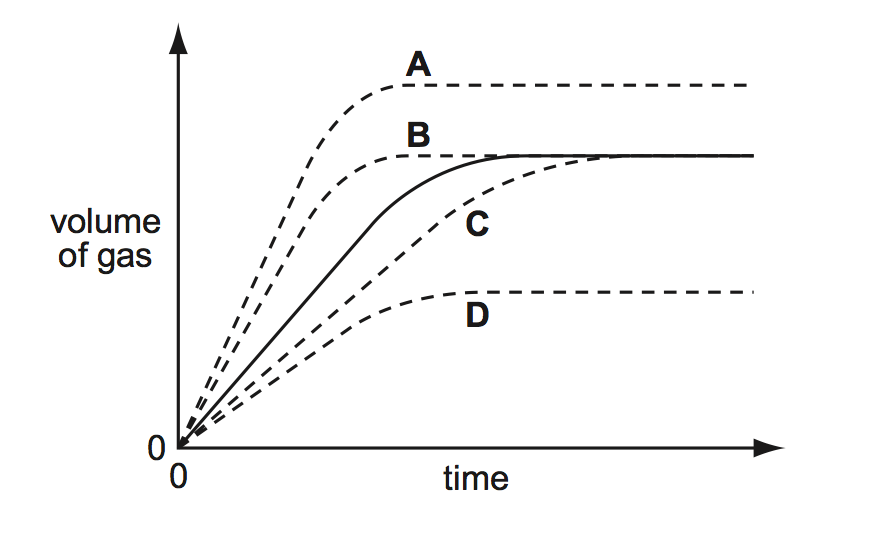
1 decreasing the concentration of hydrochloric acid
2 decreasing the particle size of calcium carbonate
3 decreasing the temperature
atoms in
2.50 moles of zinc.
Ga2(SO3)3
A gaseous mixture containing 7.0 moles of nitrogen, 2.5 moles of oxygen, and 0.5 moles of helium exerts a total pressure of 0.90 atmosphere. What is the partial pressure of the nitrogen?
0.13 atm
0.27 atm
0.63 atm
0.90 atm
A 2.00-liter sample of nitrogen gas at 27° C and 600. millimeters of mercury is heated until it occupies a volume of 5.00 liters. If the pressure remains unchanged, the final temperature of the gas is
68o C
120o C
477o C
677o C
A sample of 0.010 mole of oxygen gas is confined at 127°C and 0.80 atmosphere. What would be the pressure of this sample at 27°C and the same volume?
0.10 atm
0.20 atm
0.60 atm
0.80 atm
Samples of F2 gas and Xe gas are mixed in a container of fixed volume. The initial partial pressure of the F2 gas is 8.0 atmospheres and that of the Xe gas is 1.7 atmospheres. When all of the Xe gas reacted, forming a solid compound, the pressure of the unreacted F2 gas was 4.6 atmospheres. The temperature remained constant. What is the formula of the compound?
XeF
XeF3
XeF4
XeF6
At 25°C, a sample of NH3 (molar mass 17 grams) effuses at the rate of 0.050 mole per minute. Under the same conditions, which of the following gases effuses at approximately one-half that rate?
O2 (molar mass 32 g/mol)
He (molar mass 4.0 g/mol)
CO2 (molar mass 44 g/mol)
Cl2 (molar mass 71 g/mol)
NH4NO3(s) → N2O(g) + 2 H2O(g)
A 0.03 mol sample of NH4NO3(s) is placed in a 1 L evacuated flask, which is then sealed and heated. The NH4NO3(s) decomposes completely according to the balanced equation above. The total pressure in the flask measured at 400 K is closest to which of the following? ( The value of the gas constant, R, is 0.082 L atm mol–1 K–1)
3 atm
1 atm
0.5 atm
0.1 atm
A sample of 9.00 grams of aluminum metal is added to an excess of hydrochloric acid. The volume of hydrogen gas produced at standard temperature and pressure is
22.4 Liters
11.2 Liters
7.46 Liters
5.60 Liters
An excess of Mg(s) is added to 100. mL of 0.400 M HCl. At 0ºC and 1 atm pressure, what volume of H2 gas can be obtained?
22.4 mL
44.8 mL
224 mL
448 mL
A sample of a gas (5.0 mol) at 1.0 atm is expanded at constant temperature from 10.0 L to 15.0 L. The final pressure is ___ atm.
1.5 atm
15 atm
0.67 atm
3.3 atm
7.5 atm
The volume of a sample of gas (2.49 g) is 752 mL at 1.98 atm and 62ºC. What is the gas?
NO2
SO3
SO2
Ne
NH3
At 333 K, which of the pairs of gases below would have the most nearly identical rates of effusion?
CO and CO2
CO and N2
NO2 and N2O4
N2O and NO2
N2 and O2
Convert 191 atm to kPa.
194 kPa
1.94 x 10⁴ kPa
25.5 kPa
1.89 kPa
45600 kPa
Convert 191 mmHg to atm.
145000 atm
0.251 atm
890 atm
3.55 atm
1.23 x 10³ atm
What describes the motion of a Gas Molecule?
Molecules are far apart
Move in constant, random motion
It will travel in a straight path
All of the above
Pressure is
defined as the mass that an object exerts when at rest.
not a measurable in gases.
defined as the number of moles of substance divided by the mass of the substance.
created by the force of the gas particles impacting the walls of the container.
2Al + 6HCl --> 2AlCl3 + 3H2
Aluminium reacts with hydrochloric acid. How many grams of aluminum are necessary to produce 11 L of hydrogen gas at STP?
13
8.8
0.99
1.0
Mg3N2 + 3H2O ––> 3 MgO + 2NH3
If 10.3 g of magnesium nitride is used, what volume of ammonia gas would be collected at 20˚C and 0.989 atm?
4.9 L NH3
4.96 L NH3
0.261 L NH3
0.26 L NH3
1Mg + 2H2O --> Mg(OH)2 + H2
What volume of hydrogen will be produced at STP by the reaction 67.3 g of magnesium?
62.0 L
0.12 L
2.77 L
1.15 L
Mg3N2 + 3H2O ––> 3 MgO + 2NH3
If 10.3 L of ammonia gas at 20.0˚C and 0.989 atm is created, how many liters of water at STP are required?
0.423 L H2O
14.2 L H2O
0.204 L H2O
10.3 L H2O
2CO + O2 −-> 2CO2
How many liters of carbon dioxide at STP are produced from 10.0 L of carbon monoxide at STP?
10.0 L
20.0 L
5010 L
0.0199
4NH3+6NO --> 5N2 + 6H2O
How many liters of NH3 at 32.6 oC and 4.25 kPa are needed to react completely with 30.0L of NO at STP?
5.27 L
534 L
5.2 L
533.6 L
When solving for gas stoichiometry problems which of the following is correctly matched?
STP conditions; molar mass
NON STP conditions; PV=nRT
STP conditions; PV=nRT
NON STP conditions; 22.4 moles
2CO + O2 −-> 2CO2
How many liters of carbon monoxide at 25.0oC and 8.56 mmHg are needed to react with 12.30 L of oxygen gas at STP?
3.14 L
318 L
2390 L
200 L
2NaN3 → 2Na + 3N2
At what pressure(atm) is the nitrogen gas sample that is collected when 48.4 g of NaN3 decomposes? The temperature of the gas is 25.0°C and the volume is 18.4 L.
151 atm
1130 atm
0.125 atm
1.48 atm
2Cu2S + 3O2 → 2Cu2O + 2SO2
This reaction uses 18.2 g of copper (I) sulfide. What volume of sulfur dioxide gas would be collected at 237°C and 10.7 atm?
0.446 L
57 L
0.207 L
0.21 L
Assume that 5.6 L H2 at STP reacts with excess CuO according to the following equation:
CuO (s) + H2 (g) ---> Cu (aq) + H2O (l)
How many moles of Cu are produced?
0.250 mol
2.50 mol
25.0 mol
25.00000 mol
How many liters of NH3 are needed to react completely with 30.0L of NO?
4NH3(g) + 6NO (l)--> 5N2 (g) + 6H2O (l)
5.0 L
20.0 L
7.5 L
120.0 L
Which mole ratio is correct for the given chemical equation?
2N2 (g) + 5O2 (g) -----> 2N2O5 (g)
2 mol N2 to 5 mol N2O5
2 mol N2 to 2 mol N2O5
5 mol O2 to 2 mol NO2
None are correct.
Actual yield = 62g
Calculate the percent yield.
2CO (g) + O2 (g) --> 2CO2 (g)
How many liters of carbon dioxide (CO2) are produced from 10L of carbon monoxide (CO)?
10
20
1
5
What volume of hydrogen(H2) will be produced at STP by the reaction 67.3 g of magnesium with excess water according to the following reaction?
1Mg (s) + 2H2O (l) --> Mg(OH)2 (aq) + H2 (g)
62L
65L
31L
124L
Solid aluminum react with HCl according to the following balanced equation at STP:
2Al (s) + 6HCl (aq) --> 2AlCl3 (aq) + 3H2 (g)
If 13.5 g of Al (s) reacts with excess HCl, how many liters of H2 gas are generated?
15.2 L
16.8 L
12.5 L
14.8 L
How do I change from moles to liters in STP?
divide by 22.4
multiple by Avo number
multiply by 22.4
multiply by molar mass
How many moles of hydrogen are needed to react with 2 moles of nitrogen?
1Mg + 2H2O --> Mg(OH)2 + H2


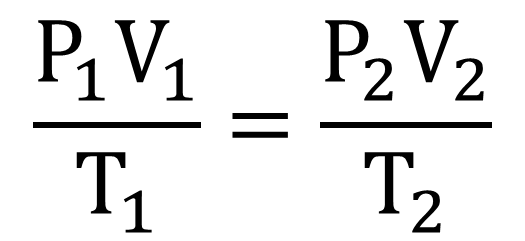
A water bottle at STP is cooled to -155°C. What is the new pressure?
3.2 atm
0.43 atm
1.8 atm
0.27 atm
The pressure of a 6.5 L sample of oxygen gas is measured to be 3.8 atm. If the gas is transferred into a 12 L tank, what is the new pressure?
6.6 atm
3.9 atm
4.5 atm
2.1 atm
A student transfers a gas at STP from a 11.0 L tank to a 25.0 L tank. If the pressure remains constant, what is the new temperature?
620 K
393 K
254 K
530 K
What is the pressure of a car tire that had an initial pressure of 1.8 atm but was heated from 38°C to 123°C?
0.9 atm
2.1 atm
1.6 atm
3.4 atm
A sample of gas containing 9.2 moles is transferred from an 13 L tank to a 23 L tank. What is the new number of moles that can be stored in the tank?
10.2 mol
13.7 mol
19.1 mol
16.3 mol
A student places four gases into a container. The pressures of the gases are: N2=2.1 atm, H2=1.3 atm, He=1.9 atm & Ar=3.4 atm. What is the total pressure?
5.1 atm
8.7 atm
7.4 atm
6.9 atm
Three gases are mixed together in a container with a total pressure of 4.8 atm. If two of the gases have pressures of 1.2 atm and 1.5 atm, what is the pressure of the third gas?
2.5 atm
1.8 atm
2.1 atm
1.3 atm


PV=nRT

2Al + 6HCl --> 2AlCl3 + 3H2
Aluminium reacts with hydrochloric acid. How many grams of aluminum are necessary to produce 11 L of hydrogen gas at STP?
13
8.8
0.99
1.0
Mg3N2 + 3H2O ––> 3 MgO + 2NH3
If 10.3 g of magnesium nitride is used, what volume of ammonia gas would be collected at 20˚C and 0.989 atm?
4.9 L NH3
4.96 L NH3
0.261 L NH3
0.26 L NH3
1Mg + 2H2O --> Mg(OH)2 + H2
What volume of hydrogen will be produced at STP by the reaction 67.3 g of magnesium?
62.0 L
0.12 L
2.77 L
1.15 L
Mg3N2 + 3H2O ––> 3 MgO + 2NH3
If 10.3 L of ammonia gas at 20.0˚C and 0.989 atm is created, how many liters of water at STP are required?
0.423 L H2O
14.2 L H2O
0.204 L H2O
10.3 L H2O
2CO + O2 −-> 2CO2
How many liters of carbon dioxide at STP are produced from 10.0 L of carbon monoxide at STP?
10.0 L
20.0 L
5010 L
0.0199
4NH3+6NO --> 5N2 + 6H2O
How many liters of NH3 at 32.6 oC and 4.25 kPa are needed to react completely with 30.0L of NO at STP?
5.27 L
534 L
5.2 L
533.6 L
When solving for gas stoichiometry problems which of the following is correctly matched?
STP conditions; molar mass
NON STP conditions; PV=nRT
STP conditions; PV=nRT
NON STP conditions; 22.4 moles
2CO + O2 −-> 2CO2
How many liters of carbon monoxide at 25.0oC and 8.56 mmHg are needed to react with 12.30 L of oxygen gas at STP?
3.14 L
318 L
2390 L
200 L
2NaN3 → 2Na + 3N2
At what pressure(atm) is the nitrogen gas sample that is collected when 48.4 g of NaN3 decomposes? The temperature of the gas is 25.0°C and the volume is 18.4 L.
151 atm
1130 atm
0.125 atm
1.48 atm
2Cu2S + 3O2 → 2Cu2O + 2SO2
This reaction uses 18.2 g of copper (I) sulfide. What volume of sulfur dioxide gas would be collected at 237°C and 10.7 atm?
0.446 L
57 L
0.207 L
0.21 L
Assume that 5.6 L H2 at STP reacts with excess CuO according to the following equation:
CuO (s) + H2 (g) ---> Cu (aq) + H2O (l)
How many moles of Cu are produced?
0.250 mol
2.50 mol
25.0 mol
25.00000 mol
How many liters of NH3 are needed to react completely with 30.0L of NO?
4NH3(g) + 6NO (l)--> 5N2 (g) + 6H2O (l)
5.0 L
20.0 L
7.5 L
120.0 L
Which mole ratio is correct for the given chemical equation?
2N2 (g) + 5O2 (g) -----> 2N2O5 (g)
2 mol N2 to 5 mol N2O5
2 mol N2 to 2 mol N2O5
5 mol O2 to 2 mol NO2
None are correct.
Actual yield = 62g
Calculate the percent yield.
2CO (g) + O2 (g) --> 2CO2 (g)
How many liters of carbon dioxide (CO2) are produced from 10L of carbon monoxide (CO)?
10
20
1
5
What volume of hydrogen(H2) will be produced at STP by the reaction 67.3 g of magnesium with excess water according to the following reaction?
1Mg (s) + 2H2O (l) --> Mg(OH)2 (aq) + H2 (g)
62L
65L
31L
124L
Solid aluminum react with HCl according to the following balanced equation at STP:
2Al (s) + 6HCl (aq) --> 2AlCl3 (aq) + 3H2 (g)
If 13.5 g of Al (s) reacts with excess HCl, how many liters of H2 gas are generated?
15.2 L
16.8 L
12.5 L
14.8 L

