
 Worksheets
Y9 Unit 6 Test Revision
Total questions: 93
Worksheet time: 3600secs

What type of interference is represented in this diagram?
Constructive
Destructive

What type of interference is represented in the diagram?
Constructive
Destructive

What type of interference do noise cancelling headphones use?
Constructive Interference
Destructive Interference

Which type of interference occurs when sound waves produced by wind instruments become louder?
Constructive
Destructive
True or False? Two waves cannot exist in the same space or in the same medium at the same time.
True
False

When a compression interferes with another compression, what occurs?
They counteract and the wave stops.
They combine to create a larger compression.
They combine to create a rarefaction.
None of the above.
When a crest and a trough interfere, what occurs?
They combine to create a higher amplitude wave.
They counteract and the wave either lessens or stops completely.
The wave changes into a longitudinal wave.
When 2 waves temporarily interfere with each other then resume their course of movement, which of the following is true?
They take on and keep a new amplitude based on the result of the interference until the end of the movement.
They are not affected by the interference and maintain their original amplitude throughout the movement.
Both waves are always counteracted and cease to exist.
They temporarily take on a new amplitude due to the interference but resume their original amplitude until the end of the movement.

The two blue and purple waves will undergo _________________ when they meet.
Constructive interference
Destructive interference

The image of the two waves depicts
Constructive interference
Destructive interference

The picture shows 4 sound waves on an oscilloscope. Which has the highest pitch?
A
B
C
D
The picture shows 4 sound waves on an oscilloscope. What can you say about A?
It is a very low pitched sound
It is a very high pitched sound
It is a very quiet sound
It is a very loud sound
The picture shows 4 sound waves on an oscilloscope. Which 2 have the smallest amplitude?
A
B
C
D
Which statement is true of sound waves. Select 2 answers.
They are made by objects vibrating
They are detected because they make our ear drum vibrate
They are transverse waves
They travel faster in air than in water.
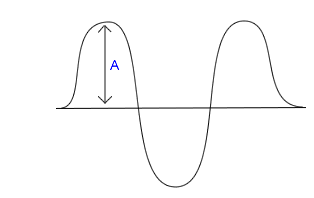
What is the height of a wave called?
Peak
Wavelength
Amplitude
Frequency
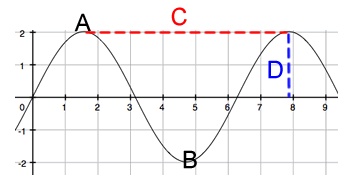
Sound waves are caused by the (a) of particles
The distance between 2 crests or troughs
wavelength
amplitude
frequency
wave speed


A
B

A
B
From the words below, which one is linked with the Pitch of the sound
Amplitude
Loudness
Frequency
speed
Frequency is measured in
m/s
m
Hz
Decibel
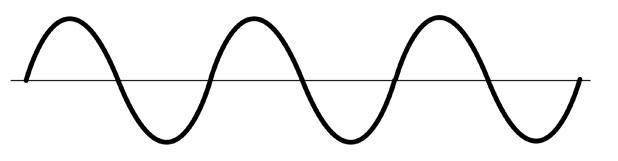


Reorder the following:
Which medium does sound travel further through, highest to lowest distance.
Solids
Liquids
Gases

Sound is a form of energy. How is it produced?
by waiting
by vibrating objects


The Moon most likely formed from an impact of a Mars-size object with early Earth.
True
False
Which of the following best describes the widely accepted theory for the formation of the moon:
An asteroid flew into Earth's gravitational field and was caught and trapped.
An asteroid roughly the size of mars smashed into Earth and cleaved off a large section of debris. The debris condensed into the moon.
The moon formed as simultaneously with the Earth as planetesimals smashed together to created the Earth-Moon system.
There is no accepted theory for the formation of the moon. No one has any idea how it got there.
The moon is actually a large alien space ship that monitors human technological progress
The collision theory suggests that an object called Theia collided with Earth. Which of these planets is closest in size to Theia?
Earth
Moon
Venus
Mars
Which evidence supports the collision theory?
The Moon has a small iron core, similar to the Earth
Venus has no moon
The Moon is Earth's only permanent natural satellite
The surface of the Earth does not appear to ever have been molten
Which evidence contradicts the collision theory?
Samples of rock from the Moon show that its surface was once molten
Similar collisions causing rings of rock and dust outside the Solar System
The collision theory fits with the theory of how the Solar System was formed
The surface of the Earth does not appear ever to have been molten.
Which of these statements could explain why the composition of rocks on the Earth and on the Moon is very similar?
The Moon is mostly formed from Theia's rocks and the Earth only has a small quantity of Theia's rocks.
The Earth is mostly formed from Theia's rocks and the Moon only has a small quantity of Theia's rocks.
Rocks from Theia and Earth were completely mixed during the collision.
In the collision theory, the object that collided with Earth was called Theia. If the collision theory were correct, which object would contain particles from Theia?
The Moon only.
The Earth only.
Both the Earth and the Moon.
Neither the Earth nor the Moon.
Reorder the following description of how the Moon was formed according to the collision theory.
An object of a similar size to Mars collided with Earth.
The impact caused a disc of dust and rock to form around Earth.
The dust and rock eventually came together under gravity to form the Moon.
The fission theory suggests that the Earth and Moon were once the same object. This object then split into two parts soon after formation. The two parts are now the Earth and the Moon.
Which piece of evidence would support both the fission theory and the collision theory?
The composition of rocks on the Moon is very similar to that on Earth.
The Moon is smaller than Earth.
The Earth only has one Moon and some other planets have more than one moon.
The moons of Mars were originally asteroids.


What are nebulae?
groups of exploding stars
clouds of gas and dust in space
a collection of stars
groups of stars forming a pattern
Which of these statements is correct?
All nebulae act as stellar nurseries.
Only some nebulae act as stellar nurseries.
No nebulae ever act as stellar nurseries.
What are the most common gases found in nebulae?
hydrogen
helium
nitrogen
neon
What is the gas most commonly found in nebulae?
hydrogen
helium
neon
oxygen
Reorder the following objects in the order of size from smallest to largest.
asteroid
moon
star
nebula
Which statements about nebulae are true?
All nebulae contain dust and gas.
All nebulae act as stellar nurseries.
All nebulae are different shapes.
All nebulae are bigger than the Milky Way galaxy.
Stellar nursery is an area in space where ____________ are formed.
stars
nebula
Solar System
planets
Where are stars formed?
Next to a moon
In a nebula
Inside another star
Next to a planet
Reorder the following star formation descriptions.
Dust and gas particles are pulled together by gravity.
The force of gravity pulling inward increases as the mass of dust and gas becomes larger.
The pressure inside the new star increases.
The high pressure causes heat.
Heat starts reaction that give out heat and light.
convection current of magma
Which set of events is most common along tectonic plate boundaries?
Earthquakes and volcanoes
Erosion and earthquakes
Tidal waves and volcanoes
Hurricanes and tsunamis

tectonic plates
Convection currents happen in the mantle. The outer core heats magma around it and causes it to become less dense. Because the magma is less dense than the material around it, it starts to rise toward the crust. Since the crust is not hot, the magma starts to cool as it gets close to the crust. Since it is cooling, it gets denser and starts to sink back down toward the outer core.
Use the information above to answer the following question: Which of the following TWO things happen to magma causing it to rise?
It gets cooler.
It gets warmer.
It gets denser.
It gets less dense.
What is the thinnest and outer most layer of the Earth, that we live on?
Outer Core
Crust
Mantle
Inner core
Which layer of the Earth is solid iron and nickel?
Mantle
Crust
Inner Core
Outer core

Describe the most likely relationship between these mountains and nearby tectonic plates.
The mountains are probably formed by earthquakes
The mountains are probably formed by the movement of glaciers
The mountains are probably located near the edge of 2 tectonic plates.
The mountains are probably formed by running water.
What was the name given to all the continents when they were joined as one super continent?
Supreme Continent
Eurasia
Plate tectonics
Pangaea


Upon observation of the Mid-Atlantic ocean ridge, scientists discovered what evidence that supports continental drift?
The ridge was made of new material while the land around it was older material
The ridge was made of old material while the land around it was newer material
Magma was actively seen producing new material
Old magma was discovered in the land around it

Rocks on each plate rub up against each other and build up a lot of potential energy. Once this energy is great enough, the rocks will break and the energy will be released. This causes...
Volcanic eruptions
Earthquakes
Both volcanic eruptions and earthquakes
First an earthquake and then a volcanic eruption

Many natural events occur in the Pacific Ring of Fire. Based on your knowledge of tectonic plates, what events occur here?
Volcanic eruptions
Mountain ridges
Both volcanic eruptions and mountain ridges
First a volcanic eruption and then formation of mountain ridges

The movement of tectonic plates is due to ____?
convection currents in the mantle
seafloor spreading

What is true about the Earth's plates?
The are made of solid rock that can never be seen.
They are made of solid rock that can be seen if not covered by soil, rock, or water.

What is true about the Earth's plates?
They are separated by oceans.
They fit closely together with each plate touching all the others.

What happens when continental plates press together?
The edges of the plates will push upward and continue to move toward each other.
The edges of the plates will be pushed downward and continue to move toward each other.

Two of Earth's plates pressed together for millions of years. What happened?
The oceanic plate was pushed downward
The continental plate was pushed downward.

The Mesosaurus was a fresh water reptile that existed on Earth about 250 million years ago. Fossils of the reptile can be found today in some rock layers in both Africa and South America as shown on the map below in locations X and Y.
Which reason best explains why fossils of this animal are found on both continents today?
The ocean between the two continents was once frozen, and the Mesosaurus traveled across the ice.
The continents of South America and Africa were once joined together as a single land mass.
The Mesosaurus swam across the ocean due to its migration.
During a sea level rise and floods fossil remains of the Mesosaurus were carried across the oceans between the two continents.
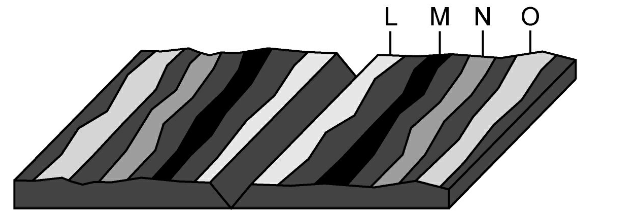
The geological theory of _______ states that pieces of Earth’s lithosphere are in constant, slow motion.
subduction
plate tectonics
deep-ocean trenches
sea-floor spreading

Most geologists think that the movement of Earth’s plates is caused by _______
convection
continental drift
subduction
conduction
Which is the correct order for the layers of the Earth?
Inner mantle, outer mantle, core, outer core
Crust, core, mantle, outer core
Crust, mantle, outer core, inner core
What must a nebula do in order to be considered a stellar nursery?
Emit light, indicating active star formation
Be completely dark, blocking all visible light
Be extremely cold to prevent gas movement
Move rapidly to avoid gravitational collapse
Some continents appear to fit together like pieces of a jigsaw puzzle. How does this provide evidence for plate tectonics?
It suggests that continents were once connected and have since drifted apart.
It shows that continents have always been in their current positions.
It proves that Earth's surface is fixed and does not change over time.
It indicates that oceans have always separated the continents.
Fossil records of the same species are found on multiple continents. How does this provide evidence for plate tectonics?
It suggests that the same ancient species evolved separately on different continents.
It indicates that continents were once connected, allowing species to spread.
It proves that all species could swim across oceans to different continents.
It shows that Earth's landmasses have always remained in the same positions.
How do rocks provide evidence for plate tectonics?
Identical rock formations are found on continents that are now separated, suggesting they were once connected.
Rocks on different continents have always been completely different, proving the continents never moved.
All rocks on Earth are the same age, showing that the continents have remained in place.
Rocks are randomly distributed across continents with no pattern to their locations.
How do aliens support the formation of the Moon?
They built the Moon as a giant space station. They built the pyramids too!
They accidentally knocked off a piece of Earth while playing cosmic dodgeball.
They created the Moon to use as a giant mirror to signal other galaxies.
They landed on Earth and decided the Moon needed a makeover.

HUH? There is no evidence!

Which best shows the direction of the convection current unearth the oceanic crust when it is subducting below the continental crust?
A
B
C
D
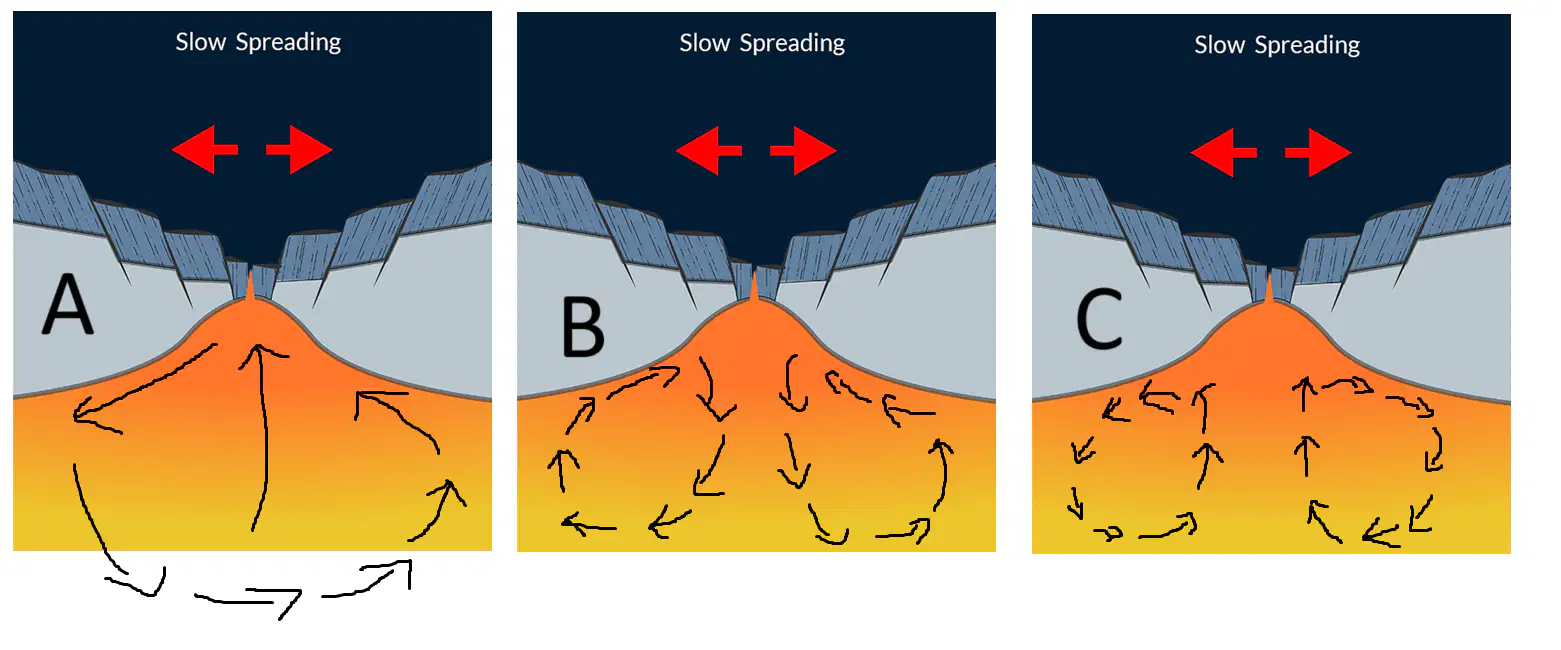
Which letter best represents the mantle convection current for the oceanic ridges forming in our oceans?
A
B
C
These are all correct
Why are active volcanoes used as evidence for the location of the boundaries of the tectonic plates?
Active volcanoes are found mostly at where plates collide, separate or slide past.
Volcanoes are located at the center of tectonic plates, showing that plate movement occurs away from boundaries.
Active volcanoes are unrelated to plate tectonics and occur randomly on the Earth’s surface.
Active volcanoes form at points where ocean currents meet, indicating plate boundaries.
What similarities (or differences) between Earth rocks and Moon rocks support the theory that the Moon was formed from a giant impact collision?
Moon rock and Earth rock are very similar in composition, suggesting they formed from the same materials.
Moon rock and Earth rock are very different in composition, suggest they formed from the same material.
What similarities (or differences) between Earth rocks and Moon rocks support the theory that the Moon was formed from a giant impact collision?
Moon rock contains less water than Earth rock, as the collision would have evaporated most of the water.
Moon rock contains more water than Earth rock, indicating the Moon formed far from Earth.
What similarities (or differences) between Earth rocks and Moon rocks support the theory that the Moon was formed from a giant impact collision?
Moon rock contains less iron than Earth rock because the collision blew away the crust and mantle in debris
Moon rock contains more iron than Earth rock because the collision fused the Earth's core with the moon's core so it should have more iron than the Earth.
What similarities (or differences) between Earth rocks and Moon rocks support the theory that the Moon was formed from a giant impact collision?
Moon rock would contain more rocks that form at high temperatures due to the collision creating immense heat
Moon rock would contain less rocks that form at high temperatures due to the collision not being very hot.

