Wayground logo

Free Printable Worksheets

Font size

S
M
L
XL
Worksheets

Chem A Final Review

Total questions: 88

Worksheet time: 1hrs 26mins

Name
Class
Date
1.
a)
Element
b)
Compound
c)
Mixture
2.
a)
Element
b)
Compound
c)
Mixture
3.
a)
Element
b)
Compound
c)
Mixture
4.
a)
Element
b)
Compound
c)
Mixture
5.
a)
Element
b)
Compound
c)
Mixture
6.
a)
Element
b)
Compound
c)
Mixture
7.
a)
Element
b)
Compound
c)
Mixture
8.
a)
Element
b)
Compound
c)
Mixture
9.
a)
Element
b)
Compound
c)
Mixture
10.
Which two particles make up the nucleus of an atom?
a)
Protons and Electrons
b)
Protons and Neutrons
c)
Molecules and Compounds
d)
Neutrons and Electrons
11.
In an atom, what is the number of protons equal to?
a)
The number of electrons.
b)
The number of neutrons.
c)
The number of molecules.
d)
The number of nuclei.
12.
An electron has this charge
a)
positive
b)
negative
c)
neutral
13.
A neutron has this charge
a)
negative
b)
positive
c)
neutral
14.
A proton has this charge
a)
negative
b)
positive
c)
neutral
15.
A particle that moves around the nucleus is a(n)...
a)
Proton
b)
Neutron
c)
Electron
d)
Quark
16.
What does the nucleus of an atom contain?
a)
Electrons and neutrons
b)
Protons and neutrons
c)
Neutrinos and positrons
d)
DNA and RN
17.
What is the mass number?
a)
the number of protons
b)
the sum of the number of protons and the number of neutrons in the nucleus of an atom 
c)
the number of electrons
d)
the number of neutrons
18.
What is the atomic number?
a)
number of protons
b)
number of neutrons
19.
Which element has 31 protons ?
a)
Gallium 
b)
Germanium
c)
Gadolinium
d)
Polonium
20.
Oxygen’s atomic number is 8. This means that an oxygen atom must have
a)
8 electrons
b)
8 protons
c)
8 neutrons
d)
a mass number of 8
21.
 What is the mass number of this element?
a)
5
b)
27
c)
32
d)
59
22.

How is the alpha particle written in a nuclear equation?

a)

42He

b)

24He

c)

0-1e

d)

00γ

23.
A helium nucleus with two protons and two neutrons is called a(n) ____.  
a)
alpha particle
b)
electroscope
c)
beta particle
d)
gamma ray
24.
Which type of nuclear radiation is being emitted here?
a)
Alpha
b)
beta
c)
gamma 
d)
none
25.
Solve this equation for alpha decay.
85209At = ___ + 24He
a)
83205Bi
b)
86209Rn
c)
81207Tl
d)
85208At
26.

Gamma rays have

a)

no mass

b)

a huge mass

c)

a small mass

d)

an average mass

27.
Solve this equation for beta decay.
614C = ___ + -10e
a)
410Be
b)
714N
c)
210He
d)
613C
28.

During beta-particle emission, a neutron splits into a____________________.

a)

proton and electron

b)

neutron and electron

c)

neutron and proton

29.
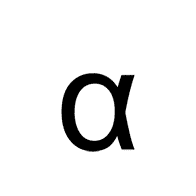
Has the symbol
a)
Alpha
b)
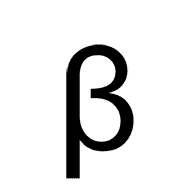
Beta 
c)
Gamma
30.
Has the symbol
a)
Alpha
b)
Beta
c)
Gamma
31.
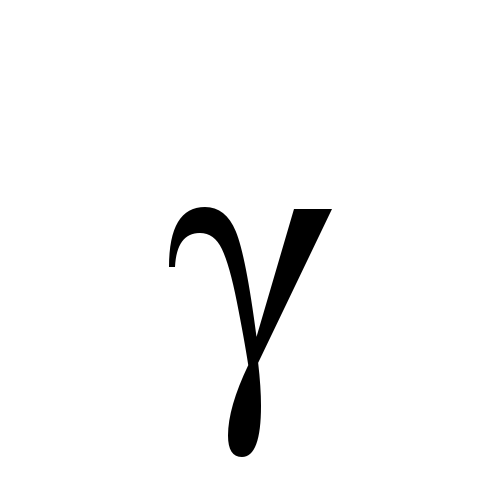
Has the symbol
a)
Alpha
b)
Beta
c)
Gamma
32.
Has the highest penetrating power.  Can penetrate our body.  Even several cm thick of lead or several meters thick of concrete cannot stop all of it.
a)
Alpha
b)
Beta
c)
Gamma
33.
Uranium-238  decays into  Thorium-234  by emitting .........
a)
an alpha particle
b)
a beta particle
c)
gamma rays
d)
visible light
34.
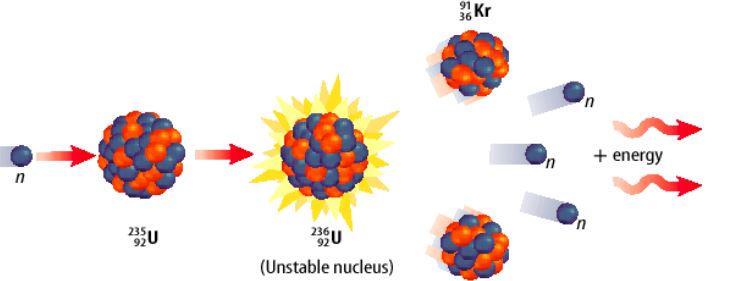
This is an example of...
a)
Fission  reaction
b)
Fusion reaction
c)
Decomposition reaction
d)
Decay
35.
In a correctly written symbol what would be located in the "A" position?
a)
number of neutrons
b)
atomic number
c)
number of electrons 
d)
mass number
36.

In a correctly written symbol what would be located in the "Z" position?

a)

number of neutrons

b)

atomic number

c)

number of electrons

d)

mass number

37.
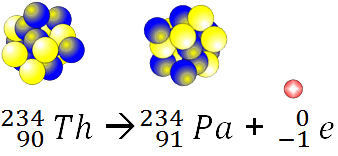
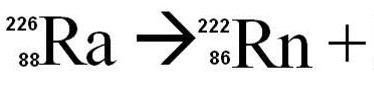
Complete the nuclear equation and determine the type of decay that is occurring in this reaction. 
a)
alpha
b)
beta
c)
gamma
d)
none
38.

What happens to an atom's atomic number when it undergoes beta decay?

a)

it always increases by 1

b)

it always decreases by 1

c)

it doesn't change

d)

it always decreases by 2

39.
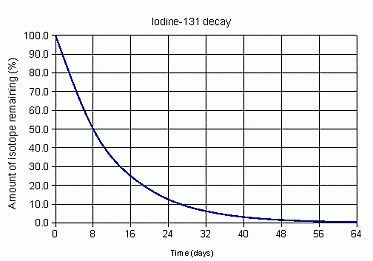
What is the half-life of iodine-131?
a)
32 days
b)
8 days
c)
16 days
d)
24 days
40.
If one-fourth of the carbon-14 is remaining then how many half-lives have passed?
a)
1
b)
2
c)
3
d)
4
41.

UP and DOWN columns on the periodic table are

a)

groups

b)

periods

42.

SIDE TO SIDE rows on the periodic table are

a)

groups

b)

periods

43.

How many protons does Lithium have?

a)

3

b)

4

c)

7

44.

How many electrons does Lithium have?

a)

3

b)

4

c)

7

45.

These elements are in a:

a)

group

b)

period

46.

These elements are in a:

a)

group

b)

period

47.

Which group does Hydrogen belong to?

a)

Group 1

b)

Group 2

c)

Group 3

d)

Group 4

48.

Which group does Aluminum belong to?

a)

Group 3

b)

Group 13

c)

Group 6

d)

Group 26

49.

Which period is Oxygen found in?

a)

Period 1

b)

Period 2

c)

Period 3

d)

Group 16

50.

Which Period is Gold (Au) found in?

a)

Group 11

b)

Group 6

c)

Period 11

d)

Period 6

51.

Which element is found in Period 4, Group 8?

a)

Iron

b)

Oxygen

c)

Nickel

d)

Silver

52.

Which element is found in Group 2, Period 3?

a)

Sc

b)

Cu

c)

Na

d)

Mg

53.

Which element is in the SAME GROUP as Oxygen?

a)

Hydrogen

b)

Helium

c)

Sulfur

d)

Carbon

54.

Which element is in the SAME PERIOD as Helium?

a)

Hydrogen

b)

Neon

c)

Nitrogen

d)

Potassium

55.

What is the ATOMIC NUMBER of the element found in Period 4, Group 1?

a)

41

b)

4

c)

1

d)

19

56.

What Group and Period does Chlorine (Cl) belong to?

a)

Group 3, Period 17

b)

Group 2, Period 17

c)

Group 17, Period 3

d)

Group 17, Period 4

57.
The MOST electronegative element is ____.
a)
Helium
b)
Hydrogen
c)
Fluorine
d)
Francium
58.
Which has the greater Electronegativity: 
N or C?
a)
C
b)
N
59.
Which of the following will have a larger radius than Zinc (Zn)?
a)
Gallium
b)
Aluminum
c)
Magnesium
d)
Strontium
60.
Which of the following will have a lower ionization energy than Scandium (Sc)?
a)
Helium (He)
b)
Titanium (Ti)
c)
Calcium (Ca)
d)
Magnesium (Mg)
61.
Which atom has the largest atomic radius?
a)
Potassium (K)
b)
Rubidium (Rb)
c)
Francium (Fr)
d)
Cesium (Cs)
62.
As you move down the periodic table atoms get bigger.  This is because ____________.
a)
The atoms have more mass.
b)
The atoms have more protons.
c)
The atoms have more energy levels
d)
The atoms have more neutrons
63.
Electronegativity is...
a)
the ability of an atom to attract/ accept electrons
b)
the ability of an atom to lose electrons
c)
the energy required to remove an electron from a specific atom
d)
how easy it is to make friends. 
64.
Ionization energy is...
a)
the energy required to add an electron to a specific atom
b)
how much energy it takes to remove an electron from an atom
c)
the energy required to shield the outer electrons from the nucleus
d)
a measure of the ability of an atom to attract electrons
65.
The element with the largest electronegativity in the halogens is - 
a)
At
b)
F
c)
Cl
d)
Br
66.
Electronegativity __________ from left to right within a period and __________ from top to bottom within a group.
a)
decreases, increases 
b)
increases, increases
c)
increases, decreases 
d)
stays the same, increases
67.
Atomic radius is ______.
a)
the distance from the center of the nucleus to the outermost electron.
b)
the distance from one outer electron to another outer electron.
c)
the distance from center of the nucleus to the first energy level.
d)
the distance from one proton to one electron.
68.

Which of the following halogens has the greatest electronegativity?

a)

Chlorine (Cl)

b)

Bromine (Br)

c)

Iodine (I)

d)

Astatine (At)

69.
Which atom has the largest atomic radius?
a)
potassium
b)
rubidium 
c)
francium
d)
cesium
70.

What is the amount of energy required to remove an electron from an atom?

a)

atomic energy

b)

ionization energy

c)

ionic energy

d)

electron energy

71.

Which has the highest ionization energy?

a)

Arsenic

b)

Iron

c)

ZInc

d)

Cobalt

72.
When two atoms share electrons, a chemical bond is formed.  This type of bond is called:
a)
covalent bond
b)
ionic bond
c)
crystal bond
d)
polyatomic bond
73.
Which of these is covalent?
a)
NaCl
b)
Pb(NO3)2
c)
CO2
d)
AlCl3
74.
What is a double bond?
a)
a bond between two atoms
b)
one pair of electrons shared between two atoms
c)
two pairs of electrons shared between two atoms
d)
James Bond's brother
75.
What is the charge on an Aluminum ion?
a)
3
b)
+3
c)
+2
d)
+1
76.
How many valence electrons does nitrogen have?
a)
3
b)
2
c)
5
d)
1
77.
How many valence electrons does hydrogen have?
a)

4

b)
3
c)
2
d)
1
78.
What is the ionic compound formed between Ba and P?
a)
Ba2P3
b)
Ba3P2
c)
BaP
d)
Ba2P2
79.
An ionic bond happens between what kinds of elements?
a)
metals and metals
b)
metals and nonmetals
c)
nonmetals and nonmetals
80.
Which type of bond does Nitrogen and Hydrogen make?
a)
covalent
b)
metallic
c)
ionic
d)
James
81.

Which Lewis Dot Model drawing correctly shows an O2 molecule?

a)
b)
c)
d)
82.

Which is the correct molecular structure for carbon dioxide?

a)
b)
c)
d)
83.

Ionic bonds typically form between

a)

A metal and a nonmetal

b)

Two nonmetals

c)

Two metals

d)

A metalloid and a metal

84.

Why are there two sodiums (Na), in the formation of this ionic compound?

a)

There always has to be 2 metals

b)

The overall charge needs to add up to 4

c)

The overall charge has to be 0

d)

It needs to have more metal atoms than nonmetal

85.

Using the model, write the chemical formula for an ionic compound that has Mg and Cl.

a)

MgCl2

b)

Mg2Cl2

c)

Mg+2Cl-1

d)

Mg2Cl2

86.

What is the role of a solvent in a solution?

a)

To change the color of the solute

b)

To evaporate quickly

c)

To dissolve the solute

d)

To react with the solute

87.

Which of the following is an example of a solute?

a)

Air in a balloon

b)

Salt in saltwater

c)

Water in saltwater

d)

Oil in water

88.

In a sugar-water solution, what is the solvent?

a)

Neither sugar nor water

b)

Both sugar and water

c)

Water

d)

Sugar