
 Worksheets
Spring Case 21 Review
Total questions: 66
Worksheet time: 1hrs 22mins
A chef observes that water in a pot is boiling. What 2 options can the chef infer about the water and the water's temperature?
The water is changing from a liquid to a solid, and the temperature of the water inside the pot is 0°C.
The water is changing from a liquid to a solid, and the temperature of the water inside the pot is 32°C.
The water is changing from a liquid to a gas, and the temperature of the water inside the pot is 100°C.
The water is changing from a liquid to a gas, and the temperature of the water inside the pot is 212°C.
How can a student measure the volume of a gas that is in a sealed container?
Record how fast the gas escapes the container.
Record how much liquid fills an identical container.
Place the sealed container on a scale.
Place the sealed container on a hot plate.
Which two temperature points have the same value for water?
boiling point
freezing point
gas point
liquid point
melting point
When two substances react to form a new substance, what is true about the new substance?
The mass of the new substance is equal to the mass of each starting substance added together.
The mass of the new substance is less than the mass of each starting substance added together.
The mass of the new substance is equal to the mass of the largest starting substance.
The mass of the new substance is less than the mass of the smallest starting substance.
A student melts 350 g of chocolate chips. The student concludes that after melting, there is more chocolate. Which statement correctly analyzes the student’s conclusion?
The student’s conclusion is correct because heat causes more chocolate to form.
The student’s conclusion is incorrect because the mass of the chocolate chips is less in solid form and greater in liquid form.
The student’s conclusion is correct because the volume of the chocolate chips increases.
The student’s conclusion is incorrect because the mass of the melted chocolate chips is the same as the mass of the solid chocolate chips.
A student adds 70 g of water to a beaker with a mass of 115 g. She also adds a specific amount of sugar to the beaker. She then mixes the contents in the beaker and measures the mass of the beaker on a scale. The beaker has a mass of 210 g. What is the mass of the sugar added to the beaker?
25 g
95 g
140 g
210 g
A chef cuts a large pizza into eight equal slices before serving the pizza to customers. Which statement about the sliced pizza is true?
The sliced pizza weighs more than the unsliced pizza.
The sliced pizza weighs less than the unsliced pizza.
The unsliced pizza weighs the same as the sliced pizza.
The unsliced pizza has a weight equal to zero.
Which statement is correct about mixtures?
Mixtures formed with water can always be separated by condensation.
The properties of the components of a mixture change after mixing.
When substances are mixed, the mixture forms a new substance.
The properties of the components of a mixture remain the same.

A student conducts an investigation on dissolving juice mix powder in water and records the results in a table. The student conducts a second trial and notices that the juice mix dissolves at a slower rate compared to Trial 1. Which conditions does the student most likely use in the second trial?
A) Amount of Water (g): 160, Amount of Juice Mix (g): 30, Mixture Stirred?: no, Temperature of Water (°C): 67
B) Amount of Water (g): 160, Amount of Juice Mix (g): 40, Mixture Stirred?: yes, Temperature of Water (°C): 67
C) Amount of Water (g): 160, Amount of Juice Mix (g): 30, Mixture Stirred?: yes, Temperature of Water (°C): 73
D) Amount of Water (g): 160, Amount of Juice Mix (g): 40, Mixture Stirred?: no, Temperature of Water (°C): 22
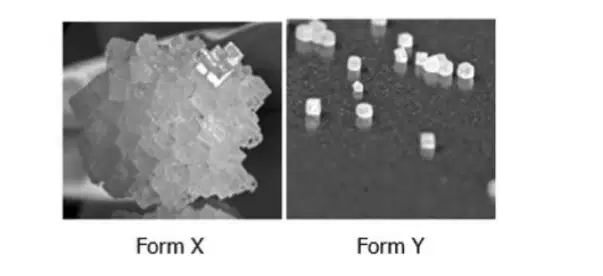
Examine the diagram of a substance in two different forms (X and Y). Which statement best describes the rate of dissolving for the substance?
Form X will dissolve faster because it has larger particles.
Form Y will dissolve faster because it has smaller particles.
Form X will dissolve slower because it has smaller particles.
Form Y will dissolve slower because it has larger particles.
A chef is cooking soup that requires her to turn down the heat when the soup begins to bubble quickly. Which event is most likely happening when the soup reaches this point?
The density of the soup is increasing.
The mass of the soup is increasing.
The soup is reaching its boiling point.
The soup is reaching its freezing point.
Which will not make a large block of sugar dissolve quicker in water?
stirring the sugar and water
heating the water before adding the sugar
breaking the sugar into smaller pieces
cooling the water before adding the sugar
Which activity produces a new substance as a result of a change occurring in the original substance?
perfume evaporating in the air
rust forming on a metal fence
hot glass cracking in cold water
butter melting in a warm pan
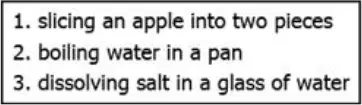
Which activity(ies) represent(s) a physical change, and why?
1 only; there is a change of shape.
3 only; there is a change of state.
2 and 3 only; new substances are formed.
1, 2, and 3; the substances retain their original properties.
Which statement best describes a property of a salt solution?
A. Salt particles completely dissolve in water.
B. Salt and water can be separated using filtration.
C. Salt particles settle at the top of a container.
D. Salt solutions have the same physical properties as water.
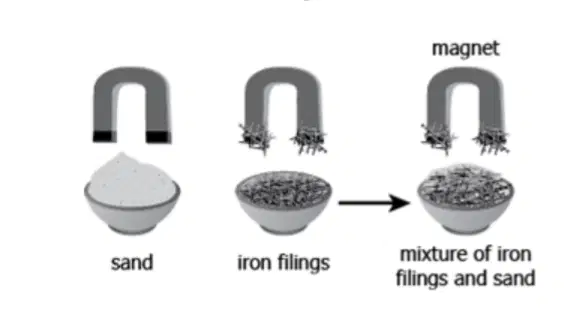
The image shows how a magnet interacts with sand and iron filings, as well as how the magnet interacts when sand and iron filings are mixed. Which statement is true about mixtures based on the image?
Substances in mixtures cannot be separated.
Substances in mixtures retain their properties.
Substances in mixtures combine to form a new substance.
Substances in mixtures are always present in fixed amounts.
A student has to develop a model of a solution using household items. Which model should the student use?
mixed salad
hot chocolate
nuts and bolts
cereal
An object is moving, and an unbalanced force is applied in the same direction in which the object is moving. What happens to the object?
A. It speeds up.
B. It slows down or stops.
C. It changes direction.
D. It continues to move at the same speed and direction.
An object is moving, and an unbalanced force is applied in the opposite direction from which the object is moving. What happens to the object?
It speeds up.
It slows down or stops.
It changes direction.
It continues to move at the same speed and direction.
Two teams are playing tug of war. The ribbon tied in the middle of the rope is not moving. What best explains the lack of movement?
The two forces are in opposite directions and balanced.
The two forces are in the same direction and balanced.
The two forces are in opposite direction and unbalanced.
The two forces are in the same direction and unbalanced.
Which is the best example of an unbalanced force?
a person standing in the middle of the gym floor
a person pushing up against the wall of the gym
a person sitting in a seat in the gym watching a game
a person pushing a cart of balls across the gym floor
Unbalanced forces are applied to a truck. In which instance will the truck remain at rest?
100 N left, 60 N right
60 N left, 100 N right
100 N left, 100 N right
100 N right, 60 N left
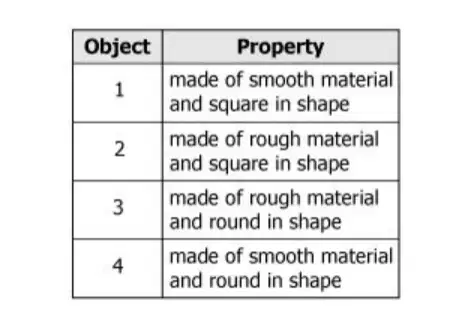
Catherine chooses four different objects and labels them 1 through 4. The properties of the four objects are shown in the table. Which object will move fastest if all four are pushed with the same force?
Object 1
Object 2
Object 3
Object 4
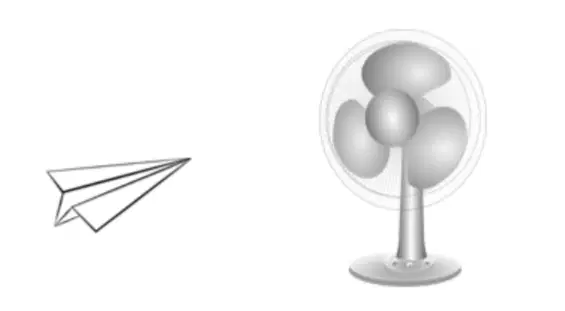
A paper airplane is flying toward a fan at a constant speed. If the fan is turned on, what is the best explanation of how the motion of the paper airplane will change?
A) The paper airplane will fly faster toward the fan because of a balanced force.
B) The paper airplane will fly faster toward the fan because of an unbalanced force.
C) The paper airplane will fly slower toward the fan because of a balanced force.
D) The paper airplane will fly slower toward the fan because of an unbalanced force.
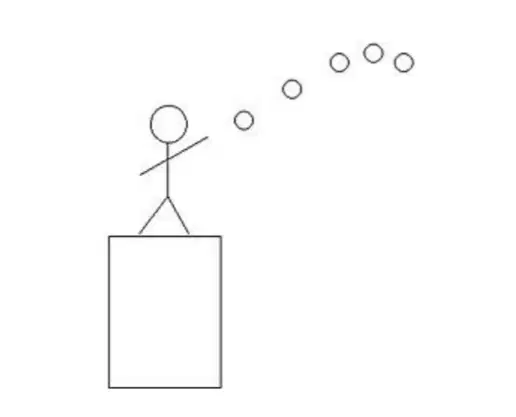
The diagram shows a ball that is thrown into the air. Why does the ball begin to fall back to the ground?
The ball loses mass as it begins to fall back to the ground.
The force of friction pulls the ball toward the ground.
The force of gravity pulls the ball toward the ground.
The ball gains mass and begins to fall back to the ground.
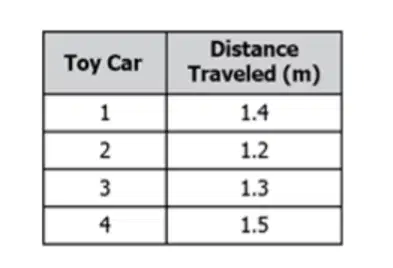
Four toy cars are pushed with the same force on a surface from the same starting line. The table shows the distance traveled by each toy car in 30 seconds. Which statement is true about the speeds of the toy cars?
Toy Car 1 moves slower than Toy Car 3.
Toy Car 3 moves faster than Toy Car 2.
Toy Car 2 moves faster than Toy Car 1.
Toy Car 4 moves slower than Toy Car 3.
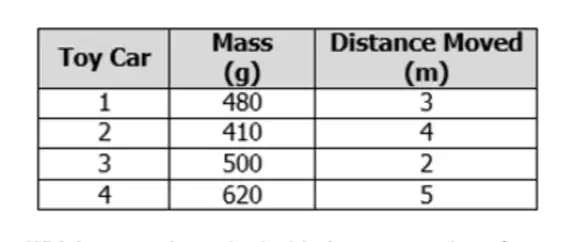
Which toy car is pushed with the greatest force?
Toy Car 1
Toy Car 2
Toy Car 3
Toy Car 4
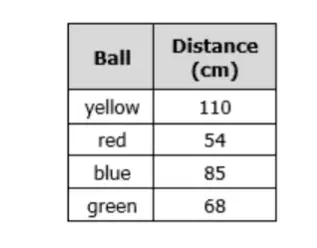
A student pushes four balls with different masses on a surface using the same amount of force. The table shows the distance each ball travels in 30 seconds. Which ball has the least mass?
blue
green
red
yellow
Which description correctly describes the pull of gravity on Earth?
towards Earth's Northern Hemisphere
towards Earth's Southern Hemisphere
towards Earth's center
towards Earth's poles
Which phenomenon occurs due to Earth’s gravity?
A. A stone falls from a cliff.
B. A box moves when pushed.
C. A coin moves upward in the air when tossed.
D. A marble rolls to a stop on a floor.
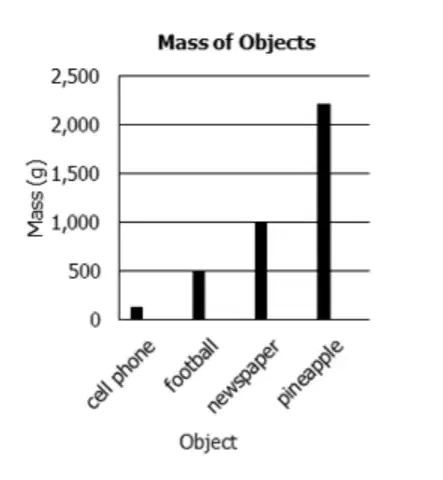
Study the bar graph that shows the masses of different objects. Which object will require the least energy to be moved?
cell phone
football
newspaper
pineapple
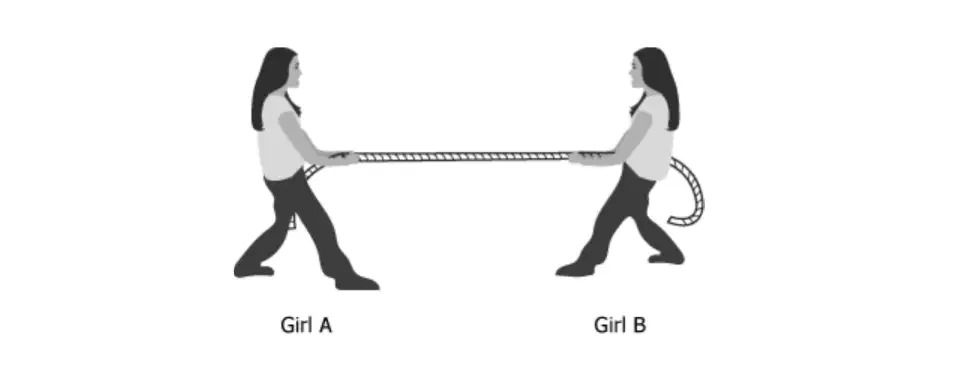
Two girls are pulling a rope in opposite directions as shown in the figure. If the mass of girl A is 50 kg, and the mass of girl B is 60 kg, in which direction will the rope be pulled?
towards girl A
towards girl B
in the upward direction
in the downward direction
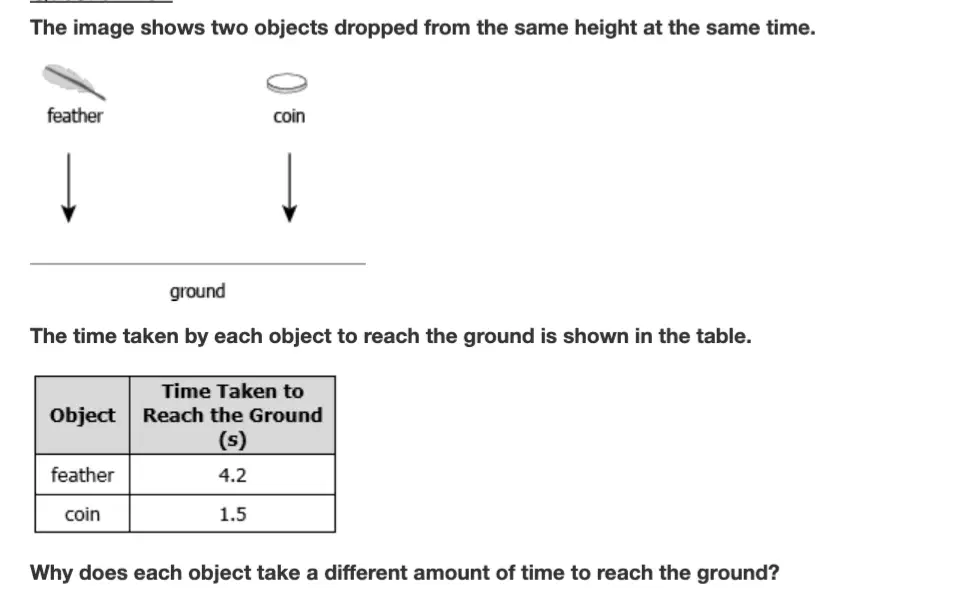
The image shows two objects dropped from the same height at the same time. The time taken by each object to reach the ground is shown in the table. Why does each object take a different amount of time to reach the ground?
Each object has a different color.
Each object has a different temperature.
Each object has a different shape.
Each object has a different texture.

Four different objects are dropped from the same height. The time each object takes to reach the ground is recorded, as shown. What can be concluded from the data?
A. The object with the least mass takes the least time to reach the ground.
B. The object with the largest surface area takes the most time to reach the ground.
C. The time taken by an object to reach the ground decreases as the mass of the object increases.
D. The time taken by an object to reach the ground decreases as the surface area of the object increases.
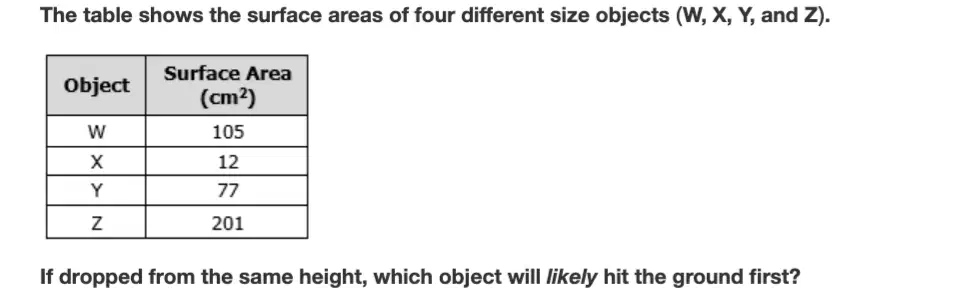
If dropped from the same height, which object will likely hit the ground first?
Object W
Object X
Object Y
Object Z
Khan and his dad were moving things around in his bedroom to make room for a new desk and computer. Which object will Kahn and his dad have to use the greatest force to move?
bookbag
desk chair
old desk
wastebasket

The seasons are caused by........
The elliptical orbit of the earth
The sun gets hotter at certain times of year.
The earth is tilted on its axis
Year rotates every 24 hours
This is the name used to describe the earths tilt.
The earths equator
The earths axis
The earths orbit
The earths poles

In what position will it be winter in the southern hemisphere
1
2
3
4

At what position will it be summer in the Southern hemisphere.
1
2
3
4
This word describes how the earth spins.
rotation
revolution
orbit
hemisphere
This word describes how the earths travels around the sun.
solstice
axis
rotation
revolution
If we split the earth into two halves at the equator then we would have two........
equinox
solstice
axis
hemispheres

Alpha Centauri A is a star that is larger than the Sun, yet it appears much less bright. Which of the following is the best explanation for this?
Alpha Centauri A is further away from Earth than the Sun.
The smaller a star the brighter it appears
The older the star the brighter it appears
The larger the star always appears to be brighter
Stars that are far away appear __ even though they might be brighter than our own Sun.
brighter
farther
closer
dimmer
Which measurement allows astronomers to compare the brightness of stars?
parallax
red shift
absolute brightness
apparent brightness
Absolute magnitude (brightness) is _______.
how far a star is
how bright a star really is
how bright a star looks from a distance
how much energy a star gives
Brightness of a star as seen from Earth is
temperature.
apparent brightness (magnitude).
absolute brightness (magnitude).
luminosity.
Barnard's Star is 5.9 light years from Earth and Luyten 726-8 is 8.7 light years away. Which star would most likely appear to be the brightest based solely on this information?
Barnard's Star
Luyten 726-8
both
neither
Galaxies are composed of (best answer)
stars
stars and gas
stars, dust, and gas
stars, dust, and gas held together by gravity
The Milky Way Galaxy is a
spiral
lenticular
elliptical
irregular
Light years are a measure of
time
speed
distance
light

What color are the coolest stars?
blue-white
yellow
orange
red

What color of star is the hottest?
blue
red
yellow
orange
What type of galaxy is oval-shaped?
a spiral galaxy
an elliptical galaxy
an irregular galaxy
What type of galaxy has no special shape or form?
a spiral galaxy
an elliptical galaxy
an irregular galaxy

What celestial body does this picture show?
meteor
star
asteroid
comet
A comet is basically a big ball of ______________ and ________________.
ice and rock
ice and metal
metal and gas
rock and metal

Between which two planets would you find most asteroids?
Mars and Jupiter
Mercury and Venus
Venus and Earth
Uranus and Neptune
What is Inherited behavior?
Something you are born knowing
Something you have to learn in life
Which is an example of an Inherited behavior?
coyote avoiding a skunk
a bird building a nest
a baby speaking
a bird building a nest in a safe place
Inherited behaviors are also called ________.
Imprinting
conditioning
inherited
instincts
Knowing not to touch a hot pan
Learned behavior
Inherited Behaviors


Each of the following is an acquired trait EXCEPT which one?
scar
purple hair
long legs
broken arm

