wayground logo

Free Printable Worksheets

Font size

S
M
L
XL
Worksheets

DNA Unit reviw

Total questions: 50

Worksheet time: 32mins

Name
Class
Date
1.
The shape of the DNA molecule is a double __________________?
a)
"S"
b)
helix
c)
rope
d)
curve
2.

What is DNA

a)

donuts need algea

b)

did no algebra

c)

do not answer

d)

deoxyribonucleic acid

3.

Where is DNA found???

a)

Cell membrane

b)

Nucleus

c)

Cell wall

d)

Auditorium

4.
What does DNA do?
a)
a.  It carries genetic codes from parents to offspring.
b)
a.  It carries oxygen from the lungs to the body.
c)
a.  It tells you who you are.
d)
a.  It defines the organism.
5.

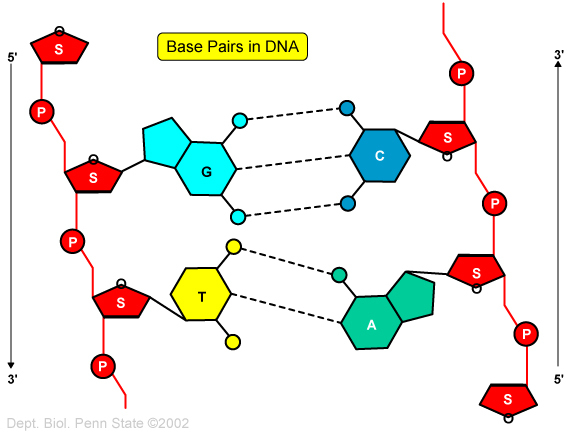
Which of the following DNA nucleotides are paired with the correct corresponding DNA nucleotide? (mark all that apply)

a)

Adenine with Thymine

b)

Guanine with Cytosine

c)

Thymine with Cytosine

d)

Adenine with Uracil.

e)

Uracil with Thymine

6.
Nitrogenous bases are joined by which type of bond?
a)
polar bonds
b)
ionic bonds
c)
covalent bonds
d)
hydrogen bonds
7.
What are the three components of a nucleotide?
a)
sugar, hydrogen, nitrogen base
b)
sugar, oxygen, nitrogen base
c)
sugar, phosphate, nitrogen base
d)
sugar, phosphate, protein
8.
What are the 4 nitrogen bases?
a)
adenine, thymine, cytoplasm, and guanine
b)
adenine, thymine cytosine, and guanine
c)
adenine, thymine, cytosine, and gylcerol
d)
adenine, thymine, cytosine, and glucose
9.
A process in which DNA has the unique ability to make an exact copy of itself.
a)
Replication
b)
Translation
c)
Transcription
10.

WHICH TWO STRUCTURES MAKE UP THE BACKBONE OF DNA?

a)

THYMINE AND ADENINE

b)

CYTOSINE AND GUANINE

c)

NUCLEOTIDES AND SUGAR

d)

DEOXYRIBOSE AND PHOSPHATE

11.

A mistake in DNA replication is known as a

a)

Mutation

b)

Free Nucleotide

c)

Chromatid

d)

Antiparallel DNA Strand

e)

Gene Revocation

12.

What sugar is found in DNA

a)

glucose

b)

lactose

c)

deoxyribose

d)

fructose

13.

This scientist was the first person to take a picture of DNA.

a)

Rosalind Franklin

b)

Watson & Crick

c)

Griffith

d)

Hershey & Chase

14.

These scientists came up with the structure of DNA and built a model. They were credited for the discovery of DNA, winning the Nobel Prize.

a)

Rosalind Franklin

b)

Watson & Crick

c)

Griffith

d)

Hershey and Chase

15.

The picture shows a

a)

Nucleic Acid

b)

Strand of DNA

c)

Nucleotide

d)

Amino Acid

16.

What type of biomolecule are DNA and RNA?

a)

Carbohydrate

b)

Lipid

c)

Protein

d)

Nucleic Acid

17.

What was the significant finding of Griffith's experiment?

a)

DNA is the molecule responsible for heredity

b)

Genetic information can be transformed from one bacteria to another

c)

Viruses infect cells by injecting their protein coat into the cell

18.

Why did Avery repeat Griffith's experiment?

a)

To determine the molecule responsible for transformation

b)

To determine how viruses infect cells

c)

To determine how DNA replicates

19.

Why was the Hershey-Chase experiment so important?

a)

They were able to find a vaccine for pneumonia

b)

The experiment supported the claim that viruses can infect bacteria cells

c)

The experiment supported the claim that DNA was responsible for heredity

20.

Which of the following are the three main roles of DNA? Select all that apply.

a)

DNA stores genetic information

b)

DNA organizes genes

c)

DNA replicates itself

d)

DNA puts genes to work

21.

At the very beginning of translation, the first tRNA molecule __________.

a)

binds to the mRNA’s start codon

b)

connects an amino acid to its anticodon

c)

binds to the mRNA’s anticodon

d)

attaches directly to the DNA codon

22.

As a result of the Hershey and Chase experiments, scientists believe that __________.

a)

bacteriophages can be grown in culture media

b)

viruses use bacterial DNA to reproduce

c)

radioactive isotopes can be used safely

d)

the “transforming principle” is DNA

23.

A specific cell is unable to make the enzyme helicase. Because of this deficiency, what would the cell most directly be unable to accomplish?

a)

The cell would not be able to fix mistakes in the DNA.

b)

The cell would not be able to add the primer to the DNA strand.

c)

The cell would not be able to add new nucleotides.

d)

The cell would not be able to unzip the double helix.

24.

Hershey and Chase chose to use bacteriophages in their experiments because these viruses __________.

a)

can infect only bacteria, not humans

b)

will not grow in radioactive culture

c)

contain little more than DNA and protein

d)

can be seen with a light microscope

25.

Nucleotides that are floating free in the nucleus can then pair up with the nucleotides of the templates on each strand of the separated DNA. A group of enzymes called DNA ______________ are involved in this process.

a)

Proteins

b)

Polymerases

c)

Adenines

d)

Cytosines

26.

An important factor in Oswald Avery’s ability to identify the "transforming principle" as DNA was the fact that proteins __________.

a)

contain very little phosphorus

b)

do not react with enzymes

c)

could be observed in the extract made from R bacteria

d)

were present in the extract made from S bacteria

27.

During transcription, a sequence of ​ (a)   is copied onto a strand of ​ (b)   so that it can leave the ​ (c)   to find a ​ (d)   .

Choose from the below words
DNA
mRNA
nucleus
ribosome
28.
RNA contains the sugar
a)
ribose
b)
deoxyribose
c)
glucose
d)
lactose
29.
What will be the resulting mRNA from this DNA sequence:
GAT-TAC-AGA-TTA-CAT?
a)
CTA-ATG-TCT-AAT-GTA
b)
GAU-UAG-UGA-UUA-GUT
c)
CUA-AUG-UCU-AAU-GUA
d)
CAT-ACA-TAC-ATA-TAG
30.
What is the correct amino acid sequence for the mRNA code AUGCCAGUAUGA
a)
Met-Pro-Ala-Val
b)
Met-Pro-Val
c)
Tyr-Gly-His
d)
Tyr-Gly-Arg-His
31.
Every three letters (example: ATC) in DNA codes for what??
a)
Amino Acid
b)
Nucleotide
c)
Lipid
d)
Carbohydrate
32.
One difference between DNA and RNA is that RNA....
a)
is double stranded 
b)
contains the base Thymine
c)
contains the base Uracil 
d)
contained the base Guanine
33.
The anti-codon 
a)
contains a sequence the same as the codon
b)
contains a sequence complementary to the codon 
c)
contains the base thymine
34.
tRNA is involved in
a)
carrying amino acids 
b)
carrying ribosomes
c)
carrying glucose
d)
carrying lipids
35.
Amino acids are joined together in order to form
a)
DNA
b)
ribosomes
c)
proteins 
d)
RNA
36.
Transcribe the following piece of DNA:
ATCGTA
a)
UAGCAU
b)
TAGCAT
c)
ATCGTA
d)
AUCGUA
37.
Which Seq could be found in RNA?
a)
ACCTGT
b)
CGCATT
c)
AUGCUU
38.
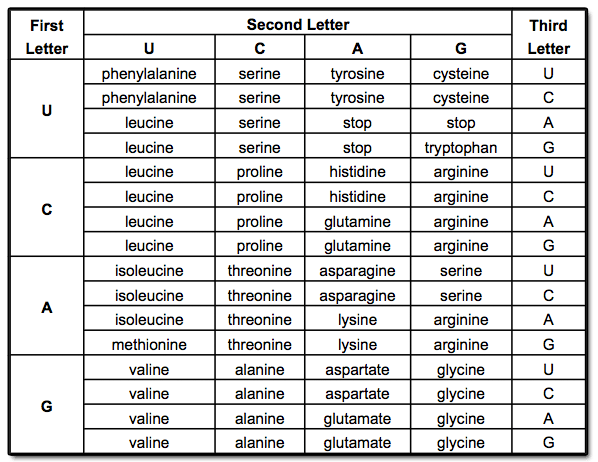
Which amino acid is made from the RNA codon UUA?
a)
Phenylalanine
b)
Leucine
c)
Serine
d)
Tyrosine
39.
Which amino acid is made from the RNA codon GUA?
a)
Phenylalanine
b)
Leucine
c)
Serine
d)
Valine
40.
The process of making RNA (i.e. mRNA) from DNA is called
a)
Replication
b)
Transcription
c)
Translation
d)
Protein synthesis
41.
Which  represents the bases of mRNA?
a)
A U C G
b)
A T U G
c)
A T C G
d)
U T C G
42.
What is the correct sequence?
a)
RNA --> DNA --> Protein
b)
Protein --> RNA --> DNA
c)
DNA --> RNA --> Protein
d)
DNA --> Protein --> RNA
43.
In eukaryotes, DNA is located in the
a)
cytoplasm
b)
nucleus
c)
cell membrane
d)
ribosome
44.
An mRNA molecule is produced in the step of protein synthesis:
a)
replication
b)
transcription
c)
duplication
d)
translation
45.
If an mRNA codon is AGU, which of the following would be the appropriate tRNA anticodon?
a)
TCA
b)
UGA
c)
AGU
d)
UCA
46.
A nucleotide includes...?
a)
pentose sugar
b)
nitrogenous base
c)
phosphate group
d)
all of the above
47.
mRNA is made in the process called....
a)
mitosis
b)
replication
c)
translation
d)
transcription
48.
Which type of RNA brings the information in the genetic code from the nucleus to other parts of the cell?
a)
rRNA
b)
tRNA
c)
mRNA
d)
RNA polymerase
49.
What happens during translation?
a)
Messenger RNA is made from a DNA code.
b)
The cell uses a messenger RNA code to make proteins
c)
Transfer RNA is made from a messenger RNA code.
d)
Copies of DNA molecules are made.
50.
The genetic code is always read
a)
3 bases at a time in the same direction.
b)
4 bases at a time in the same direction.
c)
3 bases at a time and the direction varies.
d)
4 bases at a time and the direction varies.