
Font size
 Worksheets
Waves
Total questions: 77
Worksheet time: 26mins

What do all waves transfer?
Matter
Heat
Electricity
Energy

Which of the following can waves transfer energy through?
solid
liquid
gas
empty space
all of the above

What are the two types of waves?
longitudinal and transverse
sound and light

What is the number of complete waves passing a fixed point in a given amount of time?
Amplitude
Intensity
Wavelength
Frequency

What is the frequency of this wave? You must count the number of complete waves.
1 Hz
5 Hz
10 Hz

What is frequency measured in?
Milliseconds
Miles
Hertz
Kilograms

Period of a wave refers to...
how long it takes for the event to repeat.
how strong a wave is.
how long a wave is.
how much energy a wave has.

Which type of waves have the longest wavelength?
Visible light
Radio waves
X-rays
Gamma-Rays

Wavelengths are usually measured in ....
seconds
Hz
inches
meters

Shorter wave lengths can carry more energy. Which of these probably carries the MOST energy:
Infrared light
Visible light
X-rays
UV light

What is the distance between the calm sea and the highest wave called?
Wave
Frequency
Amplitude
Magnitude

What does #1 represent?
Period
Frequency
Wavelength
Amplitude

What does #2 represent?
Period
Frequency
Wavelength
Amplitude
What determines what color of light your eyes perceive?
The frequency of the wave
The amplitude of the wave
The intensity of the wave
The type of wave it is
Isaac Newton found that sunlight is a mix of different wavelengths Which evidence supports this?
light is white.
light is found all over the universe
light separates into colors in a prism
light can travel very rapidly through space
A wave is traveling in one medium. Then it begins traveling through another medium and changes direction. What happened?
The wave was absorbed
The wave was transmitted
The wave was refracted
The wave was reflected
Which of the following waves has the highest frequency?
Radio Waves
Red Light Waves
Blue Light Waves
Infrared Light Wave
Which of the following is an example of an analog signal being stored?
DVD
CD
MP3 player
Record

Which of these waves represents an analog wave?
A
B

Which image shows transmission?
A
B
C
D
What signal type does a film camera use?
Smoke signals
Analog signals
Digital signals
Film signals
What wave has particles that move perpendicularly to the direction of the wave?
Transverse waves
Longitudinal waves
Sound waves
Light waves
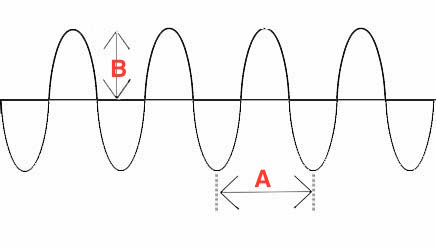
What property of this wave is represented by the letter "A"
amplitude
crest
trough
wavelength
The highest point on a wave is:
the crest
the trough
the top
the coast
The lowest point on a wave is the:
Amplitude
Crest
Trough
Wavelength
The type of waves that require medium to pass:
Mechanical Waves
Electromagnetic Waves
What types of waves carry energy at a right angle or perpendicular to the direction of the energy flow?
Longitudinal waves
Transverse waves
Sound waves
P-waves
What do waves carry from place to place?
Energy, but not matter or particles
Energy and matter or particles
Matter or particles but not energy
Neither energy nor matter or particles
The most dense part of a longitudinal wave.
Density
Compression
Rarefaction
Amplitude
What are the parts of a longitudinal wave?
Compressions and rarefactions
Crests and troughs
Compressions and crests
Rarefactions and troughs

Which wave is pictured?
Transverse
Longitudinal
Both
Neither
Sound is an example of which type of wave?
Transverse
Longitudinal
Both
Neither
Light is an example of which type of wave?
Transverse
Longitudinal
Both
Neither
Which wave travels parallel in relation to a medium?
Transverse
Longitudinal
Both
Neither
Sound needs a medium to travel through. What is a medium?
solid, liquid, gas
open space
waves
nothing
Which type of wave does sound travel in?
Transverse
Longitudinal

What type of wave is this?
Transverse
Longitudinal

What type of wave is this?
Transverse
Longitudinal

Distance from 'y' to 'y' is a _______
Wavelength
Amplitude
Compression
Rarefaction

Distance from an 'x' to an 'x' is a________
wavelength
amplitude
rarefaction
compression

What is represented by the letter 'y'?
Compression
Rarefaction
Wavelength
Amplitude

Which color has the longest wavelength?
Yellow
Red
Green
Purple

The frequency of infrared waves is..
1012 Hz
1020 Hz
104 Hz
1015 Hz

The frequency of an x-ray is --
1.41 x 10⁻¹⁰ Hz
1.41 x 10¹⁸ Hz
1.41 x 10¹⁰ Hz
1.41 x 10⁻¹⁸ Hz
The wavelength of an infrared ray is --
10-5 m
1012 Hz
105 m
10-12 Hz

This illustration best depicts which of the following behaviors?
Reflection
Refraction
Diffraction
Resonance

This image best depicts which of the following wave behaviors?
Reflection
Refraction
Diffraction
Resonance

This image depicts which of the following wave behaviors?
Reflection
Refraction
Diffraction
Resonance

The image depicts which of the following wave behaviors?
Resonance
Doppler Effect
Polarization
Diffraction

The image depicts which of the following wave behaviors?
Resonance
Doppler Effect
Interference
Polarization

The two blue and purple waves will undergo _________________ when they meet.
Constructive interference
Destructive interference

The image of the two waves depicts
Constructive interference
Destructive interference
Definition: the change in direction of a wave passing from one medium to another
Reflection
Refraction
Diffraction
Polarization
Definition: when a wave reaches the interface between two different media, typically some of the wave will bounce back into the original medium.
Reflection
Refraction
Diffraction
Polarization
Definition: The spreading out of waves as they pass through an opening or around objects.
Reflection
Refraction
Diffraction
Resonance
The two categories of waves are
Mechanical
Physical
Electromagnetic
Love
The two forms that waves can take are...
Transverse
Circular
Diamond
Longitudinal
Light waves and sound waves are similar in that...
They are both longitudinal waves
They are both transverse waves
They both transmit energy
They both can travel through space.

absorption
diffraction
reflection
refraction
transmission

Which of the following causes the separation of white light in a prism?
reflection
refraction
diffraction
transmission
If the wavelength of a sound wave is increased, what would happen to the sound made by this wave?
It would have a lower pitch
It would get softer
It would get louder
It would have a higher pitch
If the wavelength of a sound wave is decreased, what would happen to the sound made by this wave?
It would have a lower pitch
It would get softer
It would get louder
It would have a higher pitch
If the amplitude of a sound wave is decreased, what would happen to the sound made by this wave?
It would have a lower pitch
It would get softer
It would get louder
It would have a higher pitch
If the amplitude of a sound wave is increased, what would happen to the sound made by this wave?
It would have a lower pitch
It would get softer
It would get louder
It would have a higher pitch


Select the correct order of waves on the EM Spectrum from low to high energy
Radio, Micro, Infra, Visible, Ultra, X-ray, Gamma
Gamma, X-ray, Ultra, Vis, Infra, Micro, Radio
Vis, Micro, Infra, Ultra, X-ray, Gamma, Radio
Micro, Radio, Vis, Infra, Ultra, X-ray, Gamma

How are Electromagnetic waves different from Mechanical waves?
EM waves have very short wavelengths
EM waves transmit energy instead of matter
EM waves can travel through the vacuum of space (without particles)
EM waves can change direction by reflection

Which of the following statements can be concluded from the table?
X-Ray waves have a lower frequency than infrared waves.
Microwaves have a smaller wavelength than visible light.
The speed of all electromagnetic waves are equal.
The frequency and wavelengths are equal for each type of radiation.
Which of these is an advantage of digital storage of information over analog?
Analog storage of information is continuous and captures a more pure sound.
A copy of an analog file is never as good as its original.
Analog signals take up less bandwidth or storage space than digital.
Sound can be recorded either digitally or using analog techniques.
All of the following transmit energy / information:
cell phones, walkie talkies, remote controls, sunlight
Which statement is true regarding these transmissions?
They are all invisible.
They all travel at the same frequency.
They are all transmitted as electromagnetic waves.
They all travel at different speeds.
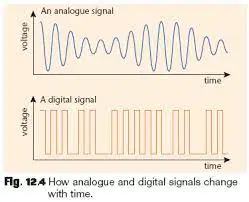
After comparing the waves in the diagram, select the statement that is true.
Digital signals are composed of continuous lines that vary over time
Analog signals are composed of continuous lines that do not vary over time.
Digital signals are composed of precise values that do not vary over time.
Analog signals are composed of precise values that vary over time
Which of these statements supports the idea that digital recordings of audio are more reliable than analog recordings?
Digital components are small and inexpensive.
Digital recordings do not get corrupted by noise
Digital recordings can be stored on a computer
Digital recordings require a power source.
An X-ray works to create a medical image by:
using sound waves to create images of the body's interior
emitting electromagnetic radiation that passes through the body to create images
using magnetic fields and radio waves to produce detailed images of organs and tissues
injecting a radioactive substance into the body to highlight areas of interest
An ultrasound works to create a medical image by:
using high-frequency sound waves to produce images of structures within the body
using X-rays to capture images of bones and tissues
using magnetic fields and radio waves to generate images
using radioactive substances to visualize organs
The main difference between an ultrasound and an X-ray is:
Ultrasound uses sound waves, while X-ray uses radiation.
Ultrasound is more expensive than X-ray.
Ultrasound is used for bones, while X-ray is used for soft tissues.
Ultrasound provides 3D images, while X-ray provides 2D images.

