
 Worksheets
Biochem Unit Review
Total questions: 100
Worksheet time: 1hrs 28mins
All of the carbon in existence is continually recycled in the carbon cycle.
Which gas do animals release, that plants depend on for survival?
Carbon dioxide
Oxygen
Sunlight
Water

How do animals get carbon?
Photosynthesis
They absorb it from the atmosphere
The sun
They eat other plants and animals

How does carbon get from animals and back into the atmosphere? (CHOOSE ALL THAT APPLY)
Respiration (breathing)
After they die, they are broken down by decomposers
Photosynthesis
None of these

What do 'plants' do with the carbon they receive?
They turn it into water
They don't need carbon
They turn it into food by photosynthesis
They keep it forever

How is carbon recycled?
The carbon cycle
At the recycle plant
It can't be recycled
Through water

Where does a TREE get its carbon from?
The sky
The sun
Dead animals and plants
Worms

Where does the SKY get its carbon from?
The sun
Animals breathing
Water
The sun

Where do ANIMALS get their carbon from?
The sun
Other animals breathing
The dirt
Their food
With the help of the Sun, through the process of photosynthesis, carbon dioxide is pulled from the air to make plant________
leaves
food
roots
nutrients
Through food chains, the carbon that is in plants moves to the animals that eat them. When an animal eats another animal, carbon is ___________________.
released
transferred
dissolved
gone
Which process contributes carbon dioxide to the atmosphere?
respiration
photosynthesis
tree farms
Which of the following is correct?
There is as much carbon on earth as when it was formed
Carbon is being created whenever it is recycled
Carbon is lost every time it is recycled
Carbon changes to different forms and is never recovered
Cellular Respiration involves the chemical breakdown of _____ to form ATP Energy
Fats
Fructose
Glucose
Proteins
Carbon is used to make sugar/glucose (chemical energy) in which step of the carbon cycle?
photosynthesis
respiration
combustion
decomposition
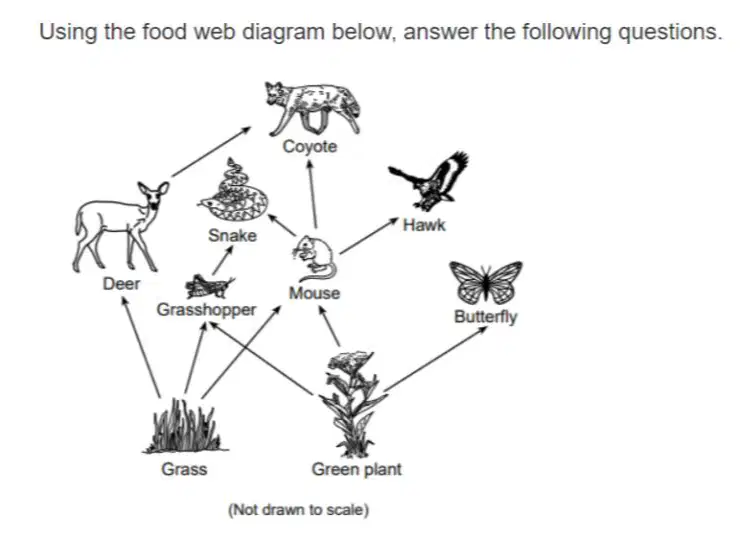
The arrows in a food chain or web represents what?
They point to the organism that is being eaten.
It shows how sunlight flows within an ecosystem.
They show what direction the energy is flowing between organisms.
They represent how water is transferred within a habitat.
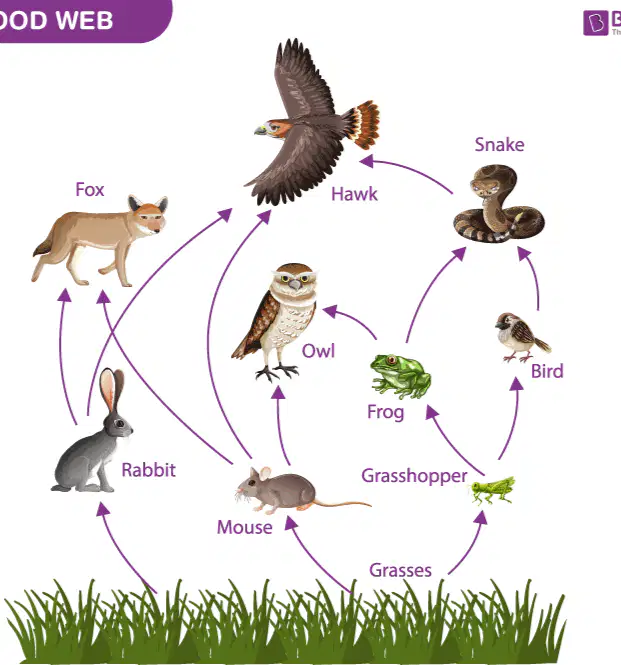
What animals get their energy from the mouse?
Owl
Hawk
Fox
Rabbit

What are the reagents (reactants) of cellular respiration?
carbon dioxide, water and ATP
carbon dioxide, water and sunlight
glucose and oxygen
glucose and water
What are the reagents of photosynthesis?
carbon dioxide, sunlight and glucose
water and oxygen
carbon dioxide, oxygen and sunlight
carbon dioxide, water and sunlight
What are the products of photosynthesis?
glucose and sunlight
glucose and carbon dioxide
glucose and oxygen
carbon dioxide, water and sunlight
What does 'conservation of energy' mean?
We can conserve energy by turning off lights when we leave the room.
We conserve energy by driving electric cars.
When energy is conserved we don't need as much energy.
Energy changes form, but never goes away
Which statement best describes 'conservation of matter'?
Molecules change, but matter is not created or destroyed.
What's the matter? I don't know - what's a matter' you?
Matter is created or destroyed when molecules are made or broken.
Atoms change, but molecules never do.
Mark ALL answers that might describe what glucose does for living things.
Chemical energy
Food energy
Energy is stored like a battery
Makes soft drinks taste sweet.
A chemical reaction is when....
Atoms are re-arranged to make new molecules.
Molecules are re-arranged to make new atoms.
When ice melts and becomes water.
Water is boiled to make steam (a gas)
Matter is conserved...
...only if we are very careful.
...when any chemical reaction happens.
...when we keep things tightly sealed.
...only during photosynthesis and cellular respiration.
The secondary consumer is a carnivore which means...
a consumer that eats both plants and other animals
a consumer that eats only plants
a consumer that eats only other animals
An omnivore is a...
consumer that eats both plants and other animals
consumer that eats only other animals
consumer that eats only plants

A connection of food chains with many food energy paths in an ecosystem is a ____________
ecosystem
food web
environment
A process by which energy is released from food.
Radiant Energy
Photosynthesis
Cellular Respiration
Chemical Energy
When oxygen is present, oxygen and glucose combine to produce energy in the form of ATP molecules. The by-product of cellular respiration in the presence of oxygen are carbon dioxide and water.
True
False
Energy that is released or absorbed in chemical reactions.
Radiant Energy
Photosynthesis
Cellular Respiration
Chemical Energy
In the cell, chemical energy is stored in glucose molecules and ATP molecules.
True
False
a simple sugar that serves as the major energy source for all cellular processes.
Radiant Energy
Photosynthesis
Glycolysis
Glucose
In which way are photosynthesis and cellular respiration different?
Cellular respiration stores ATP, while photosynthesis releases ATP.
Cellular respiration produces oxygen, while photosynthesis uses oxygen.
Photosynthesis releases energy, while cellular respiration stores energy.
Photosynthesis uses carbon dioxide, while cellular respiration produces carbon dioxide.
Which organism go through cellular respiration?
animals
plants
both animals and plants
none
Which type of organism would MOST likely benefit directly from increased levels of CO2?
mushroom
tree
bird
fish
7. How does a human body get energy?
Sunlight on the skin produces energy.
Water provides the majority of energy.
Food and oxygen combine to deliver energy
Sleep provides energy stored at night for the next day.
Which statement accurately describes an interaction between plants and animals?
Animals release CO2, required for photosynthesis.
Animals release O2, required for plant survival.
Plants provide humans with atmospheric nitrogen.
Plants provide humans with CO2 for respiration.

How do animals depend on plants?
Plants provide animals with food, oxygen and sometimes water.
Plants only provide animals with food.
Plants only provide animals with oxygen.
Plants only provide animals with water.

What are two processes that are essential for life?
photosynthesis
and cellular respiration
glucose and carbon dioxide
oxygen and photosynthesis
cellular respiration and water

What chemical formula does the picture represent?
oxygen
glucose
carbon dioxide
water

What chemical formula does the picture represent?
oxygen
glucose
carbon dioxide
water

What chemical formula does the picture represent?
oxygen
glucose
carbon dioxide
water
Elements such as oxygen, nitrogen, and carbon cycle through a system once.
True
False
Plants absorb ________________________ and release oxygen
Carbon dioxide
Carbon monoxide
Vitamin X
Oxygen
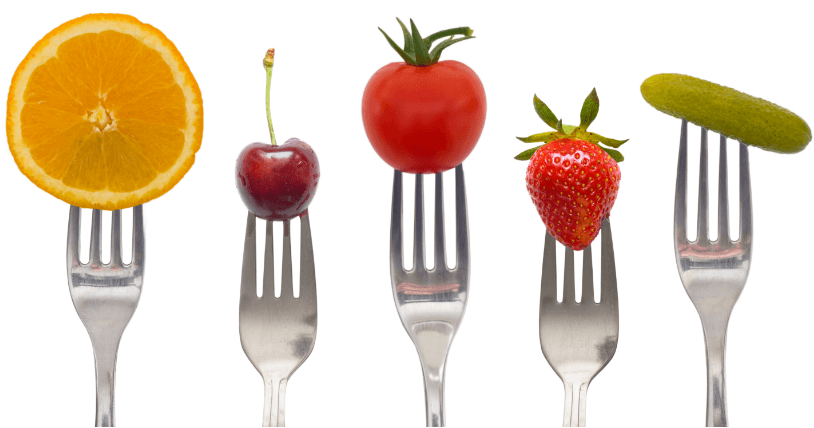
The basic building block of a carbohydrate is a _____________ molecule.
glucose
calcium
sodium
Stuff that creates energy for your body or provide building blocks:
Carbs
Nutrients
Food
Fat
Calorie is a measure of
Energy
Weight
Distance
Volume

Subunit of protein
Triglyceride
Carbohydrate
Amino acid
Fat

What is the same about carbohydrates, proteins, and fats? (Use the model below)
Carbohydrates, proteins, and fats all have carbon, hydrogen, and oxygen atoms.
Carbohydrates, proteins, and fats are all made of the same number and types of atoms.
Carbohydrates, proteins, and fats all have the same arrangement and types of atoms
Carbohydrates, proteins, and fats can all form long chains of molecules.
______ makes glucose.
What is photosynthesis?
what is cellular respiration
what is chirology
what is carbon dioxide
_____ break glucose.
what is photosynthesis
What is Cellular Respiration?
what is oxygen
Which organisms store some of the molecules from food in their bodies to use later as a source of chemical energy and building materials?
plants only
animals only
both plants and animals
Which of the following is food for a plant?
sugars that a plant makes
water that a plant takes in through its roots
carbon dioxide that a plant takes in through its leaves
Which statement is true about the breakdown of starch?
Breaking down starch is not a chemical reaction.
Animals, but not plants, can break down starch.
Organisms break down starch into carbohydrate subunits.
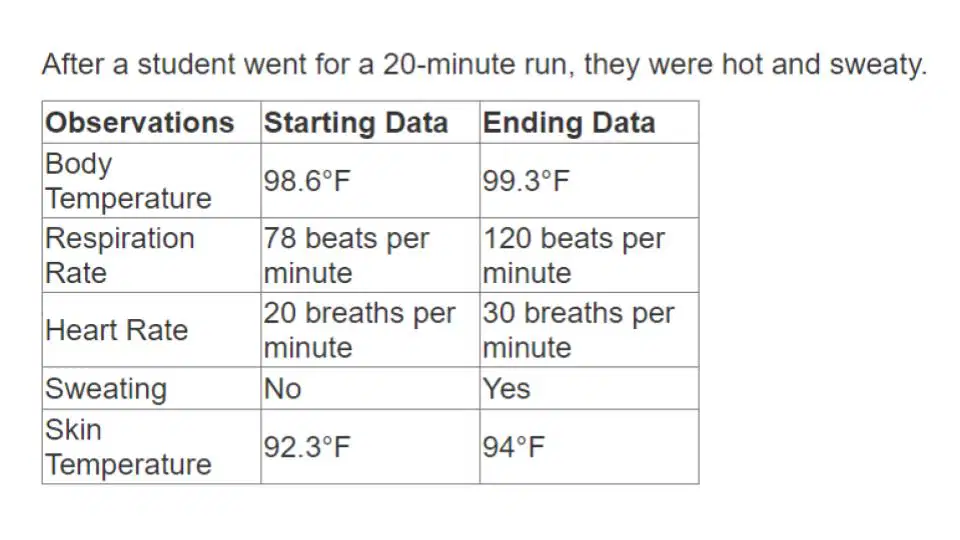
Student research data shows body temperature (a) and respiration rate (b) after exercise.
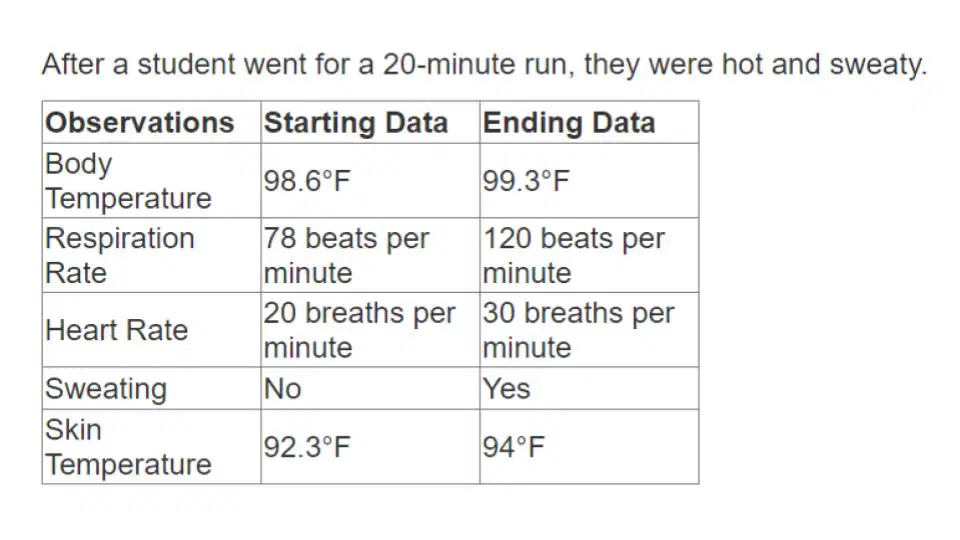
What is the best biological explanation for the student being hot and sweaty?
Her body needed to use more heat energy to run hard.
Her body needed to burn food more quickly to get energy to run hard.
Her heart had to pump faster to run hard.
The calories on a food label indicate the amount of energy the food contains in one serving. Which form of energy is contained in food?
mechanical
electrical
light
chemical

When food burns, where does the light and thermal energy given off come from?
Light and thermal energy given off from burning food comes from oxygen.
Light and thermal energy given off from burning food comes from the lighter used to light the food.
Light and thermal energy given off from burning food is converted from the chemical energy stored in the food.
When do humans store fat molecules in their bodies?
Humans store fat molecules when they eat food with a lot of fat.
Humans store fat molecules when they eat more calories than they need.
Humans store fat molecules when they eat junk food.
Choose the two best answers to complete the statement below.
Carbon atoms can be transferred from ________________________.
animal to animal
plant to animal
animal to plant
plant to plant
Define starch...
a "helper" that speeds up the chemical reaction that breakdown food
a chemical substance that is present at the start of a chemical reaction
a complex carbohydrate
a substance that changes color to indicate the presence of a substance
Define indicator...
a chemical substance that is present at the start of a chemical reaction
"spit"- breaks down starch
a substance that changes color to indicate the presence of a substance
a protein subunit
Define reactant...
a chemical substance that is present at the start of a chemical reaction
a "helper" that speeds up the chemical reaction that breakdown food
a substance that changes color to indicate the presence of a substance
a protein subunit
Milk contains water, carbohydrates, proteins, minerals, and fat. Is milk food for people?
No, because liquids can't be food, and milk is a liquid.
No, because for something to be food it must provide both energy and building materials, and milk does not provide energy.
Yes, because for something to be food it must provide energy, and the minerals in milk provides energy.
Yes, because food is a source of energy and building materials, and milk provides energy and building materials.
Define enzyme...
a "helper" that speeds up the chemical reaction that breaks down food
a substance that changes color to show the presence of a substance
a subunit of fat
a complex carbohydrate
Benedict's solution is an indicator for....
starch
glucose
What is the name of the energy molecule produced by the mitochondria?
ATP
TTP
PTP
TPA
When experimenting with the growth of a plant, a scientist uses three (of the same type of) plants, two different fertilizers, equal light, and equal water. One of the plants does not get fertilizer. This plant is known as what?
Dependent variable
Independent variable
Control
Compound
What type of energy is needed for photosynthesis to occur?
Heat energy
Kintetic Energy
light Energy
chemical energy
Vitamins are considered food
true
false
Where does the thermal energy come from when food is burnt?
The lighter being used to light the food on fire
The chemical energy stored in the food
From the oxygen needed for the food to burn
burning food
How do students grow taller?
Students grow taller when they use food molecules they eat to build large molecules that make new cells
Students grow taller when they use the food molecules they eat to make up new cells without changing the food molecules
Students grow taller when they use the energy from the food molecules, but all of the molecules leave the body as waste
Students grow taller when they store food molecules as fat
Carbon dioxide and oxygen are important resources in ecosystems and are
stored in animals in the ecosystem
lost due to the activities of decomposers
released by the process of photosynthesis
recycled through the activity of living and nonliving systems
What would be the result of removing carbon dioxide from the environment on plants?
nothing would change
Increase sugar production
Increase oxygen production
Decrease sugar production until it eventually stops
Can a plant produce sugar if there is no sunlight?
Yes, plants make sugar with water and carbon dioxide.
Yes, plants can store sunlight and keep producing sugar when the sun goes down.
No, if there is no sunlight, photosynthesis cannot happen.
No, when the sun goes down the plants die right away.
Food provides the body with _____ and _____.
Energy and amino acid
energy and building materials
nutrients and nucleic acids
fats and carbohydrates
humans use calories when
running
studying
sleeping
all of the above

