wayground logo

Free Printable Worksheets

Font size

S
M
L
XL
Worksheets

ISA Practice

Total questions: 91

Worksheet time: 2hrs 3mins

Name
Class
Date
1.
Kennedy and her mother observed the constellation Orion high in the night sky. Four hours later, they noticed that the constellation had moved to another part of the sky. Why?
a)
Earth’s axis is tilted.
b)
Earth rotates on its axis.
c)
The stars in the constellation Orion changed positions.
d)
The stars in the constellation Orion moved across the sky.
2.

In a diagram depicting the solar system as heliocentric, what is located at the center?

a)

Earth

b)

the sun

c)

the moon

d)

Mars

3.

The orbit of a planet around the sun is a(an)

a)

ellipse.

b)

straight line.

c)

circle.

d)

parabola.

4.

Which of the following helps explain why the planets remain in motion around the sun?

a)

density

b)

gravity

c)

inertia

d)

Both gravity and inertia

5.

The gravitational force between two objects increases as mass

a)

decreases or distance decreases.

b)

decreases or distance increases.

c)

increases or distance decreases.

d)

increases or distance increases.

6.

The _____________ of the sun causes the orbital motion of all the objects in the solar system.

a)

magnetic field

b)

brightness

c)

gravitational pull

d)

chemical composition

7.

Using the diagram, when would you observe a totally dark (new) moon beginning to become illuminated (waxing crescent moon)?

a)

from position W to position Z

b)

from position Z to position Y

c)

from position Y to position X

d)

from position X to position W

8.

To accurately model a solar eclipse, where would you place the golf ball?

a)

position W

b)

position X

c)

position Y

d)

position Z

9.
What is a planet?
a)
a rock
b)
object that rotates with moons
c)
object that revolves around a star in its own orbit
d)
object that is gas and bright
10.
Which letter best represents Summer in the Northern Hemisphere?
a)
A
b)
B
c)
C
d)
D
11.
Earth's rotation on its axis is what causes ______________________________.
a)
seasons
b)
moon phases
c)
day and night
d)
weather
12.
The phases of the moon are caused by
a)
The Earth's shadow on the moon
b)
The moon is a white dwarf
c)
The amount of sunlight being reflected by the moon towards Earth
d)
The amount of light emitted by the moon towards Earth
13.
What moon phase is at position 5? 
a)
waxing crescent 
b)
waxing gibbous
c)
full moon
d)
waning crescent 
14.
In what season are shadows the longest?
a)
Spring
b)
Summer
c)
Fall
d)
Winter
15.
Which image best represents the tilt of Earth's axis in December?
a)
(1)
b)
(2)
16.
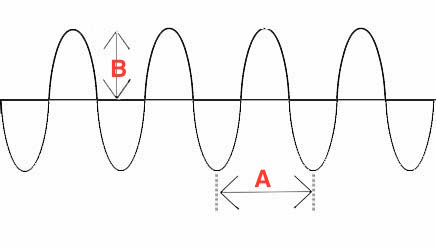
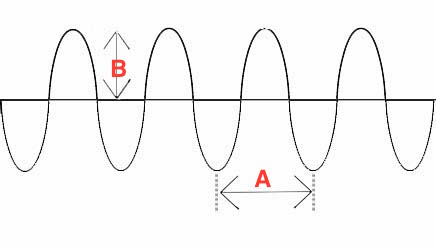
What property of this wave is represented by the letter "A"
a)
amplitude
b)
crest
c)
trough
d)
wavelength
17.
What property of the wave is represented by the letter "B"?
a)
amplitude
b)
crest
c)
trough
d)
wavelength
18.
The highest point on a wave is:
a)
the crest
b)
the trough
c)
the top
d)
the coast 
19.
The lowest point on a wave is the:
a)
Amplitude
b)
Crest
c)
Trough
d)
Wavelength
20.
The number of wavelengths that pass a point each per second is:
a)
frequency
b)
period
c)
longitudinal 
d)
transverse wave 
21.
When the frequency of a wave increases, what happens to the wavelength?
a)
The wavelength is not directly affected by the frequency of a wave.
b)
The wavelength increases.
c)
The wavelength decreases.
d)
More specific information is needed to form a conclusion about the wavelength.
22.
Which vocabulary term is used to identify the distance between points C & G?
a)
Amplitude
b)
Crest
c)
Frequency
d)
Wavelength
23.
A mechanical wave cannot travel through...
a)
a vacuum(empty space).
b)
water.
c)
air. 
d)
glass.
24.
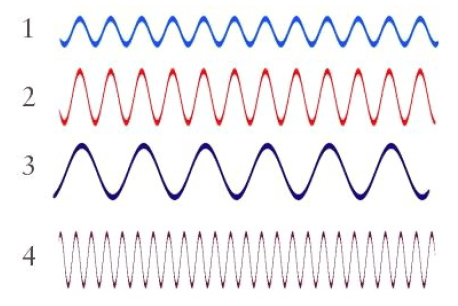
Which wave in the diagram has the greatest frequency?
a)
1
b)
2
c)
3
d)
4
25.
When a wave bends as it passes through at an angle from one medium to another.(example: pencil in a glass of water-)
a)
medium
b)
refraction
c)
reflection
d)
interference
26.
What type of wave is this?
a)
Transverse
b)
Longitudinal
27.
What part is represented by the blue lines?
a)
Crest
b)
Resting Point
c)
Wavelength
d)
Amplitude
28.
Bending of waves around an object (such as through a doorway)
a)
sound
b)
diffract
c)
pitch
d)
volume
29.
How high or low a sound is; depends on the frequency (greater frequency= higher pitch)
a)
pitch
b)
frequency
c)
sound
d)
medium
30.
You and your father inspect an empty house with the hopes of buying it. You walk through the rooms talking to one another, and you notice that your voices and footsteps are echoing in the big, empty house. What causes the echo?
a)
sound waves reflecting off smooth, flat surfaces throughout the house
b)
sound waves moving around the large rooms
c)
sound waves moving slowly through air
d)
sound waves refracting around corners in the empty rooms
31.
Cletus wants to make ear protectors for people who work around loud jet engines at Hartsfield Airport in Atlanta. Which of the following materials should he experiment with for the best results?
a)
a material that produces sound
b)
a material that absorbs sound
c)
a material that transmits sound
d)
a material that amplifies sound
32.
As the fire truck approached Mary, the pitch of the siren got higher. Once the fire truck passed and moved away, the siren's pitch got lower. This change in pitch is because of a change in the sound wave's
a)
concussion. 
b)
amplitude. 
c)
reflection.
d)
frequency. 
33.

A _________ object does not allow light to pass through it.

a)

opaque

b)

translucent

c)

light

d)

prism

34.

Which of the following is not an example of a mechanical wave?

a)

Light wave

b)

Sound wave

c)

Water wave

d)

Seismic wave

35.

What type of wave is a light wave?

a)

A sound wave

b)

A seismic wave

c)

A electromagnetic wave

d)

A mechanical wave

36.

What is the amplitude of this model wave?

a)

0mm

b)

5cm

c)

15cm

d)

10mm

37.

Why is a light wave not considered a mechanical wave?

a)

A light wave is visible to humans.

b)

A light wave moves faster than most waves.

c)

A light wave does not have a wavelength.

d)

A light wave travels through the vacuum of space.

38.

What is the frequency of this model wave?

a)

10 waves per second

b)

3 waves per second

c)

6 waves per second

d)

2 waves per second

39.

How is an electromagnetic wave different from a mechanical wave?

a)

An electromagnetic wave travels slower than a mechanical wave.

b)

An electromagnetic wave has a larger amplitude than a mechanical wave.

c)

An electromagnetic wave can travel through a vacuum, but a mechanical wave cannot.

d)

An electromagnetic wave has no wavelength, but a mechanical wave has a wavelength.

40.

Based on your observations of the prism, select the true statements.

a)

When light travels through a prism, the light is separated by wavelength.

b)

Humans see the different wavelengths of visible light as different colors.

c)

The prism is being used to combine different colors of light.

d)

The light bends when it enters the prism and again when it leaves the prism.

41.

A light wave is considered to be an electromagnetic wave. But what other kind of wave is it?

a)

Surface wave

b)

Longitudinal wave

c)

Transverse wave

42.

Based on your observations of the prism, select the true statements.

a)

When light travels through a prism, the light is separated by wavelength.

b)

Humans see the different wavelengths of visible light as different colors.

c)

The prism is being used to combine different colors of light.

d)

The light bends when it enters the prism and again when it leaves the prism.

43.
A ____________ is a push or a pull on an object.
a)
friction
b)
force
c)
magnet
d)
gravity
44.

the breakdown of rock into smaller pieces from the effects of wind, water, and ice

a)

Weathering

b)

Deposition

c)

Erosion

d)

Landform

45.

the gradual moving of smaller pieces by wind, water, and other natural forces

a)

Weathering

b)

Deposition

c)

Erosion

d)

Landform

46.

What causes the plates to move inside the earth?

a)

Pressure

b)

Convection Currents

c)

Time

d)

Heat

47.

What evidence exists that proves that Earth has layers?

a)

They can be seen from special locations on the Earth

b)

observations of earthquakes and buildings swaying

c)

seismic data from earthquakes on the other side of the Earth

d)

rock samples from deep layers

48.
What makes the inner core solid?
a)
Metals in the core are very light.
b)
Pressure at the core is very high.
c)
Chemicals in the core are very reactive.
d)
Temperatures in the core are very low.
49.
The speed of seismic waves _____ through materials that are MORE dense. 
a)
increase
b)
decrease
50.

The fact that similar fossils are found on both sides of the ocean is evidence of

a)

magnetic reversal

b)

global positioning

c)

continental drift

d)

oceanic drift

51.

When plates collide we get ________.

a)

crumbles

b)

volcanos

c)

trenches

d)

mountain ranges

52.
Associated with transform boundaries.
a)
Volcanoes
b)
mountains
c)
trenches
d)
earthquakes
53.

Subduction means.....

a)

one plate goes under another plate

b)

two plates slide past each other

c)

two plate collide and form folded mountains

54.

Sea-floor spreading explains how.....

a)

new crust is created at a divergent boundary

b)

volcanoes are formed on continents

c)

deep sea trenches are formed

55.

When oceanic lithosphere descends into the asthenosphere and creates trenches

a)

subduction

b)

divergent boundary

c)

seafloor spreading

d)

continental rifting

56.
Which of the following orders the rock layers accurately from oldest to youngest?
a)
A, B, C, D, E, F, G, H
b)
B, F, G, C, D, H, A, E
c)
B, G, C, D, E, H, A, F
d)
F, A, H, E, D, C, G, B
57.
Put the layers in order from oldest to youngest.
a)
a, b, c, d, e
b)
b, c, d, a, e
c)
b, c, d, e, a 
d)
e, d, c, b, a
58.

Which Era was mainly dominated by dinosaurs?

a)

Cenozoic

b)

Jurassic

c)

Mesozoic

d)

Paleozoic

59.

What type of event usually marks the end of an Era

a)

A Mass Extinction

b)

A Quinceanera

c)

An earthquake

d)

A Volcanic Eruption

60.
If the half-life of a radioactive group of atoms is 100 years, then how old is the rock if there have been two half-lives?
a)
25 years
b)
200 years
c)
400 years
d)
800 years
61.
What causes the balloon to move along the string?
a)
Force from string
b)
friction between straw and string
c)
Force from escaping air
d)
weight of balloon containing air
62.
Which force is represented by X?
a)
Gravity
b)
Friction
c)
Electricity 
d)
Magnetism
63.
What is the maximum mass, in grams, that could be measured by this balance?
a)
110
b)
500
c)
610
d)
1510
64.
What process in the water cycle changes water vapor into liquid water droplets that forms thunderstorm clouds?
a)
Evaporation
b)
Condensation
c)
Precipitation
d)
Climate 
65.
A proton has a ___________ charge.
a)
positive
b)
negative
c)
neutral
66.
The nucleus of the atom has  the 
___________ and ___________ in it.
a)
protons and neutrons
b)
electrons and neutrons
c)
protons and electrons
67.
____________ is anything that has mass and takes up space.
a)
matter
b)
compound
c)
particle
d)
subatomic
68.

Plants use the sunlight to make their own food. Therefore, plants are

a)

Producers, which produce energy for the rest of the ecosystem

b)

Consumers, consuming other living things in an ecosystem

c)

predators, top of the food chain

69.

The digestive system converts food into usable

a)

nutrients

b)

muscles

c)

energy

70.
What is the net force?
a)
11 N left
b)
11 N right
c)
3 N left
d)
3 N right
71.
The graph shows how the speed of an object changed over time. During which segments of this graph were the forces acting on the object balanced?
a)
R only
b)
Q and S
c)
R and T
d)
R, S and T
72.
The diagram below shows a skateboarder pushing himself forward with a force of 25 N while the wind pushes back with a force of 5 N. How will the skateboarder be affected if the force of the wind increases to 8 N?
a)
The speed of the skateboarder will increase.
b)
The speed of the skateboarder will remain constant.
c)
The speed of the skateboarder will decrease.
d)
The skateboarder will come to a stop.
73.
What happens when two forces act in the same direction?
a)
They cancel each other out.
b)
The stronger one prevails.
c)
Their strengths are added.
d)
Their sum divided by the two is the total force.
74.
The graph represents
a)
No motion
b)
Constant velocity
c)
Acceleration
d)
Deceleration
75.

What is this graph showing?

a)

Constant Speed

b)

Acceleration (speeding up)

c)

Negative Acceleration (slowing down)

d)

No motion

76.

What is happening at D?

a)

Stationary

b)

Negative Acceleration

c)

Fast steady speed; moving away from the starting position
d)

Slower steady speed; moving away from the starting position

77.
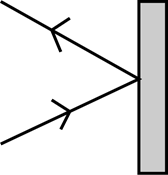
The illustration shows a light ray striking an object.
In the illustration, the light ray striking the object is-
a)
absorbed
b)
stopped
c)
reflected
d)
refracted
78.
Why are digital signals more reliable in transmitting information than analog signals? 
a)
They are more powerful
b)
They carry less information
c)
They have less interference over long distances
d)
They have more interference over long distances
79.
The transfer of what type of atomic particle is responsible for the static charges on objects?
a)
neutrons
b)
protons
c)
electrons
d)
none of these
80.
What types of charges repel?
a)
Positive and Positive
b)
Positive and Neutral
c)
Negative and Neutral
d)
Neutral and Neutral
81.
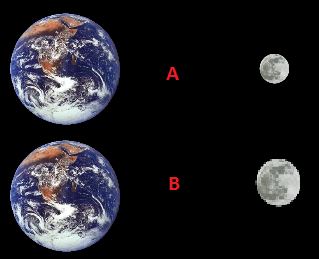
Which model has greater gravitational attraction (if any)
a)
Model A
b)
Model B
c)
Both Model A and Model B (same gravity)
82.
Which system has the greater gravitational attraction between the two objects (if any)?
a)
System A
b)
System B
c)
Same gravitational attraction fro System A and System B
83.

Which state of matter is least dense?

a)

Solid

b)

Liquid

c)

Gas

84.

Scientists observe two populations of deer mice in an arid environment. One population lives on light-colored soil, and the other lives in dark-colored soil.
The scientists make the following observations.
1. Deer mice are preyed upon by owls.
2. Fur color in deer mice is controlled by a known gene.

Select TWO predictions the scientists can make about the two populations of mice.

a)

More mice with light fur will survive on light soils

b)

More mice with light fur will survive on dark soils

c)

More mice with dark fur will survive on light soils

d)

More mice with dark fur will survive on dark soils

85.

The diagrams show the behavior of P-waves and S-waves through Earth's Layers. What behavior of S=waves is useful to scientists studying Earth based on the P-Wave behavior and S-wave Behavior diagrams?

a)

S-waves travel faster than P=waves and can alert scientists to future earthquakes.

b)

S-waves travel to more locations on Earth's surface and show up on more seismographs

c)

S-waves are unable to travel through some materials and can help scientists identfy layers of Earth's interior

d)

S-Waves are unable to reach depths below the crust so scientsts can record wave speeds along Earth's surface.

86.

The diagram shows a landscape that includes several glacial moraines deposited during a single glacial event. The moraines are labeled. Select ALL of the labels on the diagram that show the moraines that formed as the glacier advanced.

a)

J

b)

K

c)

L

d)

M

87.

According to the Rock Layer Data, which diagram matches the order in which the layers were deposited?

a)

b)

c)

d)

88.
a)

A

b)

B

c)

C

d)

D

89.
a)

A

b)

B

c)

C

d)

D

90.
a)

A

b)

B

c)

C

d)

D

91.
a)

A

b)

B

c)

C

d)

D