
 Worksheets
Chapter 13
Total questions: 104
Worksheet time: 4hrs 0mins
The weather in a place over a long period of time is called
Primate
Climate
Global Warming
Atmosphere
How much of the Earth's atmosphere is made of argon?
.9%
9%
29%
.09%
How much of the Earth's atmosphere is made of greenhouse gasses?
100%
Less than 10%
More than 1%
Less than 1%
Which of these things uses oxygen gas?
Photosynthesis
Anaerobic Respiration
Combustion
All of These
Which of these things uses Nitrogen?
Dynamite
Fertilizer
Laughing Gas
All of these

How much does this chart show carbon dioxide levels have risen during this time period
320ppm
400ppm
80ppm
2010ppm

Approximately when does this graph end?
1960
2010
2015
2020
Which of the following correctly shows the four most abundant gases in the Earth's atmosphere in order from most abundant to least abundant?
nitrogen, oxygen, argon, carbon dioxide
nitrogen, oxygen, carbon dioxide, argon
oxygen, nitrogen, argon, carbon dioxide
carbon dioxide, oxygen, nitrogen, argon

According to this chart, about how much did the average global temperature rise from 1880 to 2010?
-0.4 degrees
.9 degrees
.3 degrees
.6 degrees
What is the FIRST (1st) layer of atmosphere?
Troposphere
Stratosphere
Mesosphere
Thermosphere
Exosphere
What is the SECOND (2nd) layer of atmosphere?
Troposphere
Stratosphere
Mesosphere
Thermosphere
Exosphere
What is the THIRD (3rd) layer of atmosphere?
Troposphere
Stratosphere
Mesosphere
Thermosphere
Exosphere
What is the FOURTH (4th) layer of atmosphere?
Troposphere
Stratosphere
Mesosphere
Thermosphere
Exosphere

What layer does weather happen?
Troposphere
Stratosphere
Mesosphere
Thermosphere
Exosphere

What layer do satellites orbit?
Troposphere
Stratosphere
Mesosphere
Thermosphere
Exosphere

What layer is the coldest layer?
Troposphere
Stratosphere
Mesosphere
Thermosphere
Exosphere
What layer is the coldest layer?
Troposphere
Stratosphere
Mesosphere
Thermosphere
Exosphere

What layer is the hottest layer?
Troposphere
Stratosphere
Mesosphere
Thermosphere
Exosphere

What layer do passenger airplanes fly in?
Troposphere
Stratosphere
Mesosphere
Thermosphere
Exosphere

What layer do we live in?
Troposphere
Stratosphere
Mesosphere
Thermosphere
Exosphere

What layer do meteors burn up?
Troposphere
Stratosphere
Mesosphere
Thermosphere
Exosphere
What is the order of the layers of the atmosphere, starting with the layer closest to Earth's surface?
Stratosphere, Troposphere, Exosphere, Mesosphere, Thermosphere
Troposphere, Stratosphere, Mesosphere, Thermosphere, Exosphere
Troposphere, Stratosphere, Mesosphere, Exosphere, Thermosphere
Troposphere, Stratosphere, Thermosphere, Exosphere, Mesosphere


What gas makes up the largest proportion of air at 78%?
oxygen
nitrogen
argon
carbon dioxide


If you are standing at the BOTTOM of the mountain there is...
higher air pressure
lower air pressure
During an El Nino, it rains
in the central Pacific
in the FAR western Pacific
in the western Pacific
In all of the Pacific
Both El Nino and La Nina have this in common
Influence birds that migrate over the ocean
Influence rainy / dry weather world wide
The weather at the polar regions
The directions that ships travel in the oceans
How often do El Nino events occur?
2-5 years
2-7 years
7-10 years

The image is of a(n):
El Nino event
La Nina event
Non-El Nino (normal conditions)

The picture below is of a(n) ____ event.
Non-El Nino (Normal)
El Nino
La Nina

The picture represents a(n) ___ event.
El Nino
La Nina
Non-El Nino (normal conditions)
Without question, ENSO events:
Are preventable
Eliminate sources of rain
Are really scary
Impact everyone on the planet somehow
Why do the fisherman of Peru and South America not welcome a strong El Nino?
El Nino poisons the fish
El Nino causes strong winds and currents which move fish westward
El Nino bring cold water to the surface which kills the base of the food chain
El Nino shuts off upwelling and nutrients needed for the marine food chain do not rise to the surface

What happens during an El Nino year?
The trade winds weaken and warmer water is pushed to SE Asia
The trade winds strengthen and warmer water is pushed to the Americas.
The trade winds weaken and warmer water remains in the Americas
The trade winds strengthen and warmer water remains in the Americas

The winds that reliably blow east to west just north and south of the equator are called what?
equatorial winds
trade winds
weather winds
El Nino winds
What is NOT an effect from temperature inversions?
pollution can rise and escape
trapped pollution
freezing rain
violent thunderstorms

What happens during a temperature inversion?
warm air rises and becomes cooler as pressure lowers
cold air rises and becomes warmer as pressure lowers
a layer of cold air becomes like a lid and traps warm air below
a layer of warm air becomes like a lid and traps cold air below
What is the driving force behind Hadley Cells?
The convergence of air
The warming of the equator
The density of water
The rotation of the Earth
What happens to air as it rises in the atmosphere?
It descends to Earth's surface
It becomes more dense
It carries moisture to form clouds
It flows towards the poles
What is the result of the convergence of air from the northern and southern hemispheres?
Increase in ocean salinity
Formation of tropical rainforests
Formation of deserts
Decrease in ocean salinity
What causes the high ocean salinity at around 30 degrees north and south?
The rotation of the Earth
The convergence of air
The aridity of the region
The dilution of ocean water
What is the circulation pattern of Hadley Cells?
From east to west
From the equator to the poles
From the poles to the equator
From west to east
What is the main reason for the formation of clouds and precipitation in the tropics?
The aridity of the region
The rotation of the Earth
The convergence of air
The density of water
Why do deserts often form on the western edges of continents?
Due to dense forests
Because of frequent storms
Due to cold ocean currents
Because of high mountain ranges

How does the density of cold air compare to the density of warm air?
Cold air is less dense than warm air.
Cold air is more dense than warm air.
Cold air and warm air have the same density.
The _________ cells are found between 60 and 900 North and South. These are typically colder and feature denser air.
Polar Cell
Hadley Cell
Ferrel Cell
The Coriolis Effect is caused by what?
The wind blowing
Earth's gravity pulling things down
The rotation of the Earth
The pull of the Moon
Winds blow from areas of what to what?
High temperature to high pressure
Low temperature to high pressure
High pressure to low temperature
Low temperature to high temperature
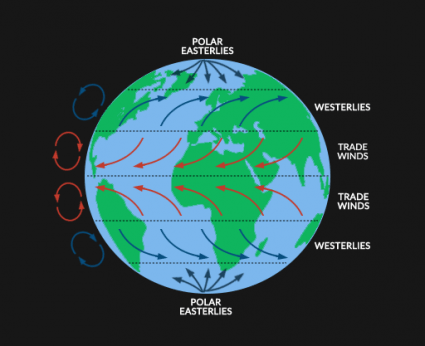
what is the coriolis effect?
change in location of warm and cold surface water every 2-7 years
tendency of objects moving large distances on Earth’s surface to bend to the right in the northern hemisphere & to the left in the southern hemisphere
winds in northern Indian ocean that blow from the southwest in the summer & from the northeast in winter
two layers of horizontal winds moving in opposite directions
What causes wind?
movement of air from high pressure to low pressure
movement of air from low pressure to high pressure
wind
warm, less dense air rises
cool, dense air sinks
large circular patterns of moving air
movement of air cause by differences in air pressure
Winds blow from areas of what to what?
High temperature to high pressure
Low temperature to high pressure
High pressure to low pressure
Low temperature to high temperature
Objects in the SOUTHERN Hemisphere deflect to which direction due to the Coriolis Effect?
Left
Up
Down
Right
Objects in the NORTHERN Hemisphere deflect to which direction due to the Coriolis Effect?
Left
Up
Down
Right

Which of the following are greenhouse gases?
Carbon dioxide
Methane
Water vapor
All answers are correct
Without the Greenhouse Effect the Earth would be
warm
cold

Which of the following does NOT happen to solar energy when it reaches Earth?
Some solar energy reflects off the atmosphere, back to space
Some solar energy passes through Earth and comes out the other side
Some solar energy is absorbed by land and water
Some solar energy is radiated from the Earth's surface and trapped by the atmosphere
Which of the following is NOT a greenhouse gas?
Carbon dioxide
Methane
Water vapor
nitrogen

The greenhouse effect is a natural process
true
false

The greenhouse effect is caused by
more heat arriving at the Earth from the sun
the Earth releasing more heat at night
gases in the air trapping heat released by the Earth
Which of the following adds Greenhouse gases into the atmosphere
Trees performing photosynthesis
Clouds reflecting sunlight
Cow's releasing methane
Using solar energy
What can be done to reduce greenhouse gases?
Cut down trees
use less fossil fuels
drive more

The greenhouse effect is natural.
True
False

Which Greenhouse Gas is found the most in our atmosphere
Methane
Oxygen
Water Vapor
Carbon Dioxide

The half of Earth located below the equator
Northern Hemisphere
Southern Hemisphere

The path an object takes as it revolves around another object
Axis
Equinox
Orbit
Solstice

The half of the Earth located above the equator
Northern Hemisphere
Southern Hemisphere

The process of turning or spinning on an axis
Rotation
Revolution
What does the earth's tilt cause?
The seasons
Day and Night
Tsunamis
Earthquakes

What season is it in the Southern Hemisphere when it is fall in the Northern Hemisphere?
winter
spring
summer
fall

Why does the area around the equator stay the same temperature all year?
The equator rotates slower than the poles.
The equator remains the same distance from the sun.
The equator always receives direct sunlight.
The equator has 18 hour days.
What causes day and night?
The sun goes around the Earth
The Earth orbits the sun
The moon rising causes night time
The Earth rotating on its axis
What would happen if Earth's axis was straight up and down instead of tilted?
Life on Earth would not be possible
There would be no night or day
There would be no seasons
Earth would be covered with ice

What results from livestock and other agricultural practices and by the decay of organic waste in municipal solid waste landfills?
Carbon Dioxide
Methane
Water Vapor
Fluorinated Gases
Nitrous Oxide

