
 Worksheets
Unit 2: Summative Assessment (1-5)
Total questions: 50
Worksheet time: 25mins
When giving a rescue breath during CPR, each breath should last about:
½ second
1 second
2 seconds
3 seconds
Which of the following could be a sign or symptom of a heart attack?
Persistent chest pain or discomfort
Profuse sweating
Nausea or vomiting
All of the answers are correct
The cycle of chest compressions and rescue breaths in CPR is:
15 chest compressions to 1 rescue breath.
15 chest compressions to 3 rescue breaths.
30 chest compressions to 1 rescue breath.
30 chest compressions to 2 rescue breaths.
You should continue CPR until:
The person shows an obvious sign of life.
Another trained responder or EMS personnel take over.
You are too exhausted to continue.
All of the answers are correct.
You are giving CPR and the first rescue breath does not cause the chest to rise. What should you do?
Perform a finger sweep.
Re-tilt the head to ensure that the airway is properly opened and ensure that the nose and mouth are properly sealed before giving the second rescue breath.
Begin the next set of compressions immediately.
Take a bigger breath and blow with more force for the second rescue breath.
Effective chest compressions:
Allow the chest to return to its normal position.
Are delivered quickly at a rate of 100 to 120 compressions per minute.
Are smooth, regular, and given straight up and down.
All of the answers are correct.
When a cardiac arrest occurs and an AED becomes available, it should be used as soon as possible.
True
False
Why is it important to stand clear and not touch the person while the AED is analyzing or delivering a shock?
You or someone else could be injured by the shock.
You might prevent the AED from analyzing the heart rhythm properly.
All of the answers are correct.
If you are alone, once you have turned on the AED, you should:
Apply the pads and allow the AED to analyze the heart rhythm.
Check for movement and breathing.
Give abdominal thrusts.
Give chest compressions.
Which of the following could signal an emergency?
Unusual behavior
An unusual sound
An unusual odor
All of the answers are correct
The steps to follow in an emergency are:
Call—Check—Secure.
Care—Call—Check.
Check—Call—Care.
Check—Care—Defibrillate.
In which situation should you call 9-1-1 or the designated emergency number?
The person is having persistent chest pain.
The person is having trouble breathing.
The person is unresponsive.
All of the answers are correct.
About how many seconds should you check for breathing?
At least 5 seconds but no more than 10 seconds
At least 10 seconds but no more than 15 seconds
No more than 5 seconds
At least 15 seconds
You are conducting a head-to-toe check on a responsive person who is complaining of a leg injury. What should you do first?
Check the person’s injured leg first.
Check to see if the person can bend the knee of the injured leg without pain.
Get consent to give care before beginning the head-to-toe exam.
All of the answers are correct.
What sudden illness is usually caused by a blockage of blood flow to the brain?
Diabetic emergency
Heat-related illness
Heart attack
Stroke
If someone is experiencing signs and symptoms of anaphylactic shock, they should administer their EPI-Pen immediately.
True
False
The EpiPen should be administered in the victim's outer thigh and held in place for at least 10 seconds. You must call 911 because you don't know if the allergic reaction will be triggered again.
True
False
A person is showing signs and symptoms of a heart attack. What should you do first?
Have the person chew one regular-strength aspirin tablet or two low-dose aspirin tablets.
Call 9-1-1 or the designated emergency number.
Help the person rest in a comfortable position and loosen any tight clothing.
Begin CPR.
What does CPR stand for?
Airway, Breathing, Circulation
Check, Call, Care
Cardiopulmonary resuscitation
Automated external defibrillator
_________________ heart disease occurs when the arteries that supply blood to the heart muscle harden and narrow.
Coronary
Soft
Enlarged
Small
When performing CPR on an adult, how deep should each compression be?
1/2 inch
1 inch
2 inches
4 inches
A person is responsive and showing signs and symptoms of a life-threatening condition but does not consent to care. What should you do?
Do not give care, but instead call 9-1-1 or the designated emergency number.
Give care and call 9-1-1 or the designated emergency number.
Do not give care and advise the person to seek medical attention immediately.
Give care; consent is not necessary if the person is responsive and has signs or symptoms of a life-threatening condition.
All of the following are links in the Adult Cardiac Chain of Survival except:
Early defibrillation
Early CPR
Prevention
Early recognition and early access to the EMS system
Which of the following statements about cardiac arrest is true?
Cardiac arrest is the same as a heart attack.
A person who is in cardiac arrest is unresponsive, not breathing, and has no heartbeat.
Cardiac arrest occurs when blood flow to part of the heart muscle is blocked.
Cardiac arrest is always caused by cardiovascular disease.
Your role in the EMS system includes four basic steps. What is the first step?
Recognize that an emergency exists
Decide to act
Activate the EMS system
Give care until help takes over
What does AED stand for?
Automated external defibrillator
Cardiopulmonary resuscitation
Airway, Breathing, Circulation
Check, Call, Care
Infectious diseases can spread from one person to another. What forms of PPE can be used to give first aid or CPR to a person in need?
utilizing breathing barriers
disposable gloves
face shields
all of the answers are correct
When checking a victim for consciousness, you should tap the victim on the shoulders and shout, "Are you okay?"
True
False

This particular move is called:
walking assist
blanket drag
ankle drag
the pack-strap carry
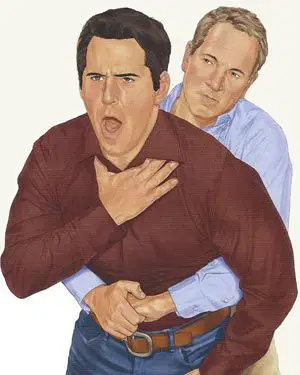
When caring for a choking victim, how many abdominal thrusts should you administer?
2
3
4
5

When caring for a victim of choking, how many back blows should you give?
5
4
3
2
Which of the following could signal an emergency?
Unusual behavior
An unusual sound
An unusual odor
All of the above
What should you do before the AED analyzes the heart rhythm?
Ensure that no one, including you, is touching the person.
Ensure that the head-tilt/jaw-thrust is maintained.
Ensure that the person is breathing.
Why is it important to stand clear and not touch the person while the AED is analyzing or defibrillating?
You or someone else could be injured by the shock.
You might prevent the AED from analyzing the heart rhythm properly.
Both answers are correct
Which of the following statements about defibrillation is true?
It is an electrical shock that may help the heart spontaneously develop an effective rhythm.
It is commonly used for a person complaining of chest pain.
It is more likely to be successful if CPR is withheld.
It is not a link in the Cardiac Chain of Survival.
The electrical system tells the ventricles to contract too quickly.
ventricular tachycardia
defibrillation
shock
ventrical fibrillation
The electrical system is firing at random, creating chaos and preventing the heart from pumping and circulating blood.
ventricular fibrillation
shock
ICD
hypothermia
2 minutes of CPR should equal approximately ______ cycles of CPR
2
3
4
5
The heart is separated into right and left halves.
True
False
Many factors increase a person's chances of developing coronary heart disease. These are called risk factors.
True
False
When you combine one risk factor, such as smoking, with others, such as high blood pressure and lack of exercise, your risk of heart attack is much greater.
True
False
The first step in the Cardiac Chain of Survival is Early Advanced Medical Care.
True
False
You can stop CPR if you are too tired to continue.
True
False
The buildup of fatty materials on the inner walls of the arteries reduces blood flow to the heart muscle and may cause a heart attack.
True
False
Dispose of contaminated material in a labeled ___________________ container.
Recycling
Trash
Laundry
Biohazard
Medical ID tags and bracelets can provide important information about an injured or ill person.
True
False
_____ is a condition in which the circulatory system fails to deliver enough oxygen-rich blood to the body’s tissues and vital organs.
Cramp
Torn ACL
Headache
Shock
When giving rescue breaths to an infant, you must place your mouth over the victim’s nose and mouth.
True
False
A, B, C stands for Airway, Breathing, _________________.
Compressions
Bleeding
Circulation
Shock
The Good Samaritan Law protects people against claims of negligence.
True
False

