
NEW
Font size
 Worksheets
Minerals and T2 Review
Total questions: 60
Worksheet time: 15hrs 0mins

The property of splitting easily along flat surfaces
fracture
hardness
cleavage
streak

How a mineral splits apart when it does not break evenly:
streak
hardness
cleavage
fracture

Minerals are the building blocks of _____________.
elements
atoms
fossils
rocks
The hardest mineral on the Mohs Hardness scale
Talc
Obsidian
Diamond
Quartz
Minerals are inorganic which means that
they were once parts of living things.
renewable
they were never part of anything living.
they are nonrenewable
What is the relationship between a rock and a mineral?
Rocks are made up of minerals.
Minerals are made up of rocks.
Rocks are on the Earth's surface. Minerals are found underground.
Rocks and minerals are different names for the same thing.
Which of the following is an accurate model of how the Sun, Earth, and Moon move?
Sun and moon orbit Earth
Earth and moon orbit Sun
Earth orbits the Sun and the moon orbits Earth
Earth and sun orbit moon
Which is the largest object in our solar system?
Sun
Jupiter
Earth
Pluto

One full orbit of an object around another object is called a ________.
axis
rotation
revolution
satellite
Day and night is caused by the _____________ of earth on its axis.
revolution
orbit
rotation
How long ago was our solar system formed?
10 million years ago
4.6 million years ago
4.6 billion years ago
2 billion years ago
The center of our solar system is the....
Earth
Sun
Moon
Asteroid belt
About 99.85% of the mass of the solar system is the __________.
Asteroid belt
Sun
Moon
planets
Each planet orbits or ______ around the Sun.
rotates
revolves
Making a complete spin on an axis.
rotation
revolution
axis
orbit
Making a complete turn or orbit around an axis or center.
Revolution
rotation
orbit
axis
The center of our solar system that supplies heat and light to Earth; its enormous gravity keeps the solar system in orbit.
Earth
sun
moon
Jupiter
What causes night and day?
The Earth's revolving
The rotation of the Earth
The atmosphere
How long does it take the Earth to revolve around the Sun one time?
365 hours
24 hours
24 days
365 days
How long does it take the Earth to make one rotation?
365 days
24 day
365 hours
24 hours
The moon revolves or rotates around the Earth?
revolve
rotate
orbit
floats
Why do we have seasons?
The earth's rotation on its axis
The earth's revolution around the sun
The moon's gravity pull on the earth
The Earth's tilt as it revolves around the sun
What causes day and night?
The sun rises and sets
The Earth rotating on its axis
The Earth revolves around the sun
The tilt of the Earth
What two things cause our tides?
the seasons and moon phases
the earths gravity and rotation
Moon's gravity and earth's rotation
moon's gravity and earth's revolution
According to Newton’s first law of motion, a moving object that is not acted on by an unbalanced force will
remain in motion.
eventually come to a stop.
change its momentum.
accelerate.
Unit of mass
m/s 2
m/s
newtons
kg
An 10 kg object is moving with an acceleration of 2 m/s squared. What is the force of the object? (F=ma)
20 N
10 N
2 N
5 N
A 5 kg object is moving with an acceleration of 2 m/s squared. What is the force of the object? (F=ma)
20 N
10 N
2 N
5 N
A 5 kg object is moving with an acceleration of 10 m/s squared. What is the force of the object? (F=ma)
20 N
10 N
50 N
5 N
A 10 N force is on a 2 kg object. What is the acceleration of the object? (a = F/m)
5 m/s squared
20 m/s squared
10 m/s squared
1 m/s squared
A 20 N force is on a 5 kg object. What is the acceleration of the object? (a = F/m)
5 m/s squared
4 m/s squared
10 m/s squared
20 m/s squared
A 10 N force is causing a 10 m/s squared acceleration on an object. What is the mass of the object? (m = F/a)
10 kg
1 kg
2 kg
20 kg

If the man pushes with an equal amount of force, which object will accelerate more?
Car because it has more mass
Lawnmower because it has less mass
Car because it has less mass
Lawnmower because it has more mass
What is the mass of a motorcycle that accelerates at 4 m/s2 when a net force of 400 N is applied to it?
1600 kg
100 kg
0.01 kg
396 kg
Any object with mass has gravity.
True
Sometimes
False
Never
As distance between two objects increase the pull of gravity
Increases
Decreases
Stays the same
The amount of matter in an object is
pressure
weight
mass
force
Two factors effecting the magnitude of the force of gravity between 2 objects are...
mass and distance
mass and matter
distance and weight
weight and mass
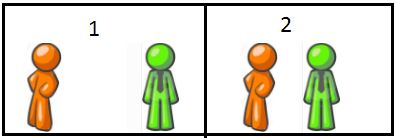
Which System has the greater gravitational pull between the two objects?
System 1
System 2
Same: there is no gravitational attraction between the two objects

Why electrical wiring usually are covered with a layer of plastic?
To make it look pretty
To help electricity flow along the wire
To make it safe
To add more energy

What type of circuit is this?
Parallel Circuit
Open Circuit
Series Circuit

What type of circuit is this?
Parallel Circuit
Open Circuit
Series Circuit

Is the circuit in the picture opened or closed?
opened
closed
neither
Which material could fill in the gap for a circuit to create a complete circuit?
metal spoon
rubber ball
plastic spoon
construction paper
The flow of electrons through a circuit.
insulator
closed circuit
electrical current
open circuit

In the picture, if you replace the paper clip with a plastic spoon, what happens?
The bulb doesn't light
The bulb is dimmer
The wires get hot
There is no charge

Why is electrical wiring usually made from copper?
Because copper is shiny
Because copper conducts electricity
Because copper is not magnetic
Because copper insulates electricity
The rubber coating on a wire cord is __________________ because it does not allow electricity to pass through to you.
magnetic
a conductor
an insulator
a circuit
An example of a conductor is?
metal paperclip
glass marble
wooden golf tee
A mineral's resistance to being scratched is called?
streak
luster
hardness
heft


Minerals must be inorganic. What does inorganic mean?
It is alive.
It was once alive.
It is not alive, never has been alive, and never will be.
It is alive, was alive, and always will be alive.

