
Font size
 Worksheets
Nervous System
Total questions: 95
Worksheet time: 2hrs 53mins

This part of the brain helps with balance and coordination by controlling how the the muscles work together.
cerebrum
cerebellum
brain stem

This part of the brain is the center of conscious thought. It controls our voluntary muscle movements like running and talking as well as our senses (hearing and tasting).
cerebrum
brain stem
cerebellum

Several important involuntary functions, such as breathing and heartbeat, digestion, and sleep are controlled by the
Hippocampus
cerebellum
brain stem or medulla
Cerebrum


The nerves in your fingertips are part of the ___ nervous system
central
peripheral

Select all that apply: The function of the nervous system is to control
voluntary movement
our senses (sight, hearing, touch, taste..)
our memories and thoughts
Involuntary actions likes breathing and heart beat

The nervous system is composed of the ___, ___, and ___.
heart, brain, kidneys
lungs, liver, stomach
brain, spinal cord, nerves

The brain is part of the ____ nervous system.
central
peripheral


The hippocampus is the part of the brain that
our heart beat
our breathing
Stores our short term memories
processes memories and stores them long term.

The brain stem or medulla is the part of the brain that controls
involuntary processes like breathing, heart rate, digestion, and sleep
processes memories and stores them long term.
our short term memories

What is true about nerves?
Nerves all have the same job - to send messages TO the brain and spinal cord.
Nerves all have the same job - to send messages AWAY the brain and spinal cord.
Nerves all have different jobs -some only send messages TO to the brain and spinal cord with other only send messages AWAY from the brain and spinal cord.
Which of the following is regulated by the autonomic nervous system
Breathing
Kicking a soccer ball
Balancing on one foot
Raising your hand
Dopamine and Serotonin are examples of _______________
Axon
Neurotransmitters
Somatic Nerves
Autonomic Nerves
The branch like figures that receive impulses & conducts them to the cell body
Dendrite
Axon
Cell Body
Myelin Sheath

What is number 3 pointing at on the neuron?
Dendrite
Axon
Myelin Sheath
Soma

What part of the neuron is number 4 pointing at?
Dendrite
Axon Terminal
Axon
Myelin Sheath

Which part of the Neuron is number 1 pointing at?
Dendrite
Cell body
Axon
Nucleus


What is this? It coordinates muscle movements.
Cerebrum
Cerebellum
Brain Stem
Diencephalon
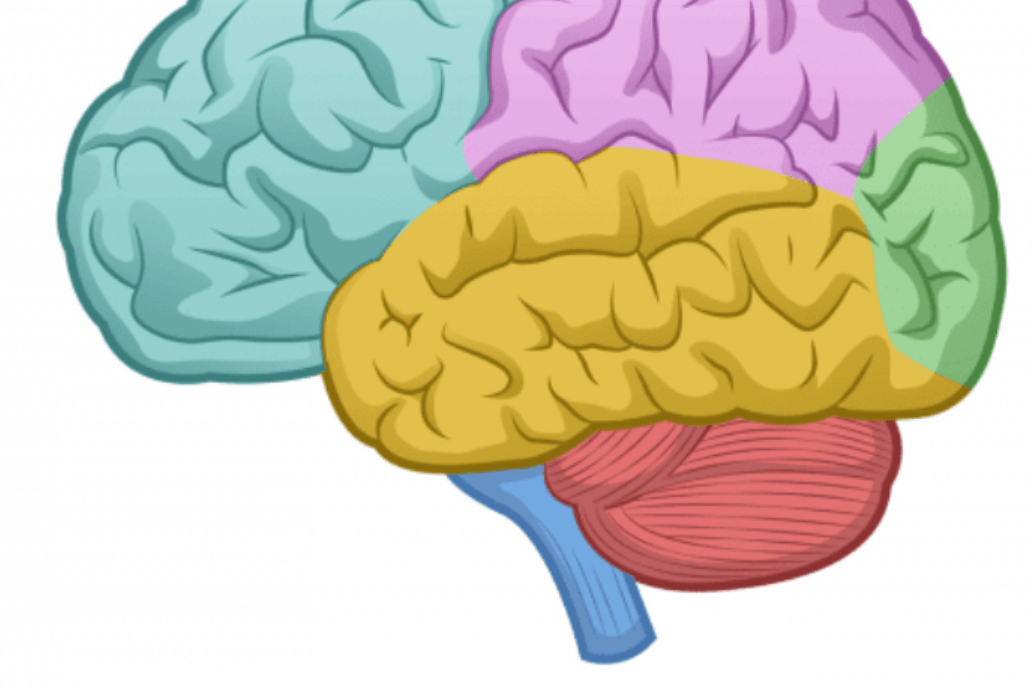
What structure is bright blue and located at bottom of the brain and controls the information sent between brain and rest of the body?
Cerebrum
Cerebellum
Brain Stem
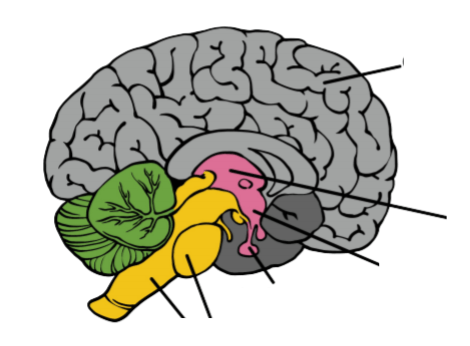
What structure is grey in this picture. It controls conscious thought and memory?
Cerebrum
Cerebellum
Brain Stem
What is the gap between two neurons called?
Impulse
Synapse
CNS
Inter neuron
Which statement best describes a reflex arc?
Slow response that you have to think about
Rapid response to protect body from harm

Where would the nerve impulse start in this reflex arc?
A
C
D
E

_____ neurons carry messages away from the central nervous system and out to muscles or glands. The RED neuron in diagram.
sensory
motor
inter
central
Which way does an impulse travel
From dendrite to axon and out axon terminal
From axon to axon and out dendrite terminal
From axon to dendrite and out axon terminal
From cell body to dendrite and out axon terminal
__________ carry messages between sensory neurons and motor neurons.
Active Neurons
Interneurons
Refraction Neurons
Flower Neurons


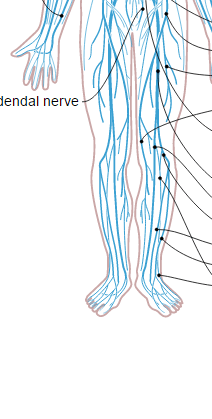
The part of the PNS that controls involuntary actions
autonomic nervous system
somatic nervous system
organic nervous system
reflexive nervous system
What are the main three parts of the brain?
mouth, cerebrum, cerebellum
cerebrum, cerebellum, brain stem
eyes, nose, mouth
ears, temporal lobe, frontal lobe
Which part of the brain is responsible for processing visual information?
Cerebellum
Brain stem
Occipital lobe
Frontal lobe
What function does the frontal lobe of the brain serve?
Balance and coordination
Memory and retrieval
Control emotion and reasoning
Hearing and language
Where is the cerebellum located in the human brain?
Below the cerebrum at the back of the skull
At the top of the head
At the lose in the skull near the spine
In front of the brain, behind the forehead
what are the main lobes in the brain?
Frontal lobe, parietal lobe, cerebellum, brain stem
Parietal lobe, occipital lobe, thalamus, amygdala
which lobe processes language?
which lobe enables language(makes you speak)?
which lobe allows us to understand images?
which lobe allows us to understand spatial recognition?
a friend of mine is speaking french but I do not know french, which lobe allows me to hear the language?
I am working at solving a math problem. which lobe is working?
I am a shy person and I behave in a shy way. Which lobe is working?
I am planning the sequence of steps in a project. Which lobe is working?
I am trying to recall a recent event. Which lobe is working?
Brenda is a very creative person. Which part of her brain determines her creativity?
Jackson works very well on solving puzzle and educational games. Which SIDE of the brain is aware of logical tasks?
Sabrina is awesome on walking on the balance beam. Which part of the brain helps her?
I burn my hand and I feel heat. What part of the brain helps with this?
Parietal lobe
which part of the temporal lobe makes us feel feelings?
which part of the temporal lobe allows us to save short term information?


Which part of the brain regulates and controls the autonomic nervous system, temperature, appetite, water balance, sleep, and blood vessel constriction and dilation. It is also involved in emotions like anger, fear, pleasure, pain, and affection.
Hippocampus
Hypothalamus
Olfactory bulb
Thalamus
Which part of the brain is the relay center and directs sensory impulses to the cerebrum. It also controls conscious recognition of pain and temperature.
Hippocampus
Hypothalamus
Olfactory bulb
Thalamus
Which part of the brain is responsible for muscle coordination, balance, posture and muscle tone.
Cerebellum
Medulla
Midbrain
Pons

Which two parts control the amount of light entering your eye?
lens and cornea
cornea and pupil
pupil and iris
retina and optic nerve

Which two parts refract light entering your eye?
lens and cornea
cornea and pupil
pupil and iris
retina and optic nerve

Which eye part contains rods and cones to help us see in dim light and color?
Sclera
Lens
Cornea
Retina

Which pupil represents someone who is in a dim or dark setting?
A
B


What am I? I am part of the eye ... I am transparent jelly like substance which supports the back of the eye ... select the correct answer.
cillary muscle
choroid
vitreous humour
retina
yellow spot/fovea
What am I? I am part of the eye ... I am the inner light sensitive layer that contains rods cells that work in dim light and cone cells that detect colour and detail ... select the correct answer.
cillary muscle
choroid
vitreous humour
retina
yellow spot/fovea
What am I? I am part of the eye ... I can change shape to focus light onto the retina ... select the correct answer.
conjunctiva
lens
aqueous humour
retina
sclerotic
What am I? I am part of the eye ... I am the tough, white, protective layer of the eye ... select the correct answer.
conjunctiva
lens
aqueous humour
retina
sclerotic

What is letter B pointing to?
Optic Nerve
Retina
Iris
Pupil

What is letter F pointing to?
Lens
Iris
Pupil
Optic Nerve
The path light takes through the eye....
Cornea, Retina, Optic Nerve, Iris, Pupil, Lens
Cornea, Iris, Optic Nerve, Pupil, Lens, Retina
Cornea, Iris, Pupil, Lens, Optic Nerve, Retina
Cornea, Iris, Pupil, Lens, Retina, Optic Nerve,

From left to right, what are the following parts of the cow eye?
retina, sclera + tapetum + choroid, iris, cornea, vitreous humor, lens
lens + tapetum + retina, iris, cornea, vitreous humor, sclera
vitreous humor, iris + tapetum + choroid, sclera, cornea, retina, lens
iris, sclera + choroid, retina, cornea, aqueous humor, lens

