
Font size
 Worksheets
Day #103 Waves Test Review
Total questions: 102
Worksheet time: 3hrs 0mins

What is the rate of acceleration of the object between 0 and 4 seconds?
1 m/s
0 m/s2
-1 m/s2
1 m/s2
A skater increases her speed uniformly from 2.0 meters per second to 8.0 meters per second over a distance of 12 meters. The magnitude of her acceleration as she travels this 12 meters is
3.8 m/s2
2.2 m/s2
1.9 m/s2
2.5 m/s2
A basketball player jumped straight up to grab a rebound. If she was in the air for 0.80 second, how high did she jump?
3.1 m
0.78 m
1.2 m
0.50 m
After a model rocket reached its maximum height, it then took 5.0 seconds to return to the launch site. What is the approximate maximum height reached by the rocket? [Neglect air resistance.]
250 m
98 m
49 m
120 m
A ball dropped from rest falls freely until it hits the ground with a speed of 20 meters per second. What is the approximate time during which the ball is in free fall?
1 s
10 s
2 s
0.5 s
A ball is thrown horizontally from the top of a building with an initial velocity of 15 meters per second. At the same instant, a second ball is dropped from the top of the building. The two balls have the same
initial horizontal velocity
final velocity as they reach the ground
path as they fall
initial vertical velocity
A ball is thrown at an angle of 45o to the horizontal. What happens to the magnitude of the ball's vertical acceleration during the total time interval that the ball is in the air?
It increases, then decreases
It decreases, then remains the same
It decreases, then increases
It remains the same
The path of a projectile fired at a 30o angle to the horizontal is best described as
circular
hyperbolic
parabolic
linear
A projectile is launched with an initial velocity of 200 meters per second at an angle of 30 degrees above the horizontal. What is the magnitude of the vertical component of the projectile's initial velocity?
200 s m×cos 30°
cos 30°200 sm
200 s m×sin 30°
sin 30°200 sm
A football player kicks a ball with an initial velocity of 25 meters per second at an angle of 53o above the horizontal. What is the vertical component of the initial velocity of the ball?
10 m/s
20 m/s
15 m/s
25 m/s

The diagram below shows a golf ball being struck by a club. The ball leaves the club with a speed of 40. meters per second at an angle of 60.o with the horizontal. If the ball strikes the ground 7.1 seconds later, how far from the golfer does the ball land? [Assume level ground and neglect air resistance.]
280 m
71 m
35 m
140 m

A ball is thrown horizontally with an initial velocity of 20.0 meters per second from the top of a tower 60.0 meters high. What is the initial vertical velocity of the ball?
0 m/s
60.0 m/s
20.0 m/s
9.81 m/s
A ball is thrown horizontally with an initial velocity of 20.0 meters per second from the top of a tower 60.0 meters high. What is the approximate total time required for the ball to reach the ground? [Neglect air resistance.]
12.2 s
2.04 s
3.50 s
3.00 s
A ball is thrown horizontally with an initial velocity of 20.0 meters per second from the top of a tower 60.0 meters high. What is the horizontal velocity of the ball just before it reaches the ground? [Neglect air resistance.]
68.6 m/s
34.3 m/s
20.0 m/s
9.81 m/s
A rock falls from rest off a high cliff. How far has the rock fallen when its speed is 39.2 meters per second? [Neglect friction.]
123 m
44.1 m
78.3 m
19.6 m
A hiker travels 1.0 kilometer south, turns and travels
3.0 kilometers west, and then turns and travels 3.0 kilometers north. What is the total distance traveled by the hiker?
7.0 km
5.0 km
3.2 km
3.6 km
Which graph represents an object moving at a constant speed for the entire time interval?


The graph represents the displacement of an object
moving in a straight line as a function of time. What was the total distance traveled by the object during the 10.0-second time interval?
0 m
16 m
24 m
8 m
Which pair of graphs represent the same motion?


The graph represents the relationship between distance and time for an object in motion. During which interval is the speed of the object changing?
AB
BC
CD
DE
Which terms both represent scalar quantities?
distance and displacement
displacement and speed
displacement and velocity
distance and speed

The graph shows the relationship between speed and elapsed time for a car moving in a straight line.
Based on the graph shown, calculate the total distance the car traveled during the time interval 4.0 seconds to 8.0 seconds.
30 m
40 m
20 m
96 m






A leftward force is applied to a crate to push it across the floor at a constant speed. Which is the correct force diagram?


A rightward force is applied to a dresser to accelerate it to the right across the bedroom floor.


A push/pull exerted on an object is called
Force
Momentum
Speed
Net force
The sum of all forces acting on an object and direction is called the
Balanced Force
Net Force
Unbalanced Force
Contact Force
Units of momentum (p)
kg m/s
kg
m/s
Ns
A purple ball and a gold ball each weigh 9.5 lbs. If the purple ball is moving at a velocity of 20 m/s, and the gold ball is moving at a velocity of 100 m/s, which ball has more momentum?
purple
gold
their momentums are equal
Your buddy Rich throws you a frisbee. It flies toward you at a speed of 22 m/s. If you use 8.8 N of force to complete the catch over a time interval of 1.0 seconds, what is the frisbee's mass?
0.4 kg
0.05 kg
2.2 kg
4.4 kg

The pendulum in the image above has a mass of 1 kg and is dropped from a height of 0.5 m. How much kinetic energy does it have at B?
0.5 J
4.9 J
9.8 J
1.0 J

What type of wave is light?
electromagnetic
mechanical

amplitude
100 N 230 N
<------ --------->



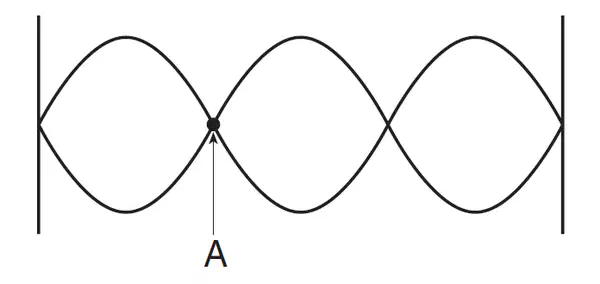
This type of wave, with both the top and bottom at the same time, is called:
Periodic
Standing Wave
Wave Pulse
Longitudinal Wave
For a sound wave, the volume (loudness) of the sound is dependent on the:
Amplitude
Period
Frequency
Wavelength

The frequency (color) of the light bulb changes as it moves away from one person and toward another. The reason this happens is because of
interference
superposition
the doppler effect
frequency

The student with the slinky is demonstrating how to create
a wave pulse
a transverse wave
a longitudinal wave
a wave front

The two waves on top are in superposition. The result of both waves coming together is shown by the dark blue wave below. This phenomena where waves can add together or cancel out is called
the doppler effect
diffraction
in-phase
interference

The period of this wave is exactly
1/4 s
2 s
1/2 s
4 s

These waves canceling out is an example of
the doppler effect
pulse
destructive interference
constructive interference

The images above is a wave diagram showing
Amplitude
Constructive Interference
Change in frequency
In-phase waves
If i multiply the frequency of a wave with its wavelength, that would equal
speed
period
medium
amplitude
Which ray diagram best illustrates refraction?

A

B

C

D
A beam of monochromatic red light passes obliquely from air into water. Which characteristic of the light does not change?
Direction
Velocity
Frequency
Wavelength
The speed of light in corn oil is the same as the speed of light in
Diamond
Flint Glass
Air
Glycerol
In which medium is the wavelength of red light the shortest?
Flint Glass
Crown Glass
Diamond
Zircon
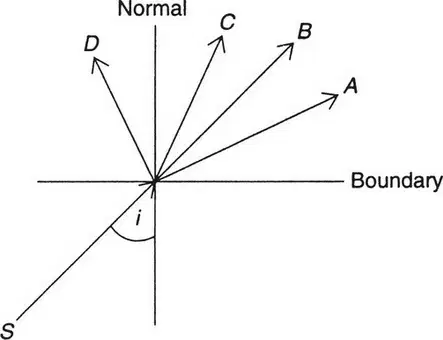
Which ray best represents Ray S as it travels from water and refracts into air.
A
B
C
D
When a light wave enters a new medium and is refracted, there must be a change in the light
Color
Frequency
Period
Speed
The speed of light in a piece of plastic is 2.00×10⁸ meters per second. What is the absolute index of refraction of this plastic?
1.00
0.67
1.33
1.50
Wave X travels eastward with frequency f and amplitude A. Wave Y, traveling in the same medium, interacts with wave X and produces a standing wave. Which statement about wave Y is correct?
Wave Y must have a frequency of f, an amplitude of A, and be traveling eastward.
Wave Y must have a frequency of 3f, an amplitude of 2A, and be traveling westward.
Wave Y must have a frequency of 2f, an amplitude of 3A, and be traveling eastward.
Wave Y must have a frequency of f, an amplitude of A, and be traveling westward.
Which arrow best represents the path that a monochromatic ray of light travels as it passes through air, corn oil, glycerol and back into air?

A

B

C

D
What occurs when light passes from water into flint glass?
Its speed decreases, its wavelength becomes shorter, and its frequency remains the same.
Its speed decreases, its wavelength becomes shorter, and its frequency increases.
Its speed increases, its wavelength becomes longer, and its frequency remains the same.
Its speed increases, its wavelength becomes longer, and its frequency decreases.
What is the speed of light (f=5.09×10¹⁴ Hz) in flint glass?
1.81×10⁸ sm
1.97×10⁸ sm
3.00×10⁸ sm
4.98×10⁸ sm

A ray of light (f=5.09×10¹⁴ Hz) traveling in air is incident at an angle of 40° on an air-crown glass interface as shown to the left. What is the angle of refraction for this light ray?
25°
37°
40°
78°
Compared to the speed of a sound wave in air, the speed of a radio wave in air is
Less
Greater
The same
If the amplitude of a wave is increased, the frequency of the wave will
Decrease
Increase
Remain the same
Sound waves strike a glass and cause it to shatter. This phenomenon illustrates
Resonance
Refraction
Reflection
Diffraction
A ray of monochromatic light, having a frequency of 5.09×10¹⁴ Hz , is traveling in air. What is the wavelength of the ray after it enters a block Zircon?
5.89×10⁻⁷ m
6.24×10⁻⁶ m
1.13×10⁻⁶ m
3.07×10⁻⁷ m
The unit of energy is?
Amp
Joule
kiloWatt
Volt
Calculate the voltage applied when a 60 watt light-bulb uses a current of 5 amps
300 volts
30 volts
12 volts
0.08 volts
Calculate the power generated as a 20 A current flows through a 10Ω resistor?
2 W
200 W
4000 W
400 W

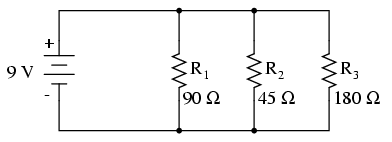
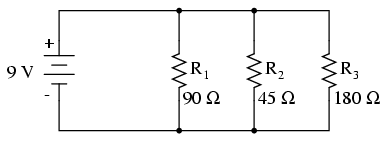
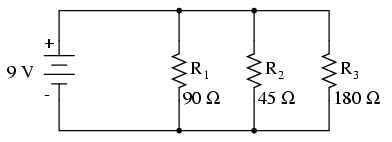


What is the total resistance of the circuit shown above?
25 Ω
40 Ω
20.2 Ω
2.5 Ω

