
Font size
 Worksheets
Neurophysiology Review
Total questions: 75
Worksheet time: 59mins
What is the role of the sodium-potassium pump in neuron function?
It decreases the membrane potential
It makes the neuron membrane impermeable to ions
It balances the concentration of sodium and potassium inside and outside the neuron
It uses ATP to transport sodium and potassium ions across the neuron membrane

At which point on the diagram does depolarization of the axon occur?
When a neuron is in it's resting state, the inside of the axon has a relatively ____________ charge compared with outside
positive
negative

Which ion is found in a higher concentration inside a neuron than outside?
Sodium
Potassium
Chloride
What biomolecule forms the ion channels and pumps in the cell membrane?
carbohydrates
proteins
hydrophilic heads
lipids
True or False: Potassium and sodium cannot freely enter and leave the cell because their movement is tightly regulated by membrane channels and pumps.
True
False
The sodium-potassium "pump" moves:
sodium & potassium ions into the cell
sodium & potassium ions out of the cell
sodium ions into the cell & potassium ions out of the cell
sodium ions out of the cell & potassium ions into the cell
Which term is used to describe channels that open in response to a change in membrane potential?
leakage channels
ligand-gated channels
voltage-gated channels
When a neuron has not been activated, it is resting, the membrane is said to be...
polarized
depolarized
hyperpolarized
At which point on the diagram does depolarization of the axon occur?
When are the potassium channels open?
during rest only
during repolarization only
during depolarization only
all the time
Action potentials run along the ______ from ______ to ________.
axon, dendrites, axon terminals
axon, axon terminals, dendrites
dendrites, axon, axon terminals
axon terminals, axon, dendrites


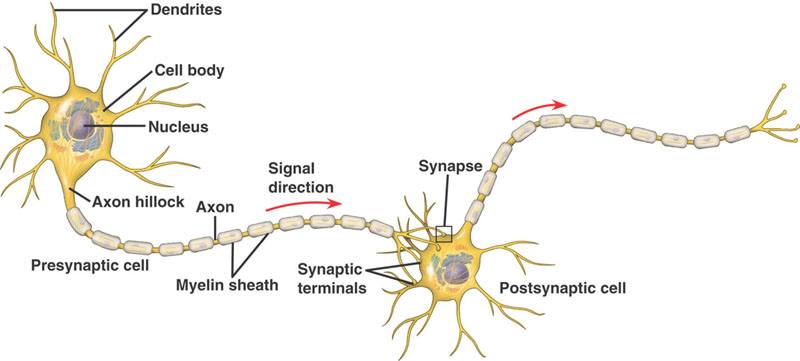
What type of neuron is this?
Motor
Sensory
Relay
It allows sodium to rush into the cell to start another action potential immediately.
It ensures the neuron resets and prevents immediate re-firing, allowing signals to travel in one direction.
It causes continuous firing of the neuron without rest.
At what stages do Sodium and Potassium Voltage Channels open?

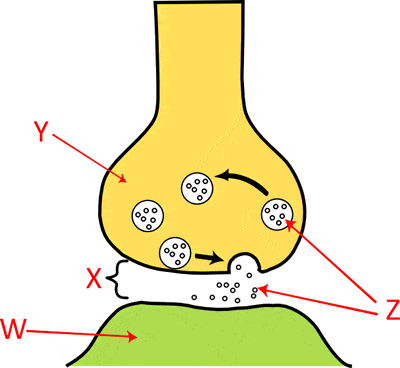
Axon Terminal

Axon Terminal
neurotransmitter
presynaptic axon terminal
Postsynaptic dendrite
vesicle
Receptor
Neurotransmitters are released from the
Dendrites
Post-synaptic neuron
Presynaptic neuron
Schwann Cells
X
Axon Terminal Button
Neurotransmitters
Dendrite
Synapse
Z
Axon Terminal
Neurotransmitters
Dendrite
Synapse

What chemical is activated by the action potential in the presynaptic neuron that causes the vesicles containing neurotranmitters to move toward the synaptic cleft?
calcium
potassium
sodium
phosphorus
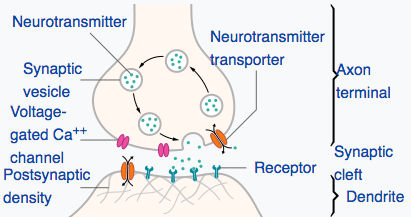
What is the response in the postsynaptic cell once the neurotransmitter has bound to it?
In opens the Na+ gated channels and Na+ rush in
It opens the Ca2+ gated channels and Ca2+ rush in
It closes the K+ channels creating a resting potential
It releases its own neurotransmitter into the synaptic cleft

What happens in an axon terminal when an action potential arrives at the presynaptic membrane?
sodium ions diffuse in
sodium ions diffuse out
calcium ions diffuse in
calcium ions diffuse out

How does neurotransmitter cross the synaptic cleft?
exocytosis
simple diffusion
carrier mediated transport
osmosis
The structure within the presynaptic neuron's axon terminal that contains neurotransmitter waiting to be released:
chemical synapse
synaptic vesicle
postsynaptic neuron
synaptic neuron

What part of the neuron receives incoming messages from other cells?
nucleus
cell body
dendrites
synaptic terminals

What structure(s) aid in speeding up synaptic transmission across the axon?
Nodes of Ranvier
dendrites
myelin sheath
both Nodes of Ranvier and the myelin sheath
What type of ion channels open at the axon terminal of the presynaptic neuron?
Potassium (K)
Sodium (Na)
Calcium (Ca)
Magnesium (Mg)
What holds the neurotransmitter before it binds to the cell membrane on the axon terminal?
Vacuoles
Vesicles
Vehicles
Ventricles
What role does Ca+2 influx play in the presynaptic terminal?
causes vesicles to bind to the cell membrane and release neurotransmitter
causes vesicles to bind to the cell membrane and release Na+
causes vesicles to bind to the cell membrane and release K+
causes vesicles to bind to the cell membrane and absorb neurotransmitter
What type of channel opens due to the neurotransmitter?
Leakage
Voltage- gated
Chemical ligand-gated
What opens ligand-gated channels?
neurotransmitter
calcium rushing in
sodium rushing in
potassium rushing out
Which of the following ions have an INWARD concentration gradient rather than outward? (Assuming that the ion’s respective channels are opened) (SELECT ALL THAT APPLY)
Sodium (Na+)
Potassium (K+)
Calcium (Ca2+)
Chloride (Cl-)
When K+ is diffusing out...
the membrane potential increases
the membrane potential decreases
All action potentials start at:
threshold
hyperpolarization
repolarization
When Na+ is diffusing IN
resting potential
depolarization
action potential
repolarization
When K+ is diffusing OUT
resting potential
depolarization
action potential
repolarization
The peak change in membrane potential
resting potential
depolarization
action potential
repolarization
a reversal of charge from -55mV to +30mV
resting potential
depolarization
action potential
repolarization
specifically -70 mV
resting potential
depolarization
action potential
repolarization
refractory period

The picture shows....
resting potential
depolarization
action potential
repolarization
refractory period

The picture shows....
resting potential
depolarization
action potential
repolarization
refractory period

The picture shows....
resting potential
depolarization
action potential
repolarization
refractory period

The picture shows....
resting potential
depolarization
action potential
repolarization
refractory period
Stronger stimuli result in
stronger action potentials
more frequent action potentials
The difference b/t electrical potential between the inside and outside of a biological cell
voltage
amperage
charge
membrane potential
Where is the charge -70 mv at rest?
Inside the axon
Outside the axon
Extracellular fluid
Synaptic cleft
Which of the following is the most permeable?
Na+
A-
K+
Cl-
When a potassium voltage channel opens- which way will potassium move?
In
Out
When a sodium voltage channel opens- which way will sodium move?
In
Out
The operation of the sodium-potassium "pump" moves:
sodium & potassium ions into the cell
sodium & potassium ions out of the cell
sodium ions out of the cell & potassium ions into the cell
sodium ions into the cell & potassium ions out of the cell
Which of the following requires energy because it moves against the gradient?
Voltage channels
Ligan channels
Na/K pump
Leak

