wayground logo

Free Printable Worksheets

NEW

Font size

S
M
L
XL
Worksheets

DNA Structure and Replication

Total questions: 55

Worksheet time: 29mins

Name
Class
Date
1.
Which sequence of DNA bases would pair with this partial strand
ATG TGA CAG
a)
ATG TGA CAG
b)
TAC ACT GTC
c)
GTA AGT GAC
d)
CAT TCA CTG
2.
Which of the following best describes a DNA molecule?
a)
double helix
b)
contains ribose
c)
made of amino acids
d)
contains Uracil
3.
Which of the following units are repeatedly joined together to form a strand of DNA?
a)
amino acids
b)
nucleotides
c)
fatty acids
d)
polysaccharides
4.
In a molecule of double-stranded DNA, the amount of Adenine present is always equal to the amount of
a)
cytosine
b)
guanine
c)
thymine
d)
uracil
5.
Adenine bonds with ______________.
a)
Guanine
b)
Thymine
c)
Cytosine
d)
Adenine
6.
Why is DNA important?
a)
it is very small and very complicated
b)
it's in everything
c)
it serves as the blueprint for traits of all living things
d)
because we eat it every day for energy
7.
What determines the code, or information, of a DNA molecule?
a)
the shape (structure) of the nitrogen bases
b)
the order (sequence) of the nitrogen bases
c)
the color of the nitrogen bases
d)
the frequency (number) of nitrogen bases
8.
Which 2 molecules form the sides (backbone) of the DNA ladder?
a)
deoxyribose sugar and adenine
b)
deoxyribose sugar and a hydrogen bond
c)
deoxyribose sugar and the nucleus
d)
deoxyribose sugar and phosphate
9.
Which organelle is DNA usually found in?
a)
cell membrane
b)
vacuole
c)
chloroplast
d)
nucleus
10.
Nitrogenous bases are joined by which type of bond?
a)
polar bonds
b)
ionic bonds
c)
covalent bonds
d)
hydrogen bonds
11.
Replicate the following strand of DNA: 
AATCATGGA
a)
AATCATGGA
b)
TTAGTACCT
c)
UUAGUACCU
d)
GGATAUCUA
12.
DNA replication results in two DNA molecules,
a)
each one with two original strands
b)
each one with two new strands
c)
each one with one new strand and one original strand
d)
one with two new strands and the other with two original strands
13.
order of replication
a)
3, 2, 1, 4
b)
2, 1, 4, 3
c)
2, 3, 1, 4
d)
3, 4, 1, 2
14.
A process in which DNA has the unique ability to make an exact copy of itself.
a)
Replication
b)
Translation
c)
Transcription
15.
What are the three components of a nucleotide?
a)
sugar, hydrogen, nitrogen base
b)
sugar, oxygen, nitrogen base
c)
sugar, phosphate, nitrogen base
d)
sugar, phosphate, protein
16.
Adenine bonds with ______________.
a)
Guanine
b)
Thymine
c)
Cytosine
d)
Adenine
17.
Which 2 molecules form the sides (backbone) of the DNA ladder?
a)
deoxyribose sugar and adenine
b)
deoxyribose sugar and a hydrogen bond
c)
deoxyribose sugar and the nucleus
d)
deoxyribose sugar and phosphate
18.
Nitrogenous bases are joined by which type of bond?
a)
polar bonds
b)
ionic bonds
c)
covalent bonds
d)
hydrogen bonds
19.
The enzyme that unzips the DNA to prepare for replication
a)
helicase
b)
replicase
c)
polymerase
d)
synthase
20.
Which of the following units are repeatedly joined together to form a strand of DNA?
a)
amino acids
b)
nucleotides
c)
fatty acids
d)
polysaccharides
21.
What are the nucleotides made of?
a)
Sugar, Phosphate, nitrogen base
b)
Phosphate, Adenine, nitrogen base
c)
Thymine, Adenine, Cytomine
d)
Phosphate, Nitrogen, Adenine
22.
If the percentage of DNA is made of 30% Thymine, what is the correct percentage of Guanine?
a)
30
b)
15
c)
20
d)
60
23.
What is the sugar in the DNA molecule?
a)
deoxyribose
b)
ribose
c)
glucose
d)
fructose
24.
Which enzyme is responsible for adding nucleotides?
a)
Topoisomerase
b)
DNA Polymerase
c)
Ligase
d)
Primase
25.
A monomer of DNA is called a(n)
a)
Monosaccharide
b)
Amino Acid
c)
Triglyceride
d)
Nucleotide
26.
The concept that DNA is made of two strands running in opposite directions is called:
a)
Antiparallel
b)
Isomerism
c)
Enantiomerism
d)
S/R Chirality
27.
The "Double Helix Model" of DNA was proposed by:
a)
Watson & Crick
b)
Meselson & Stahl
c)
Beadle & Tatum
d)
Gosling & Watkins
28.
X-Ray diffraction pictures of DNA that suggested a helical shape were taken by:
a)
Watson & Crick
b)
Meselson & Stahl
c)
Beadle & Tatum
d)
Gosling & Franklin
29.
Who's work concluded that the %A=%T  and %G=%C
a)
Chargaff
b)
Meischer
c)
Levene
d)
Hammerling
30.
The term used to describe DNA Replication is:
a)
Semi-Conservative
b)
Conservative
c)
AntiParallel
d)
Dispersive
31.
The term used to describe DNA Replication is:
a)
Semi-Conservative
b)
Conservative
c)
AntiParallel
d)
Dispersive
32.
What determines the code, or information, of a DNA molecule?
a)
the shape (structure) of the nitrogen bases
b)
the order (sequence) of the nitrogen bases
c)
the color of the nitrogen bases
d)
the frequency (number) of nitrogen bases
33.

______ is created in DNA when helicase unzips the two strands.

a)

Replication spoon

b)

Replication fork

c)

Antiparallel strands

d)

DNA fragments

34.
From the nucleotide on the right, which part is labeled 2?
a)
Sugar
b)
Phosphate
c)
Nitrogenous Base
d)
Phosphorous
35.
The backbone of DNA is made up of _______ & ________ units. 
a)
sugar & base
b)
sugar & phosphate
c)
base & phosphate
d)
phosphate & phosphate
36.

What is the function of nucleic acids?

a)

store energy (long-term)

b)

store energy (short-term)

c)

build skin, hair, nails, muscles

d)

store genetic information

37.

Which enzyme proofreads daughter DNA for errors?

a)

DNA helicase

b)

DNA polymerase

c)

DNA ligase

38.

Which enzyme acts like glue during DNA replication?

a)

DNA ligase

b)

DNA helicase

c)

DNA polymerase

39.
What is the correct order of steps for DNA replication?
a)
Unwind, unzip, bring in new nucleotides, wind back up
b)
Unzip, unwind, bring in new nucleotides, wind back up
c)
Wind back up, unzip, unwind, bring in new nucleotides
d)
Bring in new nucleotides, unwind, unzip, wind back up
40.
What does the DNA helicase do during replication?
a)
It builds the new DNA strand
b)
Glues the Okazaki fragments together
c)
Unwinds and unzips the DNA
d)
Sets the RNA primer for DNA polymerase
41.
What does DNA polymerase do during replication?
a)
It builds the new DNA strand
b)
Unwinds and unzips the DNA
c)
Glues the Okazaki fragments together
d)
Sets the RNA primer for DNA helicase
42.
What is the goal of DNA replication? (choose the most accurate answer)
a)
To destroy the DNA molecule
b)
To make a new copy of DNA from an existing strand of DNA
c)
To make a totally new DNA molecule from nothing
d)
To copy the DNA into RNA
43.
What is the complementary DNA strand to the following strand; ACT?
a)
TGA
b)
GTC
c)
ATC
d)
CAG
44.
What are sections of DNA that hold instructions on how to build proteins called?
a)
Chromosomes
b)
Centromere
c)
Nucleus
d)
Gene
45.
What is the name of the sugar found in DNA?
a)
Deoxyribose
b)
Oxyclean
c)
Glucose
d)
Ribose
46.
What do we call a protein that helps biological processes happen?
a)
Sugars
b)
Carbohydrates
c)
Enzymes
d)
Nucleic Acids
47.
Which enzyme proofreads the new DNA strand during replication?
a)
DNA Polymerase
b)
DNA Helicase
c)
DNA Ligase
d)
DNA Primase
48.
What does it mean to say DNA replication is "semi-conservative?"
a)
A new strand is built from an original strand
b)
A new strand is built from nothing
49.
Why is it important that when DNA is copied, it makes an exact copy?
a)
If not, then there will be different instructions passed on to the new cell
b)
It's not important
c)
It's not important because the cell will just figure it out
50.

Why is DNA important?

a)

it is very small and very complicated

b)

it's in everything

c)

it serves as the blueprint for making proteins in living organisms

d)

because we eat it every day for energy

51.

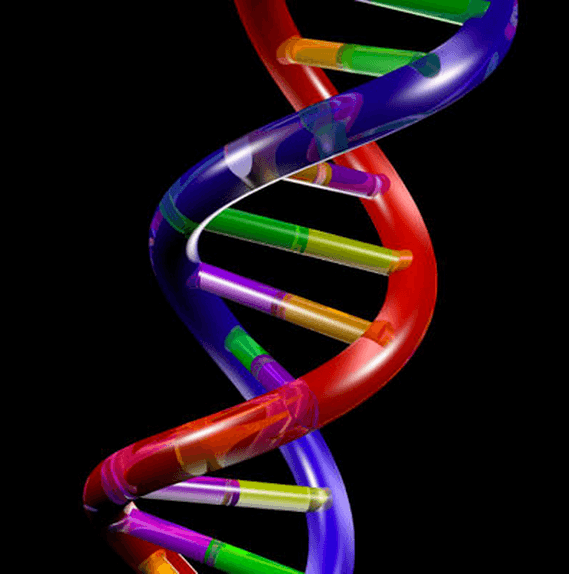
Name this structure

a)

double helix

b)

nucelotide

c)

twisted ladder

d)

hydrogen bond

52.
Which of the following best describes a DNA molecule?
a)
double helix
b)
contains ribose
c)
made of amino acids
d)
contains Uracil
53.
Which organelle is DNA usually found in?
a)
cell membrane
b)
vacuole
c)
chloroplast
d)
nucleus
54.

The goal of DNA replication is

a)

to make proteins in the cell

b)

to divide cells

c)

to make an identical copy of DNA

d)

to fix mistakes in the DNA

55.

Describe the 2 DNA molecules produced during DNA replication.

a)

There is one old molecule and one new molecule.

b)

Each molecule has an original side and a new side.

c)

Both molecules of DNA are different than one another.