
Font size
 Worksheets
Purpose of the Analyze Phase
Total questions: 36
Worksheet time: 18mins
The purpose of the Analyze Step of the problem-solving process is to:
Identify the problem
Gather information
Develop solutions
Find the root cause of the problem
What is a Root Cause Hypothesis Statement?
A detailed analysis of a problem
An educated guess about the suspected cause of the problem
A solution to the problem
A summary of the problem
What does FMEA stand for?
Failure Mode and Effects Analysis
Failure Management and Evaluation Analysis
Fault Management and Error Analysis
Failure Mode and Error Assessment
What is the "5 Whys" analysis technique?
A method to find the root cause of an issue by asking 'why' multiple times.
A technique to solve mathematical problems.
A way to improve communication skills.
A strategy for time management
A Fishbone Diagram is used for:
Identifying the root causes of a problem
Measuring the performance of a team
Tracking the progress of a project
Analyzing financial data
What does a significant correlation between X and Y mean?
X causes Y
Y causes X
They move together
X and Y are unrelated

Which of the following might be true if X and Y are correlated?
X causes Y
Y causes X
Another variable might be the causal factor
All of the above
Why must assumptions be tested when analyzing X-Y diagrams?
To ensure the accuracy of the analysis
To make the diagram look better
To avoid using any assumptions
To simplify the analysis process
Batch processing is:
a method of processing data in which transactions are collected and processed all at once
a real-time processing method
a method of processing data one at a time
a method of processing data using parallel computing
Which of the following is an example of batch processing?
A person filling out a complete form before passing it on.
A person filling one part of a form on ten forms (batch) before sending it to the next person to fill out another part of the form.
A person working on a single form at a time.
A person completing all steps of a process alone
Bad multitasking is:
The ability to perform multiple tasks efficiently at the same time
The inability to focus on one task due to constant switching between tasks
The skill of managing time effectively while handling various tasks
The practice of completing tasks sequentially without interruption
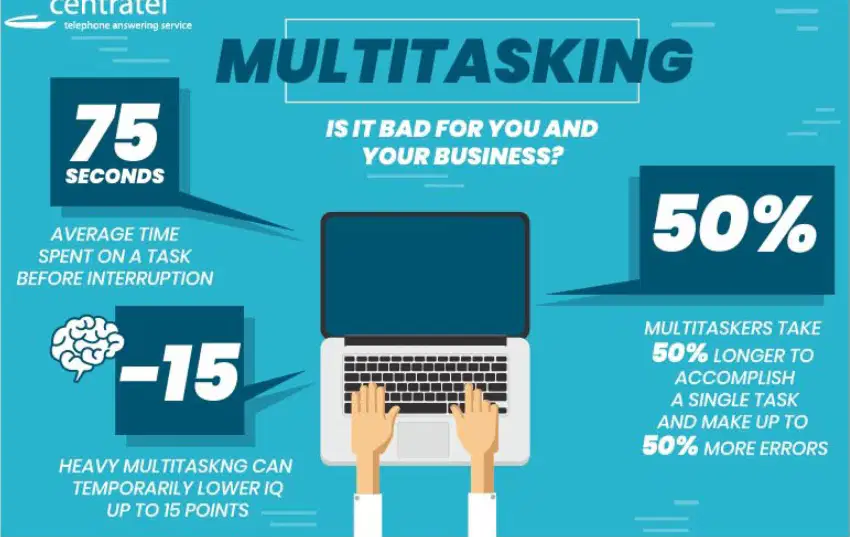
According to the infographic, how much longer do multitaskers take to accomplish a single task?
25% longer
50% longer
75% longer
100% longer
What is one solution to bad multitasking mentioned in the image?
Focus on one task at a time
Use a task management app
Take regular breaks
Prioritize tasks
What is "Slow Changeover"?
The waiting time between the last item produced/performed until the set up for a new item is ready to be produced/performed.
The time taken to produce a new item after the last one.
The process of speeding up production.
The time taken to change a machine's settings.
An example of 'Slow Changeover' is the time between operations in a hospital.
Time between patient check-ins
Time between operations
Time between doctor consultations
Time between hospital shifts
What is the solution to 'Slow Changeover'?
Quick changeover process (Single Minute Exchange of Die)
Lean manufacturing
Total Quality Management
Just-In-Time production
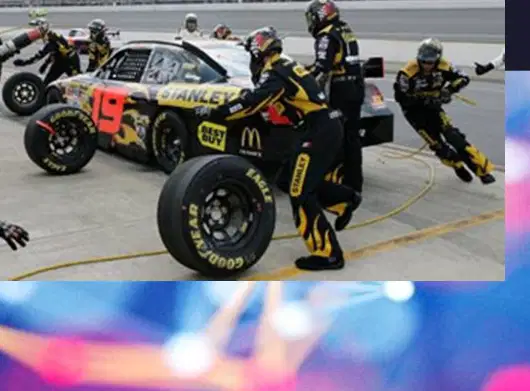
How is the changeover process improved in NASCAR racing?
By reducing pit stop time
By increasing the number of crew members
By using advanced technology
By improving driver skills
What is a Process Map?
A tool to represent steps, inputs, outputs, and decision points of a process.
A tool to measure the efficiency of a process.
A tool to calculate the cost of a process.
A tool to manage human resources.
Fill in the blank: A Process Map is a technique that visually represents the steps, inputs, outputs, and _______ of a process.
decision points
tools
resources
timelines

What does the Value-Added Analysis assess?
Which steps add value in the eyes of the customer
Where time and effort are wasted in the process
Both A and B
None of the above
What is 'Gold Plating' in project management?
Adding extra features to a project that were not planned or approved.
Reducing the scope of a project to save resources.
Completing a project under budget.
Delaying a project to improve quality.

A Gemba Walk is a:
method to observe the actual work process, engage with employees, and explore opportunities for improvement
type of physical exercise
traditional Japanese dance
form of meditation

During a Gemba Walk, leaders aim to:
Observe and understand work processes.
Engage with employees to gather insights.
Identify areas for improvement and waste reduction.
Foster a culture of continuous improvement.
A Gemba Walk involves leaders staying in their offices to manage processes remotely.
True
False

What are Team Norms?
Guidelines that define acceptable behavior for team members
A list of team members and their roles
A schedule of team meetings
A summary of the team's goals
Team Norms are needed because:
They help in setting clear expectations and guidelines for team behavior.
They increase the workload of team members.
They are only necessary for large teams.
They eliminate the need for communication within the team.
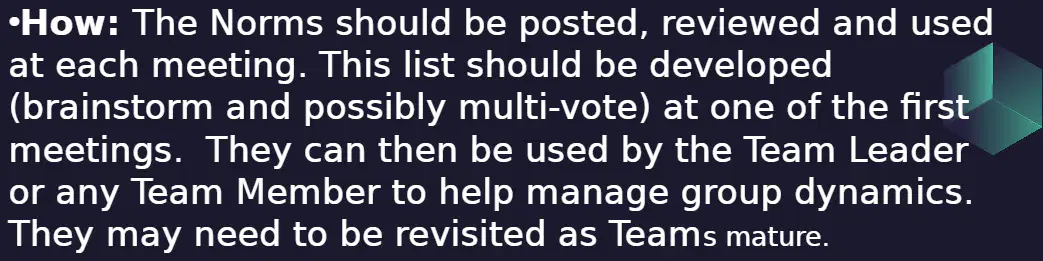
How should Team Norms be implemented?
By setting clear expectations and guidelines
By ignoring team dynamics
By allowing team members to do as they please
By focusing solely on individual goals
The main focus of team members during the forming stage is:
Establishing clear goals and roles
Building trust and relationships
Resolving conflicts
Evaluating team performance
During the forming stage, the atmosphere is usually:
Hostile
Polite and positive
Competitive
Indifferent
In the forming stage, roles, goals, and expectations are clearly defined.
True
False
What is a key characteristic of Stage 2: Storming in team development?
Complete harmony
Conflicts and tensions
Lack of communication
Finalizing roles
Why is Stage 2: Storming important for a team?
It helps in establishing team roles and responsibilities.
It is the stage where team members get to know each other.
It is the stage where conflicts are resolved and team cohesion begins.
It is the final stage of team development.
In the example provided, what causes friction within the group?
Different opinions among members
Lack of communication
Competition for resources
Unclear goals
What is the main focus of Stage 3: Norming in team development?
Team finds common ground and establishes norms.
Team members are in conflict and struggle for power.
Team is forming and getting to know each other.
Team is performing at a high level.
In Stage 3: Norming, what becomes clearer among team members?
Roles and responsibilities become clearer.
Team members become more competitive.
Communication becomes less effective.
Conflict resolution becomes more difficult.
Explain how trust and collaboration change during the Norming stage.
Trust and collaboration decrease as team members become more independent.
Trust and collaboration remain the same as in the previous stage.
Trust and collaboration increase as team members start to work more cohesively.
Trust and collaboration are not relevant in the Norming stage.

