
Font size
 Worksheets
6th Grade Review - Part 1
Total questions: 100
Worksheet time: 54mins
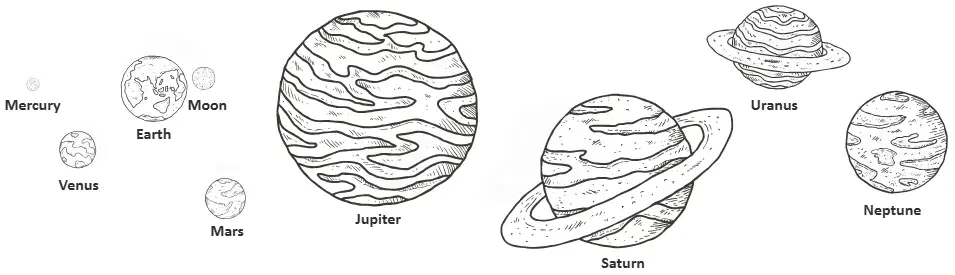
The planets in their relative positions from the sun are -
Mercury, Venus, Earth, Mars, Jupiter, Saturn, Uranus, Neptune
Neptune, Uranus, Saturn, Jupiter, Mars, Earth, Venus, Mercury
Mars, Earth, Venus, Mercury, Jupiter, Saturn, Uranus, Neptune
Venus, Mercury, Earth, Mars, Saturn, Jupiter, Neptune, Uranus
The time it takes an object to go around the sun is called a –
rotation
revolution
spin
turn
The solar system images shown are scaled by mass. Which one has the most gravity?
Earth
Moon
Jupiter
Sun
A scientific article is about a solar system component that is similar to a planet, but is not large enough to clear its orbital region of other objects. What is the article about?
Asteroid Belt
Dwarf Planets
Comets
Kuiper Belt
How are the inner planets similar to each other?
They are smaller than outer planets.
They have rocky surfaces.
They are denser than the outer planets.
They have gassy surfaces.
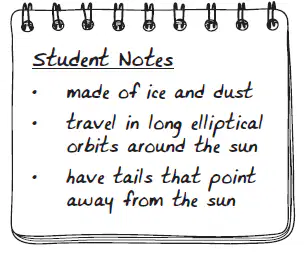
What is the student’s class notes describing?
Comets
Planets
Meteoroids
Moons
The millions of rocky objects revolving around the sun, mostly between Mars and Jupiter, that are too small to be planets are called -
Comets
Asteroids
Meteorites
Stars
In 2006, the International Astronomical Union demoted which planet to dwarf planet status?
Pluto
Mars
Mercury
Ceres
An engineer is designing a new protective gear for astronauts aboard the International Space Station. After building a device, what should the engineer do?
Brainstorm how the device will help the crew
Draw a labeled sketch of the device to gather materials
Test the device to see improvements that could be made
Share the device with the crew to have them use it aboard the ISS
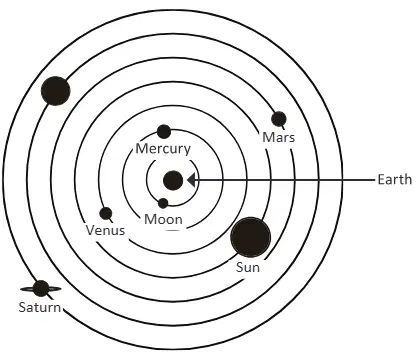
What invention did scientists use to make observations that challenged the model shown?
Computers
The telescope
New Mathematical Physics
Robotic space craft

According to the table, which statement is true?
Mercury’s day is longer than Earth’s day.
Jupiter’s day is longer than Earth’s day.
Both Venus and Saturn have longer days than Earth.
No planet has a longer day than Earth.
Mercury and Venus have a longer year than Earth
A student gathered research from various scientific texts about the diameter of each planet. Which would best display the data the student collected?
Bar graph
Circle graph
Picture graph
Line graph
Which planet is known as the Red Planet?
Neptune
Venus
Jupiter
Mars

The planets are labeled correctly in the image; however, it is not an accurate model of our solar system. Why is the image inaccurate?
The planets are all equally spaced.
Some planets are tilted and others are not.
The planets are round instead of oval.
Jupiter is the largest planet.
What are the four inner planets of our solar system?
Venus, Mars, Earth, Mercury
Venus, Mars, Saturn, Jupiter
Neptune, Uranus, Earth, Mercury
Earth, Mars, Jupiter, Saturn
If Earth began to revolve faster around the sun, then -
Earth would eventually collide with the sun
Earth’s orbit would expand outward
the shape of Earth would become more oval
Earth would likely hit Venus
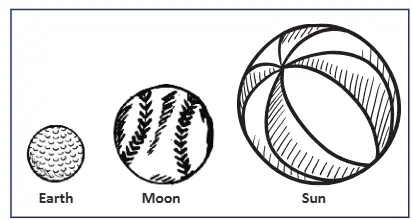
A student made the models shown using a golf ball, softball, and beach ball. How could this model be improved?
Use a flat object, such as a Frisbee, for Earth
Use a marble to represent the moon
Place Earth between the moon and the sun
Equally space the three balls in a straight line across a hula hoop
Which two planets have no moons?
Mercury and Venus
Venus and Neptune
Mercury and Earth
Jupiter and Mars
Place the solar system components in order from largest to smallest.
Sun, Jupiter, Earth, Moon
Jupiter, Sun, Moon, Earth
Earth, Sun, Jupiter, Moon
Moon, Earth, Sun, Jupiter
Which of the following best describes why the moon orbits Earth?
The gravitational attraction between the moon and Earth
The winds generated on Earth by the energy of the sun
The energy reflected from the surface of Earth
The distance the moon and Earth are from the sun
The body at the center of our solar system is -
A black hole named 3C 75
A star named the sun
A moon named Deimos
A planet named Earth

A student examines a labeled model of the solar system. According to the model shown, the planet that will likely move with the greatest velocity is -
Planet A because it is closest to the sun and experiences the strongest gravitational pull from the sun
Planet B because it is the largest planet and experiences the strongest gravitational pull from the sun
Planet F due to its large set of rings
Planet H because it is furthest away from the sun
What would happen to Earth if the sun’s gravitational force suddenly stopped?
Earth’s axis would no longer be tilted.
Earth would revolve faster around the sun.
There would be no change to Earth’s orbit.
Earth would leave its orbit and travel in a straight line.
Besides Earth, humans have also landed on which celestial object?
Venus
The moon
Mars
The asteroid, Ceres
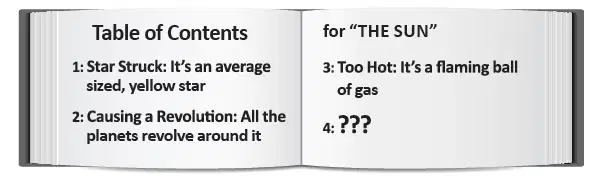
In the library, a student found the book shown titled, “The Sun.” What could be the title to Chapter 4?
Around We Go: It revolves around Earth in a spherical orbit
Rock ‘n Roll: It is also known as a huge space rock or shooting star
Power Up: It provides energy to give Earth light and heat
Level Up: It is mainly made of methane giving it its distinct color
What characteristics describe each solar system component?
Neptune - The hottest planet
Venus - Known for its amazing rings
Saturn - The farthest planet
Jupiter - The biggest planet
How has technology changed our understanding of the solar system?
A heliocentric (sun-centered) view was accepted.
New technologies supported the Earth-centered view.
A conclusion was made that our solar system was the only one in the galaxy.
New planets are named when they are proven to orbit Earth.
The hard, rocky planet that is the smallest and closest to the sun is -
Venus
Neptune
Earth
Mercury
The force of gravity between objects is greatest when -
Masses are small and objects are close together
Masses are small and objects are far apart
Masses are large and objects are close together
Masses are large and objects are far apart
The pattern of day and night is caused by the -
revolution of Earth around the sun
rotation of Earth on its axis in relation to the sun
revolution of the moon around the Earth
rotation of the sun around visible constellations
Which statement is TRUE about the revolution of Earth?
Earth revolves around the sun which creates night and day.
Earth takes 365¼ days to revolve around the sun one time.
Earth completes one full revolution in a 24-hour period.
Earth revolves faster than Mercury around the sun.
Which are factors that cause seasons on Earth?
the tilt of Earth on its axis
the position of the moon from Earth
the angle where sunlight strikes Earth’s surface
the gravitational pull of the moon
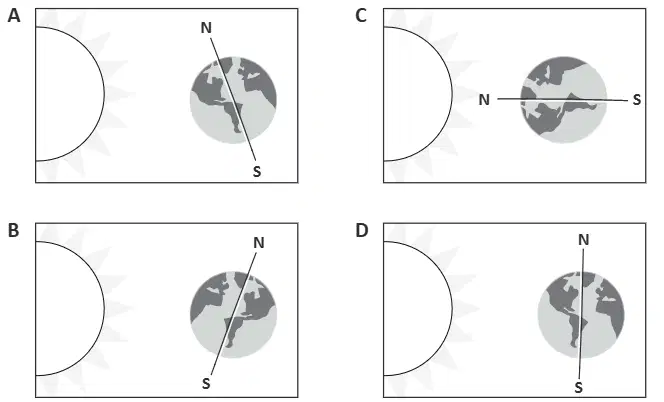
Which figure correctly shows the Northern Hemisphere experiencing summer?
A
B
C
D
The phases of the moon are caused by the –
rotation of Earth on its axis
revolution of Earth around the sun
gravitational pull of the sun
positions of the moon, Earth, and sun
What are characteristics that describe Earth?
Has a rocky surface
Is the 4th planet
from the sun
Has an atmosphere made of nitrogen and oxygen
Has the highest gravity in our solar system
Is a terrestrial planet

In which diagram would Earth experience a spring tide?
Diagram A
Diagram B
Diagram C
Diagram D
What helps shield Earth’s surface from harmful solar radiation?
Nitrogen and oxygen
Water in oceans and ice caps
Atmosphere and magnetic field
Rock surface and orbiting moon
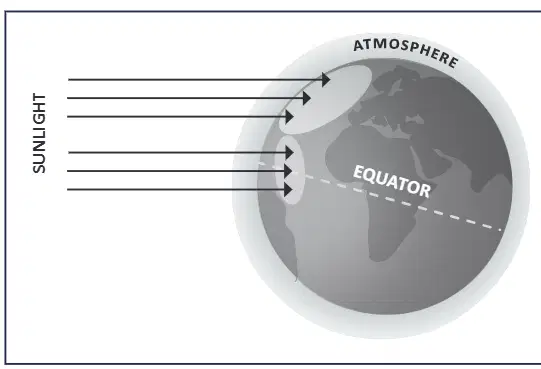
According to the diagram, the equator is the warmest area on Earth because-
there is more water near the equator
the atmosphere is thinner at the equator
it receives the most direct sunlight
it receives the most indirect sunlight
The moon phases are –
shadows when the moon blocks the sun’s light
the appearances of the moon from Earth
reflections of hot gassy craters on the moon’s surface
four periods of the year caused by revolution and rotation
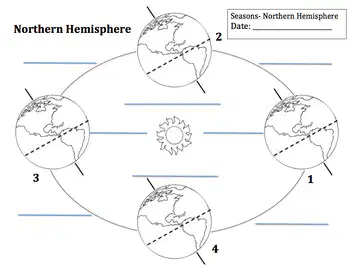
Label each season of the Northern Hemisphere as the Earth orbits the sun.
Summer
1
Autumn (Fall)
2
Winter
3
Spring
4
During new moon phase and full moon phase when the sun, Earth, and moon are in a line, coastal areas would experience a _______________ tide.
spring
neap
low
high
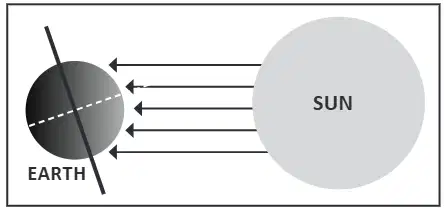
According to the image shown, the southern hemisphere would be experiencing —
spring
summer
fall
winter
Which accurately describe Earth’s rotation?
Rotation happens when the Earth spins on its axis.
One complete rotation of Earth takes 365 1/4 days.
Earth’s rotation causes day and night.
Earth’s rotation causes seasons.
Earth is the only planet in our solar system to have –
water in all its forms
gases in the atmosphere
a solid surface
seasonal temperature changes
Which might cause Earth to stop experiencing seasons?
If Earth’s axis was no longer tilted
If Earth’s rotation increased speed
If Earth’s orbit became smaller
If Earth no longer had a moon
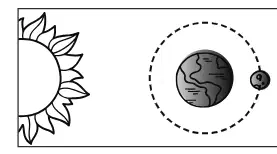
A student made a model of the sun, moon, and Earth as shown. According to the model, which phase of the moon would be viewed from Earth?
First Quarter
Full Moon
Last Quarter
New Moon
Scientific evidence shows that Earth is approximately how old?
110 billion years old
4.5 billion years old
4.6 million years old
45 million years old

In the diagram shown, Earth is rotating counterclockwise causing -
phases of the moon
day and night
seasons
tide cycles
The gravitational pull of which body in our solar system has the greatest effect on Earth's tidal ranges?
The sun
The moon
Jupiter
Mars
Where must you be in order to see a total solar eclipse?
On the surface of the sun
In the path of the moon’s shadow on Earth’s surface
In the path of the sun’s shadow on Earth’s surface
On the moon
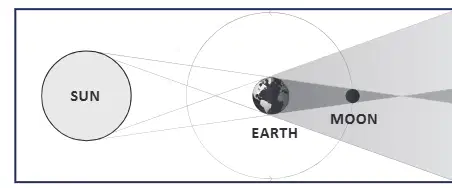
What type of eclipse is shown in the diagram?
Solar
Lunar
Planetary
Gibbous
During a total solar eclipse, the sun’s outer atmosphere is visible for a brief time. This outer atmosphere of the sun is called the -
corona
shadow
umbra
penumbra
Most energy sources on Earth originate from -
the atmosphere
coal
the sun
natural gas
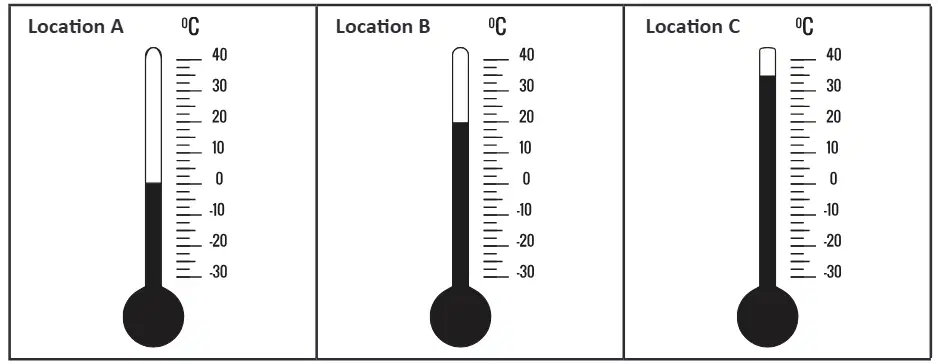
Each thermometer is measuring air temperature at different locations. Which location would have air molecules that are the most spread out and move the fastest?
Location A
Location B
Location C
All locations have air molecules with equal speed

Engineers designed which device to capture energy from the sun?
Wind turbines
Dam
Oil pump
Solar panels
The gradual increase in the temperature of the atmosphere due to trapped heat is known as –
the greenhouse effect
the water cycle
global warming
Earth’s energy budget
On a hot summer day at the beach, a person would expect the -
sand to heat up faster than water
water to heat up faster than the sand
water and sand to heat up equally
water and sand to remain the same temperature all day
Solar radiation that can be broken down into the individual colors of the rainbow is called -
visible light
ultraviolet radiation
infrared radiation
microwave radiation
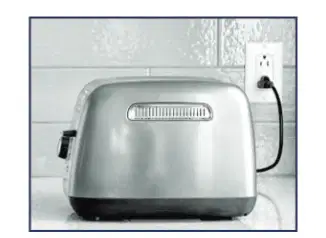
Which energy transformation occurs when using a toaster?
Chemical → Electrical
Electrical → Thermal
Thermal → Electrical
Electrical → Chemical
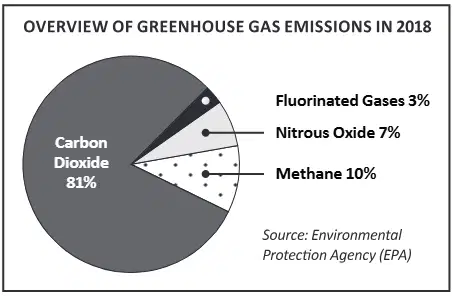
According to the circle graph, which greenhouse gas was being released into our atmosphere the most in 2018?
Nitrous oxide
Methane
Fluorinated gases
Carbon dioxide
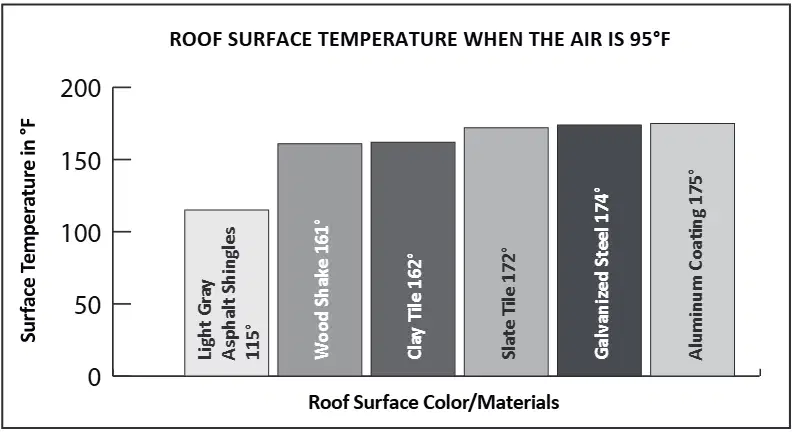
A student performed an investigation to see which roof surface would reflect the most sunlight and keep the home cooler during the summer months. According to the student’s data, which roof surface was most successful?
Light Gray Asphalt Shingles
Wood Shake
Clay Tile
Slate Tile
When warm air rises because it is less dense and cool air sinks because it is more dense, heat is being transferred by -
conduction
convection
radiation
evaporation
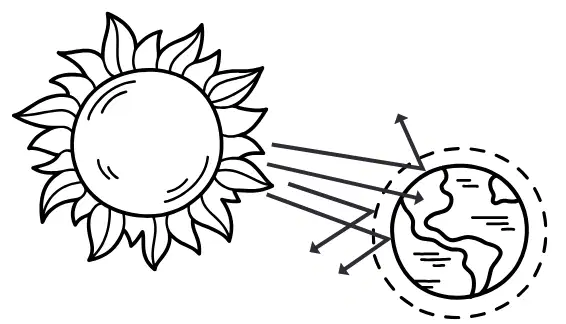
What would be the best title for this diagram?
Earth’s Mechanical Energy
Solar Radiation and Me
Earth’s Energy Budget
How To Convert Chemical Energy
What are the different types of energy?
Thermal
Energy produced by atoms moving
Electrical
Energy made by the flow of electrons
Mechanical
Energy due to motion or position
Radiant
Energy that travels by waves
Chemical
Energy stored in the bonds of compounds
What absorbs most ultraviolet rays emitted by the sun before they hit Earth’s surface?
The clouds in the atmosphere
The ozone layer
Greenhouse gases
Water vapor in the atmosphere
What type of solar radiation cannot be seen but can be felt by the skin?
Ultraviolet radiation
Visible light
Infrared radiation
Radio waves

What type of heat transfer occurs when the sun heats your body?
Conduction
Convection
Radiation
Circulation
Which of the following waves is NOT part of the electromagnetic spectrum?
X-Rays
Radio Waves
Intertidal waves
Microwaves
Secondary sources of energy (such as electricity) are used to store, move, and deliver energy-
in a usable form
as thermal energy
in a safe, cost-effective way
as mechanical energy
A group of students enjoyed a pizza dinner before going bowling. While bowling, the chemical energy in the pizza will be transferred into what type of energy?
Solar
Mechanical
Electrical
Radiant
What does Earth's energy budget track?
How much energy is flowing in and out of Earth’s climate
How much chemical energy is released from plants
Where energy is going
If the energy coming in balances with the energy going out
The number of people using electrical energy
The energy stored in a battery is –
electrical
thermal
mechanical
chemical

The home shown uses solar panels to collect sunlight and store energy in batteries, which runs household appliances such as refrigerators and televisions. The path that the energy coming into the home follows is -
chemical to radiant to electrical
radiant to chemical to electrical
electrical to radiant to chemical
radiant to electrical to chemical
Another name for radiant energy is -
electrical
thermal
light
chemical
Which are fossil fuels?
Oil, Nuclear, Coal
Solar, Biomass, Wind
Oil, Coal, Natural gas
Nuclear, Wind, Hydroelectric
Earth’s atmosphere and oceans circulate and are warmed due to what type(s) of thermal energy transfer?
convection and conduction
radiation and convection
conduction and radiation
convection only
Which example best illustrates the energy transformation from electrical to mechanical?
Using a pencil sharpener that is plugged into a wall outlet
Lighting up a dark room using a cell phone’s flashlight
Heating a slice of bread in a toaster oven
Eating a candy bar before a big race
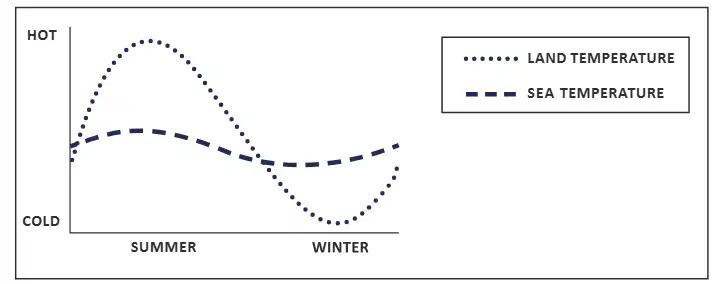
According to the graph, which of Earth’s surfaces heats up and cools down the fastest?
Winter
Land
Summer
Sea
Two students are investigating the density of water at different temperatures. Based on the question shown, which could be their hypothesis?
If water is heated, then its density will reduce causing it to rise.
I think that hot water is denser.
Does hot water rise or does cold water rise?
The independent variable is the different water temperatures.

A student conducted research. Based on the notes shown, what was the student researching?
Elements
Atoms
Molecules
Compounds
An atom’s nucleus contains -
only protons
only neutrons
protons and neutrons
protons and electrons
When two or more atoms of different elements combine, they form a -
stable element
compound
neutron cloud
nucleus
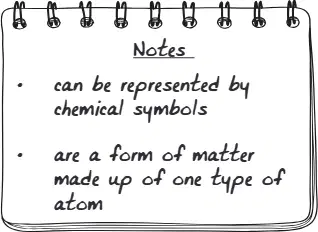
A student conducted research. Based on the notes shown, what was the student researching?
Elements
Atoms
Molecules
Compounds

Based on the table shown, which is the correct information about the element nitrogen?
Chemical Symbol-N, Protons-7, Neutrons-14
Chemical Symbol-N, Protons-7, Neutrons-7
Chemical Symbol-N, Protons-14, Neutrons-7
Chemical Symbol-N, Protons-14, Neutrons-14

According to the graphs, what element is found in Earth's crust, ocean, and atmosphere, as well as living things?
Carbon
Hydrogen
Silicon
Oxygen
Which is considered a molecule and a compound?
H
H₂O
O
H₂
An example of a molecule that is not a compound is -
C
O
H₂
SiO₂
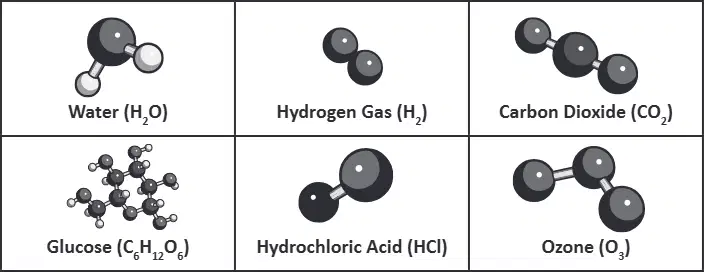
Which models represent compounds?
Water (H₂O), Carbon Dioxide (CO₂), Glucose (C₆H₁₂O₆), Hydrochloric Acid (HCl)
Hydrogen Gas (H₂), Ozone (O₃)
Water (H₂O), Hydrogen Gas (H₂), Ozone (O₃)
Carbon Dioxide (CO₂), Hydrogen Gas (H₂), Ozone (O₃)
Which molecule contains three different elements?
NaOH
NaCl
CaCl₂
SiO₂
The element in the table that has 16 protons is -
boron
oxygen
phosphorus
sulfur

A student was gathering data on element samples. According to the chart shown, which two samples are of the same element?
Samples R & S
Samples S & T
Samples T & U
Samples R & U
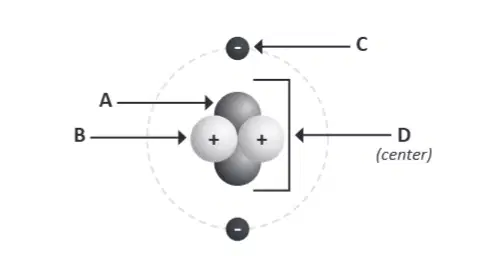
Identify the location of each part of the atom in the diagram.
Proton
B
Nucleus
D
Neutron
A
Electron
C
One molecule of the compound H₂SO₄ contains –
1 element
2 different elements
3 different elements
7 different elements
Each element on the periodic table is unique and identifiable by its:
Atomic mass number
Number of protons
Chemical symbol
Number of neutrons
According to the key, which could represent a chemical reaction?
⚪ + ⚪ = ⚪⚪
⚪ + ⚪ = ⚪⚪ + ⚪⚪
⚪ + ⚪ = ⚫ + ⚫⚫
⚪ + ⚪ = ⚫⚪ + ⚪⚪
A common sedimentary rock found in Virginia is limestone, also called calcium carbonate. The chemical formula for calcium carbonate is CaCO₃. The subscript 3 represents the number of -
atoms of oxygen in calcium carbonate
total molecules of calcium carbonate
atoms of calcium in calcium carbonate
molecules of carbon in calcium carbonate
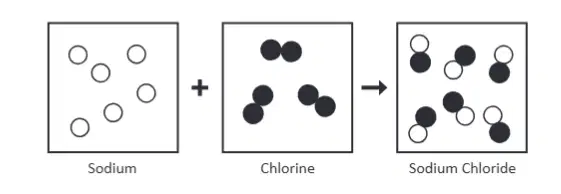
When sodium bonds to chlorine, sodium chloride (or salt) is created. According to the diagram shown, which statement is TRUE about sodium chloride (salt)?
One atom of sodium bonds to one atom of chlorine to form one molecule of sodium chloride.
One atom of sodium bonds to two molecules of chlorine to form one molecule of sodium chloride.
One molecule of sodium bonds to one molecule of chlorine to form one atom of sodium chloride.
One molecule of sodium bonds to two atoms of chlorine to form one atom of sodium chloride.

What does the chemical equation above show?
New atoms can be created in a chemical reaction.
New compounds can be created in a chemical reaction.
New elements can be created during a chemical reaction.
Elements can be destroyed during a chemical reaction.
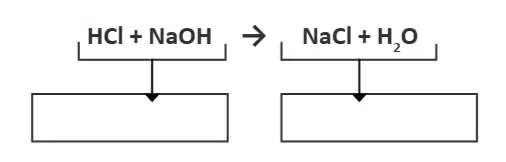
What are the atoms and the new substance called in this chemical process?
Reactants
HCl + NaOH
Products
NaCl + H2O
Yields
Arrow
Which part of the atom is responsible for creating bonds that hold atoms together in molecules?
Protons
Neutrons
Electrons
Nucleus

