wayground logo

Free Printable Worksheets

Font size

S
M
L
XL
Worksheets

REVIEW: Atoms, Elements and the Periodic Table

Total questions: 95

Worksheet time: 2hrs 38mins

Name
Class
Date
1.
Which group of the periodic table is composed of inert (not reactive)  gases?
a)
alkali metals
b)
alkaline earth metals
c)
halogens
d)
noble gases
2.
The atoms along the staircase are called 
a)
metals
b)
nonmetals
c)
metalloids
d)
noble gases
3.
The number at the top of each square on the periodic table is the ...
a)
atomic number
b)
atomic mass
c)
Chemical Symbol
d)
Element Name
4.
If you have a material that can conduct electricity well it is probably a...
a)
Metalloid
b)
Matter
c)
Non-metal
d)
Metal
5.
________ are the COLUMNS on the periodic table and are organized by similar properties.
a)
Classifications
b)
Groups
c)
Periods
d)
Elements
6.
Where are the nonmetals located on the periodic table?
a)
top left corner
b)
bottom left corner
c)
top right corner
d)
bottom left corner
7.
Fluorine, chlorine, bromine, and iodine are part of a family called
a)
metalloids.
b)
noble gases.
c)
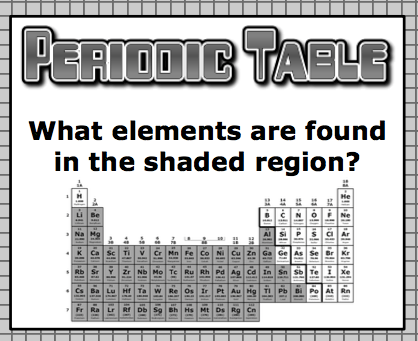
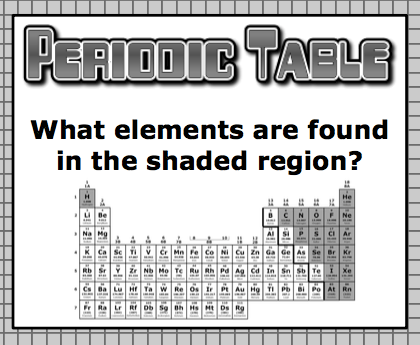
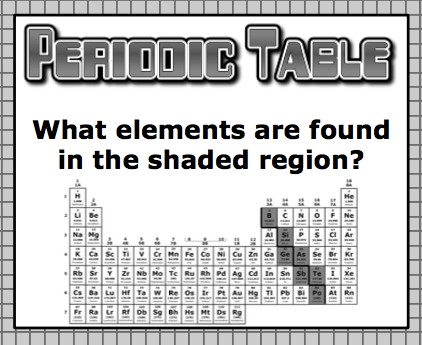
alkali metals.
d)
halogens.
8.

Which element is not a metal?

a)

Na

b)

Re

c)

Al

d)

N

9.
Which is an alkali metal?
a)

Magnesium (Mg)

b)

Iron (Fe)

c)

Sodium (Na)

d)

Titanium (Ti)

10.
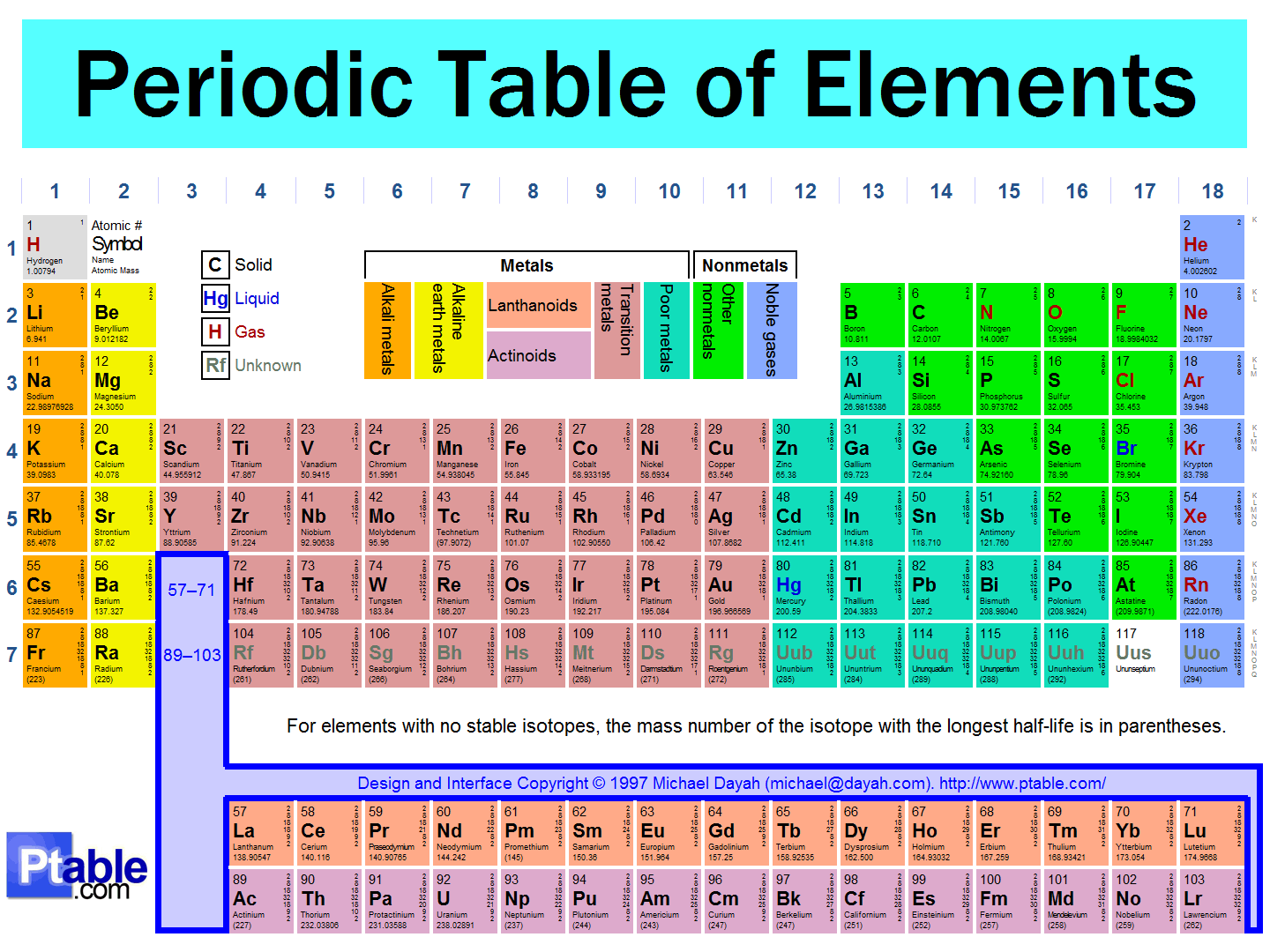
How would this element be classified?
a)
Metal
b)
Nonmetal
c)
Metalloid
d)
Metamorphic
11.
Silicon is a semiconductor and has properties of both metals and nonmetals. What type of element is Silicon? 
a)
Metal
b)
Nonmetal
c)
Metalloid
d)
Pretty
12.
What are the two structures found in the atom's nucleus?
a)
Electrons and Neutrons
b)
Protons and Electrons
c)
Protons and Neutrons
d)
Neutrons and Electrons
13.
What does the atomic number tell you?
a)
Number of Protons
b)
Number of Neutrons
c)

Sum of Protons and Neutrons

d)

Sum of Neutrons and Electrons

14.
What is matter composed of?
a)
Atoms
b)
Space
c)
Electrons
d)
Ions
15.
Which one of the following items can found on the periodic table of elements?
a)
Location of element
b)
Number of Protons
c)
Element's Isotopes
d)
Number of Nucleus
16.

Use your periodic table to find which element has 5 protons.

a)

Lithium

b)

Calcium

c)

Boron

d)

Neon

17.

Use your periodic table to find which element has 26 protons.

a)

Lithium (Li)

b)

Calcium (Ca)

c)

Oxygen (O)

d)

Iron (Fe)

18.

Which element does not have any Neutrons?

a)

Lithium (Li)

b)

Helium (He)

c)

Hydrogen (He)

d)

Carbon (C)

19.

Which element has an atomic number of 13?

a)

Silicon (Si)

b)

Aluminum (Al)

c)

Oxygen (O)

d)

Nitrogen (N)

20.

How do you find the number of neutrons in an atom?

a)

Atomic Number

b)

Atomic Mass

c)

Atomic Mass - Atomic Number

d)

Atomic Number + Atomic Mass

21.

The number of protons is equal to the number of

a)

electrons

b)

neutrons

c)

isotopes

d)

nucleus

22.

Which Halogen is a liquid at Room Temperature?

a)

Bromine (Br)

b)

Iodine (I)

c)

Chlorine (Cl)

d)

Fluorine (F)

23.
What do you call the one or two letter abbreviation derived from the element's English or Latin name?
a)
Atomic Number
b)
Atomic Mass
c)
Symbol
d)
Condensed
24.

The neutron has a ________________ charge.

a)

negative

b)

neutral

c)

positive

d)

low

25.

What subatomic particle has a positive charge?

a)

electron

b)

neutron

c)

proton

d)

nucleus

26.

a collection of atoms of one type that cannot be broken down into simpler substances by ordinary chemical or physical means

a)

element

b)

subatomic particle

c)

electron

d)

matter

27.

the positively charged subatomic particle contained in the nucleus of an atom

a)

proton

b)

neutron

c)

electron

d)

matter

28.

a subatomic particle, contained in the nucleus of an atom, having the same mass as a proton but no electrical charge

a)

proton

b)

neutron

c)

electron

d)

matter

29.

an arrangement of the elements according to their atomic numbers so that elements with similar properties are in the same column and properties repeat from row to row

a)

Periodic Table of Elements

b)

Atomic Theory

c)

Isotopes

d)

Subatomic Particles

30.

a negatively charged subatomic particle that orbits the nucleus of an atom

a)

proton

b)

neutron

c)

electron

d)

matter

31.
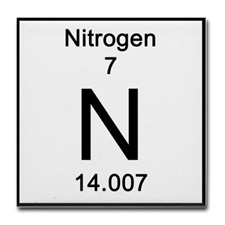
What is the number of protons that the element in this image contain?
a)
14
b)
7
c)
15
d)
18
32.
The positive particles of an atom are 
a)
Electrons 
b)
Positrons 
c)
Neutrons 
d)
Protons 
33.
The central region of an atom where its neutrons and protons are is its _______.
a)
Nucleus 
b)
Electron cloud
c)
Core 
d)
Center 
34.
An atom with atomic number 6 would have how many protons?
a)
6
b)
12
c)
3
d)
Cannot be determined 
35.
Particles in an atom that are neutral and have no charge are ______. 
a)
Negatrons 
b)
Electrons 
c)
Neutrons 
d)
Protons 
36.
Which of the following is a negatively charged subatomic particle?
a)
Electron
b)
Proton
c)
Neutron
d)
Quark
37.
The particles that are found in the nucleus of an atom are _____.
a)
Neutrons and electrons
b)
Electrons only
c)
Protons and neutrons
d)
Protons and electrons
38.
The atomic number of an elements is the total number of which particles in the nucleus?
a)
Neutrons
b)
Protons
c)
Electrons
d)
Protons and electrons
39.
Where are electrons of an atom found?
a)
Nucleus
b)
Electron Cloud
c)
Some are in the nucleus and some in the electron cloud.
d)
They are moving everywhere.
40.
Most of the mass in an atom is concentrated in the _____.
a)
Electrons
b)
Nucleus
c)
Protons
d)
Empty space
41.
What are the 3 particles that make-up the atom?
a)
Protons, neutrons, and isotopes
b)
Neutrons, isotopes, and electrons
c)
Positives, negatives, and electrons
d)
Protons, neutrons, and electrons
42.

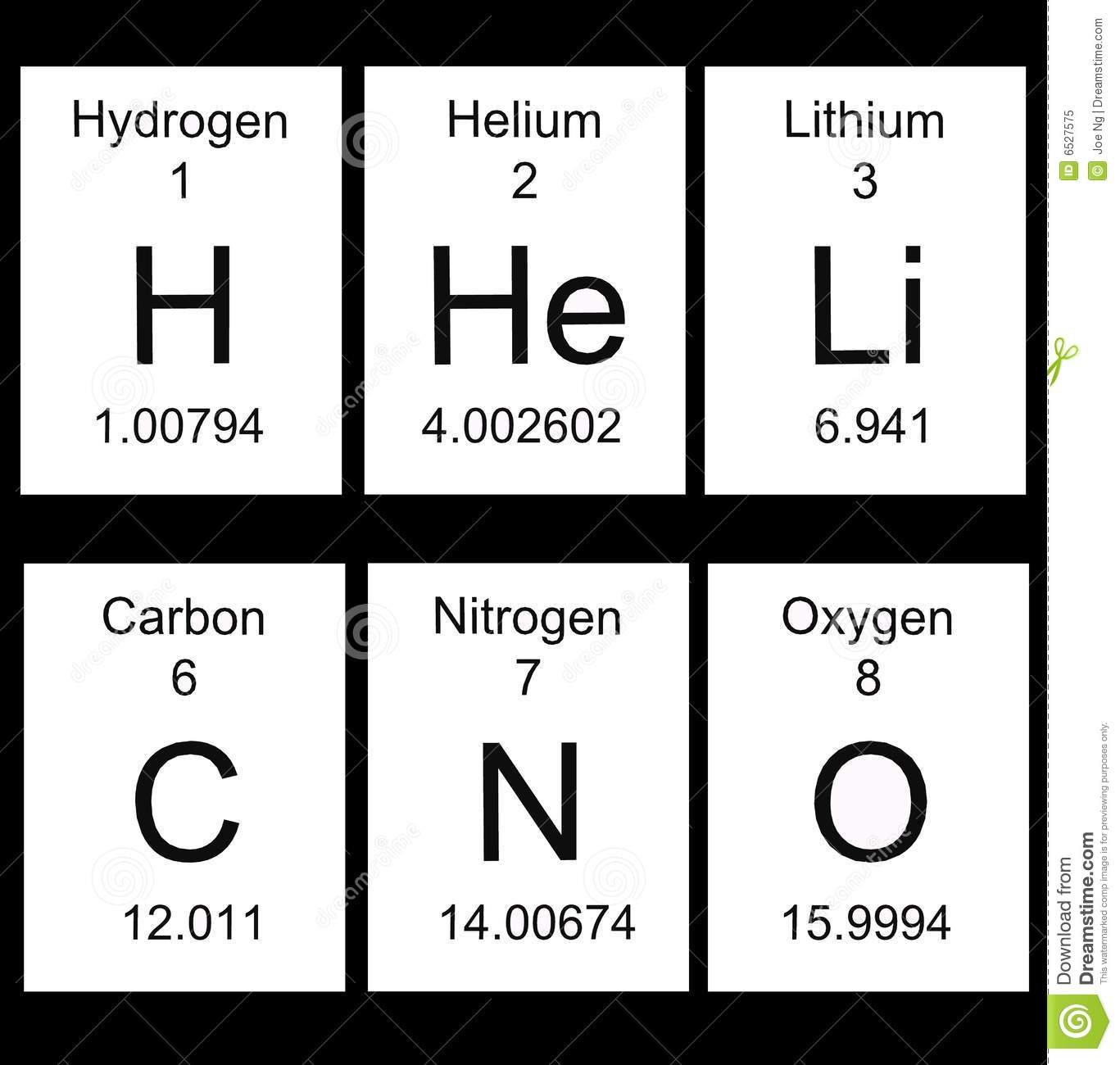
What does the 1.00794 stand for?

a)

Hydrogen

b)

atomic number

c)

atomic mass

d)

atomic explosion

43.

What subatomic particles would you find in the nucleus of an atom?

a)

Protons only

b)

Protons and Neutrons

c)

Neutrons and Electrons

d)

Protons and Electrons

44.

If an atom has 10 protons, 10 neutrons, and 10 electrons, what is the mass of the atom?

a)

10

b)

20

c)

30

d)

40

45.

If an atom has 15 protons, 18 neutrons, and 15 electrons, what is the mass of the atom?

a)

15

b)

3

c)

18

d)

33

46.

If an atom has 100 protons, 110 neutrons, and 100 electrons, what is the mass of the atom?

a)

100

b)

200

c)

110

d)

210

47.
What is the atomic mass of "F"
a)
9
b)
18
c)
17
d)
19
48.
How many protons are in an atom of carbon?
a)
12.01
b)
8
c)
6
d)
14
49.

Which number here is the atomic number?

a)

5

b)

10.811

50.

All matter is made of what

a)

energy

b)

atoms

c)

electrons

d)

compounds

51.

Particles in an atom that are neutral and have no charge are

a)

negatrons

b)

electrons

c)

neutrons

d)

protons

52.

What is the atomic number for an element with 3 protons?

a)

2

b)

1

c)

3

d)

6

53.

A particle that moves around the nucleus is a(n)...

a)

Proton

b)

Neutron

c)

Electron

d)

Quark

54.

In the modern periodic table, elements are arranged by:

a)

atomic mass

b)

atomic number

c)

valence electrons

d)

number of isotopes

55.

What particle uniquely identifies an element?

a)

Number of Valence Electrons

b)

Number of Protons

c)

Number of Electrons

d)

Atomic Mass

56.

Anything that has mass and takes up space is called

a)

heterogeneous

b)

homogeneous

c)

matter

d)

density

57.
An atom's overall charge is ________.
a)
positive 
b)
depends
c)
neutral 
d)
negative 
58.
Contributes basically no mass to an atom.
a)
protons
b)
neutrons
c)
electrons
d)
protons and neutrons
59.
Neon has an atomic number of 10 and an atomic mass of 20.180.  How many protons, electrons, and neutrons will it have?
a)
P=10 E=10 N=11
b)
P=5  E=5  N=10
c)
P=10  E=10  N=10
d)
P=10  E=5  N=5
60.
The atomic number for Oxygen is 8, so
a)
there are 8 protons in the atom
b)
the atomic mass is less than 8
c)
the mass of the atom is 8
d)
the atom is decaying
61.
Why has the model of an atom changed over time?
a)
Scientists discovered new information about atoms over time.
b)
Scientists couldn't agree on what the atom looked like.
c)
Atoms today are different than they were for Democritus in Greece.
d)
Atoms are always changing and may be different in the future.
62.

The vertical (up and down) columns in the Periodic Table are called

a)

groups

b)

towers

c)

periods

d)

atomic numbers

63.
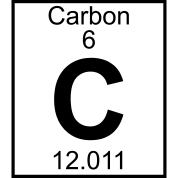
What does the C represent?
a)
atomic mass
b)
atomic number
c)
element name
d)
chemical symbol 
64.

Who predicted new elements for the gaps in the periodic table?

a)

Henry Moseley

b)

Lothar Meyer

c)

Dmitri Mendeleev

d)

Antione Laviosier

65.

What are the rows in the periodic table called?

a)

Families

b)

Groups

c)

Periods

d)

Orbitals

66.

What are the columns in the periodic table called?

a)

Periods

b)

Groups

c)

Orbitals

d)

Energy Levels

67.

Which of the following elements would be a transition metal?

a)

Ca

b)

Au

c)

Rb

d)

Fr

68.

Who arranged the elements by increasing atomic number?

a)

John Newlands

b)

Lothar Meyer

c)

Dmitri Mendeleev

d)

Henry Moseley

69.

The first usable modern periodic table was developed by

a)

Dmitri Mendeleev

b)

Glenn Seaborg

c)

John Newlands

d)

Johan Dobereiner

70.

Why was Henry Moseley responsible for solving the mystery of the anomalous elements on the periodic table?

a)

He corrected the mass of those elements

b)

He corrected the properties of those elements

c)

He discovered the electron

d)

He discovered atomic number

71.

Noble gases are present in ___ group of the Periodic Table

a)

13th

b)

15th

c)

17th

d)

18th

72.

Halogens are present in the ___ group of the Periodic Table

a)

13th

b)

15th

c)

17th

d)

18th

73.

Alkali Metals are present in the ___ group of the Periodic Table

a)

1st

b)

2nd

c)

3rd

d)

5th

74.

Alkaline Earth Metals are present in the ___ group of the Periodic Table

a)

1st

b)

2nd

c)

3rd

d)

5th

75.
a)
Periods
b)
Groups
76.
a)
Periods
b)
Groups
77.
a)
energy levels
b)
valence electrons
c)
protons
d)
neutrons
78.
a)
Same group
b)
Same period
79.
a)
Group 1
b)
Group 17
c)
Group 2
d)
Group 18
80.
a)
Group 1
b)
Group 17
c)
Group 18
d)
Group 2
81.
a)
Metals
b)
Nonmetals
c)
Metalloids
82.
a)
Metals
b)
Nonmetals
c)
Metalloids
83.
a)
Metals
b)
Nonmetals
c)
Metalloids
84.
a)
Metals
b)
Nonmetals
c)
Metalloids
85.
a)
Metals
b)
Nonmetals
c)
Metalloids
86.
a)
Metals
b)
Nonmetals
c)
Metalloids
87.
a)
Metals
b)
Nonmetals
c)
Metalloids
88.
Most of the elements on the periodic table are classified as _____.
a)
Metals
b)
Nonmetals
c)
Metalloids
d)
Periods
89.
Elements which are shiny, conduct electricity and heat are called
a)
metal
b)
nonmetal
c)
metalloid
d)
nonexistent
90.
Which is a halogen?
a)
Helium
b)
Chlorine
c)
Oxygen
d)
Neptune
91.
Which is an alkali metal?
a)
Magnesium
b)
Iron
c)
Sodium
d)
Europium
92.
A horizontal row of elements in the periodic table.
a)
column
b)
group
c)
period
93.
Elements in a ..................have similar chemical properties.  
a)
period
b)
group
c)
row
94.
The simplest substance is..?
a)
Carbon
b)
An element
c)
Water
d)
A simple compound 
95.
What is the chemical symbol for Carbon?
a)
C
b)
Ca
c)
Car