
Font size
 Worksheets
C 8-9 Review ES
Total questions: 69
Worksheet time: 2hrs 12mins
Igneous Rock:
Rocks that form from the bonding of rock fragments such as sand, silt, or clay; from organic materials; and from chemicals dissolved in water.
Rocks that form when other rocks are changed by heat and pressure.
Rocks that form from cooling magma or lava

Fossil
A gap in the geologic record that shows where rock layers have been lost due to erosion.
A record of the geologic events and the evolution of life forms as shown in the rock and fossil records.
The preserved remains or traces of an organism that lived in the past.
One of the units of geologic time into which geologists divide eras.
the mixture of gases surrounding a planet
atmosphere
biosphere
geosphere
hydrosphere
an event or series of events that causes changes in the geosphere, such as flowing water or flowing lava
landform
geological process
channel
rocky planet
When many types of living things become extinct at the same time
Relative Age
Absolute Age
Radioactive Dating
Mass Extinction
fossil that is useful for dating and correlating the rock layer in which it was found.
Geologic Time Scale
Eras
Periods
Index Fossil
Eras are subdivided into units of geologic time called...
Geologic Time Scale
Eras
Periods
Index Fossil
Geologists divide the time between the Precambrian and the present into 3 long units of time called..
Geologic Time Scale
Eras
Period
Index Fossil
A record of the geologic events and the evolution of life forms as shown in the rock and fossil record.
Geologic Time Scale
Era
Period
Index Fossil
In undisturbed horizontal sedimentary rock, the oldest is at the bottom and the newest the top.
Unconformity
The Law of Superposition
Radioactive Dating
Radioactive Decay
The process of determining the age of an object using the half-life of one or more radioactive isotopes.
Relative Age
Absolute Age
Radioactive Dating
Radioactive Decay
The atoms of one element break down to form atoms of another element.
Relative Age
Absolute Age
Radioactive Dating
Radioactive Decay
The number of years that have passed since the rock formed.
Relative Age
Absolute Age
Radioactive Dating
Radioactive Decay
Age of rock compared to ages of other rocks.
Relative Age
Absolute Age
Radioactive Dating
Radioactive Decay
Match the image to how many half lives have passed if
Blue = Original substance, Red = New substance

0 half lives

1 half life

2 half lives

3 half lives

4 half lives
The half life of any substance (a) and the amount of the substance that changes is (b) .
Which of these choices is the best definition of absolute dating?
determining the age of a rock layer by studying the fossils present
finding the age of an object compared to other objects
measuring the age of an object in years using any method
determining the amount of a radioactive isotope in an object

According to this fossil record, scallops lived when in relation to dinosaurs?
after
before
the same time
Unless a series of sedimentary rock layers has been overturned, which layer is usually the oldest?
the layer on the top
the layer with the most minerals
the layer with the most fossils
the layer on the bottom
Which description is most comparable to the convection currents that exist in Earth’s mantle?
hot air rising and cold air sinking
cold water rising and hot water sinking
the Sun rising and then setting 14 hours later
random distribution of temperatures


The biggest time period into which scientists have divide the time between the formation of the Earth and now is called:
periods
epochs
eons
eras

Look at the diagram.
What are eons divided into?
eras
epochs
periods

Look at the diagram.
Which era do we live in?
phanerozoic
neogene
cenozoic

Dinosaurs lived in this era.
Mesozoic
Cenozoic
Paleozoic
What is the next smallest division of time after eras in the geological timescale?
Eon
Epoch
Age
Period
Which is the oldest era?
Precambrian
Paleozoic
Mesozoic
Cenozoic
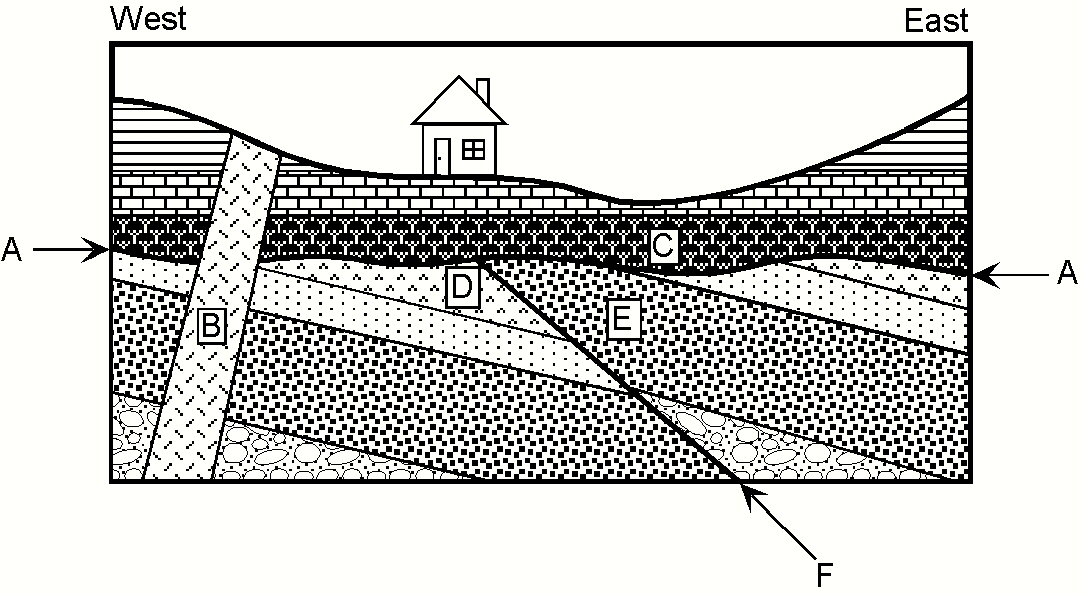

Look at the reference image. Which combination accurately portrays the correct age order?
B is higher so it is OLDER than D
C is older than E, even though it is FOLDING upwards
G is older than all the other layers
A is higher, so is OLDEST layer
The way the Earth's rotation causes winds to curve is called what?
Convection Currents
Unequal Heating
Coriolis Effect
Conduction
What are the Doldrums?
A Global Wind Belt
Trade Wind
Global Calm Area
Jet Stream
Overall, where are the high pressure areas on Earth?
North Pole
South Pole
Equator
Eastern Hemisphere
What type of wind blows from a body of water towards the land during the day?
Sea Breeze
Land Breeze
Trade Wind
East Wind
What instrument is used to measure wind speed?
Wind Vane
Wind Sock
Wind Turbine
Anemometer
Why does warm air rise and cold air sink?
Warm air weighs more than cold air.
Cold air weighs more than cold air.
Warm air is more dense than cold air.
Cold air is more dense than warm air.
Warm air rising and cold air sinking creates what?
Conduction
Convection Currents
Coriolis Effect
Radiation
What is created when air moves from high to low pressure?
Precipitation
Clouds
Gas
Wind
What type of heat transfer is given off by flames of a fire?
Convection
Conduction
Radiation
What types of heat transfer occurs between two substances that are in direct contact with each other?
Convection
Conduction
Radiation
What is thermal energy?
The total amount of heat an object contains.
How hot or cold an object is.
The total energy of motion in the particles of a substance.
How much heat is transferred from one object to another.
What is currently happening to the level of Greenhouse gases in the atmosphere due to human activity?
Increasing
Decreasing
Staying the same
What causes the motion of currents in the deep ocean?
Tides
Salinity
Temperature and density differences
Wind
What is the Global Conveyor Belt?
A type of ship
A pattern of surface and deep-ocean currents
A type of fishing net
A type of ocean pollution
What happens to the warm, salty water from the equator when it reaches the poles?
It cools down and gets denser
It becomes warmer
It becomes less salty
It evaporates
What happens to the water that reaches the surface after its long trip around the world?
It becomes warmer and rises to the surface
It becomes denser and sinks
It becomes less salty
It evaporates
What is the main factor that causes the water to sink to the bottom of the ocean in the North Atlantic?
Temperature
Tides
Salinity
Wind

Warm water is __________ cold water.
more dense than
less dense than
the same density as

Salt water is ____________ fresh water.
more dense than
less dense than
the same density as

In both the Indian and Pacific Oceans, deep water begins to warm up and ______________, joining back in with the Gulf Stream.
sinks
rises
freezes
evaporates
Where would I find the most dense ocean water?
At the surface
In the middle
At the bottom
Lake Michigan

Deep Ocean currents caused by
Global Wind Patterns
Earth's Rotation
Differences in density
All of the above
During a(n) ____ event, trade winds are much stronger than usual.
El Nino
La Nina
Normal
Partly sunny
Normally, atmospheric upwelling and rain occurs in the:
FAR Western Pacific
Central Pacific
Western Pacific
During an El Nino, it rains
in the central Pacific
in the FAR eastern Pacific
in the western Pacific
In all of the Pacific
Both El Nino and La Nina have this in common
Influence birds that migrate over the ocean
Influence rainy / dry weather world wide
The weather at the polar regions
The directions that ships travel in the oceans
During an El Nino, trade winds are typically...
about average
stronger
weaker
The Gulf Stream begins near the equator.
True
False

