
Font size
 Worksheets
Ecosystems Quiz
Total questions: 61
Worksheet time: 57mins
What is a biome?
A single animal's habitat
A group of ecosystems with similar climates and organisms
The inside of an animal’s body
A population of one species
Which of the following is an abiotic factor in an ecosystem?
A tree
A mushroom
Sunlight
A fish
What is an ecosystem?
A group of the same species living together
The nonliving parts of the environment only
Living and nonliving things interacting in an area
Just a food chain
Which organism is a producer?
A wolf
A tree
A mushroom
A rabbit
What does a primary consumer eat?
Producers
Tertiary consumers
Decomposers
Rocks
What is the role of a decomposer in an ecosystem?
Eats producers
Makes its own food
Breaks down dead organisms
Hunts prey
Which of the following is a tertiary consumer?
Grass
Rabbit
Snake
Hawk
Which best describes an omnivore?
Only eats meat
Only eats plants
Eats both plants and animals
Makes its own food
What happens if a producer is removed from a food web?
Nothing changes
Only carnivores are affected
The whole food web can be disrupted
More producers grow
Which direction does energy flow in a food web?
From consumers to producers
From decomposers to consumers
From producers to consumers
From predators to prey
Which domain includes organisms with cells that have a nucleus?
Bacteria
Archaea
Eukarya
Prokaryotes
Which domain contains organisms that often live in extreme environments like hot springs?
Bacteria
Archaea
Eukarya
Fungi
Which of the following is a prokaryote?
Plant
Fungus
Bacterium
Protist
Which kingdom includes mushrooms and molds?
Animalia
Plantae
Protista
Fungi
Which kingdom includes only autotrophs with cell walls made of cellulose?
Protista
Plantae
Animalia
Fungi
Which organism is multicellular and heterotrophic?
A plant
A fungus
An animal
A protist
Which of the following is an invertebrate?
Bird
Fish
Insect
Dog
An animal with body parts arranged like a star has what kind of symmetry?
No symmetry
Bilateral symmetry
Radial symmetry
Asymmetry
Which part of a scientific name is capitalized?
The species
The genus
Both genus and species
Neither
Which is the correct way to write a scientific name?
tiger Panthera
Panthera tigris
PANTHERA TIGRIS
panthera Tigris

A spider is an example of...
Unicellular Organism
Multicellular Organism
Neither
Both
What type of organism makes its own food?
Autotroph
Heterotroph
Which category of organism cannot make its own food?
Autotroph
Heterotroph

What are humans?
Autotrophs
Heterotrophs

What is a lily pad?
autotroph
heterotroph




In this food web, what trophic level is the snake?
Secondary and Tertiary Consumer
Primary Consumer
Secondary Consumer
Primary and Secondary Consumer
In this food web, what trophic level is the owl?
Producer
Primary Consumer
Secondary Consumer
Tertiary Consumer


Which of the following organisms
could be classified as a tertiary consumer
based on the food web to the right?
Frog
Weasel
Great horned owl
Goldfinch
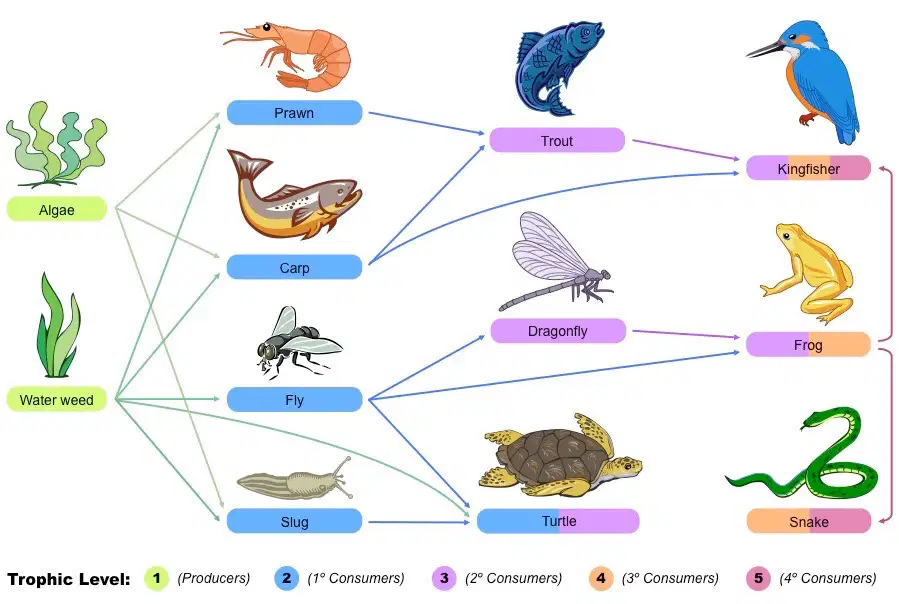
What kind of consumer is the turtle?
carnivore
herbivore
omnivore
detritovore
Animals correspond to with the domain:
Archaea
Eukarya
Bacteria
Fungi correspond to with the domain:
Eukarya
Bacteria
Archaea
In this domain, you can find the organisms on the earth planet that have eukaryotic cells
Bacteria
Eukarya
Archaea
Which domain is characterised by multi-cellular organisms?
(a)
Which domain is characterized by organisms that live in extreme environments?
(a)
Humans belong to which domain?
Eukarya
Bacteria
Archaea
Eubacteria
Thermoacidophiles, organisms that thrive in acid and high temperatures, belong to the Archaea domain.
True
False
The difference between prokarytic organisms and eukaryotic organisms is the absense of a nuclear membrane and membrane-bound organelles in the former.
True
False
Which two domains are categorized as "prokaryotic"?
Archaea
Bacteria
Eukarya
Which domain has organisms whose cells have DNA inside a nucleus?
Archaea
Bacteria
Eukarya
Scientists classify (group together) organisms based on...
similar characteristics
differences in DNA
their habitat
their lifespan

An organism with__________________________can be divided into two parts that are nearly mirror images of each other.
asymmetry
bilateral symmetry
Radial symmetry
An organism which can be divided into two parts that are nearly mirror images of each other anywhere through its central axis.
Asymmetry
radial symmetry
bilateral symmetry
trilateral symmetry

A butterfly has a _________________
Asymmetry
radial symmetry
bilateral symmetry
What is an invertebrate?
an animal with a backbone
an animal without a backbone
mammals
birds

Are these animals vertebrates or invertebrates
vertebrates
invertebrates

Which group does it belong to?
vertebrate
invertebrate

Which group does it belong to?
vertebrate
invertebrate

Which group does it belong to?
vertebrate
invertebrate


What is an ecosystem?
The interactions among living and non-living things in an environment.
A type of organism that can only be seen with a microscope.
A bunch of moving parts that do work.
The newest craze in social media.


Reorder the organisms from producer (left) to Quaternary consumer (right) in a food chain.
Grass
grasshopper
Frog
Snake
Hawk

