
 Worksheets
Chemical Reactions Reviw
Total questions: 114
Worksheet time: 4hrs 30mins
Which example provides evidence of a chemical change?
Wood releases ash and smoke when burned.
Rock particles separate when soil is being sifted.
Boiling water bubbles when being heated.
Sugar is not visible when dissolved in water.
Mixing silver nitrate and sodium chloride in water will cause silver chloride to precipitate out of solution. In this example, the precipitate is silver chloride. Which example represents the formation of a precipitate?
Heat and light are produced when paper burns.
White chunks form when you add vinegar to milk or heavy cream.
Gas is released when vinegar and baking soda are mixed together.
A cut apple turns brown when left out in the open air.
When vinegar and baking soda are combined, bubbles and foam are produced.
What evidence demonstrates that a chemical change has occurred?
A color change occurs.
A gas is formed.
A solid is dissolved.
A precipitate is formed.

Which processes from the table can be used as evidence to identify the formation of a new substance?
Processes A, B, C, and D
Processes B, C, E, and F
Processes B, C, D, and F
Processes C, D, E, and F

Students performed investigations using water and three chemicals, baking soda, calcium chloride, and phenol red solution. The student observations are shown in the table.
Which investigations above provide supporting evidence that a new substance formed?
Investigations 1, 2, and 3
Investigations 1, 3, and 5
Investigations 2, 3, and 4
Investigations 3, 4, and 5
After an investigation, students were disposing of left over substances. One student poured all of the liquids down the sink drain. A few seconds later, a white cloud formed above the sink and the student’s eyes began to burn.
Which statement accurately describes what caused this occurrence?
The student did not wait two minutes in between pouring each liquid down the drain.
The student did not allow water to run in the sink after pouring each liquid down the drain.
A physical change occurred resulting in the formation of a new substance.
A chemical change occurred resulting in the formation of a new substance.

Table salt is a compound made from two elements, sodium and chlorine.
Which statement best explains why the characteristics of table salt are so different from the characteristics of sodium and chlorine?
Salt is processed by the evaporation of seawater or mineral-rich spring water
Salt is processed from salt mines because pure sodium does not occur in na
When sodium and chlorine combine, a physical change occurs and a new substance is formed.
When sodium and chlorine combine, a chemical change occurs and a new substance is formed.
Flour, sugar, cocoa, oil, and eggs are mixed together and placed in the oven to make brownies. When the brownies are removed from the oven, they no longer look like the original ingredients.
Which of the following describes why the ingredients changed?
A biological change occurred.
No change occurred.
A physical change occurred.
A chemical change occurred.

Students were investigating two clear solutions. Students added 2 mL of one solution to a beaker of the other solution. The result is pictured.
A student observed that the temperature of the beaker did not have any noticeable changes, however the mass of the substances in the beaker increased. A red precipitate formed where the substance was poured into the beaker. The precipitate separated from the solution and fell to the bottom of the beaker.Which observation provides the best evidence that a chemical change formed a new substance in the beaker?
A precipitate is formed.
The precipitate fell to the bottom.
The temperature did not change.
There is an increase in mass.
Two liquids are mixed together. Which of the following does NOT identify the formation of a new substance?
A gas is produced.
One liquid dissolves into the other.
The temperature changes.
A solid is formed.

Which column in the table includes only chemical changes?
A
B
C
D
During a science class investigation, a teacher places a small amount of sugar in a beaker and heats it over a candle. Which of the following would be the best evidence that a change in the chemical properties of the sugar has taken place?
The sugar gets hotter.
The sugar gets larger.
The sugar turns into a liquid.
The sugar turns black.
A student had a beaker with a small amount of baking soda. The student added a few drops of pickle juice to the baking soda and observed fizzing and bubbling. Based on observation, which of these can the student conclude?
A chemical reaction produced a solid.
No chemical reaction took place.
Only a physical change happened.
A chemical reaction produced a gas.

How many atoms in all are in a molecule of serotonin?
C10H12N2O

H2 + O → H2O
2HgO → 2Hg + O2
Al + O2 → 2Al2O3


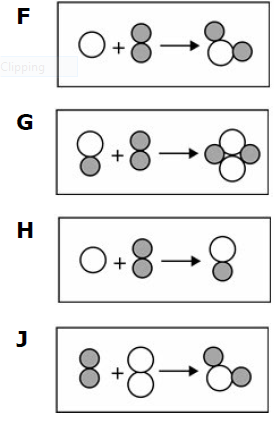
Look at the chemical equation.
Is it written correctly to show the Law of Conservation of Mass?
Yes
No
True or False: In a complete chemical equation, there must be the same number of atoms of each element on the reactants and products side.
True
False
___________________ are the elements or compounds that leave (are formed in) a chemical
reaction.
Polymers
Bonds
Reactants
Products
6MgF2
What is the BEST definition of a chemical reaction?
A change in matter that produces one or more NEW substances
When two things combine and EXPLODE.
A substance that is formed as the result of a chemical reaction is a __________________
Product
Reactant
Starters
Enders
What is the pH range of an acid?
4-6
1-7
1-6
8-14
What would happen to blue litmus paper if it came into contact with an acid?
It would turn red
It would turn green
It would stay blue
It would turn pink
Which of the following pH values would be the weakest acid?
1
3
5
6
Which of the following pH values would be the strongest acid?
1
3
4
6
What would happen to red litmus paper when it encounters a base?
It turns blue
It stays red
It turns purple
It turns green
A substance is found to have the following characteristics:
Very bitter taste
Feels slippery to the touch
Produces OH- ions when dissolved in water
In what category would the substance be classified?
acid
base
enzyme
fatty acid
7
11
Which of these pH values represent an acid?
4
8
10
12

Milk is a very weak acid. What might its pH value be?
6
7
4
12
The strongest bases have pH values close to
0
14
7
5
Bases turn blue litmus paper red.
True
False
Which option below places the pH values in the correct order, from WEAKEST ACID to STRONGEST ACID?
1,4,5,6
6,4,3,1
7,9,11,14
13,12,10,8
What is Solubility?
If something dissolves in water
If something sinks in water
If something floats in water
None of the above
Salt has Solubility because it dissolves in water.
True
False
Which answer does NOT have solubility?
sugar
salt
oil
What does dissolve mean?
The particles spread out and become part of the water
It sinks to the bottom of the water
It floats on top of the water
None of the above
Is pepper soluble?
Yes, it dissolves in water
No, it sinks in water
No, it floats in water
Yes, it doesn't dissolve in water
When something dissolves in water then it has Solubility.
True
False


A column of the periodic table is a ________.
group
period
range
A row on the periodic table is a _______.
group
period
range
About 3⁄4 of the elements on the periodic table are ________.
metalloids
nonmetals
metals
gases
All _________ are semiconductors.
metals
metalloids
nonmetals
gases
All _________ share properties that include luster, conductivity, malleability, and ductility.
gases
nonmetals
metalloids
metals
Elements on the periodic table are arranged in rows and columns according to their _________.
properties
categories
atomic number
boiling point
Elements with properties of metals and nonmetals are ___________.
metalloids
metals
nonmetals
gases
Group 1 metals that react quickly with other elements are ___________.
metals
alkaline earth metals
alkali metals
nonmetals
Group 2 metals that are soft and silvery are _______________.
metals
alkali metals
alkaline earth metals
gases
___________ are located on the left side of the periodic table.
Nonmetals
Gases
Metals
Metalloids
_________ are located on the right side of the periodic table.
Nonmetals
Metals
Metalloids
Gases
________________ are located in the middle of the periodic table.
Metals
Transitions metals
Nonmetals
Metalloids

Kathy buys a 5-ounce cup of ice cream. The summer heat melts the ice cream before she can eat any. Which best describes the weight of the melted ice cream?
2.5 ounces
5 ounces
15 ounces
15 ounces
An ice cube is placed in a glass of water. The total weight of the ice cube and water is 1.5 pounds. After the ice cube melts, what will most likely be the total weight of the water?
0.8 pounds
0.4 pounds
1.5 pounds
1.0 pound
Ashley placed 20 grams each of water, grape juice, orange juice, and coffee in an ice cube tray. Ashley wanted to see what the mass of each liquid would be after freezing. Which is most likely Ashley's conclusion when she weights the frozen samples?
Each sample will weight 40 grams
Each sample will weigh 25 grams
Each sample will weigh 20 grams
Each sample will weigh 15 grams
James wanted to observe the interaction between his favorite soda and some candy. James poured 20 ounces of soda and 2 ounces of candy in a closed container weighing 5 ounces. What would most likely be the weight of the mixture and container after the candy has completely dissolved?
5 ounces
20 ounces
25 ounces
27 ounces
John filled a bottle half way with water, placed a lid on it, and then put it in the freezer. How does the weight of the water and bottle compare before and after it is in the freezer?
The water and bottle weigh the same as they did when they went in the freezer.
The water and bottle weigh more when they came out of the freezer because ice weighs more.
The water and bottle weigh less when they came out of the freezes because water evaporates when it gets cold.
Pat raked and bagged 2 pounds of maple leaves that had fallen to the ground. Which best describes the weight of the leaves before they fell to the ground?
0.5 pounds
1 pound
2 pounds
2.5 pounds
A jeweler melts silver to make jewelry. As the silver melts, the mass?
increases
decreases
is destroyed
stays the same
Anthony is performing an experiment. He adds 0.25 grams of baking soda to 5 grams of water and stirs. Anthony watches as the baking soda dissolves in the water. If Anthony weighs the water and baking soda solution, what will its mass be?
4.75 grams
5.75 grams
5.25 grams
What is the Law of Conservation of Mass?
Mass is created in a chemical reaction
Mass is created in a physical change
New chemicals formed from a chemical reaction have a larger overall mass than the original reactants
Mass is never created or destroyed
In reaction A +B --> C, reactants A + B have a total mass of 9g. What is the mass of product C?
4g
5g
9g
14g
In reaction A +B --> C, reactant A has a mass of 4g and product C has a mass of 9g. What is the mass of reactant B
4g
5g
9g
14g
In reaction A +B --> C, reactant B has a mass of 9g and product C has a mass of 14g. What is the mass of reactant A?
4g
5g
9g
14g
7 g of hydrogen reacts with 17 g of oxygen to produce ______ g of water
14
24
38
62
During a chemical reaction matter cannot be created or destroyed.
True
False

